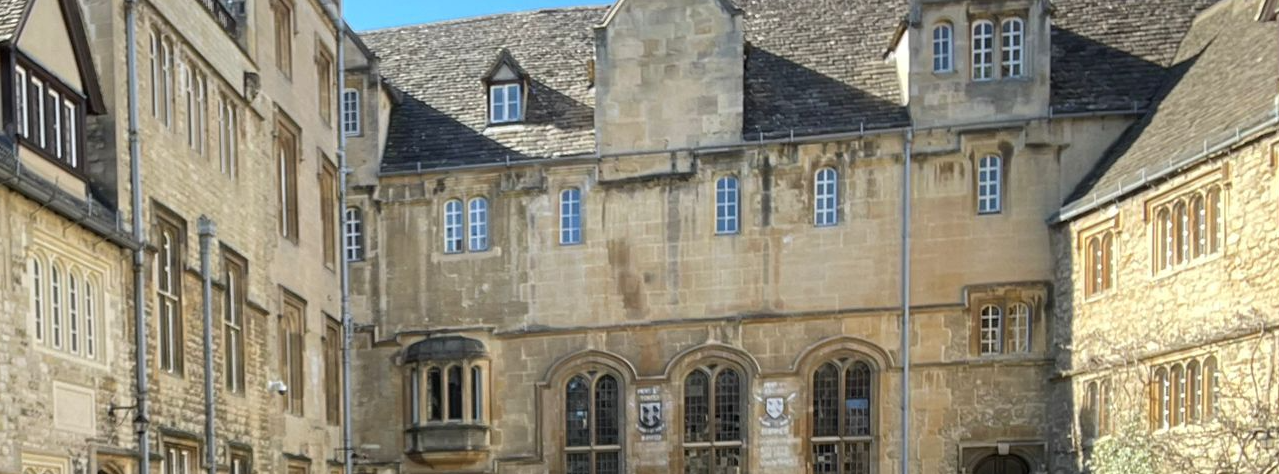
The Association for Spanish and Portuguese Historical Studies (ASPHS) invites you to participate in our 56th Annual Conference which will take place at Exeter College, University of Oxford, between 22 and 25 June 2027.
This year’s theme is ‘Unexpected Journeys: New Pathways through Iberian History’. Our theme is intended to inspire rather than delimit submissions and, as in past years, the ASPHS invites contributions on any aspect of Iberian and Iberian-Atlantic history, art history, or literature, from the early medieval to the modern day. Applicants are encouraged to consider and creatively interpret the following suggestions in their proposals:
Uncommon perspectives and history from the margins
Intersections of people, texts, or ideas on the move
Journeys in time: transhistorical approaches
Entangled paths: global and transnational approaches within and beyond Iberia
Crossing boundaries: linguistic, religious, cultural, material
Interrogating archives: critical approaches to material, visual, sonic records
We welcome proposals for panels (three speakers and a chairperson), individual papers or roundtable discussions on a particular work or theme. Proposals should include a 200-word abstract for each paper and a one-page curriculum vitae for each participant. Proposals are due by 15 January 2027 to AS*******@***********ac.uk. Papers will be delivered in-person and participants must be members of the ASPHS.
Keynote speakers: Mary Vincent (University of Sheffield) and Rebecca Earle (University of Warwick).
The conference is organised by Giuseppe Marcocci (University of Oxford), Karoline Cook (Royal Holloway, University of London), Matthew Kerry (University of Oxford) and Teresa Witcombe (University of Oxford).
The ASPHS will provide a limited number of $300 travel grants to graduate students presenting at the conference. Preference will be given to first-time presenters and those who have not previously received this grant. If you wish to apply for a grant please fill out this application when you submit your proposal to the conference. Questions can be addressed to pr*******@***hs.net.
The ASPHS will also provide modest grants to defray the costs of childcare for conference participants. If you wish to be considered for these grants, please send an email to pr*******@***hs.ne
Peter Payne: A Forgotten Great Europeanwas an international workshop taking place at St Edmund Hall, Oxford, 30 September – 1 October 2026, co-organised by Elizabeth Solopova, Henrike Lähnemann, Hannah Schühle-Lewis and James Howarth. The workshop was generously funded by a grant from the John Fell Fund awarded to Elizabeth Solopova and Hannah Schühle-Lewis, supported by St Edmund Hall and the Bodleian Centre for the Study of the Book, and organised in association with ‘Medieval Vernacular Bibles as Unity, Diversity and Conflict‘, funded by the Arts and Humanities Research Council and Deutsche Forschungsgemeinschaft as part of the UK-German Funding Initiative in the Humanities.
Focussing on an outstanding individual, the workshop explored connectedness in European cultural development and the emergence, as a result of joint artistic and scholarly endeavour, of modern local and common European identity. Contact the organisers: Elizabeth Solopova and Hannah Schühle-Lewis.
Peter Payne, the Principal of St Edmund Hall
Peter Payne (d. 1455/6?), referred to as ‘Peter Engliss’ in Bohemia, was an outstanding scholar, theologian, diplomat and an international figure. His career spans two universities and several European countries. He started to study at Oxford shortly before 1400 and became a highly outspoken supporter of the reformist theologian John Wyclif (d. 1384). Payne became the principal of St Edmund Hall in 1410.
Payne participated in some of the most famous events of the Wycliffite movement in England. Medieval evidence suggests that he introduced Sir John Oldcastle (d. 1417), the rebel and Lollard leader, to Wycliffite ideas. He also met two Bohemian scholars, Mikuláš Faulfiš and Jiří of Knínice, who came to England to copy Lollard texts, and provided them with a letter, bearing the university seal, affirming that Wyclif was an outstanding scholar and never condemned for heresy. The letter was taken to Prague and published in 1409 by Jerome of Prague. Jerome was later burned at the stake with Jan Hus, leader of the Bohemian reform movement, after their condemnation at the Council of Constance in 1414. Peter Payne may have acted as an intermediary in the correspondence between Hus and the English Wycliffites.
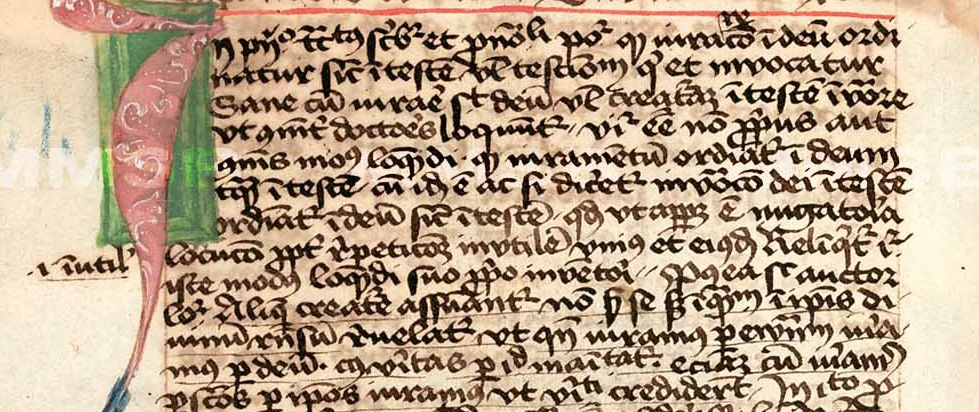
Peter Payne, Tractatus de iuramento, Prague, National Library of the Czech Republic MS V.F.2. Image provided by Manuscriptorium.
Payne left England in 1413 to avoid prosecution and travelled to Germany and possibly Switzerland, meeting with representatives of the European reform movement including a Waldensian emissary, Friedrich Reiser. He settled in Prague in 1414 and became a highly prominent member of the Hussite movement. He authored several theological and polemical treatises, compiled high quality indices of Wyclif’s works, and was registered as a Master of Arts at Prague University, where he acted as a teacher and examiner. His authority, as an English Wycliffite and defender of the Hussite doctrine, was so great that the city of Prague chose him as a principle speaker of several Hussite delegations to King Sigismund of Germany and Bohemia, and to King Władysław of Poland in 1420 and later. A skilful diplomat, he acted as a go-between and impartial adviser to different Hussite groups. He was elected to defend Hussite positions in a debate with Catholic clergy in 1429 and at the Council of Basel in 1433. The positions included utraquism (the idea that communion should be administered to the laity in the same form as to the clergy); free preaching of God’s word; and clerical poverty. He continued to be in danger throughout his career: arrested in 1438, he was imprisoned and ransomed by Hussite towns. Despite this he remained a public figure, acting as a negotiator and respected arbitrator in doctrinal disputes among the Hussites into the early 1450s. He is presumed to have died in Prague.
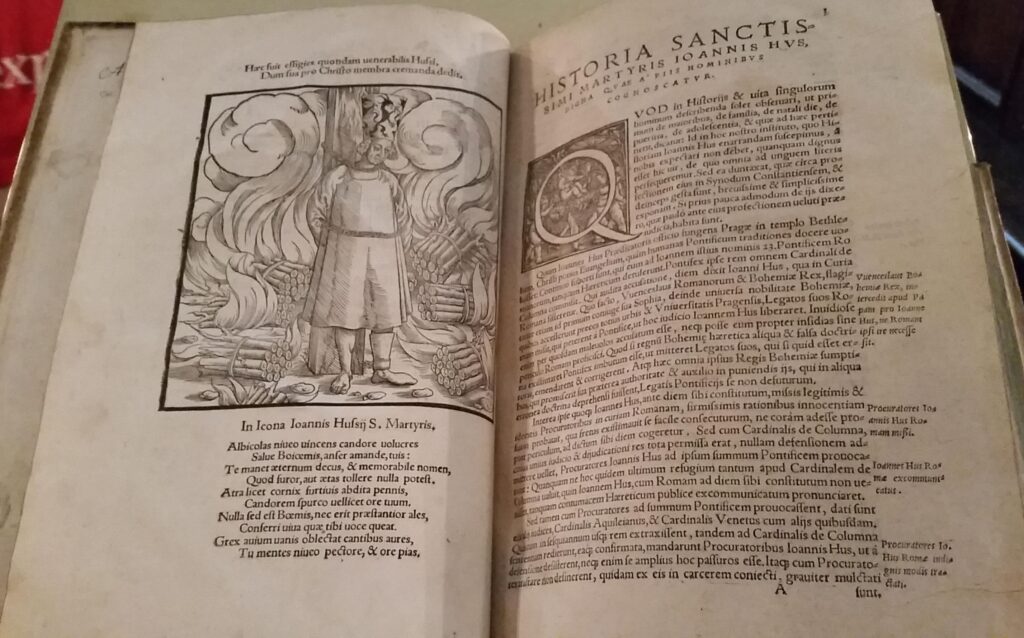
The burning of Jan Hus in the St Edmund Hall copy (Old Library QQ 23) of the first complete edition of his works which will be on display during the conference. VD16 H 6154
European connectedness
Peter Payne is an iconic figure of the university milieux and religious reform movements in England and Europe: a scholar and an exceptionally brave and dedicated intellectual reformer. He is less known and studied than he deserves, and this is emphasised in the workshop’s title, paraphrasing the title of his biography published by James Baker in 1894 (‘a forgotten great Englishman’). He is a perfect example of the European connectedness evident in all aspects of medieval culture.
Our focus on an individual
The workshop’s focus on a relatively well-documented individual, rather than on groups or social categories, such as Wycliffites and Hussites, is an important methodological point. The study of medieval religion is first of all the study of the written tradition, with texts acting as the sources of information about ideas. We want to supplement this approach with emphasis on the experience of writers and users of texts, bringing a real individual to life, and giving him a chance to speak and be heard. Without the study of experience, materiality and everyday practices we get a limited picture of medieval life, including religion, education, scholarship and travel. The focus on an individual will allow us to make observations on how a change of material and cultural environment influenced the formation of national and European identity.
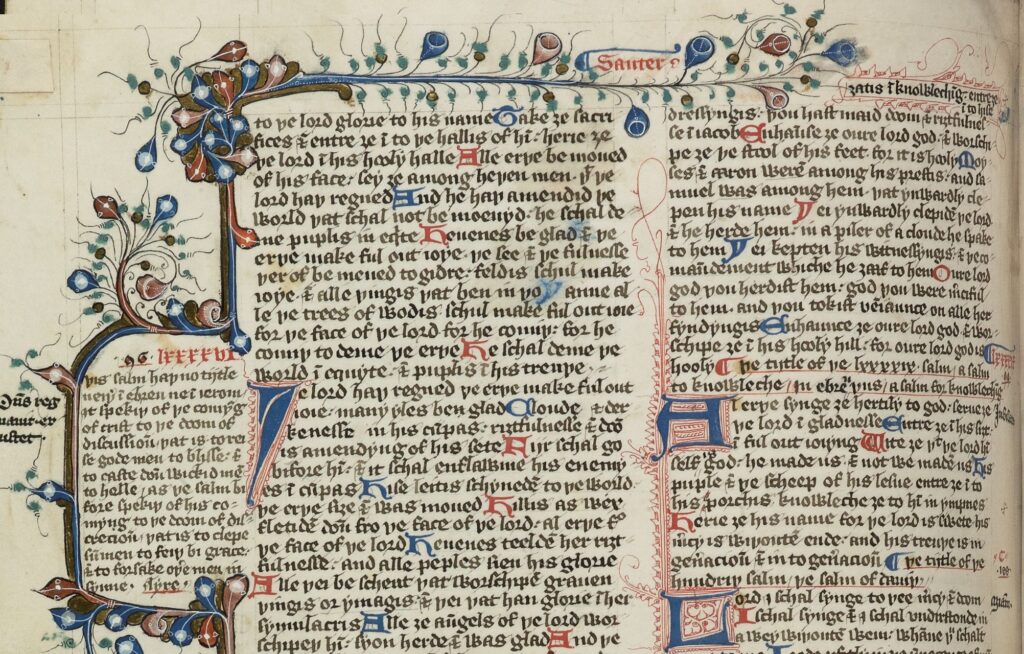
Wycliffite Bible, Oxford, Bodleian Library MS Bodl. 277
Programme
29 September
Arrival at St Edmund Hall. Dinner at a restaurant.
30 September
9am-10.30am: St Edmund Hall, Old Dining Hall
Chair: Elizabeth Solopova (University of Oxford)
Katherine J. Willis (Principal of St Edmund Hall), Henrike Lähnemann and Elizabeth Solopova (University of Oxford), Welcome
James Howarth (University of Oxford), ‘“At Oxford he called himself Peter Clerk”: Peter Payne as Principal of St Edmund Hall’
Michael Kuczynski (Tulane University), ‘Payne on Paper: The London and Prague Copies of Peter Payne’s Testimonial to Wyclif’
Ondřej Fúsik (Charles University and National Library of the Czech Republic) and Kristýna Loušová (National Library), ‘Peter Payne Manuscripts in the National Library of the Czech Republic’
10.30am: Coffee
11am-12.30pm: St Edmund Hall, Old Dining Hall
Chair: Vladimir Agrigoroaei
Pavlina Rychterová(Austrian Academy of Sciences), ‘Peter Payne and John of Pribram’
Dušan Coufal(Centre for Medieval Studies, Institute of Philosophy of the Czech Academy of Sciences and Charles University), ‘Peter Payne’s Treatise De Iuramento in the Hussite Discourse on the Oath’
Martin Dekarli (University of Hradec Králové), ‘Notes on Peter Payne’s Notabile de trinitate increata’
1-2pm: Lunch at St Edmund Hall
2.15pm Book display at the Old Library, St Edmund Hall
3pm Excursion to Godstow Abbey and Binsey church
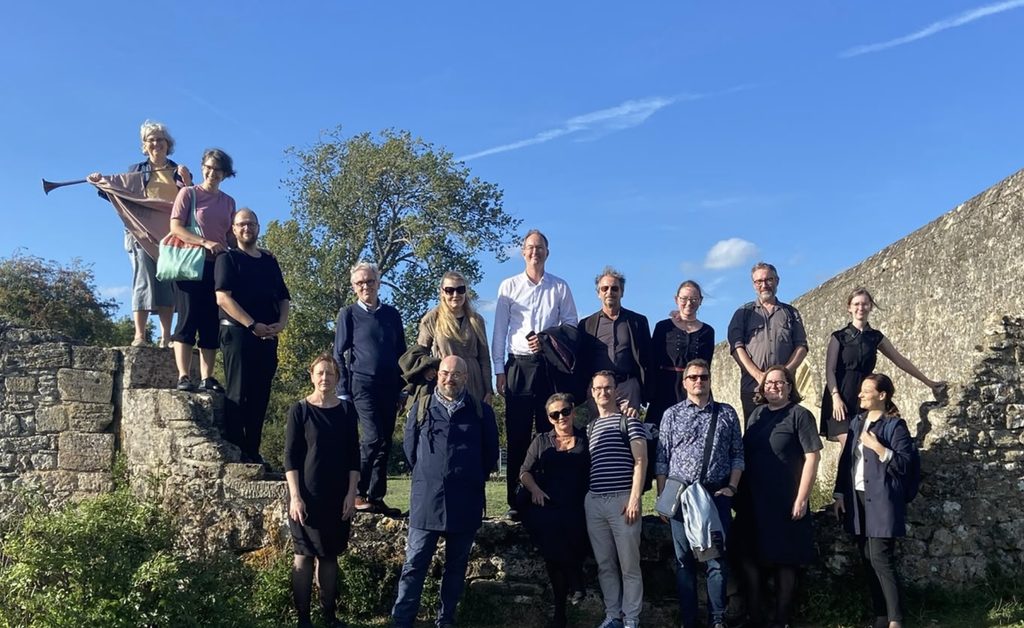
The Peter Payne Workshop participants among the ruins of Godstow Abbey
Evening: Pub dinner
1 October
9am-10.30am: St Edmund Hall, Old Dining Hall
Chair: Manfred Kern (University of Salzburg)
Vladimir Agrigoroaei (CNRS / Centre for Medieval Studies, Poitiers), ‘How Constantine Platris, the English Czech of Constantinople (1452), Came to be Confused with Peter Payne’. Consisting of a playful rewriting of the bibliography, incorporating the various conjectures that have been proposed and attempting to make sense of them, and a research paper, explaining the hypotheses incorporated into the video
Ana-Maria Gînsac (Institute of Interdisciplinary Research, Alexandru Ioan Cuza University of Iași), ‘Iași and the Transmission of the Constantinople-Prague 1452 Dialogue: Dositheos’s 1698 Edition’
Ágnes Korondi (Fragmenta et Codices Research Group of the Hungarian Research Network, National Széchényi Library), ‘English Saints in Two Hungarian Calendars and the Anglo-Hungarian Relations during the Later Middle Ages’
10.30am: Coffee
11am-12.30pm: St Edmund Hall, Old Dining Hall
Chair: Pavlina Rychterová (Austrian Academy of Sciences)
Kateřina Voleková (Charles University / Czech Language Institute), ‘Representations of Foreign Reformers in Hussite-Era Topical Songs’
Hannah Schühle-Lewis (University of Oxford), ‘Late-Medieval English Oath Discourse and Peter Payne’s de Iuramento’
Elizabeth Solopova (University of Oxford), ‘England and Europe: the Calendar of the Munich Manuscript of the Hussite Bible and the Wycliffite Mammotrectus’
1–2pm Lunch at St Edmund Hall
3pm–4.30pm: Open Lecture (Bodleian Library Lecture Theatre) – all are welcome!
Chair: Michael Kuczynski (Tulane University)
Michael van Dussen (McGill University), ‘Peter Payne’s Europe’
In the early 15th century, when English Church officials were closing in on the expanding Wycliffism, a proto-Protestant reform movement, Peter Payne, once Principal of St Edmund Hall, fled the country to begin a remarkable career in Central Europe. He became Wyclif’s surrogate in Bohemia and one of the leading representatives in nearly every Hussite delegation, including at the Council of Basel. This talk shows how Payne navigated his delicate situation in Europe and, in the process, gained a reputation (or notoriety) as an emblem of European Wycliffism. Today Payne remains an iconic figure of cross-linguistic and cross-cultural connectedness in European intellectual life and social development.
Bodleian manuscripts featured in the post-talk Show & Tell session:
Linc. Lat. 106 (Netter, Doctrinale fidei catholice, vol. 2)
Linc. Lat. 118 (Gascoigne, Liber de veritatibus, the second part)
Bodl. 55 (Floretum)
Tanner 86 (containing Juan Palomar’s Replicacio to Payne’s defense at Basel)
7pm: Conference dinner at St Edmund Hall, Old Dining Hall
9pm: Multilingual compline in the Norman Crypt of St-Peter-in-the-East (library church of St Edmund Hall)
All week, from Tuesday through to Saturday, you can watch The Harrowing of Hell.26, a 2026 experimental and abstract adaptation of the medieval Harrowing of Hell narrative, created from English mystery plays (York Cycle, Towneley Plays, Ludus Coventriae, Chester Cycle) and rewritten into contemporary English. Performances are at 9:30, in the Oxford Playhouse. Tickets can be bought here. And do book your (free) place for the Inaugural Lecture of theologian and medievalist Andrew Davison on Monday, 15 June, 5pm, in the Concert Hall of the Humanities Centre which promises to be spectacular: 1000 years of Creed settings in music with the choir of Christ Church singing. Do come and make sure the concert hall buzzes with medievalists! All information here.
Monday
French Palaeography Manuscript Reading Group – 10:30, Weston Library. If you are interested in joining the group or would like more information, please email the convenor Laure Miolo.
Medieval History Seminar: – 5:00, All Souls College. Guy Geltner (Monash University) will be speaking on ‘The workers’ view: an environmental approach to premodern public health’.
Edgar Wind Society Lecture – 6:00, House of St Gregory and St Macrina (1 Canterbury Road). Sir Richard Temple will be speakgin on ‘Andrei Rublev and the Hesychastic Mysteries of Byzantium’.
Tuesday
Latin Palaeography Manuscript Reading Group – 2pm, Weston Library. Those who are interested can email the convenor Laure Miolo.
Early Modern Diplomacy Seminar 1400-1800 – 4.15, Schwartzman 20.402. Philippa Jackson (Independent Scholar) will be speaking on ‘Girolamo Ghinucci (1480-1541): Papal Judge and English Ambassador’.
Medieval Church and Culture Seminar– Tea & coffee from 5pm; papers begin at 5.15pm, Harris Manchester College. Mary O’Connor (Balliol) will be speaking on ‘Pride and Humility: biblical typologies in Old Norse romances’.
Wednesday
Methods in Arabic and Islamic Studies Class – 10:30, LMH Library.
Medieval German Graduate Seminar on Thomasin von Zerklaere – 11:15, Oriel College. If you are interested to be added to the teams group for updates and access to the sources, please contact Henrike Lähnemann.
Oxford Seminar in the History of Alchemy and Chemistry – 3:00, Maison Française d’Oxford. Session 3 — Compuational History of Alchemy and Chemistry. Vojtěch Kaąe (University of West Bohemia, Plzeň) and Sarah Lang (Max Planck Institute, Berlin) will be speaking on ‘Tracing the Histories of Early Modern Conceptual Ecosystems: Remote Sensing Methods for the Archaeology of Alchemical Knowledge’; Guillermo Restrepo (Max Planck Institute, Leipzig) will be speaking on ‘Computational History of Chemistry: How Big Data Illuminates Macrohistorical Trends and Microhistorical Events’.
Old Norse Reading Group – 4:00, Merton College, Americas Room. This term we are reading Völsunga saga. If you are interested in joining the group, please contact one of the group convenors via email Brooklyn Arnot or Zeynep Kirca.
The Medieval Latin Documentary Palaeography Reading Group – 4:00, online. To join and/or to find out more about this and the possibility of some hands-on experience of cataloguing such documents to develop further your research skills, please contact Michael Stansfield.
David Patterson Lecture – 5:00, Clarendon Institute. Elisheva Baumgarten (Hebrew University of Jerusalem) will be speaking on ‘Shared Words: Jews, Christians and Prayer in Medieval Europe’.
Late Antique and Byzantine Seminar – 5:00, Late Antique and Byzantine Seminar, Ioannou Centre. Saun Tougher (Cardiff) will be speaking on ‘Minor Characters? Other Eunuchs in Byzantine Historiography of the Tenth Century’.
Centre for Manuscript and Text Cultures: Provenance Unknown – 5:15, Memorial Room, The Queen’s College. Dr Stella Panayotova, Royal Librarian, will be speaking on ‘Islamic Manuscripts in the Royal Library’.
Thursday
Transmitting and Preserving Languages in the Medieval and Early Modern Mediterranean, Second Workshop – 9:00, Balliol College. To register for online attendance, please contact Ugo Mondini at ugo.mondini@mod-langs.ox.ac.uk.
Middle English Reading Group (MERG) – 11:00, Lincoln College, Beckington Room. All are welcome as we finish Sir Gawain and the Green Knight. Bring any edition of the original text! There will be tea and biscuits. For more information or to be added to the mailing list, please email Rebecca Menmuir.
Oxford Centre for Islamic Studies Lecture – 2:00, Oxford Centre for Islamic Studies. Dr Kaouther Karoui (University of Münster) will be speaking on ‘Reframing Transcultural Justice: From Early Arabo Islamic Philosophy to Postcolonial Critique’.
Medieval Women’s Writing Research Seminar- 4:00, Somerville College. Recording Women’s Deeds, including extracts from Agnes d’Harcourt’s Life of Isabelle of France and the Crònica de Sant Pere de les Puel·les
Medieval Visual Culture Seminar – 5:00, St Catherine’s College. JessicaBarker (Courtauld Institute) will be speaking on ‘Contemporary Art Meets the Medieval Monastery’.
‘There is an Animal That is Called an Elephant’ – 5:00, Keble College. Research presentation by Dr Alexandra Paddock and sharing of a work-in-progress exploring the life and times of Henry III’s elephant through music, puppetry and text.
The Khalili Research Centre Seminar – 5:15, KRC Lecture Room. Emine Fetvaci (Boston College) will be ‘Portrait as Biography at the Ottoman Court: the Case of Murad III (r. 1574–95)’.
Bede Reading Group (or, ‘Bede-ing Group’) – 6:00, Blackfriars. To sign up, email Maura McKeon. Don’t stop Bede-lieving.
Friday
Medievalist Coffee Morning – 10:30, Visiting Scholars Centre (Weston Library). All welcome, coffee and insight into special collections provided.
Older Scots Reading Group – 3:00, Schwarzman room 30.401. No intensive preparation required. All are welcome and there are usually snacks. This week the theme is Orpheus and Eurydice. Contact me************@*************ac.uk for further details.
Medieval Latin Reading Group – 5:30, Christ Church. This term, we will be reading the Cosmographia of Bernardus Silvestris in the original. For more information, please contact Clara Bykvist or Monty Powell.
Saturday
Production of Fulgens and Lucrece – 5:30, St Hilda’s College Pavillion. Light refreshments will be served. Audience standing with limited seating around the outside of the room. Register online: https://www.tickettailor.com/events/sthildascollege/2225373
Publishing with the Journal Manuscript and Text Cultures. Are you interested in submitting to the journal Manuscript and Text Cultures? Please review the About the Journal page.
Sir John Rhŷs Prize for the study of the Celtic languages, literature, history, and antiquities. Entries should be submitted by email, with the subject line “Sir John Rhŷs Prize”, to the English Faculty Office, no later than Monday of Week 8 of Trinity Term (15 June 2026).
The Mortimer History Society will once again be offering two Research Bursaries (each of £1000) for the academic year 2026 to 2027, for PhD and MA students whose research includes any aspect of the medieval Welsh Marches or the Mortimers. More information here. Deadline: 30 June 2026.
Bodleian Purchasing Opportunity. Do you know of books that would aid your work but are not in the Bodleian? Help us strengthen the university’s collections. You can submit details of suggested books via https://www.bodleian.ox.ac.uk/collections-and-resources/recommend-a-purchase or by email to me******@************ac.uk.
Last week’s Wikipedia editathon proved a great success, and there is now a wikipedia article for OMS itself! Thanks again to Louise for leading the session – a recording of the introductory talk can be found here.
Exciting news! The Thegns of Mercia – an Anglo-Saxon reconstruction group – are coming to Balliol the Friday 29th May to show off a range of replicas (Old Common Room, 14:30). All are welcome!
Monday
French Palaeography Manuscript Reading Group – 10:30, Weston Library. If you are interested in joining the group or would like more information, please email the convenor Laure Miolo.
Armenian Studies Lecture – 4:00, Pembroke College. Ruth Gornandt (Faculty of Asian and Middle Eastern Studies) will be speaking on ‘‘Measured Theology’ – Gregory of Tatev (1346–1410) and the limits of theological knowledge’.
Medieval History Seminar: – 5:00, All Souls College. Julia Hillner (University of Bonn) will be speaking on ‘The marrying kind: how late Roman emperors chose their wives’.
Tuesday
Latin Palaeography Manuscript Reading Group – 2pm, Weston Library. Those who are interested can email the convenor Laure Miolo.
Medieval French Research Seminar – 5:00, Maison Francaise. Laura Campbell (Durham University) will be speaking on‘In the Beginning: Re-Creating the Creation Story in Medieval French Translations’.
Medieval Church and Culture Seminar– Tea & coffee from 5pm; papers begin at 5.15pm, Harris Manchester College. Youfei Fan (St Anne’s) will be speaking on ‘The Potion and the Women around It: female knowledge and trickery in the Tristan Legend’.
Professor Frank Griffel’s inaugural lecture – 5:00, Humanities Centre. ‘Double Truth and Multiple Rationalisms: Philosophy in Islam’s Post-Classical Period’. More information here.
Centre for Manuscript and Text Cultures – 5:15, Memorial Room, Queen’s College. Gunnar Seelentag (Hannover & Münster) will be speaking on ‘Monumentalising Norms, not Names: cartelisation and colossality in Archaic Crete’.
Wednesday
Methods in Arabic and Islamic Studies Class – 10:30, LMH Library.
Medieval German Graduate Seminar on Thomasin von Zerklaere – 11:15, Oriel College. If you are interested to be added to the teams group for updates and access to the sources, please contact Henrike Lähnemann.
Old Norse Reading Group – 4:00, Merton College, Breakfast Room. This term we are reading Völsunga saga. If you are interested in joining the group, please contact one of the group convenors via email Brooklyn Arnot or Zeynep Kirca.
The Medieval Latin Documentary Palaeography Reading Group – 4:00, online. To join and/or to find out more about this and the possibility of some hands-on experience of cataloguing such documents to develop further your research skills, please contact Michael Stansfield.
Late Antique and Byzantine Seminar – 5:00, Late Antique and Byzantine Seminar, Ioannou Centre. Alessandra Bucossi (Venice)will be speaking on ‘The Komnenian Panoplies between Religious Polemic and Political Self-Defence’.
Medieval English Research Seminar – 5:15, The Schwarzman Centre, room 00.018 . Mel Cowdery (U of North Carolina, Chapel Hill) will be speaking on ‘What Does a Mirror Mean to Thomas Hoccleve?’.
‘Public Health in the Premodern World’ Book Launch – 5:30 in the Mark Bedingham Room, St John’s College. Discussants: H. Skoda, U. Khan, G. Geltner, Janna Coomans, and Ronit Yoeli-Tlalim. Drinks reception to follow.
Thursday
Middle English Reading Group (MERG) – 11:00, Lincoln College, Beckington Room. All are welcome as we finish Sir Gawain and the Green Knight. Bring any edition of the original text! There will be tea and biscuits. For more information or to be added to the mailing list, please email Rebecca Menmuir.
Oxford Environmental History Working Group – 12:30, Schwarzman Centre History Hub Room 20.421. Dr. Kelsey Granger (IHR History Research Fellow) will be speaking on ‘Messengers of Empire: The Lives and Labour of Horses in China’s Ancient Postal System’.
Medieval Visual Culture Seminar – 5:00, St Catherine’s College. Lloyd Debeer (British Museum) will be speaking on ‘The Many Lives of the Asante Ewers’.
Global Manuscript and Text Cultures Seminar – 5:15, Memorial Room, Queen’ College. Lauren Dogaer (Univ) will be speaking on ‘How the Greek Text Culture Has Shaped Modern Views of Ptolemaic Egyptian Priests’; Fergus Bovill (Merton) will be speaking on ‘Rebuilding the Medieval, Preserving the 19th Century: Littifredi Corbizzi, Johann Anton Ramboux, and the making and breaking of a choirbook in Gubbio’.
Old English Graduate Reading Group – 5:15. This term we will be reading some of the Exeter Riddles. Our Location is variable so please email Hattie (ha************@*******ac.uk) or James (ja****************@**********ac.uk) if you’re interested.
The Khalili Research Centre Seminar – 5:15, KRC Lecture Room. Margaret Squires (Ashmolean Museum) will be speaking on ‘Woven Together: Carpets and Architecture in Safavid Iran’.
Oxford Trobadors Concert – 7:00, La Maison Francaise.
Bede Reading Group (or, ‘Bede-ing Group’) – 6:00, Blackfriars. To sign up, email Maura McKeon. Don’t stop Bede-lieving.
Oxford Festival of the Arts: Reading the signs: The meanings of medieval and Renaissance objects, symbols, and tokens – 9:30, The Hub, Kellog College.
Medievalist Coffee Morning – Friday 10:30, Visiting Scholars Centre (Weston Library). All welcome, coffee and insight into special collections provided.
Thegns of Mercia: Learning through Making – 2:30, Balliol College (Old Common Room).
Medieval Latin Reading Group – 5:30, Christ Church. This term, we will be reading the Cosmographia of Bernardus Silvestris in the original. For more information, please contact Clara Bykvist or Monty Powell.
OMS small grants is now open! Grants are normally in the region of £100–250 and can either be for expenses or for administrative and organisational support such as publicity, filming or zoom hosting. Closing date for applications: Friday of Week 5.
Publishing with the Journal Manuscript and Text Cultures. Are you interested in submitting to the journal Manuscript and Text Cultures? Please review the About the Journal page.
Sir John Rhŷs Prize for the study of the Celtic languages, literature, history, and antiquities. Entries should be submitted by email, with the subject line “Sir John Rhŷs Prize”, to the English Faculty Office, no later than Monday of Week 8 of Trinity Term (15 June 2026).
The Mortimer History Society will once again be offering two Research Bursaries (each of £1000) for the academic year 2026 to 2027, for PhD and MA students whose research includes any aspect of the medieval Welsh Marches or the Mortimers. More information here. Deadline: 30 June 2026.
Bodleian Purchasing Opportunity. Do you know of books that would aid your work but are not in the Bodleian? Help us strengthen the university’s collections. You can submit details of suggested books via https://www.bodleian.ox.ac.uk/collections-and-resources/recommend-a-purchase or by email to me******@************ac.uk.
by Louise Tjoline Keitsch (University of Freiburg, Research Intern with Henrike Lähnemann Hilary and Trinity Term 2026)
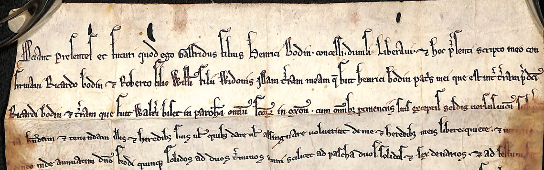
On 29 May 2026, the Weston Library hosted the one-day conference Exploring Medieval Oxford through Surviving Archives, organised by Laure Miolo and Matthew Holford and supported by the Centre for the Study of the Book. Bringing together students, early-career researchers, and established scholars, the event showcased research centred on medieval documents preserved in the Bodleian Libraries and the Christ Church archives: Claims, charters, letters and tenancy agreements.
The programme combined longer presentations by established Oxford academics with shorter papers by participants in the seminar, creating a productive dialogue between methodological reflection and original research. The keynote-style contributions by Natasha Jenman, Teresa Witcombe, Julian Munby, Richard Allen, and Dan Wakelin explored topics including the Queen’s Gold accounts of Eleanor of Castile, medieval Castilian archives, the documentary record of medieval Oxford, the cartulary and charters of the Hospital of St John the Baptist, and the challenges of working with late medieval letter collections (in that order). Together, these papers offered best-practice insights into archival research, palaeography, and the interpretation of medieval documentary sources.
The shorter presentations demonstrated the remarkable thematic breadth that a single archive can sustain. Papers addressed property ownership in thirteenth-century Oxford, the administration of religious houses, the lives of individuals at the margins of the historical record, and questions of legal practice, social obligation, and institutional memory. Several contributions drew on documents connected to the Priory of St Frideswide, whose extensive property interests across Oxford and the surrounding countryside formed a recurring thread throughout the day, while others highlighted the richness of individual charters, tenancy agreements, and parish records.
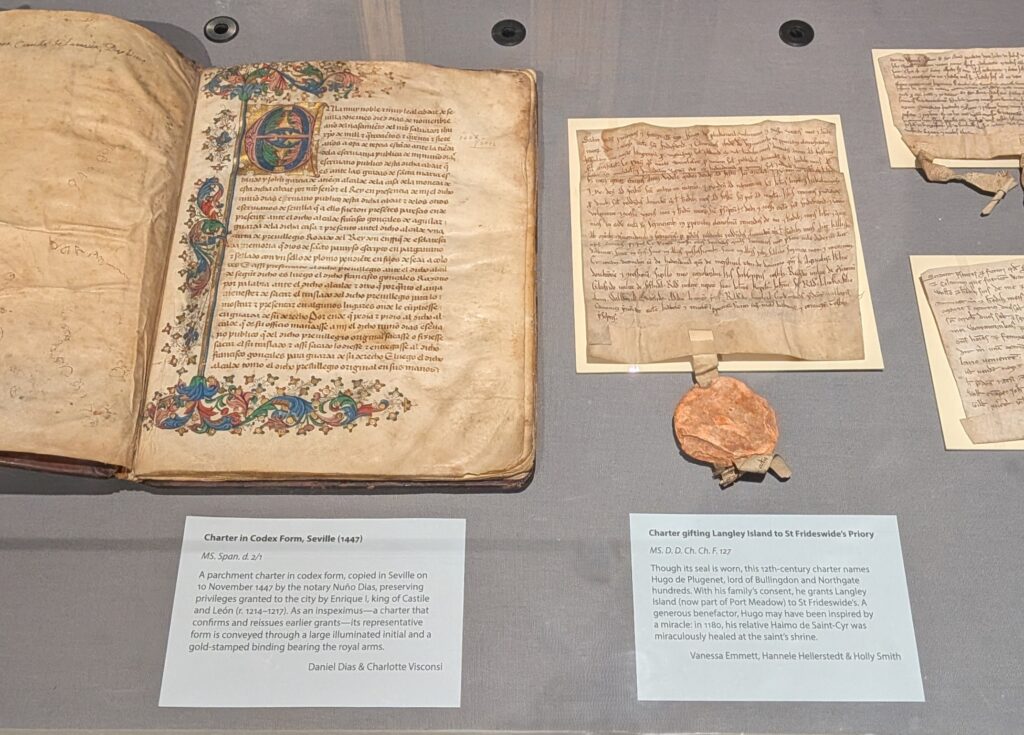
A particular strength of the conference was its sustained attention to medieval documents as material objects. Discussions addressed the challenges of transcription, the significance of seals and diplomatic features, and the interpretive possibilities opened up by close palaeographical analysis. This emphasis on materiality was complemented by an exhibition curated by the participants, displayed in two cases in the Weston Library, which presented a selection of the documents discussed during the conference and allowed attendees to engage directly with the archival material.
The conference highlighted the continued vitality of archive-based research in medieval studies and demonstrated the value of bringing together experienced scholars and emerging researchers to explore the rich documentary heritage of medieval Oxford. It offered an excellent example of how close engagement with archival sources continues to generate new perspectives on the medieval past.
Exhibition curated by the students in the Weston Library (photograph: Louise Tjoline Keitsch)
Programme
Conference Friday 29 May 2026 – Weston Library With an exhibition curated by the participants
9 Welcome Matthew Holford & Laure Miolo
9.15 Lauren Pidgeon & Deborah Seymour : An agreement between Agatha the widow and John Halegod
9.30 Emily Breithaupt & India Kelly: The Charter of Alice of Stokes
9.45 Alice Zhang & Annabel Brodersen: A Study of Christ Church F. 48: Property Ownership in Thirteenth-Century St Aldates, Oxford
10 Natasha Jenman (History, St Edmund Hall): Jews in the Queen’s Gold Accounts of Eleanor of Castile
10.30 Marina Giraudeau & Philine Armbuster: Renting and Salvation: The Tenancy Agreement of Christ Church F. 17
11.15 Teresa Witcombe (History, Wadham College): Captives and slaves in medieval Castilian archives
11.45 Tabitha Claydon: At the “insistence” of an “intervening” king
12 Julian Munby (Conted, Oxford): Mapping medieval Oxford from the archives
12.45 Lunch
2 Richard Allen (Magdalen College): Towards a new edition of the cartulary and charters of the Hospital of St John the Baptist, Oxford
2.30 Kevin Hoff & Cara Nicholls: Christina Pady and the Priory of St Frideswide
2.45 Hannele Hellerstedt, Holly Smith & Vanessa Emmet: Land and Legacy: The Life of Hugo de Plugenet
3 Louise Keitsch: Giving up (on) everything?
3.15 Yijia Wang& Luka Luhai: Cumin, Lamp, and Obligation: Making Continuity in a Medieval Oxford Parish.
3.30 Dan Wakelin (English Faculty, St Hilda’s College): Late medieval letters: disorderly archives
4.15 Daniel Dias & Charlotte Visconsi: Copying Amidst Conflict: Reproducing Castilian Law in the Wake of Civil War, (1437-1445).
4.30 End
This event is supported by theCentre for the Study of the Book.
This Thursday sees our first ever Wikipedia Editathon for Medievalists, at 5:00 in the Old Library at St Edmund Hall. Whether you have always wanted to write or improve a Wikipedia article, are looking for a low-pressure way to start writing about your topic, or simply want a productive and enjoyable distraction from exams or papers, this editathon offers a space to do so! Participants are encouraged to bring a topic they would like to work on, and prior experience with Wikipedia editing is not required – beginners are very welcome.
Exciting news! Two of our medievalists – Sumner Braund and Helen Flatley – have just opened a used bookshop in Oxford’s Golden Cross called ‘Barker and Company’, full of medieval books.
Monday
Bartlemas 900 Exhibition – weeklong, Bartlemas Chapel (Cowley Road). Exhibition exploring the history and significance of Bartlemas. More info here.
French Palaeography Manuscript Reading Group – 10:30, Weston Library. If you are interested in joining the group or would like more information, please email the convenor Laure Miolo.
Medieval History Seminar: – 5:00, All Souls College. Teresa Witcombe (Wadham College, Oxford) will be speaking in ‘The spoils of war: Andalusi captives in medieval Castile’.
Italian Research Seminar – 5:15, Taylorian, Room 2. Ambrogio Camozzi Pistoja (Harvard) will be speaking on ‘towards a Criminal History of Medieval Satire: Boccaccio, Decameron 5.10 (Sodomy, Apuleius, Forgery)’
Tuesday
Latin Palaeography Special Session – 2pm, Weston Library. Angela Cossu (Grenoble/ Richard Sharpe Memorial Visiting Fellow, Bodleian Libraries) will show and speak about “Medieval Latin florilegia: palaeography, mise en page and mise en texte” Those who are interested can email the convenor Laure Miolo.
Medieval Church and Culture Seminar– Tea & coffee from 5pm; papers begin at 5.15pm, Harris Manchester College. Henry Merrifield (Corpus) will be speaking on ‘Adoption or Rejection: assessing Anglo-Saxon attitudes to ancient Rome’; Rhys Schwan (Trinity) will be speaking on ‘Revisiting the Regnal Chronology of the Kingdom of Northumbria in the 9th Century’
The Oxford Society for the Caucasus and Central Asia (TOSCCA) Seminar Series – 5:00, Lecture Room 4, New College. Dilnoza Duturaeva (University of York/ONGC) will be speaking on ‘Animal Power in the Highlands: Qarakhanid Hybrid Camels to China.’
Wednesday
Methods in Arabic and Islamic Studies Class – 10:30, LMH Library.
‘AI and the Future of Everyday Heritage’ Heritage Pathway Programme – 11:00, Humanities Centre. Speaker: Dr Dominique Bouchard, Heritage and Engagement Director, Leeds Castle Clara Saliba, AI and Data Insights Analyst, Blenheim Place. More details and booking here.
Medieval German Graduate Seminar on Thomasin von Zerklaere – 11:15, Oriel College. If you are interested to be added to the teams group for updates and access to the sources, please contact Henrike Lähnemann.
Oxford Seminar in the History of Alchemy and Chemistry – 3:00, Maison Française d’Oxford. Session 2 — Spiritual Foundations of Alchemy. Chair: Ellen Hausner (Oxford). Speakers: Mark Edwards (Oxford) on ‘Ancient Alchemy as Philosophy’; Charles Burnett (Warburg Institute) on ‘Alchemy as Divinatio’.
Old Norse Reading Group – 4:00, Merton College, Americas Room. This term we are reading Völsunga saga. If you are interested in joining the group, please contact one of the group convenors via email Brooklyn Arnot or Zeynep Kirca.
The Medieval Latin Documentary Palaeography Reading Group – 4:00, online. To join and/or to find out more about this and the possibility of some hands-on experience of cataloguing such documents to develop further your research skills, please contact Michael Stansfield.
Late Antique and Byzantine Seminar – 5:00, Late Antique and Byzantine Seminar, Ioannou Centre. Apolline Gay (Brussels and Oxford) will be speaking on ‘They Also Tell the Story: The Role of Biblical Female Figures in Images from Byzantine and Early Islamic Egypt‘.
Medieval English Research Seminar – 5:15, Medieval English Research Seminar – 5:15. Annie Englund (U of Oxford) will be speaking on ‘Ghosts, roasts, and the speaking dead: grappling with the popularity of the Old English Soul and Body’; Corinne Clark (U of Oxford) will be speaking on ‘The Reading bee: honey and venom in Walter Map’s De Nugis Curialium’.
Centre for Manuscript and Text Cultures: Provenance Unknown – 5:15, Memorial Room, The Queen’s College. Roberta Mazza (University of Bologna) will be speaking on ‘Beyond Provenance: Publishing Papyri and Other Manuscripts from Egypt in 2026’.
Thursday
Middle English Reading Group (MERG) – 11:00, Lincoln College, Beckington Room. All are welcome as we finish Sir Gawain and the Green Knight. Bring any edition of the original text! There will be tea and biscuits. For more information or to be added to the mailing list, please email Rebecca Menmuir.
Medieval Women’s Writing Research Seminar- 4:00, Somerville College. Poetry and Song, including extracts from the works of Kassia of Constantinople, Florencia Pinar and Gwerful Mechain.
Wikipedia Editathon for Medievalists – 5:00, Old Library at St Edmund Hall. More info here.
The Khalili Research Centre Seminar – 5:15, KRC Lecture Room. Stephane Pradines (The Aga Khan University) will be speaking on ‘Islamic Archaeology in Egypt: Sixteen Years of Rescue Excavations in Cairo’.
Bede Reading Group (or, ‘Bede-ing Group’) – 6:00, Blackfriars. To sign up, email Maura McKeon. Don’t stop Bede-lieving.
Friday
Medievalist Coffee Morning – 10:30, Visiting Scholars Centre (Weston Library). All welcome, coffee and insight into special collections provided.
Older Scots Reading Group – 3:00, Schwarzman room 30.401. No intensive preparation required. All are welcome and there are usually snacks. This week the theme is Orpheus and Eurydice. Contact me************@*************ac.uk for further details.
Oxford Medieval Manuscript Group: Tour of the Magdalen College Old Library – 3:00, Magdalen College, Porter’s Lodge. Booking required.
Medieval Latin Reading Group – 5:30, Christ Church. This term, we will be reading the Cosmographia of Bernardus Silvestris in the original. For more information, please contact Clara Bykvist or Monty Powell.
OMS small grants is now open! Grants are normally in the region of £100–250 and can either be for expenses or for administrative and organisational support such as publicity, filming or zoom hosting. Closing date for applications: Friday of Week 5.
Publishing with the Journal Manuscript and Text Cultures. Are you interested in submitting to the journal Manuscript and Text Cultures? Please review the About the Journal page.
Sir John Rhŷs Prize for the study of the Celtic languages, literature, history, and antiquities. Entries should be submitted by email, with the subject line “Sir John Rhŷs Prize”, to the English Faculty Office, no later than Monday of Week 8 of Trinity Term (15 June 2026).
CfP – Contested Ground: Ownership and Belonging in the Middle Ages. More information here. Deadline: 1 June 2026.
CfP – 1027 – 2027 : The World in which William was Born. More information here. Deadline: 1 June 2026.
The Mortimer History Society will once again be offering two Research Bursaries (each of £1000) for the academic year 2026 to 2027, for PhD and MA students whose research includes any aspect of the medieval Welsh Marches or the Mortimers. More information here. Deadline: 30 June 2026.
Bodleian Purchasing Opportunity. Do you know of books that would aid your work but are not in the Bodleian? Help us strengthen the university’s collections. You can submit details of suggested books via https://www.bodleian.ox.ac.uk/collections-and-resources/recommend-a-purchase or by email to me******@************ac.uk.
Week 3 is upon us, and it’s jam-packed with medieval events and opportunities. Of particular note is Balliol’s Oliver Smithies Lecture, this Thursday, which sees Elaine Treharne discussing Medieval women scribes.
Looking to the future, we’re hoping to put together a list of Oxford participants in this year’s IMC Leeds. If you are organising or speaking on a panel, please drop me a quick email with the details.
Monday
French Palaeography Manuscript Reading Group – 10:30, Weston Library. If you are interested in joining the group or would like more information, please email the convenor Laure Miolo.
Medieval History Seminar: – 5:00, All Souls College. Round table on Richard Hodges’s The Origins of Anglo-Saxon Towns: A Viking Gift? (London, 2025) with John Blair, Helen Gittos, Helena Hamerow and Rory Naismith.
Italian Research Seminar – 5:15, Taylorian, Room 2. Graduate Work-in-Progress. Presentations from DPhil students Silvia Cercarelli (modern/contemporary), Esme Hodson (modern/contemporary), Katherine McKee (medieval), and Victoria White (early modern)
Tuesday
Latin Palaeography Manuscript Reading Group – 2pm, Weston Library. Those who are interested can email the convenor Laure Miolo.
Medieval French Research Seminar – 5:00, Maison Francaise. Adrian Armstrong (Queen Mary University of London) will be speaking on ‘Testopolis: The Testament as Urban Art’ .
Medieval Church and Culture Seminar– Tea & coffee from 5pm; papers begin at 5.15pm, Harris Manchester College. Cris Arama (St Anne’s) will be speaking on ‘Gender embodiment in Old French hagiography: a textual and iconographical approach’; Bartholomew Chu (Lincoln) will be speaking on ;The Quandary of Quality: copying prestige in MS. Bodl. 770′.
Wednesday
Methods in Arabic and Islamic Studies Class – 10:30, LMH Library.
Medieval German Graduate Seminar on Thomasin von Zerklaere – 11:15, Oriel College. If you are interested to be added to the teams group for updates and access to the sources, please contact Henrike Lähnemann.
Early Printed Books: A Computer-Aided Collate-A-Thon – 2:00, Taylor Institute Library. To book a place, please sign up here. For information about the project see here or contact Giles Bergel at gi**********@*******ac.uk
Oxford Seminar in the History of Alchemy and Chemistry: Life and Nature in Early Modern Alchemy – 3:00, Maison Française d’Oxford. Oana Matei (Western University of Arad) will be speaking on ‘Can Life Rise from Ashes? Discussions on the Possibility of the Palingenesis of Plants in the Seventeenth Century’; Xinyi Wen(Warburg Institute) will be speaking on ‘Cosmos or Coitus? A Copy Census of Oswald Croll’s Basilica Chymica, 1609–1690′.
Old Norse Reading Group – 4:00, Merton College, Breakfast Room. This term we are reading Völsunga saga. If you are interested in joining the group, please contact one of the group convenors via email Brooklyn Arnot or Zeynep Kirca.
The Medieval Latin Documentary Palaeography Reading Group – 4:00, online. To join and/or to find out more about this and the possibility of some hands-on experience of cataloguing such documents to develop further your research skills, please contact Michael Stansfield.
Late Antique and Byzantine Seminar – 5:00, Late Antique and Byzantine Seminar, Ioannou Centre. Pawel Nowakowski (Warsaw) will be speaking in ‘New Fragments of the Order (forma generalis) of the Praetorian Prefect of the East, Pusaeus Dionysius, 480 CE, from Stratonikeia in Caria’.
Oxford Centre for Islamic Studies Lecture – 5:00, Oxford Centre for Islamic Studies. Dr Harry Muntv(University of York) will be speaking on ‘Haram Historiography: Writing the History of Mecca, Medina and Jerusalem in the Early Islamic Centuries’.
Oxford Centre of Early Medieval Britain and Ireland: Invisible East – 5:00, online. Nima Asefi (Universität Hamburg) will be speaking on ‘Documents from Turbulent Times: Studying Middle Persian Collections from the Late Sasanian and Early Islamic Periods-Opportunities and Challenges’. Registration essential.
Medieval English Research Seminar – 5:15, The Schwarzman Centre, room 00.018 . Cathy Shrank (U of Sheffield) will be speaking on ‘Thomas More’s dialogues’.
Thursday
Middle English Reading Group (MERG) – 11:00, Lincoln College, Beckington Room. All are welcome as we finish Sir Gawain and the Green Knight. Bring any edition of the original text! There will be tea and biscuits. For more information or to be added to the mailing list, please email Rebecca Menmuir.
Oxford Environmental History Working Group – 12:30, Schwarzman Centre History Hub Room 20.421. Wallerand Bazin will be speaking on ‘Bracken dissensus: a historical political ecology of tree planting in the English Lake District’.
Oliver Smithies Lecture at Balliol College – 5:15, Gillis Lecture Theatre, Balliol College. Elaine Treharne (Stanford University) will be speaking on “Death of a Nun: Medieval Women Scribes and Networks of Piety”. Followed by a Drinks Reception. More information here.
Bede Reading Group (or, ‘Bede-ing Group’) – 6:00, Blackfriars. To sign up, email Maura McKeon. Don’t stop Bede-lieving.
Medieval Academy of America’s Graduate Student Council webinar on funding – 8:00 online. MAA Special Projects Assistant Jon Dell Isola will discuss what grants are available to graduate students, how to apply, and tips for grant applications. Register here.
Compline in the Crypt – 9:30, St Edmund Hall.
Friday
Medievalist Coffee Morning – Friday 10:30, Visiting Scholars Centre (Weston Library). All welcome, coffee and insight into special collections provided.
Oxford Medieval Manuscript Group – 3:00. Courtauld Gallery (London) Visit.
Old Frisian Reading Group – 3:00, Online.
Medieval Latin Reading Group – 5:30, Christ Church. This term, we will be reading the Cosmographia of Bernardus Silvestris in the original. For more information, please contact Clara Bykvist or Monty Powell.
OMS small grants is now open! Grants are normally in the region of £100–250 and can either be for expenses or for administrative and organisational support such as publicity, filming or zoom hosting. Closing date for applications: Friday of Week 5.
Publishing with the Journal Manuscript and Text Cultures. Are you interested in submitting to the journal Manuscript and Text Cultures? Please review the About the Journal page.
Sir John Rhŷs Prize for the study of the Celtic languages, literature, history, and antiquities. Entries should be submitted by email, with the subject line “Sir John Rhŷs Prize”, to the English Faculty Office, no later than Monday of Week 8 of Trinity Term (15 June 2026).
CfP – 9th International Conference on Myth Criticism. Deadline: 15 May 2026
CfP – The Nine Worthies: Interdisciplinary Perspectives. Deadline: 15 May 2026
CfP – Contested Ground: Ownership and Belonging in the Middle Ages. More information here. Deadline: 1 June 2026.
CfP – 1027 – 2027 : The World in which William was Born. More information here. Deadline: 1 June 2026.
The Mortimer History Society will once again be offering two Research Bursaries (each of £1000) for the academic year 2026 to 2027, for PhD and MA students whose research includes any aspect of the medieval Welsh Marches or the Mortimers. More information here. Deadline: 30 June 2026.
Bodleian Purchasing Opportunity. Do you know of books that would aid your work but are not in the Bodleian? Help us strengthen the university’s collections. You can submit details of suggested books via https://www.bodleian.ox.ac.uk/collections-and-resources/recommend-a-purchase or by email to me******@************ac.uk.
Call for papers Representations of Women and/as Animals in Literature, Arts, and Other Media
University of Oxford, Oriel College, 14-16 April 2027 Keynote speakers: Prof Chloë Taylor (University of Alberta) and Dr Kaori Nagai (University of Kent) Roundtable with Queer Kinship Network led by Prof Charlotte Ross (University of Oxford) Organising committee: Dr Fanny Clemente (University of Oxford), Dr Greta Colombani (independent scholar), Dr Cécile Bishop (University of Oxford)
FEMINANIMALS is a three-day international conference investigating representations of women as non-human animals and of the relationship between women and non-human animals in literature, arts, and other media across languages, from medieval to contemporary times. The last decades have witnessed an explosion of theoretical discourses directed towards a critique of humanism and a re-evaluation of humans’ interactions with the non-human world and wider ecosystem. Since the 1970s such a focus has found a privileged expression in ecofeminist theories, which have started to interrogate and deconstruct the history-long, negatively connoted association of women with non-human animals and to denounce the fundamental links between the oppression of women and that of non- human nature simultaneously perpetrated by the patriarchal system. From the ecofeminist manifestos of the 1990s (Gaard 1993, Gruen 1993, Plumwood 1993, Adams and Donovan 1995), the field of inquiry examing the deleterious intersections of anthropocentric and androcentric attitudes has been prolifically expanded and enriched by a notable array of theoretical standpoints adopting diverse disciplinary perspectives and an increasingly intersectional approach, that is, bringing to the fore of the analysis other categories of oppression that ought to be necessarily considered alongside gender and species, such as race, sexuality, class, physical abilities. Recent contributions to the field include Alaimo and Hekman 2008, Decka 2012, Adams and Gruen 2014, Gaard 2017, Vakoch and Mickey 2017, Braidotti 2022, and Taylor 2024. Theoretical discourses on the intersected nature of different systems of oppressions have been productively applied to the study of literature and other arts. Some of the above-mentioned works already include references to or analysis of literary and artistic sources (Taylor 2024); other contributions directly postulate, for instance, the benefits of intertwining ecofeminism and literary criticism (Gaard and Murphy 1998, Vakoch and Mickey 2019, and Vakoch 2023). Increasingly moving away from a privileged Anglo-American-centred perspective, moreover, scholarship is embracing more comprehensive assessments of literary and artistic portrays of nature, non-human animals, and humans’ relationship with them. Following in the footsteps of such recent contributions, dialoguing with different theoretical approaches and exploring different media, FEMINANIMALS seeks to enrich and foster ongoing discussions around the connections and intersections between our changing constructions of womanhood and animality by looking at representations of women as non-human animals and of the relationship between women and non-human animals, from medieval to contemporary times, assessing the significance and implications of those representations against the backdrop of diverse historical and cultural contexts. Across time and space, literature, arts, and other media have been pervaded by portrayals of women as/and animals, from the moralistic, religiously informed intertwining of gender and species in medieval bestiaries, exempla such as the cuento XXXV “La mujer brava” in Don Juan Manuel’s El Conde Lucanor or works like Boccaccio’s Il Corbaccio (ca. 1365) describing women as an “animale imperfetto” to the countless retellings and translations of the legend of the half-human half-snake Melusine in widely circulating texts like Jean d’Arras’s Mélusine (ca. 1393) and its adaptations in the following centuries, from the woman-animal erotic unions and shapeshifting in the late seventeenth- and early eighteenth-century supernatural tales Liaozhai zhiyi by Pu Songling to the numerous poems dedicated to wild, exploited, or domesticated animals by Romantic and Victorian women authors such as Anna Letitita Barbauld’s “A Mouse’s Petition” (1773) and Elizabeth Barrett Browning’s “To Flush, My Dog” (1843), from Odette’s transformation into a swan in Pyotr Ilyich Tchaikovsky’s ballet Swan Lake (1877) to visual depictions of woman-animal entanglements like Oskar Kokoschka’s painting Mädchenakt auf galoppierendem Schimmel in Weiherlandschaft (1905) and the surrealist works of Leonora Carrington who herself identified as a “female human animal”. The manifold associations between women and non-human animals continue to be prominent in recent times, enriched by new media and perspectives, with meaningful examples including Clarice Lispector’s novel A paixão segundo G.H (1964) centring on the unsettling encounter of the female protagonist with a cockroach, Marie Darrieussecq’s satirical tale of a woman’s metamorphosis into a female pig in Truismes (1996), the Africanfuturist speculative fiction of Nnedi Okorafor who endows the heroine of Who Fears Death (2010) with the magical ability to turn into a vulture and dedicated her novella Binti (2015) to a jellyfish, and the central place that the porous borders between women and animals occupy in Athina Rachel Tsangari’s cinema, particularly in Attenberg (2010) and her short film The Capsule (2012). What can these pervasive representations of women as/and animals in different cultures and historical periods tell us about the complexities and intersections of shifting notions of gender and species, the fraught line between humanity and animality, and the entwined practices of domination and othering to which women and animals have been subjected? How can we look at such a variety of literary and artistic sources with the benefit of decades of theoretical perspectives that have tackled the historical, philosophical, social, cultural, and political implications of the multifaceted association of women and non-human animals? In what crucial ways can an interdisciplinary, comparative, and temporally wide approach help us think about and rethink this fundamental pairing today, as we continue to navigate, experience, suffer, and/or reclaim it against the backdrop of a dramatic environmental crisis, a deterioration of our relationship with nature and other living creatures, and a new rising tide of sexism that is infiltrating the virtual and real-life world? The conference aims to foster new conversations around these questions by inviting scholars to examine representations of women as/and animals across languages and cultures, from medieval times to the present day. We encourage proposals considering works belonging to different media and genres, focusing on canonical as well as non-canonical authors and artists, and dialoguing with diverse theoretical and methodological approaches, such as human-animal studies, posthumanist studies, new materialism studies, ecofeminist studies, animal studies, critical animal studies, animality studies, gender studies, critical race and postcolonial studies, queer studies, psychoanalytic and post-structural studies, affect theory, and other relevant fields of inquiry.
Papers may explore topics including, but not limited to:
women-animals metamorphoses
women-animals hybrids
women, animals, and the body
women, animals, and sexuality
women, animals, and gender
women, animals, and race
women, animals, and class
women, animals, and motherhood
metaphors of women as animals
women, animals, and language
kinship between women and animals
women, animals, and ethics and aesthetics of care
women, animals, and the environmental crisis
women, animals, and science
women, animals, and spirituality
women, animals, and folklore
women writers/artists and animals
trans women and animals
women, animals, and the male gaze
The conference is part of a wider project including a cultural programme of public events that will take place at the Schwarzman Centre for the Humanities in April 2027 and will consist in:
a writers roundtable with authors Naomi Booth, Chịkọdịlị Emelụmadụ, Helen Jukes, and Helen Macdonald;
a screening of H is for Hawk (2025) preceded by conversation with director Philippa Lowthorpe.
More information on the cultural programme, confirmed dates, and how to register will follow. All conference participants are very welcome to extend their stay in Oxford to attend the events. Please note that the conference will take place in person in Oxford with no possibility for hybrid participation. There will be no conference fee. All presentations should be in English and last no longer than 20 minutes. Proposals, including title, abstract (250 words max), and short bio (150 words max), must be submitted via email in a single Word document to Dr Fanny Clemente and Dr Greta Colombani by 15 July 2026. Notification of acceptance will be sent by 30 July 2026. Please feel free to contact the organisers Dr Fanny Clemente and Dr Greta Colombani at any point for inquiries and further information.
Welcome to week 2. Alongside the usual weekly roster of reading groups and opportunities, this weeks sees a number of exciting one-off events: ‘Black Lives in the Archives’ (Thur), Prof Treharne on ‘The Look of the Medieval Book’ (Fri), and Dr Griffith in the annual O’ Donnell Lecture (Fri).
Monday
French Palaeography Manuscript Reading Group – 10:30, Weston Library. If you are interested in joining the group or would like more information, please email the convenor Laure Miolo.
Medieval History Seminar: – 5:00, All Souls College. Nancy Thebaut (St Catherine’s College, Oxford) will be speaking on ‘When Christ turns away: representing the ascension ca. 1000’.
Tuesday
Latin Palaeography Manuscript Reading Group – 2pm, Weston Library. Those who are interested can email the convenor Laure Miolo.
Medieval Church and Culture Seminar– Tea & coffee from 5pm; papers begin at 5.15pm, Harris Manchester College. Hannah Free (Kellogg) will be speaking on ‘Christian Fanfiction? Searching for truth in biblical retellings’; Samuel Bedford (Wadham) will be speaking on ‘Reginald Pecock’s Rationalist Turn: a study in medieval intellectual biography’
Wednesday
Methods in Arabic and Islamic Studies Class – 10:30, LMH Library.
Medieval German Graduate Seminar on Thomasin von Zerklaere – 11:15, Oriel College. If you are interested to be added to the teams group for updates and access to the sources, please contact Henrike Lähnemann.
Old Norse Reading Group – 5:00, Merton College, Americas Room. This term we are reading Völsunga saga. If you are interested in joining the group, please contact one of the group convenors via email Brooklyn Arnot or Zeynep Kirca.
The Medieval Latin Documentary Palaeography Reading Group – 4:00, online. To join and/or to find out more about this and the possibility of some hands-on experience of cataloguing such documents to develop further your research skills, please contact Michael Stansfield.
Late Antique and Byzantine Seminar – 5:00, Late Antique and Byzantine Seminar, Ioannou Centre. Ekaterini Vavaliou (Oxford) will be speaking on ‘Dissecting a Medieval Frontier: The Fortifications of Eastern Central Greece‘.
Thursday
Middle English Reading Group (MERG) – 11:00, Lincoln College, Beckington Room. All are welcome as we finish Sir Gawain and the Green Knight. Bring any edition of the original text! There will be tea and biscuits. For more information or to be added to the mailing list, please email Rebecca Menmuir.
Writing Environmental History Workshop – 2:00, Schwarzman Centre Room TBA. For updated meeting information, please email Ryan Mealiffe.
Black Lives in the Archives: Chivalric Romances – 3:00, Weston Library. This hands-on workshop will explore how surviving medieval manuscripts can help us understand race and race-making in medieval Europe. Register here.
Medieval Women’s Writing Research Seminar- 4:00, Somerville College. Spiritual and Material World, including extracts from the works of Margery Kempe, Leonor López de Córdoba and Isabel de Villena
Medieval Visual Culture Seminar – 5:00, St Catherine’s College. CécileVoyer (Université de Poitiers) will be speaking on “Under the Gaze of the Judge: New approaches to a re-reading of the Conques tympanum”
Centre for Manuscript and Text Cultures: Global Manuscript and Text Cultures Seminar – 5:15, Memorial Room, Queen’s College. Shaahin Pishbin (Queen’s) & Thomas Newbold (Asian University for Women, Chittagong) will be speaking on M’uhajir manuscripts: Field notes from the Alia Madrasa Library in Dhaka’; Jaimee Comstock-Skipp (New College) will be speaking on ‘What’s in a nisba? Manuscript makers and migrations in 16th-century Central Asia’.
The Khalili Research Centre Seminar – 5:15, KRC Lecture Room. Suna Çağaptay (Muğla Sıtkı Koçman University) will be speaking on ‘Reading Between the Lines: The Maritime Landscape of Anaia on the Byzantine-Genoese and Aydinid Cusp’
Guild of Medievalist Makers – 5:30, online. Making Space Session – optional theme: dreams.
Bede Reading Group (or, ‘Bede-ing Group’) – 6:00, Blackfriars. To sign up, email Maura McKeon. Don’t stop Bede-lieving.
Compline in the Crypt – 9:30, St Edmund Hall.
Friday
Medievalist Coffee Morning – 10:30, Visiting Scholars Centre (Weston Library). All welcome, coffee and insight into special collections provided.
Older Scots Reading Group – 3:00, Schwarzman room 30.401. No intensive preparation required. All are welcome and there are usually snacks. This week the theme is Orpheus and Eurydice. Contact me************@*************ac.uk for further details.
Oxford Medieval Manuscript Group – 5:00, Merton College Mure Room. Professor Elaine Treharne (Stanford University) will be speaking on ‘The Look of the Medieval Book: Manuscripts and Their Uses’. Please join us for a drinks reception following the lecture.
Medieval Latin Reading Group – 5:30, Christ Church. This term, we will be reading the Cosmographia of Bernardus Silvestris in the original. For more information, please contact Clara Bykvist or Monty Powell.
O’ Donnell Lecture – 5:30, Schwarzman Centre for the Humanities. Dr Aaron Griffith (Utrecht University) will be speaking on ‘Old Irish: plenty of variation, but of what kind?‘. Register for free tickets here.
OMS small grants is now open! Grants are normally in the region of £100–250 and can either be for expenses or for administrative and organisational support such as publicity, filming or zoom hosting. Closing date for applications: Friday of Week 5.
Publishing with the Journal Manuscript and Text Cultures. Are you interested in submitting to the journal Manuscript and Text Cultures? Please review the About the Journal page.
Sir John Rhŷs Prize for the study of the Celtic languages, literature, history, and antiquities. Entries should be submitted by email, with the subject line “Sir John Rhŷs Prize”, to the English Faculty Office, no later than Monday of Week 8 of Trinity Term (15 June 2026).
CfP – 9th International Conference on Myth Criticism. Deadline: 15 May 2026
CfP – The Nine Worthies: Interdisciplinary Perspectives. Deadline: 15 May 2026
CfP – Contested Ground: Ownership and Belonging in the Middle Ages. More information here. Deadline: 1 June 2026.
CfP – 1027 – 2027 : The World in which William was Born. More information here. Deadline: 1 June 2026.
The Mortimer History Society will once again be offering two Research Bursaries (each of £1000) for the academic year 2026 to 2027, for PhD and MA students whose research includes any aspect of the medieval Welsh Marches or the Mortimers. More information here. Deadline: 30 June 2026.
Bodleian Purchasing Opportunity. Do you know of books that would aid your work but are not in the Bodleian? Help us strengthen the university’s collections. You can submit details of suggested books via https://www.bodleian.ox.ac.uk/collections-and-resources/recommend-a-purchase or by email to me******@************ac.uk.