The Society for the Study of Medieval Languages and Literature warmly invites OMS community members to a wine reception to launch the Nigel F. Palmer Travel Fund, to be held at 18:00 on Monday 11 May in the Hinrich Reemtsma Auditorium of the Warburg Institute (Woburn Square, London WC1H 0AB).
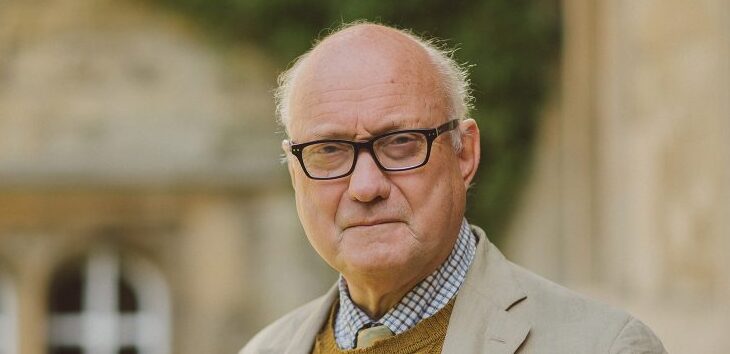
The Fund will support graduate students whose research in medieval languages and literature necessitates travel, and its launch comes at a point when funding for graduate students across the arts and humanities is becoming increasingly restricted. Its specified aim is to enable students to visit libraries and archives to consult manuscripts or other archival material, and to visit archaeological sites and/or monuments of direct relevance to their research. The Fund is named in honour of Nigel F. Palmer, executive editor of the Society’s journal Medium Ævum, and its responsible editor for German, Latin and all historical disciplines for well over thirty years from 1990 until his death in 2022. Our Society’s intention with the Fund is to take forward Nigel’s work, undertaken through the Society and widely beyond, in encouraging young scholars, by supporting graduate students in medieval studies to travel and pursue research on original materials.
Please email the Society’s Executive Officers at ss***@***********ac.uk to confirm your attendance by 1 May. If you are unable to join us on 11 May, I would be delighted if you would consider a donation towards the endowment of the Fund. You can donate to the fund via this link: Donate
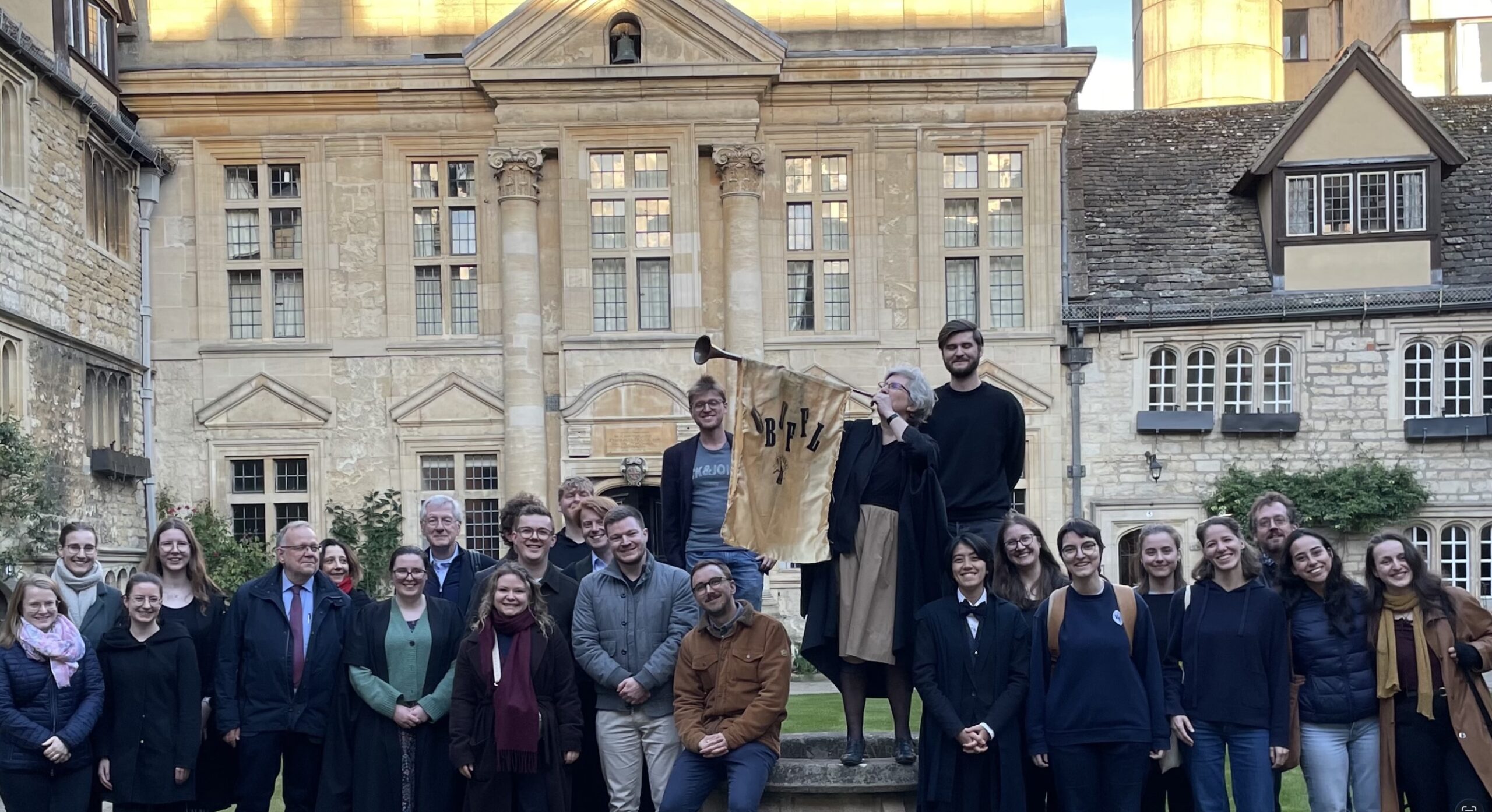
Enough rays to make functional the St Edmund Hall sundial; yellow, orange, and burgundy tulips; the four-note blast of that iconic hunting horn: these signs heralded the beginning of the three-day GBOFFL Conference of medieval Germanists one late afternoon in April.
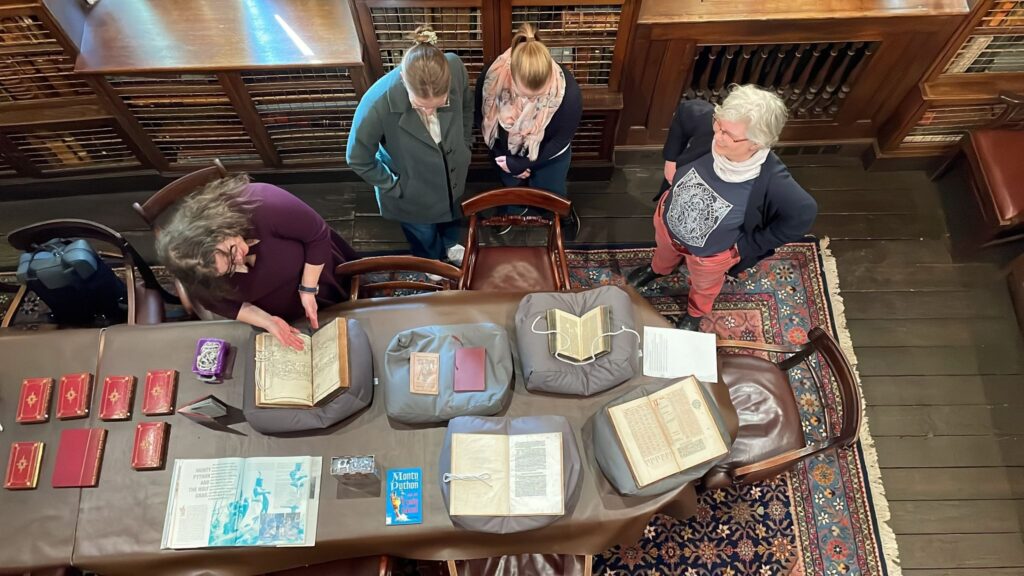
The GBOFFL participants — from universities whose cities make up the abbreviated title, i.e. Geneva, Bern, Oxford, Freiburg (im Breisgau), Freiburg (im Üechtland), and Lausanne — kicked off the conference with a gathering in the cosy, climate-controlled Old Library of Teddy Hall, where they noshed anise cake and perused materials from the Hall’s collection, including a pamphlet on St Edmund and a Monty Python-themed cardboard catapult.
GBOFFL participants engage with the Teddy Hall collections (Photograph: Giovanna Truong)
After the reception, and with the rare books safely stowed, the participants poured tea and coffee and partook in analyzing and performing the Passionsspiel, in particular scenes from the Frankfurt and Alsfeld versions which are being prepared for an edition focussing on the life of Mary Magdalen — more on this during a workshop on medieval German drama on 2 May!
With their dramatic prowess soundly proven, the Germanists poured into the Wadham Room of The King’s Arms for a celebratory pint, each looking forward to the schedule of lectures and workshops in the days to come.
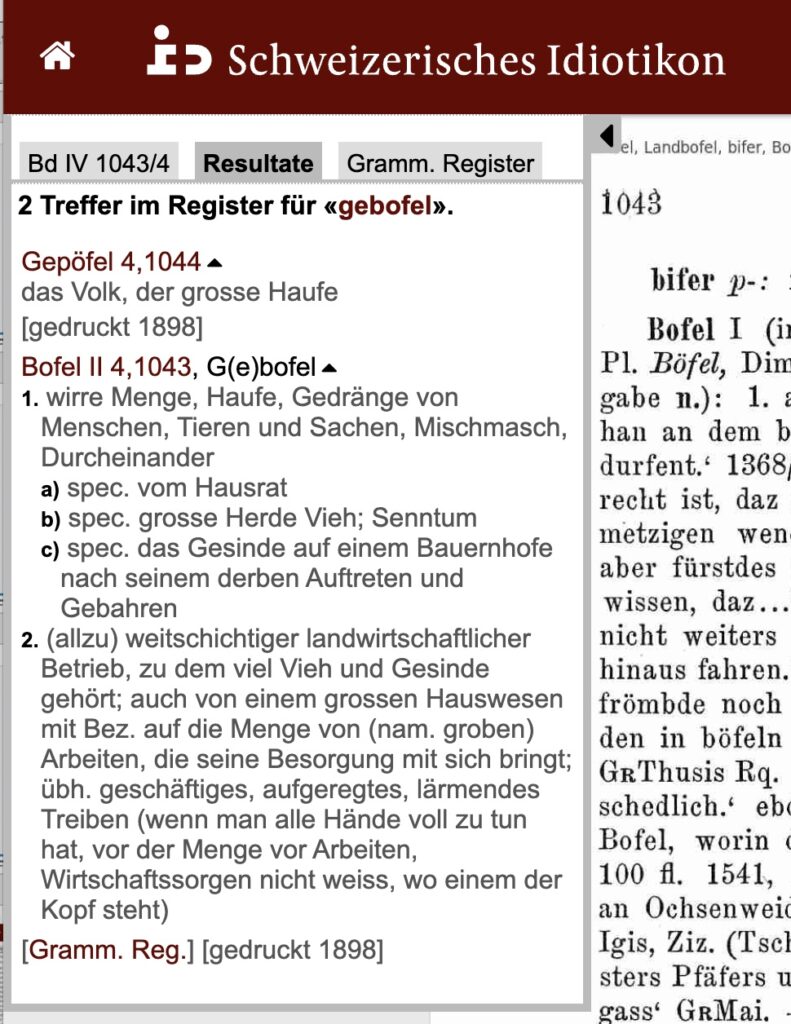
The ninth of April saw a slate of four lectures by graduate scholars Monty Powell, Luke Cooper, Jasmin Eggel, and Felix Stürz. Each prepared a 30–40-minute presentation and fielded questions for the remainder of the given hour. Lively discussions ensued, on the voice of God, on magical poets, on video games, and on many further interesting topics, that are too many to elaborate here (,der zu vil zu schreiben wer’). A surprise lecture was given by Cornelia Herberichs on the etymology of the word GBOFFL, which proved not just to be an acronym, but a Swiss German description of a spirited (if labour-intensive) gathering.
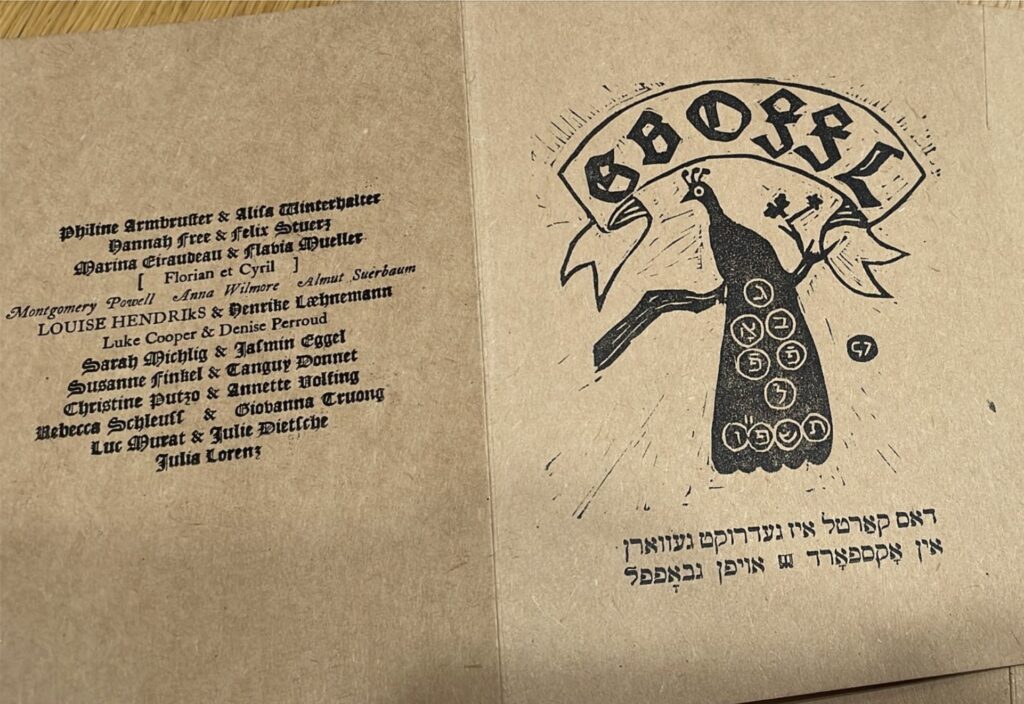
After lunch, doctoral student Giovanna Truong (that’s me) led a workshop on letterpress printing (and early Yiddish typography) in which the GBOFFL participants learned to set their own names in lead type. With the expertise of Richard Lawrence, the Bodleian Bibliographical Press’s master printer, the students and faculty were able to print the list of names on a card alongside a linocut image of a peacock under a GBOFFL banner (designed and produced by yours truly with materials and assistance from Henrike Lähnemann). Some participants also printed t-shirts bearing the unofficial logo.
The card lists the names of workshop participants and bears a description in Yiddish: “דאָס קאַרטל איז געדרוקט געװאָרן אין אָקספֿאָרד אויפֿן גבאָפֿפֿל” — “This card was printed in Oxford at the GBOFFL.”
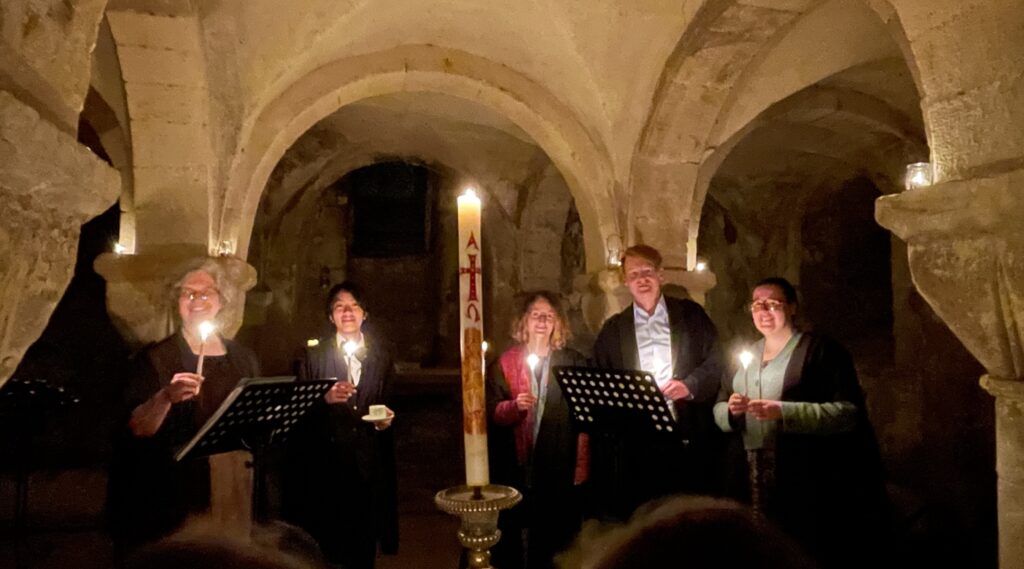
The day ended with a candlelit vegetarian dinner in the St Edmund Hall Old Dining Hall, where joyous chatter could be heard until twilight. Some of the merry group migrated to the Hall’s Crypt, where gowned Oxford scholars sang Compline in Latin and Middle High German around an Easter candle. The evening ended after sundown with the sung prayers of Havdalah, marking the end of the Jewish Passover holiday.
GBOFFL Schola in the Norman crypt of St-Peter-in-the-East, the library church of St Edmund Hall
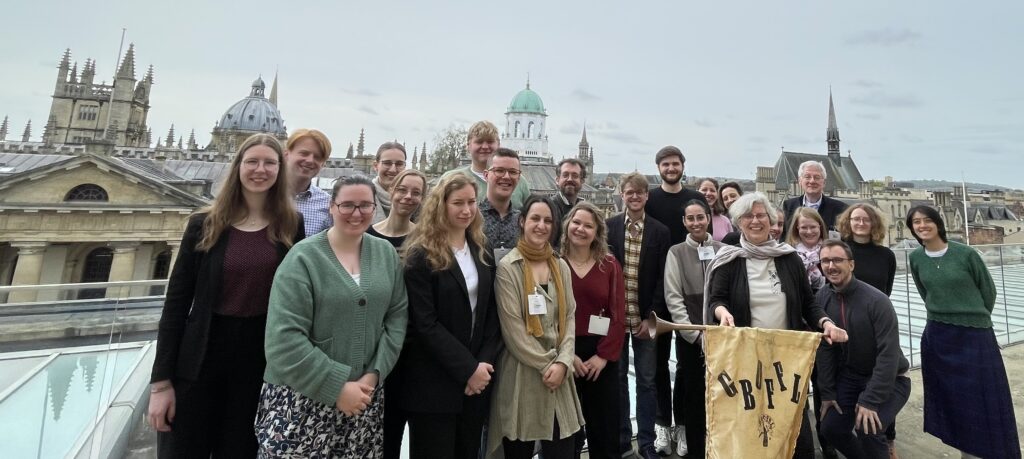
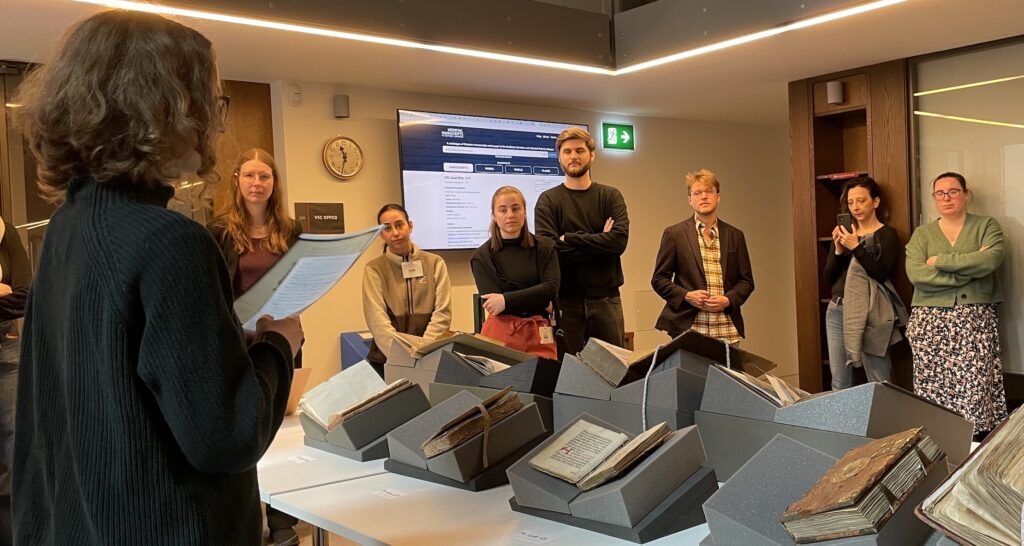
The GBOFFLers returned the next day to Teddy’s Doctorow Hall for an enlivening of the senses — an early lecture by Susanne Finkel on visual poetics in Partonopier and Meliur works. The schedule called for a trip to the Weston Library for the weekly Coffee Morning, this week led by Philine Armbruster, Lucian Shepherd, and Henrike Lähnemann on the topic of manuscript fragments (and, as usual, including a few minutes for gazing at the dreaming spires from the roof terrace).
Douce 212 Die vierundczweinczig Altē. od’ d’ guldin tron, GW M28503Augsburg: Anton Sorg, 10.III.1480. 2° Letter by Wieland Schmidt, Die vierundzwanzig alten Ottos von Passau, Palaestra, 212 (Leipzig, 1938), 231-2 no. 1; See VL VII 229-34. Augsburg: Anton Sorg, 10 Mar. 1480. Folio. Wanting gathering [*] containing the register, sheet [05.6], and gathering [x]
Boec des gulden throēs of der xxiiij. ouden 1484[X.25] | herlem [J. Bellaert] | (fol.) Auct. 6 Q 5.23 GW M28517 Provenance: Haarlem, Netherlands, Franciscan Tertiary Nuns, S. Anna; inscription on r9r: Dit boec hoert toe den susteren van sinte Marien conuent binnen Haerlem in sinte Jans straet ende heeft ghege[n]en pieternel dirck der Ende marijtgen maertens der onse susteren tot een testement’. Purchased from Asher & Co. for £2.15.0; see Library Bills (1851-5), 77; Books Purchased (1853), 65. O-036 in Bod-Inc
Die vier und zweintzig Alten. Auffs new gebessert. Vet. D1 c.426, Dillingen: Sebald Meier 1568
Fragments which were previously bound with the Der Heiligen Leben fragments
MS. Eng. hist. c. 36: summary catalogue, p. 865: was part of a series of unreferenced fragments &c. arranged as Palæographical Specimens, which was broken up in 1895. Now MS. Eng. hist. c. 36. 1) a cardinal’s hat sent to Woolsey by the pope 15 Nov 1515, backed by the Bodleian (?) conservations; this presumably refers to the Cardinal’s hat still held at Christ Church https://www.chch.ox.ac.uk/news/cardinal-wolseys-hat-ipswich 2) etc. mainly early modern letters, some 19th cent 75, 76) list with specimen announcing and recouncing German-Turkish war
Rebecca Schleuß / Henrike Lähnemann: Regelhandschriften
Fun with Fragments manuscript presentationThe GBOFFL participants enjoyed exclusive views of Oxford.
The GBOFFL participants were allowed to stay for an extra hour-long manuscript workshop session with the aforementioned presenters plus Rebecca Schleuss, who showed off manuscripts of nuns’ regulations.
Rebecca Schleuß presenting manuscripts with monastic rules
After a lunch out on the town, the digestively sated but intellectually ravenous scholars rounded out the programme with two lectures, by Julie Dietsche and Hannah Free, which drew connections between printed works and manuscripts, and truth, fiction, and fanfiction, respectively. Their energetic presentations were the exclamation point at the end of a packed couple of days.
The group parted under sunny skies, promising to carry the warm, convivial, erudite spirit of the conference to next year’s gathering in Freiburg, Switzerland. Until then — zayt gezunt (be well)!
A presentation by Dr Alan Coates, Assistant Librarian, Rare Books, Dept. of Special Collections and Subject Librarian, Bibliography & History of the Book on the occasion of the Memorial Colloquium for Nigel Palmer and as part of the Weston Library Medievalists Coffee Mornings. This builds on the work the late Nigel F. Palmer did with the Incunable Catalogue of the Bodleian Library, available as Bod-Inc. He contributed the text of descriptions for the section on blockbooks and wood- and metalcut prints. All digitised incunabula and blockbooks are available on digital.bodleian.
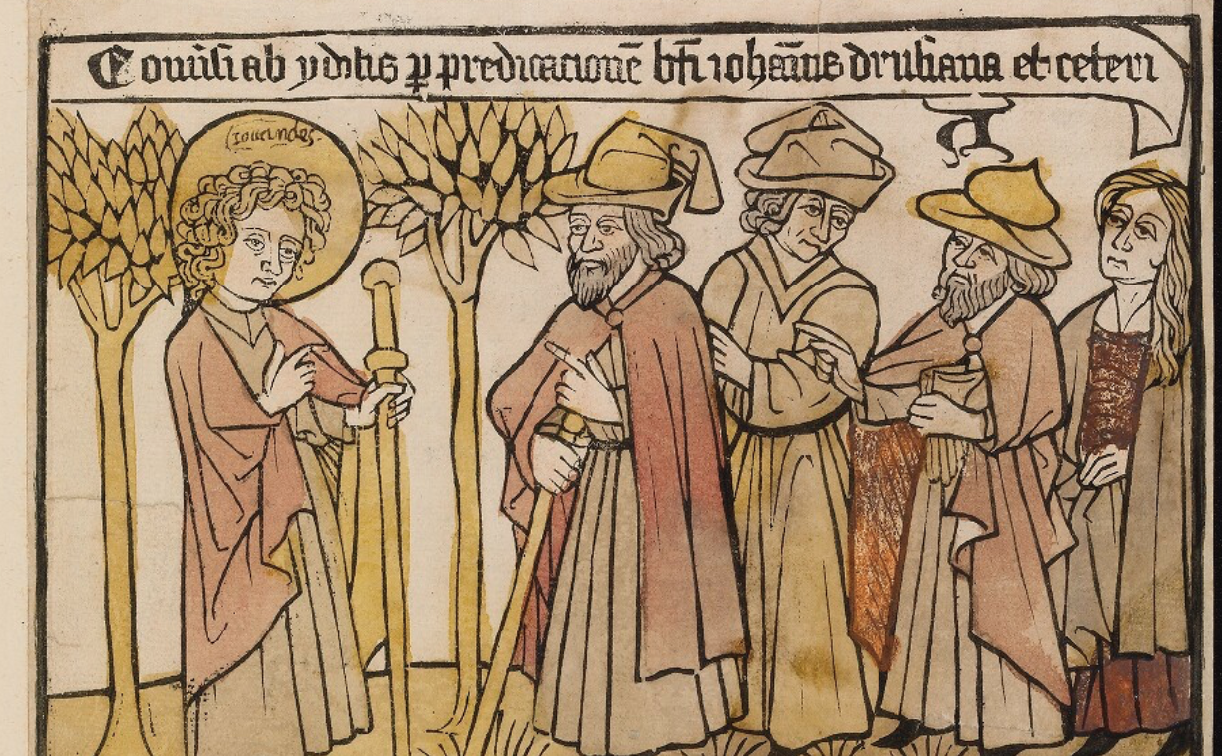
Death and the Last Judgement ([England (Syon Abbey?), c.1499]) Woodcut, with Latin typographic text Shelfmark: MS. Rawlinson D. 403, fol. 3v [= Bod-inc. XYL-19]
St George; St Maurelius ([Italy (Ferrara), c.1520]) Woodcut book cover with Italian inscriptions Shelfmark: Broxb. 30.13 [= Bod-inc. XYL-23]
Büchlein von den peinen (Strasbourg: Bartholomaeus Kistler, 1506) Shelfmark: Douce L 189
Büchlein von den peinen (Strasbourg: Bartholomaeus Kistler, 1506) Shelfmark: Vet. E1 e.217
In 1524, the Augsburg organist Bernhart Rem started writing the part books Österreichische Nationalbibliothek Ms. 18 810 from which the songs for the concert are taken. The pre-concert talk will explore the writing and music-making of late medieval Germany. The early 16th-century soundscape was varied and colourful, ranging from street cries, via religious songs in processions and meetings of the Meistersinger, to instrumental music performed by “town waits”, groups of instrumentalists playing for festive occasions. The songs of Ms. 18 810 retain features of this exclusive aristocratic song culture. They might look like pop music with run-of-the-mill lyrics but in fact these are cutting-edge text-musical combinations. Singing about love’s woes and (occasionally) joys, and of how the poet, assuming the persona of a male lover, constantly runs into and (occasionally) overcomes the obstacles society throws in his way, is as noble a pastime as falconry or commissioning costly manuscripts.
On 7 March 2023 (Tuesday of week 8 of Hilary Term for the Oxonians), music editor and viol player David Hatcher, Professor of German Literature & Linguistics Henrike Lähnemann, and singer James Gilchrist met in the Holywell Music Room to discuss the songs of this manuscripts, taking in music, literature and culture in early 16th century Germany.
Pre-Concert Talk recording by Dr Natascha Domeisen for Oxford Medieval Studies
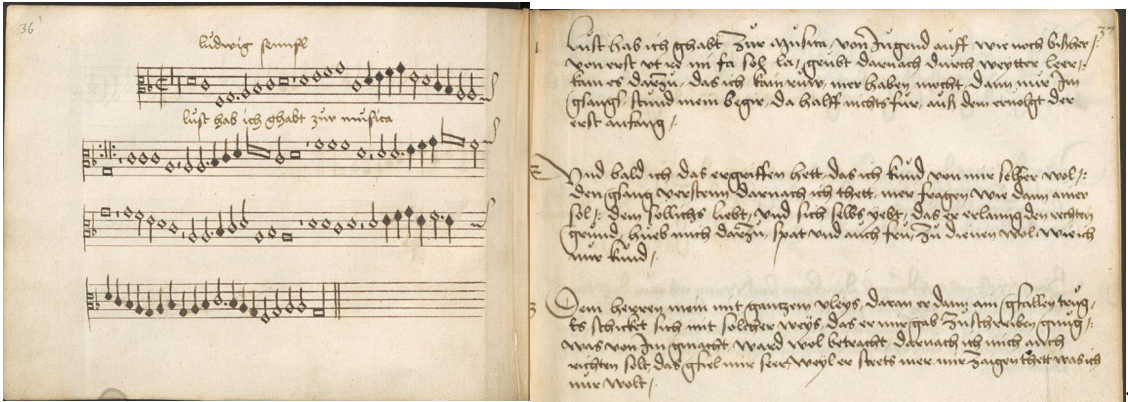
The authors were members of the same courtly circles or, in cases such as Ludwig Senfl’s autobiographical song ‘Lust hab ich ghabt’, even writing texts themselves as singer-songwriters of the period. In line with the poetic habits of the period, they pay more attention to stanza form than to originality of content. Maximilian’s court was an international meeting point: not only would all forms of German dialects have been spoken, but Latin, French, and even English as well; Ludwig Senfl’s teacher Heinrich Isaac was Dutch.
The pre-concert talk also mentioned the autobiographical song Lust hab ich gehabt zur musica, a song in praise of music education which spells in the verse initials the name of its author and composer, LUDWIG SENNFL, and charts his musical training.
Henrike Lähnemann writes: It is appropriate that with James Gilchrist this repertoire is interpreted by a non-native speaker. Coming to the repertoire not from within the system gives performers the advantage over a German singer to be aware of temporal and regional varieties of the language of song. I was delighted when James contacted me via Claire Horáček – alumna of my own College St Edmund Hall – to check out historical pronunciation. It was exciting to go through this repertoire which can only be grasped when spoken out aloud; this is not a text for silent reading!
Concert in the Hollywell Music Room with the Linarol Consort of viols and James Gilchrist (tenor)
What: Literary, religious and manuscript cultures of the German-speaking lands: a symposium in memory of Nigel F. Palmer (1946-2022)
When: 19/20 May 2023
Where: Oxford, Bodleian Library, Taylor Institution Library, St Edmund Hall
To celebrate the life and scholarship of Nigel F. Palmer, Professor of German Medieval Literary and Linguistic Studies at the University of Oxford, we invite expressions of interest from those who wish to honour his memory with an academic contribution to speak at a symposium in Oxford that is to take place 19-20 May 2023. Presentations of twenty minutes’ length are sought. They should speak to an aspect of the wide spectrum of Nigel’s intellectual interests, which ranged extensively within the broad scope of the literary and religious history of the German- and Dutch-speaking lands, treating Latin alongside the vernaculars, the early printed book alongside the manuscript, and the court and the city alongside the monastery and the convent. His primary intellectual contributions were methodological rather than theoretical, and he brought together a study of the book as a material object with the philological and linguistic discipline of the Germanophone academic tradition.
The first session planned for the afternoon of Friday 19 May will take place consequently in the Weston Library, and will consider the manuscript cultures of the German-speaking lands; presentations may take a workshop format, and may – though need not – focus upon one or more manuscripts in the Bodleian collections. The second and third sessions will take place on Saturday 20 May in the Taylorian Library, and will consider the religious and literary history of the German-speaking lands in relation to the questions, issues and working methods central to Nigel’s published scholarship.
We would request expressions of interest, of not more than one full page, to be received by 11 November 2022, to be sent to Stephen Mossman. We ask in advance for the understanding of all who submit that we anticipate receiving many more expressions of interest than we can accommodate within the schedule. A reception will be held at St Edmund Hall on the Saturday afternoon, to which all are cordially invited and welcome, followed by a dinner in College. Those planning to attend are advised to reserve accommodation in good time, e.g. via universityrooms. We hope to secure funding to support early career researchers in attending the symposium, but anticipate that participants will need to cover their travel and accommodation expenses. Details of the symposium and registration will be available through the Faculty of Medieval and Modern Languages web-site in early 2023.
For the organising committee: Racha Kirakosian, Henrike Lähnemann, Stephen Mossman, Almut Suerbaum
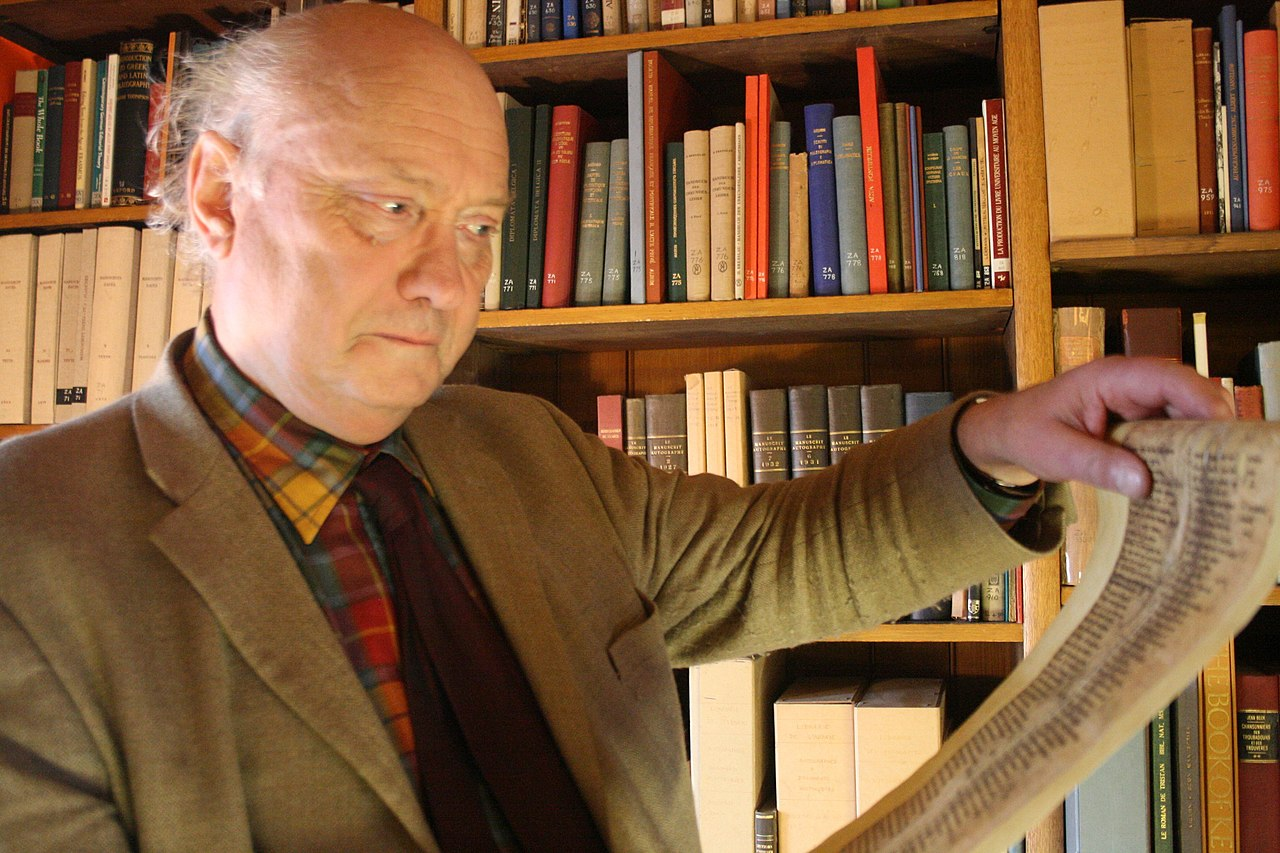
Image: Nigel F. Palmer studying the facsimile of the Osterspiel von Muri on the gallery of the Taylor Institution Library. Photograph by Henrike Lähnemann