Feminaminals

Call for papers Representations of Women and/as Animals in Literature, Arts, and Other Media

University of Oxford, Oriel College, 14-16 April 2027
Keynote speakers: Prof Chloë Taylor (University of Alberta) and Dr Kaori Nagai (University of Kent)
Roundtable with Queer Kinship Network led by Prof Charlotte Ross (University of Oxford)
Organising committee: Dr Fanny Clemente (University of Oxford), Dr Greta Colombani (independent scholar), Dr Cécile Bishop (University of Oxford)

FEMINANIMALS is a three-day international conference investigating representations of women as non-human animals and of the relationship between women and non-human animals in literature, arts, and other media across languages, from medieval to contemporary times. The last decades have witnessed an explosion of theoretical discourses directed towards a critique of humanism and a re-evaluation of humans’ interactions with the non-human world and wider ecosystem. Since the 1970s such a focus has found a privileged expression in ecofeminist theories, which have started to interrogate and deconstruct the history-long, negatively connoted association of women with non-human animals and to denounce the fundamental links between the oppression of women and that of non- human nature simultaneously perpetrated by the patriarchal system. From the ecofeminist manifestos of the 1990s (Gaard 1993, Gruen 1993, Plumwood 1993, Adams and Donovan 1995), the field of inquiry examing the deleterious intersections of anthropocentric and androcentric attitudes has been prolifically expanded and enriched by a notable array of theoretical standpoints adopting diverse disciplinary perspectives and an increasingly intersectional approach, that is, bringing to the fore of the analysis other categories of oppression that ought to be necessarily considered alongside gender and species, such as race, sexuality, class, physical abilities. Recent contributions to the field include Alaimo and Hekman 2008, Decka 2012, Adams and Gruen 2014, Gaard 2017, Vakoch and Mickey 2017, Braidotti 2022, and Taylor 2024. Theoretical discourses on the intersected nature of different systems of oppressions have been productively applied to the study of literature and other arts. Some of the above-mentioned works already include references to or analysis of literary and artistic sources (Taylor 2024); other contributions directly postulate, for instance, the benefits of intertwining ecofeminism and literary criticism (Gaard and Murphy 1998, Vakoch and Mickey 2019, and Vakoch 2023). Increasingly moving away from a privileged Anglo-American-centred perspective, moreover, scholarship is embracing more comprehensive assessments of literary and artistic portrays of nature, non-human animals, and humans’ relationship with them. Following in the footsteps of such recent contributions, dialoguing with different theoretical approaches and exploring different media, FEMINANIMALS seeks to enrich and foster ongoing discussions around the connections and intersections between our changing constructions of womanhood and animality by looking at representations of women as non-human animals and of the relationship between women and non-human animals, from medieval to contemporary times, assessing the significance and implications of those representations against the backdrop of diverse historical and cultural contexts. Across time and space, literature, arts, and other media have been pervaded by portrayals of women as/and animals, from the moralistic, religiously informed intertwining of gender and species in medieval bestiaries, exempla such as the cuento XXXV “La mujer brava” in Don Juan Manuel’s El Conde Lucanor or works like Boccaccio’s Il Corbaccio (ca. 1365) describing women as an “animale imperfetto” to the countless retellings and translations of the legend of the half-human half-snake Melusine in widely circulating texts like Jean d’Arras’s Mélusine (ca. 1393) and its adaptations in the following centuries, from the woman-animal erotic unions and shapeshifting in the late seventeenth- and early eighteenth-century supernatural tales Liaozhai zhiyi by Pu Songling to the numerous poems dedicated to wild, exploited, or domesticated animals by Romantic and Victorian women authors such as Anna Letitita Barbauld’s “A Mouse’s Petition” (1773) and Elizabeth Barrett Browning’s “To Flush, My Dog” (1843), from Odette’s transformation into a swan in Pyotr Ilyich Tchaikovsky’s ballet Swan Lake (1877) to visual depictions of woman-animal entanglements like Oskar Kokoschka’s painting Mädchenakt auf galoppierendem Schimmel in Weiherlandschaft (1905) and the surrealist works of Leonora Carrington who herself identified as a “female human animal”. The manifold associations between women and non-human animals continue to be prominent in recent times, enriched by new media and perspectives, with meaningful examples including Clarice Lispector’s novel A paixão segundo G.H (1964) centring on the unsettling encounter of the female protagonist with a cockroach, Marie Darrieussecq’s satirical tale of a woman’s metamorphosis into a female pig in Truismes (1996), the Africanfuturist speculative fiction of Nnedi Okorafor who endows the heroine of Who Fears Death (2010) with the magical ability to turn into a vulture and dedicated her novella Binti (2015) to a jellyfish, and the central place that the porous borders between women and animals occupy in Athina Rachel Tsangari’s cinema, particularly in Attenberg (2010) and her short film The Capsule (2012). What can these pervasive representations of women as/and animals in different cultures and historical periods tell us about the complexities and intersections of shifting notions of gender and species, the fraught line between humanity and animality, and the entwined practices of domination and othering to which women and animals have been subjected? How can we look at such a variety of literary and artistic sources with the benefit of decades of theoretical perspectives that have tackled the historical, philosophical, social, cultural, and political implications of the multifaceted association of women and non-human animals? In what crucial ways can an interdisciplinary, comparative, and temporally wide approach help us think about and rethink this fundamental pairing today, as we continue to navigate, experience, suffer, and/or reclaim it against the backdrop of a dramatic environmental crisis, a deterioration of our relationship with nature and other living creatures, and a new rising tide of sexism that is infiltrating the virtual and real-life world? The conference aims to foster new conversations around these questions by inviting scholars to examine representations of women as/and animals across languages and cultures, from medieval times to the present day. We encourage proposals considering works belonging to different media and genres, focusing on canonical as well as non-canonical authors and artists, and dialoguing with diverse theoretical and methodological approaches, such as human-animal studies, posthumanist studies, new materialism studies, ecofeminist studies, animal studies, critical animal studies, animality studies, gender studies, critical race and postcolonial studies, queer studies, psychoanalytic and post-structural studies, affect theory, and other relevant fields of inquiry.

Papers may explore topics including, but not limited to:

  • women-animals metamorphoses
  • women-animals hybrids
  • women, animals, and the body
  • women, animals, and sexuality
  • women, animals, and gender
  • women, animals, and race
  • women, animals, and class
  • women, animals, and motherhood
  • metaphors of women as animals
  • women, animals, and language
  • kinship between women and animals
  • women, animals, and ethics and aesthetics of care
  • women, animals, and the environmental crisis
  • women, animals, and science
  • women, animals, and spirituality
  • women, animals, and folklore
  • women writers/artists and animals
  • trans women and animals
  • women, animals, and the male gaze

The conference is part of a wider project including a cultural programme of public events that will take place at the Schwarzman Centre for the Humanities in April 2027 and will consist in:

  • a writers roundtable with authors Naomi Booth, Chịkọdịlị Emelụmadụ, Helen Jukes, and Helen Macdonald;
  • a screening of H is for Hawk (2025) preceded by conversation with director Philippa Lowthorpe.

More information on the cultural programme, confirmed dates, and how to register will follow. All conference participants are very welcome to extend their stay in Oxford to attend the events. Please note that the conference will take place in person in Oxford with no possibility for hybrid participation. There will be no conference fee. All presentations should be in English and last no longer than 20 minutes. Proposals, including title, abstract (250 words max), and short bio (150 words max), must be submitted via email in a single Word document to Dr Fanny Clemente and Dr Greta Colombani by 15 July 2026. Notification of acceptance will be sent by 30 July 2026. Please feel free to contact the organisers Dr Fanny Clemente and Dr Greta Colombani at any point for inquiries and further information. 

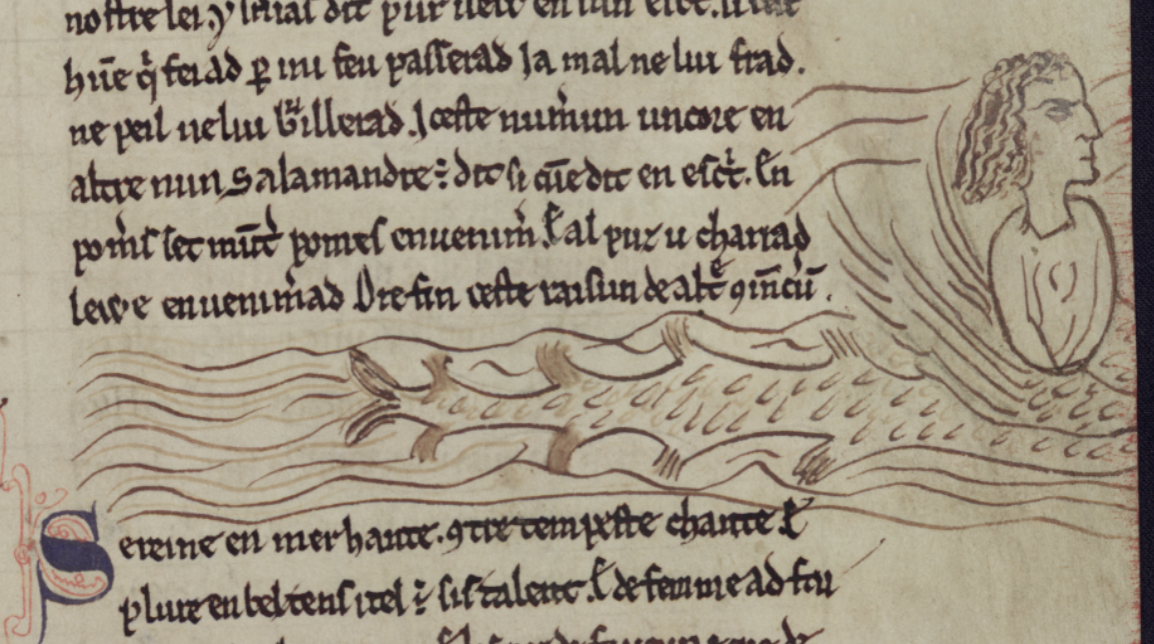
Image: The siren from the Merton Bestiary https://editions.mml.ox.ac.uk/editions/bestiary/#Serena
Medieval Women’s Writing Group

Talk: Breaking Walls, A Graphic Novel: Reflections on Public History. Medieval Women’s Writing Research Seminar

Friday 28 February 2025, 5pm -7pm

Lower Lecture Room, Lincoln College, Turl St, Oxford OX1 3DR

Medieval Women’s Writing Research Seminar Hilary Term 2025

Lower Lecture Room, Lincoln College

Week 6: Friday, 28 February 2025, 5pm

Speaker: Dr Carolin Gluchowski (University of Hamburg) 

All welcome

The Medieval Women’s Writing Research Group meets to discuss everything to do with women’s writing in the medieval period. We hold a variety of events throughout the term. All welcome! 

 Week 1,  Saturday 25th January   Medieval Women’s Writing Research Group Trip to the British Library’s exhibition “Medieval Women” (London) – The registration period for subsidised tickets has passed but if anyone wants to purchase their own tickets for the same time slot and join our group, please get in contact with Kat Smith: katherine.smith@lincoln.ox.ac.uk  
 Week 3, Wednesday, 5th February    Special Event: Medieval recipe books at the Oxford Bodleian Libraries. A collaboration between Critical Food Studies Network, Medieval Women’s Writing Research Group and the Bodleian Academic Engagement – Horton Room, Weston Library  
 Week 6, Friday, 28th February   Medieval Women’s Writing Research Seminar: Dr. Carolin Gluchowski (University of Hamburg) – Breaking Walls, A Graphic Novel: Reflections on Public History (provisional title) – Time & place tbc  
 Week 7, Friday, 7th March   Medieval Women’s Writing Research Seminar: Ved Prahba Shama (Independent Researcher) – Medieval Indian Women’s Writing (provisional topic) – Online 12.30pm (GMT), registration details tbc  

Please see the individual dates for time and place of the session. 

Stay up to date with events by joining our mailing list or following us on X @MedievalWomenOx

Convenors: Katherine Smith, Marlene Schilling and Santhia Velasco Kittlaus. 

Funded by the “TORCH Critical-Thinking Communities” fund. 

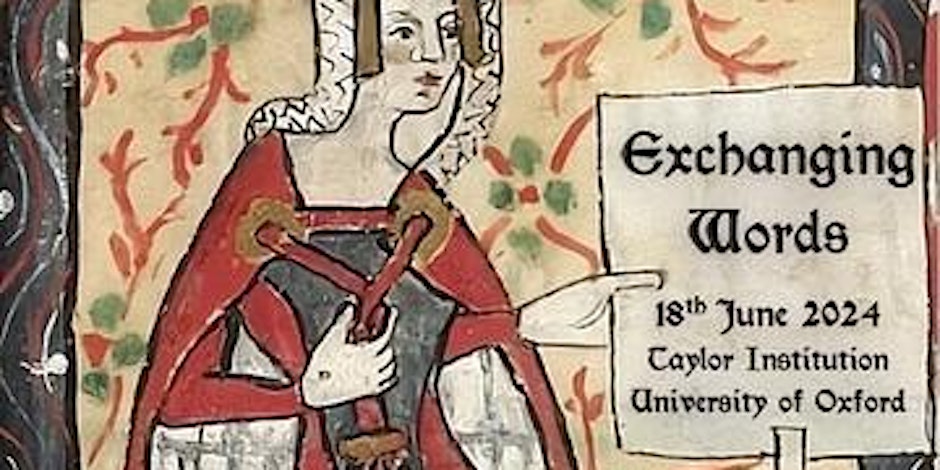
Medieval Women’s Writing Research Group Conference 2024: Exchanging Words

The Medieval Women’s Writing Research Group Conference 2024 will be held on 18th June 2024 with the theme of “Exchanging Words” in Room 2 of the Taylor Institution Library both in person (presenters/attendees) and online (attendees).

Tuesday 18 June 2024, 9am – 5pm
Online and In-person, Room 2, Taylor Institution Library, Saint Giles’, Oxford OX1 3NA
Free but registration required
Register here for in-person attendance – Sold out
Register here to join the conference online
Online registration closes 15 minutes before the start of the event. You will be sent the joining link within 48 hours of the event, on the day and once again 10 minutes before the event starts.

The aim of this conference is to explore the concept of exchange, whether it be textual or material, to, for and between women in the global Middle Ages. As a research group based upon the concept of exchanging ideas, we wish to explore medieval women’s own networks of exchange and transmission, and the influence of this upon both the literature and culture of the period as well as the present day.

We are delighted to present the programme for the day:

9:00-9:30 Registration 
9:30-9:45 Welcome and Opening Remarks 
9:45-11:15 Session 1 “Scholarly Networks” 
Katrin Janz-Wenig (SUB Hamburg) & Lenka Panušková (The Czech Academy of Sciences) | Communication Strategies Through Change: Translations, Compilations and Ekphrasis 
Ved Prabha Sharma (Independent Researcher) | Women Scholars and Knowledge Exchange in Medieval Indian shāstrārth Tradition 
Tatiana Barkovskiy (University of Cambridge) | A Beguinian Learning Network, or How to Approach ‘Medieval Women Mystics’ as Philosophers  
11:15-11:45 Break with Refreshments 
11:45-13:15 Session 2 “Relationships With and Between Women” 
Costas Gavriel (University of Oxford) | Gaining the Queen’s Confidence: The Relationship Between Leonor López de Córdoba and Catherine of Lancaster, Queen of Castile 
Lucia Akard (University of Oxford) | Talking About Rape and Exchanging Knowledge in Medieval Dijon 
Meg Greenough (Independent Researcher) | The Wilton Matrix: Mothering in Goscelin of Saint Betin’s Liber Confortatorius
13:15-14:30 Lunch Break 
Exploring the Taylorian’s Treasures, with Professor Henrike Lähnemann (University of Oxford) 
14:30-15:45 Keynote Address 
Professor Diane Watt (University of Surrey) | Medieval Women Writers: Troubling a Feminist History of British Women’s Writing
15:45-16:15 Break with Refreshments 
16:15-17:45 Session 3 “Nuns’ Words” 
Francesca Maria Villani (University of Bari) | Eloise’s Psalmody: Body and Voice Through the Epistles
Jane Bliss (Independent Researcher) | The Nun Changes her Library Book 
Hilary Pearson (Independent Researcher) | Teresa de Cartagena’s Models of Female Authority 
17:45 Closing Remarks 
18:00 End of Conference

Please direct any questions to any of the conference organizers: 
Katherine Smith (katherine.smith@mod-langs.ox.ac.uk
Marlene Schilling (marlene.schilling@mod-langs.ox.ac.uk
Carolin Gluchowski (carolin.gluchowski@mod-langs.ox.ac.uk
Santhia Velasco Kittlaus (santhia.velascokittlaus@mod-langs.ox.ac.uk)

The research group and the conference are generously funded by The Oxford Research Centre in the Humanities (TORCH) and their “Critical-Thinking Communities” Initiative.

Remembering Medieval Memory Experts

The end of the year and the start of a new one traditionally are opportunities for remembering the time that has passed. For medieval holy women, too, memory mattered. In fact, medieval holy women were experts in remembering the year round, being trained in memoria, the art of memory. In particular, their minds were saturated with sensory memories of the liturgy: the sights, sounds, smells, movements and other sensations of the Divine Office and the Mass, which they shared with their communities, crowded their minds. My MSCA-IF project “Women Making Memories: Liturgy and the Remembering Female Body in Medieval Holy Women’s Texts”, hosted by the Faculty of Medieval and Modern Languages, investigated how texts by medieval women appropriate the memoria taught by the liturgy, and scrutinized the significance of the body, senses, and gender play in these transformations. (This project has received funding from the European Union’s Horizon 2020 research and innovation programme under the Marie Skłodowska-Curie grant agreement No 842443.)

“Historiated initial of a nun”. Detail from London, British Library, Sloane 2468, fol. 227v. England, c. 1420.

Begun in September 2019 and concluded on 31 December 2022, this project was the first academic project to juxtapose female-authored texts in different north-western European vernaculars. It compared six vernacular (auto)biographies and visionary texts in Middle Dutch, Middle English, and Middle High and Low German. They date from 1300 to 1500 and originate from the European regions now known as the Netherlands (the Diepenveen sister-book, in Middle Dutch), Belgium (Jacomijne Costers’ and Mechtild van Rieviren’s visions, referred to in this study as the Facons revelations), Germany (the Medingen prayerbook), Switzerland (the Sister-book of St Katharinental), and the United Kingdom (Julian of Norwich’ A Revelation of Love, and The Book of Margery Kempe). Medieval culture saw memory predominantly as a generative faculty designed to fashion new discourses and identities, akin to modern imagination. This blogpost therefore summarizes what medieval women want us to remember, linking to the project publications that detail these findings.

In direct response to the pandemic, my project shifted towards examining how medieval women negotiated trauma by means of the liturgy, and we will therefore see that medieval women deployed memory to envision different (post-pandemic) futures.

The Middle Dutch sister-Book under discussion, compiled by Griet Essinghes. Deventer, Deventer Library, MS 101 E 26 KL, fol. 111v-112r. The Low Countries, 1524.

In this liturgical memoria, placing memories somewhere liturgical was key. Their texts were informed by the physical places in which medieval holy women remembered and the mental “places” (loci, particular locations in their “memory palaces”) with which they remembered. In texts by and for anchorites, individuals living confined to little rooms attached to parish churches, the anchoritic cell provides a powerful interpretative structure for memories of particular sins and physical and mental health complaints associated with anchoritism. In some texts, the cell as physical space and as locus predisposes the anchorite and reader towards penitential practices to both combat these sins and increase these complaints, making this feedback loop reinforce itself more. In A Revelation of Love, however, the cell reframes these memories, transfiguring them into reminders of spiritual homesickness for a space beyond the cell rather than of essential sinfulness contained by the cell.

A reconstruction of Julian of Norwich’s cell at St Julian’s in Norwich. Photo: Godelinde Gertrude Perk

Painful memories can haunt individuals and communities, as medieval holy women were well aware. The Facons revelations and the Diepenveen sister-book both recount the tragic losses to these religious communities during the Bubonic plague, even weaponizing the painful sensory impressions of this pandemic to exhort the nuns to pray for the continued survival of the community. (A similar strategy animates the St Katharinental’s attempts to remember the souls of the departed more generally.) In chronicling medieval bodily suffering, however, these texts composed by women also bear witness to the corporate trauma of these female communities and tentatively gesture to potential avenues towards integrating these memories into new ones of communal worship. Texts from medieval female religious communities thus anxiously harmonize the shriek of trauma into a single communal voice, singing.

“Geertruy Haeck Kneeling in Prayer before Saint Agnes”, c. 1465, Low Countries, https://www.rijksmuseum.nl/en/collection/SK-A-3926.

Finally, these women’s memoria point to shared texts and shared embodied experiences weaving shared memories, even when the persons remembering are separated in time and/or space. The project’s nuns from the German-speaking lands and the Low Countries lived a century apart, while the Channel divided Julian of Norwich and Margery Kempe from their Continental peers. Nevertheless, all of these holy women contemplated the mnemonic image of Christ’s suffering body as indelibly engraved upon their minds by the liturgy of Holy Week and spun new memories out of this common memory. Many of them, too, drew on the attitude (intentiones) of joy that pervaded Easter chants or lessons in which Sapientia, a female personification of God’s wisdom, rejoices in dwelling among humanity to celebrate the charity between their fellow religious or between human beings. Memory translates the liturgy into love.

In sum, this project has shown that the medieval art of memory helped (re)build communities and fostered compassion. Ultimately, “Women Making Memories” has not only demonstrated medieval women’s essential contributions to Europe’s literary and spiritual legacy, but also their boundless resilience, which can inspire beyond linguistic, religious, and national boundaries.

This article results from “Women Making Memories: Liturgy and the Remembering Female Body in Medieval Holy Women’s Texts,” Godelinde Gertrude Perk’s MSCA-IF project at the Faculty of Medieval and Modern Languages at the University of Oxford. This project received funding from the European Union’s Horizon 2020 research and innovation programme under the Marie Sklodowska-Curie grant agreement No 842443.

Liturgy and the Female Body

Introducing the MSCA-IF project “Women Making Memories: Liturgy and the Remembering Female Body in Medieval Holy Women’s Texts”.

19 September 2019 Godelinde Perk

“Weren’t intelligent women in the Middle Ages seen as witches?” one of my theology undergrads once asked “Could they even read and write?”. These questions illustrate how many still think of the Middle Ages as “the Dark Ages” (an epithet long rejected by scholars), a time in which women lacked opportunities for education, reflection, and agency. Numerous texts by medieval women writers testify to reality being far more complex. What is more, many of these texts are religious in character: often, the earliest known text by a woman writer in the vernacular is a mystical, visionary or devotional text. These works suggest that life as a nun, devout laywoman, a “semi-religious”, or lay-sister (a kind of free-lance nun), allowed women to find “a room of one’s own”, to Virginia Woolf’s phrase. My name is Godelinde Gertrude Perk, and I am a Marie Skłdowska Curie Fellow at the faculty of Medieval and Modern Languages (supervised by Professor Henrike Lhnemann) and am delighted to introduce my two-year project “Women Making Memories: Liturgy and the Remembering Female Body in Medieval Holy Women’s Texts”, which started on the first of September 2019. (This project has received funding from the European Union’s Horizon 2020 research and innovation programme under the Marie Skłodowska-Curie grant agreement No 842443.)
 

initial of nun
“Historiated initial of a nun”. Detail from London, British Library, Sloane 2468, fol. 227v. England, c. 1420.

Medieval women writers responded to and transformed the religious ideas of their times; my project investigates how they did so. Considering both well-known figures (Julian of Norwich), and lesser-known ones (the Sisters of the Modern Devout), it situates their texts in a particularly omnipresent but often understudied context, the liturgy of the Mass and the Divine Office. It should be kept in mind that devout women from medieval Europe frequently took part in the Divine Office (the monastic hours), nuns and lay-sisters, even several times a day, and strove to attend Mass as frequently as possible. They therefore knew the words, sounds, sights, and movements of the liturgy by heart: we find numerous references to these sensations and words in their texts.

senior sister
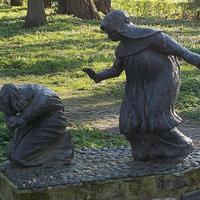
Bronze sculpture by Samuel Crommelin on the site of the Diepenveen convent, depicting a senior sister encouraging a novice. Photo: JanB46 (Wikimedia)

Using thick description and close reading, I will investigate the role of memories of the liturgy in their works, analysing these texts through the prism of memoria, the medieval art of remembering. Medieval culture saw memoria as essential for moral behaviour and literary invention; medieval devout women deployed memory arts daily when meditating. The liturgy indirectly taught an art of memory as well. Because of the many sensations and movements the liturgy entailed, this art of memory involved both body and mind. Exploring the function of memoria therefore illuminates the role of the body in these women’s writings. The project, then, will unveil what and how medieval women’s texts want us to remember.

https://www.digitaleetalages.nl/dam/moderne-devotie/zusters-van-het-gemene-leven/Zwedera%20van%20Rechteren%20in%20Zusterboek%20Diepenveen.jpg/_jcr_content/renditions/cq5dam.web.200.320.jpeg
The Middle Dutch Sister-Book under discussion, compiled by Griet Essinghes. Deventer, Deventer Library, MS 101 E 26 KL, fol. 111v-112r. The Low Countries, 1524.

The project is uniquely international and multilingual; it is the first to juxtapose female-authored texts in different north-western European vernaculars, reflecting how medieval women’s devotion was not bound by national borders. I will compare six vernacular (auto)biographies and visionary texts in Middle Dutch, Middle English, and Middle High and Low German. They date from 1300 to 1500 and originate from the European regions now known as the Netherlands (the Diepenveen Sister-book, in Middle Dutch), Belgium (Mechtild van Rieviren’s visions), Germany (the Medingen prayerbook), Switzerland (the Katarinentaler Sister-book), and The United Kingdom (Julian of Norwich’ A Revelation of Love, and The Book of Margery Kempe). At the end of the project, I will have revealed European parallels and interactions between texts and writers. Ultimately, I endeavour to amplify medieval women’s voices and illuminate their significance to Europe’s cultural and spiritual heritage. This European quality is my reason for applying to the MSCA-IF, and for it being based at the Faculty for Medieval and Modern Languages and the University of Oxford, which hosts many academics considering medieval European religious and literary culture.

st matt
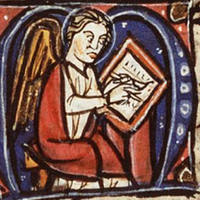
“The symbol of the Evangelist St. Matthew: the angel, writing.” Detail from a thirteenth-century French Book of Hours.  The Hague, Museum Meermanno-Westreenianum & Koninklijke Bibliotheek, MS KB 132 F 21, fol. 484v.  

I will inform the general public and academic audiences of the project findings in a variety of ways, including several TORCH outputs. I am particularly passionate about appealing to non-academic audiences and helping them discover the wisdom, humour, and the fascinating lives of medieval women: in addition to publishing several academic articles, I will write a number of popular articles (available online), give popular lectures in museums and churches, possibly direct or contribute to a play, and tweet regularly from the project twitter account (@WMM_Oxford). Open Access is central to MSCA-IF projects, and I will make all outputs as freely accessible as possible.

You may be curious to know a little more about the post-doctoral researcher performing this project. I’m originally from the Netherlands, and have a background in English Literature. While doing my PhD in northern Sweden working on a dissertation tracing the evolution of Julian of Norwich’ narrative and theological thought, I developed an interest in the parallels between Middle English and Middle Dutch texts by women; my research has since shifted to a more comparative, European focus. (The texts that particularly caught my interest were the Middle Dutch Sister-books (collections of short biographies by nuns or laysisters of the sisters in the community). Some of you may be familiar with The Book of Margery Kempe; the Sister-books are similar in how they brim with with dramatic vignettes, vivid detail, pithy sayings and local colour). I also lived in Oxford during my PhD: in 2015, I spent four months here, immersing myself in its vibrant seminar culture and unique knowledge base. It was then that I met Professor Lähnnemann, whom I have since envisaged as the ideal supervisor for this project. After my PhD, I was employed as an associate professor at another Swedish university, that of Sundsvall, and looked for postdoc opportunities in order to broaden my knowledge of medieval women’s literature from north-western Europe and become one of the leading scholars in the nascent field of pan-European literary and devotional culture. (One of the academic endeavors from that time is a play produced together with two friends, which was based on the Middle Dutch Sister-Books; I hope to organize something similar in Oxford.). This year, I was awarded the Marie Sklodowska Curie Fellowship, as well as a Fulford Junior Research Fellowship at Somerville College, home to a dynamic medievalist community.

The project and the Fellowships contribute significantly to my academic and professional development, and I could not be more grateful for this wonderful opportunity and for being given the chance to return to Oxford. However, I am equally grateful to be working with many highly knowledgeable and generous scholars and to shed light upon medieval women’s minds, ultimately making their voices better heard. 


eu

Dr Godelinde Gertrude Perk, PhD
Marie Skłodowska-Curie Fellow
Faculty of Medieval and Modern Languages
University of Oxford
 

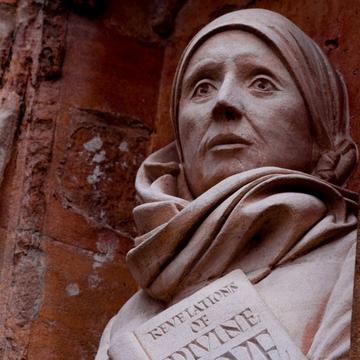
Front page image credit: “Statue of Julian of Norwich, Norwich Cathedral, by David Holgate FSDC. Photo: Rocketjohn (Wikimedia).