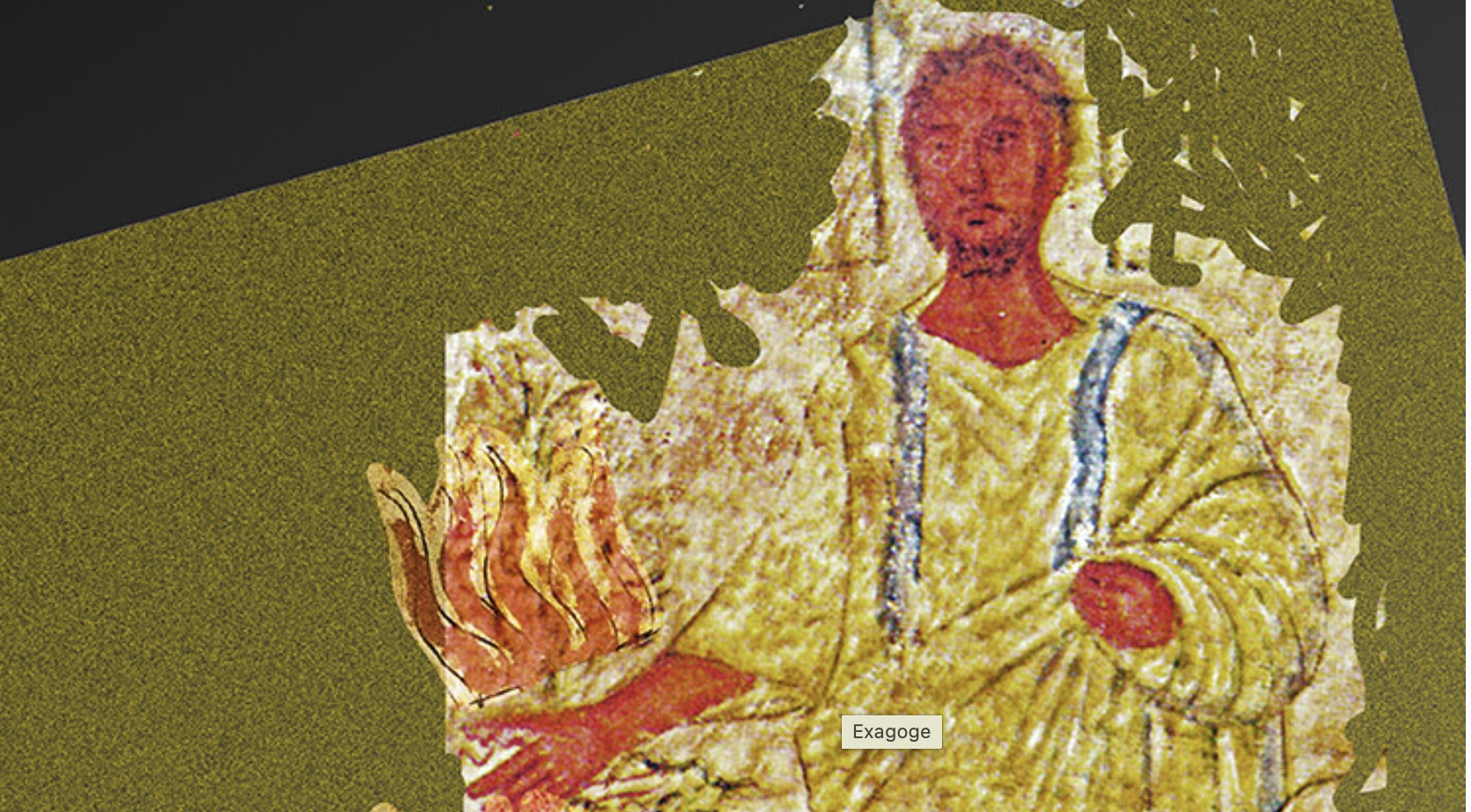
Moses. The ‘Exagoge’ of Ezekiel. ‘Moses and the Shepherd’ by Rumi
Friday, May 8, 2026 – 18:30: Ioannou Centre, 66 St Giles
Sunday, May 10 – 12.30: Iffley Church Hall
Monday, May 11 – 6pm: Wolfson College Buttery
David Wiles directs a production of the extant fragments of a tragedy written in Alexandria in the second century BC. Drawn from the Book of Exodus, the story tells of the Hebrews’ escape from Egypt. The play was written by a Jew, and is the first extant dramatization of a biblical text.
The performance is mostly given in ancient Greek, with the opening scene played in English. The project follows on from Hrosvita’s Martyrdom of the Three Virgins performed in Latin in 2025, and prior to that Seneca’s Octavia in a Renaissance translation.
The cast are a mix of students and seniors. The production style will be choral, using movement to illustrate narrative passages such as the burning bush and the crossing of the Red Sea – so fluent knowledge of ancient Greek is not required.
The first performance is in the Classics Centre in St Giles at 6.30 on Friday May 8, sponsored by the APGRD https://www.apgrd.ox.ac.uk/events. The second is in Iffley Church Hall at 12.30 on Sunday, May 10. The third is in Wolfson College Buttery at 6.00 on Monday, May 11, sponsored by the Ancient World Research Cluster. The performance should last for about 35 minutes, and we will have a brief Q&A afterwards. The APGRD and AWRC are both kindly providing wine.
EXAGOGE by Ezekiel. The Exagoge was written in Alexandria in the 2nd century BCE in the mode of a Greek tragedy, adapted from the Book of Exodus. It is the earliest dramatic adaptation of Biblical text. 269 lines were preserved by Christian commentators. We have made only a small number of cuts, but line allocations have been transposed, with the role of Moses divided between four different actors. Storyline: Pharaoh’s daughter discovers baby Moses in the Nile, and rears him. He kills an Egyptian overseer and flees to Libya, where he marries, sees a vision of the stars, and then God in a burning bush. Moses is reluctant to return. God tells him to inflict plagues on Egypt in order to secure the release of the Hebrews from bondage. After an angel of death has ‘passed over’ the houses of the Hebrews, they flee, pursued by the Egyptian army. The waters of the Red Sea open for them, then drown the Egyptians. In the final non-Biblical episode, the story is resolved by a kind of deus ex machina – perhaps a mirage, perhaps a demon, perhaps a phoenix.
- Ruthanne Brooks. Mariam, Chum (Sepphora’s sister); Moses 3.
- Leonie Erbenich. Pharaoh’s daughter; Sepphora (Moses’ wife).
- Valentina Davi. Moses’ Mother.
- Loveday (Junyu) Liu. Moses 1.
- Alex Marshall. Raguel (Sepphora’s father); Moses 4.
- Laurence Nagy. Pharaoh; God.
- Vishal Rameshbabu. Herald.
- David Wiles (standing in). Moses 2.
- All. Chorus
MOSES AND THE SHEPHERD by Rumi. Much more contemplative, Moses and the Shepherd is a story from the Manavi, a compilation of parables dictated by the Persian Sufi poet Rumi (1207-1273) over the last fifteen years of his life. We hope that the two plays speak to each other in interesting ways.
- Goatherd: Laurence Nagy
- Moses: David Wiles
- God: Alex Marshall
- Director: David Wiles
- Music: Jessica Qiao