As we prepare for the start of term, I want to encourage anyone and everyone to contribute ideas for content on the Oxford Medieval Studies social media.
We are active anywhere and everywhere — Beacons (this platform), BlueSky, Instagram, and Threads—and eagerly awaiting your suggestions.
If you want an event, workshop, or seminar advertised, please let me know and I will spread the word!
If (when!) something exciting happens in your research, we can raise awareness about that too!
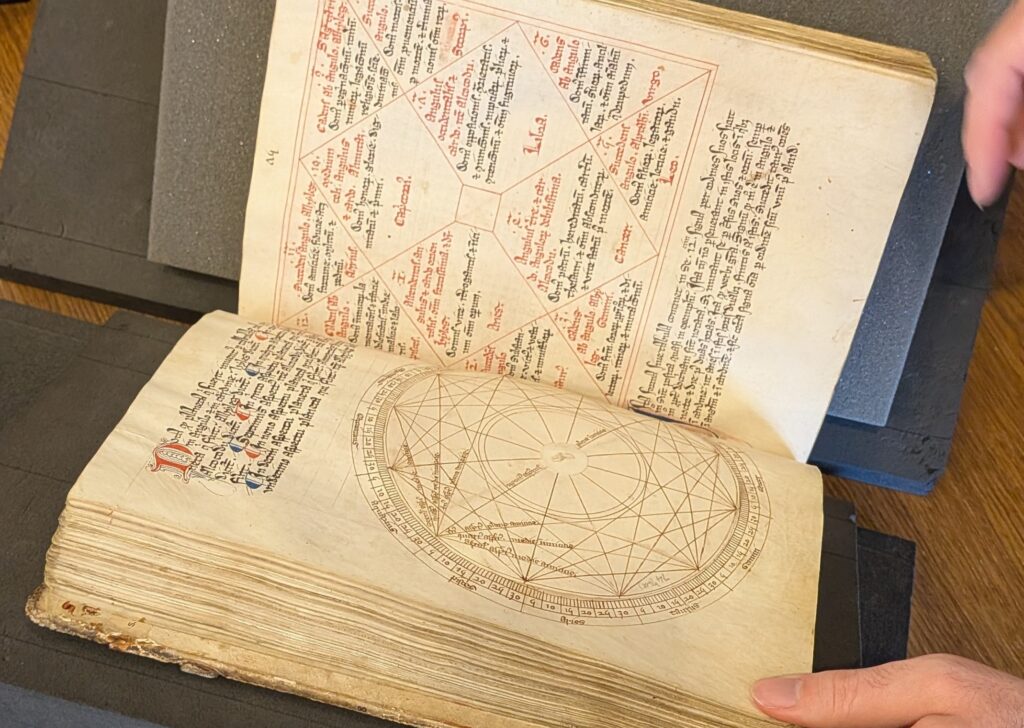
I hope to hear from many of you throughout the year. Wishing everyone a great start to a new term, with a reflection on the weird and wonderful of medieval manuscripts:
Customer: I’d like a letter ‘E’ please. Scribe: A normal one, or a snail-helmeted warrior with an ostrich leg and plums down his pants? Customer: The plums one, obviously.
Cheers, Elizabeth Crabtree elizabeth.crabtree@bodleian.ox.ac.uk
Term draws near. Please send all entries for next term’s OMS booklet to medieval@torch.ox.ac.uk, by Wednesday of -1 week at the latest (1st October). Until then, please see below a number of upcoming deadlines and opportunities:
CFP: CHASE Medieval and Early Modern Research Network (MEMRN) postgraduate conference – deadline 12 September. More info here.
Oxford School of Rare Jewish Languages classes. The deadline to apply is 12 September at 12 noon UK time. More info here.
The Medieval Academy of America’s podcast series The Multicultural Middle Ages is accepting episode proposals for their 5th season. More info here.
CFP: Cambridge Medieval History Graduate Workshop. Deadline 29th September. More info here.
Applications are open for the John W. Baldwin Post-Doctoral Fellowship. The Post-Doctoral Fellow will be a scholar whose research aligns with the goals of the study of “Europe in the world” and who has demonstrated evidence of innovative methodologies. Deadline 10th Nov. More info here.
The West Horsley Place Trust seeks a researcher. More info here.
‘In our own tongues’: The Medieval Vernacular Bible and its European Contexts’ is organised jointly by the Oxford and Augsburg research teams of the ‘Medieval Vernacular Bibles as Unity, Diversity and Conflict’. The project is based at the universities of Oxford and Augsburg and is supported by the UK-German Funding Initiative in the Humanities (Arts and Humanities Research Council and Deutsche Forschungsgemeinschaft) and the Bavarian Academy.
Compline based on the translations and manuscripts discussed at the conference. Text booklet
As part of the conference, we will be hosting the following session on Wednesday 1st October 2025:
3pm-5pm Bodleian Library, Lecture Theatre Chair:Andrew Dunning (University of Oxford)
Elizabeth Solopova (University of Oxford), Welcome
Hannah Schühle-Lewis (University of Oxford), ‘Þe pope, maister of bischopps’: Translating an Episcopal Oath in 1380s England
Michael Kuczynski (Tulane University), Hebrew and Greek Words in the Wycliffite Bible
10.30am – Coffee
11am-12.30pm St Stephen’s House
Chair: Nadine Popst (University of Augsburg)
Domenic Peter (University of Augsburg), ‘Als Daniel gesprochen hat’: The Book of Daniel in the Work of the Austrian Bible Translator and Beyond
Stefanie Katzameyer (University of Augsburg), ‘Ungefüerte pfaffen’, ‘Stiffter alles kriegs vnd streytz’, ‘Discipuli Antichristi’: Criticism of the Clergy by the Austrian Bible Translator, Austrian Heretical Movements, and the Wycliffites
Angila Vetter (Hamburg University), Modelling Lay Authority in Digital Editions: When the Austrian Bible Translator Invokes Wolfram von Eschenbach
1-2pm Lunch at St Stephen’s House
Afternoon: Walk to the Norman church of St Mary, Iffley, with Henrike Lähnemann, followed by viewing of the Old Library, St Edmund Hall.
Evening: Buffet dinner, followed by Compline in the Norman Crypt of St-Peter-in-the-East (library church of St Edmund Hall).
1 October
9am-10.30am St Stephen’s House
Chair: Catherine Mary MacRobert (University of Oxford)
Kateřina Voleková (Charles University / Czech Language Institute), Old Czech Glosses on the Psalms in Latin Biblical Dictionaries
Andrea Svobodová (Czech Language Institute), Colophons in Late-medieval Bohemian Biblical Manuscripts
Katarzyna Jasińska-Różycka (Institute of Polish Language, Polish Academy of Sciences), Scriptural Echoes in the Prologues to Medieval Dictionaries: Motifs, Citations, and Inspiration
10.30am – Coffee
11am-12.30pm St Stephen’s House
Chair: Freimut Löser (University of Augsburg)
Vladimir Agrigoroaei ( CNRS / Centre for Medieval Studies, Poitiers), The Cultural Implications of God’s Preference for the French Speech in the Old Testament Poem Written by Évrat (Late–Twelfth Century)
Corentin Delattre (University of Poitiers / Centre for Medieval Studies, Poitiers), ‘To furnish the priests to maintain the law’: Structures and Contents of London, British Library, MS Arundel 230
Ágnes Korondi (Fragmenta et Codices Research Group of the Hungarian Research Network, National Széchényi Library), Converting the Gospel of Nicodemus into a Sermon: The Old Hungarian Adaptation of the Apocryphon and its Latin Homiletic Background
1-2pm Lunch at St Stephen’s House
3pm-5pm Bodleian Library, Lecture Theatre
Chair:Andrew Dunning (University of Oxford)
Emily Davenport Guerry (University of Oxford),MS. Duke Humfrey c. 1:Illuminating the French New Testament and its readers, from Jean le Bon to Duke Humfrey
Freimut Löser (University of Augsburg), MS. Laud Misc. 479: The Paradisus-collection
Henrike Lähnemann (University of Oxford), MSS. Bodl. 969-970: A Fifteenth-century German Bible
Catherine Mary MacRobert (University of Oxford), MS e Mus. 184: The Vicissitudes of the Church Slavonic Psalter
Elizabeth Solopova (University of Oxford), MS. Bodl. 441: Gospels in Old English
7pm Conference Dinner at St Stephen’s House
2 October
9am-10.30am St Stephen’s House
Chair: Vladimir Agrigoroaei (CNRS / Centre for Medieval Studies, Poitiers)
Ana-Maria Gînsac (Institute of Interdisciplinary Research, Alexandru Ioan Cuza University of Iași), The Practice of Alternative Translation in Two Seventeenth-century Romanian Psalters
Ileana Sasu (University of Tours), Translating Saint Audrey:Images, Motifs, and Cultural Adaptations Across Europe
Élisa Marcadet (University of Tours), From Latin to Middle English: Vernacular Adaptations of Psalm 135 in the Surtees Psalter
10.30am – Coffee
11am-12.30pm – St Stephen’s House
Chair: Ian Johnson (University of St Andrews)
Ondřej Fúsik (Charles University and National Library of the Czech Republic), Latin Gerunds and Gerundives and their Old English Translational Equivalents as Evidenced in Old English Biblical Translations
Audrey Southgate (University of Oxford), Wyclif on Scripture and Islam
Mishtooni Bose (University of Oxford), The Sword of Solomon: John Bury, Reginald Pecock and the Authority of Scripture
1-2pm Lunch at St Stephen’s House
Image credit: Pentecost, Sherbrooke missal, fol. 169v, c. 1320
Time marches ever on, and the new term is on the horizon.
It will soon be time to put the next iteration of the OMS booklet together. If you are organising a seminar series, reading group, or one-off event (conference, medievally-themed social event, workshop etc), please email the details to medieval@torch.ox.ac.uk ASAP. If you are still awaiting confirmation on the finer points of your event (eg. paper titles), please send a place-holder email so that an entry can be made in preperation.
This year’s Dorothy Whitelock Lecture will be given by Profesor Jane Roberts (University of London) on ‘Guthlac: What the Early Medieval Records Tell Us’. The lecture will take place on 3 December at 5.15pm at St Peter’s College chapel, New Inn Hall Street, Oxford, OX1 2DL.
The lectures in this series honour Prof. Dorothy Whitelock’s remarkable contributions to medieval studies and to improving the status of female scholars at Oxford and beyond. The first lecture in this series took place on 4 December 2024. Professor Gale Owen-Crocker spoke on ‘Social History and False Friends: From Anglo-Saxon Wills to the Bayeux Tapestry via Material Culture’. Read a review of the lecture to find out more.
Image: Courtesy British Library, Harley/Guthlac Roll Y 6, fol. 6r
Kislak Center for Special Collections, Rare Books and Manuscripts Van Pelt-Dietrich Library Center, University of Pennsylvania, Philadephia And online via Zoom
On September 12, 2025, the Kislak Center for Special Collections, Rare Books and Manuscripts at the University of Pennsylvania will host a day-long symposium commemorating Elizabeth (Peggy) A. R. Brown’s extraordinary legacy in the field of Medieval Studies. The event will also mark the official launch of the Elizabeth A. R. Brown Medieval Historians’ archive, a new initiative at Penn Libraries to collect the professional papers of scholars of the Middle Ages and of associated professional organizations. The goal of the symposium is to honor Peggy’s legacy and gift by celebrating research on her area of specialty, namely Medieval France.
The symposium will consist of three panels of short papers devoted to subjects featured in Peggy’s work: Source and Archive; Politics and Kingship; and Liturgy and Sacred Image.
The day will also include an introduction to the research possibilities and historical interest of the medievalists’ archive at Penn, presented by the inaugural Elizabeth A.R. Brown Archivist, an endowed position in the Kislak Center for Special Collections, Rare Books and Manuscripts. The day will conclude with reminiscences by friends, students, and mentees, and a reception for all attendees.
Co-organized by Nicholas Herman (Schoenberg Institute for Manuscript Studies, Penn) and Ada Kuskowski (Department of History, Penn). Closing reception generously sponsored by the New York Medieval Society.
See here for event details, program, and abstracts. For Registration, click here. Donations to the Elizabeth A. R. Brown Medieval Historians’ Archivist Fund can be made here. Public messages honoring Peggy Brown’s contributions to the field of medieval studies can be left here.
The Latin hymnic tradition is one that spans over a millennium from Late Antiquity through the Middle Ages to the Reformation (and beyond). In that period, there are aspects of it that have remained in many ways stable and enduring, but individual and local contexts and usages at various junctures in its long-lived history have required it to change and to adapt. The corpus also represents a group of texts that would, in many cases, have been very well known beyond the narrow confines of the intellectual and social elite who operated at the highest levels of Latinity and – even if largely penned by incredibly adept Latinists – had a much wider reach than many other Latin texts because of the performed nature of hymns. The relationship of hymns to other exegetical traditions and to the liturgical and para-liturgical contexts in which they were used is also noteworthy.
This conference brings together an international group of scholars at varied career stages from different disciplinary backgrounds with interests that include the Latin hymnic tradition and scriptural exegesis across a period covering a little over a thousand years. We intend to explore the ways in which the widespread but understudied phenomenon of hymnody has been used as a means of elaborating on, engaging with, and complementing the teachings of Christian scriptures by homing in closely on the texts themselves.
Organisers: Tristan Franklinos and Cosima Gillhammer
Thursday, 25 September 2025
Arrivals from 1330.
1400–1445 Simon Whedbee (Loyola) Hymnus est laus Dei cum cantico: Teaching with and about hymns in the cathedral schools of twelfth-century Paris.
1445–1530 Tristan Franklinos (Oxford) Exegesis in Abelard’s hymns for the Feast of the Ascension.
1530–1600 Tea & Coffee
1600–1645 Marie Zöckler (LMU Munich) Ave mundi creator – Nature, its creator, and the fusion of scholastic philosophy and scriptural exegesis in Latin hymns.
1645–1730 Juan Montejo (LMU Munich) The Flores Psalmorum of Gregory of Montesacro: exegesis through abbreviatio.
1730 Reception
Friday, 26 September 2025
1015–1100 Cillian O’Hogan (Toronto) Martyrs as exegetes in Prudentius’ Peristephanon.
1100–1145 Katie Painter (Oxford) Nature and scripture in the Liber Kathemerinon: Prudentius on the kaleidoscope of creation.
1145–1230 Joshua Caminiti (Oxford) Singing alone: the private hymns of Marius Victorinus.
1445–1530 Cosima Clara Gillhammer (Oxford) Lux vera gentis Anglice: Latin hymns in Anglo-Saxon England
1530–1600 Tea & Coffee
1600–1645 Nicholas Richardson (Oxford) mellifluis nostras musis qui impleuerat aures: Scripture and sweet music in the hymns of St Paulinus of Aquileia.
1645–1730 Christoph Uiting (Zurich) Festa Christi – Notker’s sequence on Epiphany in a late medieval commentary.
This event is generously supported by the Faculty of Classics Board, the Craven Committee, the Institute of Classical Studies, and Oxford Medieval Studies (sponsored by The Oxford Research Centre in the Humanities [TORCH]).
Using Data to find Interesting Manuscripts in the Bodleian’s Medieval Catalogue
On Friday 25th July 2025, the Bodleian Coffee Morning presentation was given by Matthew Holford and Sebastian Dows-Miller, who are working on a project on the Bodleian’s western medieval manuscript catalogue data.
The purpose of the project, funded by Digital Scholarship @ Oxford, is to open up the library’s TEI catalogues for use by students and non-digital scholars by extracting the data into spreadsheets, which allow cross-comparison of over 11,000 medieval manuscripts held in Oxford’s collections.
Being able to compare manuscripts by details like their size and layout means that we can identify particularly interesting outlier manuscripts, and that was the topic of this presentation. Those present were treated to an introduction to:
MS. Lat. th. b. 4: the manuscript with the most lines per page (105+).
MS. Canon. Liturg. 28: the manuscript with the thinnest binding (9mm).
MS. Rawl. G. 26: one of just 4 manuscripts in the catalogue recorded as having 5 columns per page.
MS. Auct. F. 2. 6: the narrowest manuscript in the catalogue (that is, the one with the lowest ratio of leaf width to leaf height).
Canon Class. Lat. 84: one of the manuscripts in the catalogue with the biggest margins (that is, the lowest ratio of text to blank page).
MS. Bodl. 787 (endleaves): the manuscript unit with the greatest average height between lines.
If you’re interested, you can download the raw data by clicking here.
Watch the full recording of the talk below! The slides shown are included beneath the video.
Weekly emails will stop over the long vac, but it is worth drawing to your attention a number of opportunities that take place before term starts up again. It is never too early to send in events for the booklet and / or the calendar – we will keep posting events on the OMS calendar as soon as you send them in.
Two more things OMS is looking for: 1) We are still seeking information on your publications for the production of an impact document – please send information of any monographs/edited volumes etc with a short blurb to this email address ASAP. 2) The social media officer position is still vacant – we know that Ashley Castelino is a hard act to follow (see his report here) but he is prepared to help whoever is taking over to learn the trade secrets.
Last week saw the premiere of the filmed version of the Oxford Medieval Mystery Play – thank you to all of you who watched along online! The entire collection is available on our Youtube channel here, where each individual play can also be found.
IMC Leeds 2026 has opened its Call for Papers. Following the death of Twitter, it can be hard to circulate CfPs – if you are organising an event for this, please send me information ASAP, and I will try and make sure that these are all circulated as a group. Medievalists Coffee Mornings continue throughout the term break, only stopping in August.
Events
26th June, 6:30pm. Oxford University Heraldry Society online lecture on ‘The King’s Esquire. The life of Robert Waterton ( c.1365-1425 ) in its heraldic context’. Zoom link here.
1st July, 5.15pm-6.15pm. ‘Invisible Treasures’ film screening and panel discussion. More information, and free tickets, here.
Opportunities
Three-year postdoc research fellowship in Göttingen in Early Medieval Manuscript Studies and Germanic Philology, on the ERC INSULAR project. More information here.
CfP for ‘Borders, Boundaries and Barriers: Real and Imagined in the Middle Ages’, a conference held at Oxford 20th-21st April 2026. More information here.
Another academic year draws to a close: welcome, finally, to Week 8. The full Medieval Studies booklet is available here.
Next Thursday, 19 June, 4:30-6pm, is the official launch date for the “The Oxford Medieval Mystery Plays – the Film”. This is a wonderful chance to come together to celebrate the end of the year, and watch some of the excellent performances that were put on earlier in the term. At 4:45pm, the film will have its youtube premiere. You can tune in from anywhere in the world to comment; find the full schedule of when each play will start, more information, and a teaser here.
NB. If you are leaving us at the end of this year, and you would like to remain a member of this mailing list (and you are most welcome to do so), please register here with your personal email (link always available from our homepage https://medieval.ox.ac.uk/).
Monday
Poetry, Power, Literacy, and the Emergence of Vernacular Literatures – 9am in the Radcliffe Humanities Building, Seminar Room. The workshop is part of the activities of the TORCH Network Poetry in the Medieval World.
French Palaeography Manuscript Reading Group – 10:30 am in the Weston Library.
Medieval History Seminar – 5pm at All Souls College. Stuart Airlie (Glasgow) will be speaking on ‘Returns of the Repressed: Aby Warburg’s cultural history of Percy Ernst Schramm’. Following the talk, a special drinks reception will be held to mark Julia’s retirement. Please sign up here.
Tuesday
The Latin Palaeography Reading Group meets 2-3.30pm. Please email Laure Miolo for more information.
Medieval Church and Culture – tea and biscuits from 5pm in the Wellbeloved Room, with talks from 5.15. Cassidy Serhienko (Pembroke) will be speaking on ‘‘That Fayre Lady’: women and the code of chivalry in late Arthurian romance’; Senia Magzumov (Worcester) will be speaking on ‘Imagining the Rus’ Pagan Past in the Radziwill Chronicle: a comparative study with the Litsevoi Letopisnyi Svod’.
Wednesday
The Medieval German Graduate Seminar meets Wednesdays 11.15am–12.45pm in Oriel College, Harris Lecture Room. The topic for this term is the ‘Alexanderroman’ and this week Lucian Shepherd and Monty Powell will present. If you are interested to be added to the teams group for updates for future terms, please contact Henrike Lähnemann.
Medieval Latin Document Reading Group – 4pm, online, please contact Michael Stansfield.
Late Antique and Byzantine Seminar – 5pm in the Ioannou Centre. Special OCBR lecture – Marc Lauxtermann (Exeter) will be speaking on ‘The Emergence of Fiction: Byzantium and the East’.
Oxford Centre of Islamic Studies Seminar – 5pm in the Oxford Centre of Islamic Studies. Dr Glaire Anderson (University of Edinburgh) will be speaking on ‘A Bridge to the Sky: Science and Arts in the Age of Ibn Firnas (d. 887)’.
Medieval Women’s Writing Research Seminar – 5pm in the Lower Lecture Room, Lincoln College. The theme is ‘Letters of Friendship and Gratitude’.
Lincoln Unlocked – 5.15pm in the Weston Library. Rebecca Menmuir will be speaking on ‘Achilles at Lincoln: Unlocking the Medieval Text of a Classical Poem’. Book here.
Friday
Medievalists Coffee Morning – 10.30am at the Weston Library. All welcome, coffee and insight into special collections provided.
Opportunities (new additions in bold)
British Academy talks on Anglo-Saxon and medieval Irish numismatics. More info here.
London Medieval Society’s 80th anniversary colloquium on ‘Memory and Commemoration’ is being held at on Saturday 28th June at The Warburg Institute.
‘Big Data’ and Medieval Manuscripts Exploring the Potential of Large-Scale Catalogue Data – Thursday 26th June, 1–5pm, Weston Library. More information here.
The Terence Barry Prize for Best Graduate Paper in Irish Medieval Studies – deadline May 30, 2025. More information here.
Anglo-Israeli Archaeological Society Travel Grant – more info here.
Call for Submissions: Taube Prizes for Student Writing in Hebrew & Jewish Studies – see blog post.
CfP for ‘Staging Silence from Antiquity to the Renaissance’ – more information here.
CfP for ‘Music and Reformation: A Symposium at Lambeth Palace Library, 16 September 2025’
A regular pub trip is being organised on a Friday at 6pm at the Chequers, from 0th week to 8th week, for all medievalists at Oxford. Email maura.mckeon@bfriars.ox.ac.uk
Additional spaces are available on the ‘Big Data’ and Medieval Manuscripts workshop – please sign up here.
Registration for the Masterclass by Patrick Boucheron – Pourquoi des médiévistes ? Penser le contemporain depuis le Moyen Âge – 29 May, 2:30pm, Maison Française d’Oxford.
Registration for Patrick Boucheron’s lecture entitled ‘The Birth of the Black Death: New Approaches in World History’ – 29 May, 5:00pm, Pembroke College.
The Digital Medieval Studies Institute is hosting a set of workshops on digital scholarly methods specifically tailored for medievalists as part of the International Medieval Congress at the University of Leeds. More information can be found here.