OMS is deeply saddened by the passing of Stephen Baxter (Professor of Medieval History). To view a number of touching memories of Stephen, and to contribute your own, please visit the memorial page. Further plans for remembering Stephen at St Peter’s will be announced in due course.
Monday
French Palaeography Manuscript Reading Group – 10:30, Weston Library
Seminar in Palaeography and Manuscript studies – 2:15, Weston Library. Kees Dekker (Groningen) will be speaking on ‘Manuscripts in the hands of Franciscus Junius (1591-1677)’
Medieval Archaeology Seminar – 3:00, Archaeology Faculty. Jennifer Coulton (Oxford) will be speaking on ‘Structural Depositions, Haunted Houses, and Domestic Protection in England c.800-1250’
Medieval History Seminar – 5:00, All Souls College. Rob Portass (Robinson College, Cambridge) will be speaking on “Estate Management and the Beginnings of Specialised Production in Early Medieval Iberia”.
Tuesday
‘A Quiet Revolution’: Engaging Heritage Audiences with West Horsley Place’s Historic Landscape – 11:00, Learning Centre (Room 00.018), Humanities Centre. Book a place.
Medieval English Research Seminar – 12:15, Room 00.079 (Humanities Centre). Rachel Moss (University of Northampton) will be speaking on ‘Chivalry is a code for men willing to fight’: medievalism, masculinity and the modern far-right’.
Europe in the Later Middle Ages Seminar – 2:00, New Seminar Room, St John’s College. Annabel Hancock (Trinity College Dublin) will be speaking on ‘Negotiating Uncertain Waters: Trust in trade and diplomacy in the Mediterranean’
Latin Palaeography Manuscript Reading Group – 2:00, Weston Library (Horton Room). Those who are interested can contact the convenor, Laure Miolo.
Medieval Church and Culture, theme: TRANSLATION(S) – tea and coffee from 5:00, Harris Manchester College. Natasha Bradley (Lincoln) will be speaking on ‘Trans Saints in Old Norse Translation: Marina*us the Monk and Pelagia*us the penitent in the medieval North’
Maghrib History Seminar – 5:00, The Queen’s College. Amira Bennison (University of Cambridge) will be speaking on ‘Power and Peace: Re-viewing the Dynastic History of the Western Maghrib through an Urban Lens’.
Heraldry Society – 5:00, MacGregor Room, Oriel College. Mr Mark JR Scott (Somerset Herald) will be speaking on “British Royal Heraldry: 1800-2025”.
Old English Hagiography Reading Group – 5:15, Jesus College Memorial Room. The first text is the anonymous Life of Saint Giles – email Luisa Ostacchini for a copy.
Church Historian Pub Night – 6:00 at the Chequers Inn. Contact Rachel Cresswell
Wednesday
Medieval German Graduate Seminar – 11:15, Old Library, St Edmund Hall. The topic for this term is the ‘Liederbuch der Clara Hätzlerin’.
History and Materiality of the Book Seminar series – 2:00, Weston Library. Andrew Honey & Matthew Holford will be discussing ‘Writing supports (parchment and paper) and manuscript structure’.
Older Scots Reading Group – 2:30, Room 30.401 (Humanities Centre). Palyce of Honour, First Part, ll. 127-771.
Late Antique and Byzantine Seminar – 5:00, Ioannou Centre for Classical and Byzantine Studies. Julian Baker (Oxford) will be speaking on ‘Medieval Epiros and Albania: Geopolitical and Economic Reflections in the Light of Coinage’.
Thursday
Middle English Reading Group (MERG) – 11:00, Lincoln College, Beckington Room. All are welcome as we read Sir Gawain and the Green Knight: bring any edition of the original text.
Medieval Women’s Writing Research Seminar – 4:00, Somerville College. The Debate on Women – extracts from the works of Christine de Pizan, Teresa de Cartagena and Lady Murasaki.
Seminars in Medieval and Renaissance Music – 5:00, online. Kévin Roger (University of Lorraine) will be speaking on ‘Latin Motets and Literary Networks in the Late Middle Ages: Intertextuality, Rhetoric, and Digital Reading’. Discussants: Yolanda Plumley (University of Exeter) and Karl Kügle (Universities of Oxford and Utrecht).
Medieval Visual Culture Seminar – 5:00, St Catherine’s College. Robert Mills (University College London) will be speaking on “Wild Forms: Hermits, Saints and Rock Art in Medieval England”
Celtic Seminar – 5:15, Room 20.306 (Humanties Centre) and Online. Elizabeth Edwards (CAWCS) will be speaking on ‘Home Circuits: the Ladies of Llangollen, queer temporalities and Welsh landscapes’.
The Khalili Research Centre For the Art and Material Culture of the Middle East: Research Seminar – 5:15, The Khalili Research Centre. Joumana Medlej (Independent Scholar) will be speaking on ‘The hidden life of Kūfī scripts: practice-based insights and theories’.
Compline in the Crypt – 9:30, St Edmund Hall.
Friday
In Tesserae workshop – details TBC.
Medievalist Coffee Morning – Friday 10:30, Visiting Scholars Centre (Weston Library). All welcome, coffee and insight into special collections provided.
The History of the Bible: From Manuscripts to Print – 12:00, Visiting Scholars Centre at the Weston Library. The theme this week ‘The Septuagint and its Transmission’. Places are limited. To register interest and secure a place, please contact the lecturer at peter.toth@bodleian.ox.ac.uk
Exploring Medieval Oxford through Surviving Archives – 2:00, Weston Library (Horton Room). Those who are interested can contact the convenor, Laure Miolo.
Oxford Medieval Manuscript Group – 5:00, online.
Opportunities and Reminders
The OMS Booklet is linked here, and is available on the OMS website throughout the term. The 2026 OMS Lecture will take place on Thursday 19 February 5–6.30pm in the Old Dining Hall of St Edmund Hall. Prof. Ian Forrest (Glasgow) will be speaking on ‘Telling Tails: Weaponizing Gender in the Late Medieval Church‘. Drinks to follow. More information and register for dinner.
Are you interested in submitting to the journal Manuscript and Text Cultures? Please review the About the Journal page for the journal’s section policies.
CfP: 20th Annual MEMSA Conference: Connection, Conversation, Contention: Encounters in the Medieval and Early Modern World – deadline 9 March 2026
CfP: Gender and Medieval Studies conference 2026: Gender and Creativity. The conference will take place at University College, Oxford, 8-10 September. Deadline 13 April.
Call for submissions for a special issue of Public Humanities journal on the topic ‘Creating the Medieval Now.’ Edited by Laura Varnam and Eleanor Barraclough. Short essays of 2,000-3,000 words, due 1 May 2026, by medievalists who are also creative practitioners.
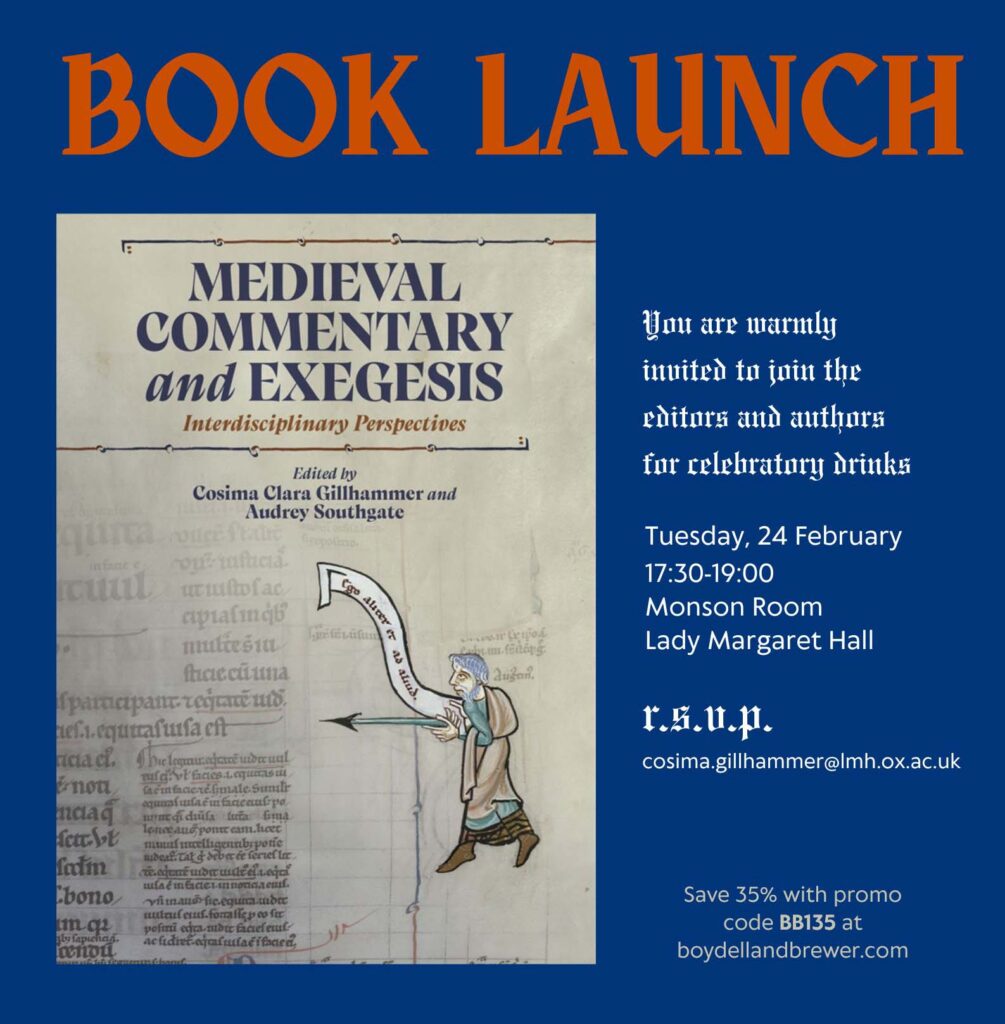
Medieval Commentary and Exegesis: Interdisciplinary Perspectives, ed. Cosima Gillhammer and Audrey Southgate, includes chapters by Alastair J Minnis, Alexandra Barnes, Anna Wilmore, Audrey Southgate, Cosima Clara Gillhammer, David J Elliott, Edit Anna Lukács, Eduardo de Oliveira Correia, Elizabeth Solopova, Jiani Sun, Joshua Caminiti, Lesley Smith, Michael P Kuczynski, Rachel Cresswell, Simon Whedbee, William Marx, Zachary Guiliano.
More information on the volume can be found here. Use the voucher code BB135 for 35% off.
There will be a book launch at LMH on 24 February; all are welcome. For further details see below.
Welcome to Week 1. Thanks to all those who submitted their events for the upcoming term. An updated version of the OMS Booklet is linked here, and is available on the OMS website throughout the term.
For your diary: The 2026 OMS Lecture will take place on Thursday 19 February 5–6.30pm in the Old Dining Hall of St Edmund Hall. Prof. Ian Forrest (Glasgow) will be speaking on ‘Telling Tails: Weaponizing Gender in the Late Medieval Church‘. Drinks to follow. More information and register for dinner.
Tony Hunt’s memorial service is will be held on 16th May, 2.30, St Peter’s College Chapel (booking etc in due course).
Monday
French Palaeography Manuscript Reading Group – 10:30, Weston Library
Medieval History Seminar – 5:00, All Souls College. John Sabapathy (UCL) will be speaking on “Humanism and bestiality in the land of Cockagne”.
Celtic Language Teaching continues throughout the week – please consult the booklet, p. 39 for a full table of dates and locations.
Tuesday
Medieval English Research Seminar – 12:15, Room 00.079 (Humanities Centre). Stacie Vos (University of California, San Diego) will be speakin on “Norfolk Broads, or Discovering medieval women with twentieth-century collectives”.
Europe in the Later Middle Ages Seminar – 2:00, New Seminar Room, St John’s College. Peregrine Horden and Nicholas Purcell (Oxford) will be speaking on “Beyond the Mediterranean by land and sea: Two medieval cases in a (very) broad context”.
Latin Palaeography Manuscript Reading Group – 2:00, Weston Library (Horton Room). Those who are interested can contact the convenor, Laure Miolo.
Medieval Church and Culture, theme: TRANSLATION(S) – tea and coffee from 5:00, Harris Manchester College. John Mulhall (Purdue University) will be speaking on “‘Blessings on All the Prophets’: Islamic prayers in the Latin scientific translations of the twelfth century”.
Church Historian Pub Night – 6:00 at the Chequers Inn. Contact Rachel Cresswell
Wednesday
Medieval German Graduate Seminar – 11:15, Old Library, St Edmund Hall. The first week will be a shortish planning meeting. The topic for this term is the ‘Liederbuch der Clara Hätzlerin’.
Older Scots Reading Group – 2:30, Room 30.401 (Humanities Centre). Theme: ‘Palyce of Honour, Prologue, ll. 1-126’.
Late Antique and Byzantine Seminar – 5:00, Ioannou Centre for Classical and Byzantine Studies. John Mulhall (Purdue) will be speaking on “The Republic of Translators: Translating from Greek and Arabic into Latin in the Twelfth-Century Mediterranean”.
Thursday
Middle English Reading Group (MERG) – 11:00, Lincoln College, Beckington Room. All are welcome as we read Sir Gawain and the Green Knight: bring any edition of the original text.
Environmental History Working Group (EHWG) – 12:30, Room 20.421 (Humanities Centre). Niklas Groschinski (DPhil History) “Environing from Below — Supplications, Denunciations, and Other Sources for Rewriting Early Modern Environmental History”
Celtic Seminar – 5:15, Room 20.306 (Humanties Centre) and Online. Brigid Ehrmantraut (St Andrews) will be speaking on “Death of the author? Authorship and authority in the Middle Irish classical adaptations”.
The Khalili Research Centre For the Art and Material Culture of the Middle East: Research Seminar – 5:15, The Khalili Research Centre. Yusuf Tayara (Wolfson College) will be speaking on “Timekeeping between art and science: integrated approaches to the history of Mamluk astronomy”.
Old English Graduate Reading Group – 5:15. Location is variable so please email Hattie Carter or James Tittering if you’re interested. This term’s text is Apollonius of Tyre.
Compline in the Crypt – 9:30, St Edmund Hall. Sung by the College Choir in English
Friday
Medievalist Coffee Morning – Friday 10:30, Visiting Scholars Centre (Weston Library). All welcome, coffee and insight into special collections provided.
The History of the Bible: From Manuscripts to Print – 12:00, Visiting Scholars Centre at the Weston Library. The theme this week is ‘The Hebrew Bible”. Places are limited. To register interest and secure a place, please contact the lecturer, Péter Tóth.
Exploring Medieval Oxford through Surviving Archives – 2:00, Weston Library (Horton Room). Those who are interested can contact the convenor, Laure Miolo
EMBI ‘Databases: A Skills Workshop’ has been POSTPONED until Week 4 on 13 February, 16:00-17:15.
Are you interested in submitting to the journal Manuscript and Text Cultures? Please review the About the Journal page for the journal’s section policies.
12 February, 6:15–8pm, The Chapel at King’s College London/River Room, Strand Campus with Sarah Bowden, Hannah Conway, Johanna Dale and Hazel Gould
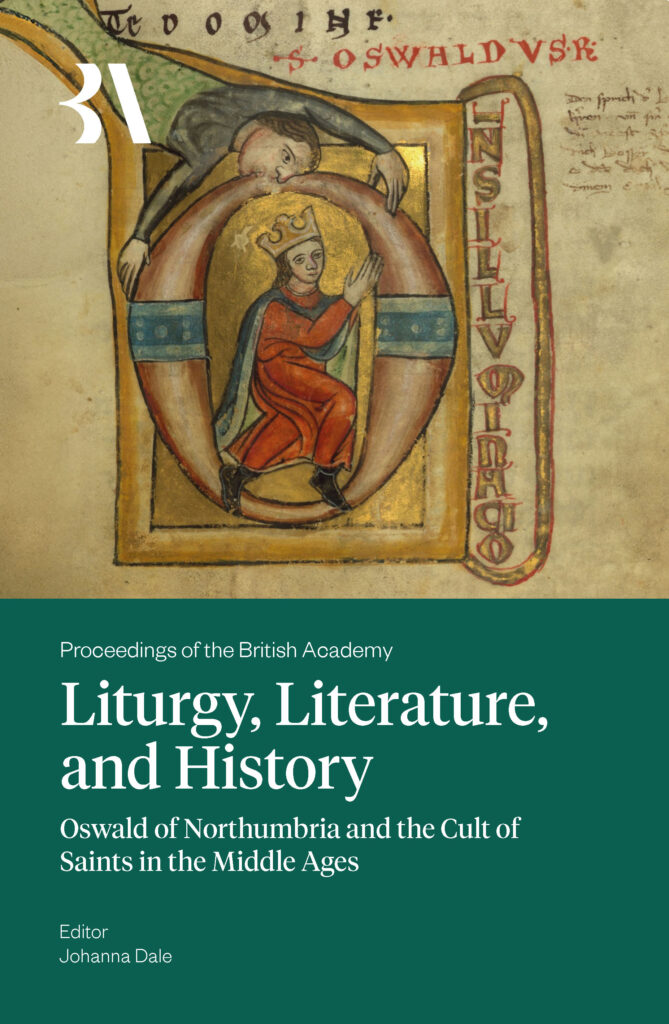
An evening exploring creative responses to medieval saints. The focal point is the world premiere of the new work “My Name is Oswald” by award-winning composer Hannah Conway and writer Hazel Gould. This work draws on stories of Oswald of Northumbria, a significant early English king and pan-European saint, and new research by King’s academics Sarah Bowden and Johanna Dale. The performance will be accompanied by short readings from medieval texts and discussion.
“My Name is Oswald” will be performed by Tim Dickinson (baritone), Peter Sparks (clarinet), Joseph Walters (horn), and Hannah Conway (piano).
Thursday week 4, Trinity Term 2026, 5–10pm, St Edmund Hall – confirmed! with Louise Tjoline Keitsch
This workshop invites everyone – students, researchers, and anyone curious – to take part in a Wikipedia Editathon for Medievalists. Whether you have always wanted to write or improve a Wikipedia article, are looking for a low-pressure way to start writing about your topic, or simply want a productive and enjoyable distraction from exams or papers, this editathon offers a space to do so!
Participants are encouraged to bring a topic they would like to work on: this could be a medieval object, person, concept or manuscript; an existing Wikipedia article that needs improvement; or an article that could be translated into another language. Prior experience with Wikipedia editing is not required – beginners are very welcome. Bringing a few sources is helpful, but online articles or similar are perfectly acceptable starting points.
The editathon is designed as a low-pressure entry. Participants can focus on clarity, structure, and communicating knowledge to a broad audience rather than perfection or originality in the academic sense. Contributions can be published immediately, offering a rare sense of instant gratification alongside meaningful scholarly engagement. Throughout the session, support will be available, either through a short introductory tutorial or hands-on help in small groups, depending on participants’ needs.
Editing Wikipedia means contributing to a vibrant, active community and helping shape what knowledge is publicly visible. Make a public impact, practice digital humanities, be part of a broader effort to make Wikipedia more equitable (for example by addressing the persistent gender gap in biographical articles) and increase the visibility and accuracy of medieval topics on the platform! Please come by to write, to learn, to experiment, and to contribute to shared knowledge – all while eating pizza at 6pm!
Prof. Ian Forrest (Glasgow): Telling Tails: Weaponizing Gender in the Late Medieval Church
St Edmund Hall, Old Dining Hall
Thursday 19 February 5–6.30pm, followed by drinks
All welcome!
The fringes of the institutional church in the later Middle Ages were difficult to control. Pardoners, summoners, and priests of dubious status caused headaches for bishops and scandalized the public. The stories people told about them often concerned deceptive or ambiguous gender presentation. Touching upon famous fictions like Chaucer’s Pardoner and Summoner, and Pope Joan, the lecture will also examine the political culture of violent direct action against humans and their animals which sought to regulate gender and status at the edges of the medieval clerical estate.
After the talk and the drinks, there will be the opportunity to stay for a buffet dinner a in St Edmund Hall at 7pm. Please contact Henrike Lähnemann if you would like to take part in this. At 9:30pm, there will be the opportunity to take part in the Compline in the crypt of St-Peter-in-the-East, the library church of St Edmund Hall (more details on that in the current Medieval Studies booklet.).
This is linked with a workshop on Friday 20 February, 10am for the graduate students of the MSt. in Medieval Studies: ‘Fragments and photographs: what are we doing when we try to get close to medieval people?’ which will start using examples from medieval records and Ian Forrest’s account of publishing with the photographer Martin Stott.
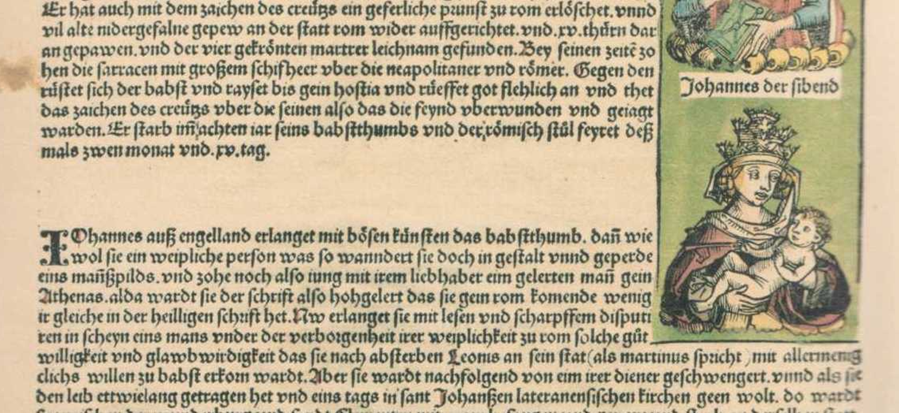
Header image: Pope Joan / John VII in the Nuremberg Chronicle (Hartmann Schedel 1494)
We are pleased to announce the seminars for Hilary Term 2026. The seminars are all held via Zoom on Thursdays at 5 p.m. GMT. If you are planning to attend a seminar this term, please register using this form. For each seminar, those who have registered will receive an email with the Zoom invitation and any further materials a couple of days before the seminar. If you have any questions, please send an email to Joe Mason at all.souls.music.seminars@gmail.com; this address is the main point of contact for the seminars. We look forward to an exciting series and hope to see many of you there.
Margaret Bent (Convener, All Souls College)
29 January 2026, 5pm–7pm GMT: Presenter: Kévin Roger (University of Lorraine) Title: Latin Motets and Literary Networks in the Late Middle Ages: Intertextuality, Rhetoric, and Digital Reading Discussants: Yolanda Plumley (University of Exeter) and Karl Kügle (Universities of Oxford and Utrecht)
Abstract: Latin motets of the 14th and early 15th centuries preserve one of the most complex bodies of lyric poetry from the Late Middle Ages. While vernacular art was flourishing, these pluritextual works maintained a dense, erudite, and allusive Latin that has long hindered scholarly interpretation. Because their meaning is often obscure, research has traditionally focused on musical structure rather than on the literary strategies that shape the motet as a poetic object.
This paper investigates the modes of textual invention in Latin motets by analysing their intertextual mechanisms, rhetorical organisation, and broader literary framework. It considers the major French sources and examines how composers drew on classical, biblical, and patristic materials, as well as on florilegia and mnemonic practices. Rather than merely identifying quotations, this research seeks to characterise different forms of borrowing (citation, allusion, discursive resonance) and to understand how they evolve across the corpus.
Digital methods play a central role: TEI encoding enables fine-grained annotation of stylistic features and standardisation of data, while NLP approaches, including LatinBERT, assist in detecting textual reuse and semantic patterns at scale. These tools complement traditional expertise, revealing previously unknown intertextual links and restoring the literary richness of this challenging repertoire.
26 February, 5pm–7pm GMT Andrew Kirkman (University of Birmingham) Title: Made to measure or prêt à chanter? The Court of Wilhelm IV and the Later Alamire Manuscripts Discussants: Thomas Schmidt (University of Manchester) and Zoe Saunders (Independent scholar)
Abstract: The Alamire codices have traditionally been seen as diplomatic gifts, or at the very least commissions from magnates and super-rich aficionados. This article argues that for most of the later, paper codices at least, the sequence happened in reverse: in other words they comprised workshop material that was first produced and then sold once buyers could be found. The same conclusion prompts also a review of the construction of some of the more elegant, parchment sources, and the proposal that the ‘bespoke’ aspects of such codices may have extended no further than their opening—and hence most immediately visible—pages.
12 March, 5pm–7pm GMT Presenters: Elisabeth Giselbrecht, Louisa Hunter-Bradley and Katie McKeogh (King’s College London) Title: No two books are the same. Interactions with early printed music and the people behind them
Abstract: The DORMEME project investigates how early modern owners, readers, and users engaged with printed polyphonic music books, focusing on 1500–1545, when music printing introduced new modes of circulation alongside manuscript and oral transmission. This technological shift expanded and reshaped how individuals interacted with music books—as tools for performance and teaching, as collectable objects, and as sites of confessional negotiation. Our project undertakes a copy-based survey of surviving printed polyphonic books across European and North American collections, documenting marks of use and developing case studies that reveal how these books were used, altered, and understood.
This paper presents the project’s first synthetic results. We outline a taxonomy of interventions—textual, musical, material, and paratextual—and consider them in relation to user motivations such as correction, performance facilitation, confessional adaptation, education, personalisation, and proof-reading. Drawing on detailed examples, we examine textual changes in religious motets, musical annotations including crosses, numbers, custodes, and barline-like dashes, and patterns of personalisation that illuminate different types of owners and users. We also address the distinctive role of the proof-reader as the “first reader,” whose interventions bridge production and use. Together, these findings show how annotations can reshape our understanding of early modern musical practice and book culture.
Change of policy on seminar recording
The seminars have taken place on Thursdays at 5 p.m. UK time for over thirty years. When we moved them to Zoom in 2020 during Covid, it soon became clear that in attracting wide global participation, including expertise not available locally in Oxford, they would continue online into the foreseeable future. Many have indicated how much they value these online but ‘live’ opportunities to share and respond to new work, or just to learn from them. We decided from the start not to make them hybrid (which doesn’t facilitate awareness or interaction between the in-person and online participants), not to make them webinars (where there is no interaction with the audience), and not to record them. The reasons for that were to protect unpublished work (we know who has registered and received any associated materials), and to ensure a sense of occasion and enable participation in real time. Much of that would be lost if people could easily listen in at their convenience. We are receiving increasing requests to record the seminars from those who can never come because of conflicting schedules or unfriendly time zones. We are therefore proposing the following change:
Where a speaker and the invited discussants are happy to do so, we will record the first hour of the seminar;
If the speaker but not the invited discussants are happy to record, only the first half hour may be available;
We will not record the second hour of general discussion, as we do not wish to inhibit that discussion, and would need to secure too many permissions;
This change of policy is intended to serve those whose schedules do not permit them to attend, as well as those who would like to revisit the presentation afterwards. Recordings will not include the general discussion, and may not include the invited discussion. As for the protection of unpublished material: any unauthorised or uncredited ‘borrowing’ can be documented from the availability of the Youtube recording. As not all speakers may want to be recorded, and as it will not be known in advance which seminars will be available afterwards, we still hope to encourage as much attendance in real time as at present.
You can register for the seminar’s YouTube channel here, where any recordings will be uploaded.
All Souls College, OxfordHilary Term, 2023
Led by Dr Margaret Bent (Convenor, All Souls College, Oxford) and Matthew Thomson (University College Dublin)
The seminars are all held via Zoom on Thursdays at 5 p.m. GMT. If you are planning to attend a seminar this term, please register using this form. For each seminar, those who have registered will receive an email with the Zoom invitation and any further materials a couple of days before the seminar. If you have questions, please just send an email to matthew.thomson@ucd.ie.
Seminar programme
Thursday 26 January, 5pm GMT
Julia Craig-McFeely (DIAMM, University of Oxford)
The Sadler Sets of Partbooks and Tudor Music Copying
Discussants: Owen Rees (University of Oxford) and Magnus Williamson (University of Newcastle)
The digital recovery of the Sadler Partbooks has revealed considerably more than simply the notes written on the pages. Surprisingly more in fact. It has led to a re-evaluation of pretty much everything we thought we knew about the books and their inception, and indeed the culture of music copying in England in the mid- to late-16th century. This paper examines the question of who was responsible for copying Bodleian Library Mus. e. 1–5. Some tempting speculations are explored, and some new paradigms proposed.
Thursday 16 February, 5pm GMT
Martin Kirnbauer and the project team Vicentino21: Anne Smith, David Gallagher, Luigi Collarile and Johannes Keller (Schola Cantorum Basiliensis / FHNW)
Soav’ e dolce – Nicola Vicentino’s Intervallic Vision
The musical ideas and visions that Vicentino sets out in his writings L’antica musica ridotta alla moderna prattica (Rome 1555) and the Manifesto for his arciorgano can only be concretely traced on the basis of a few, mostly fragmentary, surviving compositions. However, the research carried out within the framework of the SNSF-funded research project “Vicentino21” (https://www.fhnw.ch/plattformen/vicentino21/), with the aim of creating a digital edition of Vicentino’s treatise, now provides concrete findings. Using the example of the madrigal Soav’ e dolce ardore (III:51, fol. 67), questions concerning Vicentino’s musical visions and the edition will be discussed.
Thursday 9 March, 5pm GMT
Emily Zazulia (University of California at Berkeley)
The Fifteenth-Century Song Mass: Some Challenges
Discussants: Fabrice Fitch (Royal Conservatoire of Scotland) and Sean Gallagher (New England Conservatory)
Love songs and the Catholic Mass do not make easy bedfellows. The earthly, amorous, even carnal feelings explored in fifteenth-century chansons seem at odds with the solemnity of Christian observance’s most central rite. Recent scholarship has attempted to bridge this divide, showing how some of these genre-crossing pieces conflate the earthly lady with the Virgin Mary, thereby effacing the divide between sacred and secular. But a substantial body of song masses survives whose source material is decidedly not amenable to this type of interpretation—masses based on songs that are less “My gracious lady is without peer” and more “Hey miller girl, come grind my grain”—or, as we shall see, worse. This paper turns an eye toward these misfit masses, surveying the corpus for a sense of what there is—the Whos, Whats, Wheres, and Whens—as a first step toward the Hows and Whys of these puzzling pieces. One particularly tricky example, the mass variously referred to as Je ne demande and Elle est bien malade, suggests that it may be time to replace prevailing sacred–secular interpretative models with a new approach.
Welcome back to Oxford – I hope you all had a restful vac. Please find below the first draft of the upcoming medieval Hilary Term Booklet, which includes a range of seminars, reading groups and opportunities.
PLEASE:
If you have submitted an event, check that the details are correct and provide any corrections ASAP.
Note that a large number of entries have no information (noted by the symbol ##). If you are in charge of one of these events, or have previously been so, please reply to this email address ASAP with further information, or informing us that the event is not running this term.
Finally, a few upcoming events and deadlines for week 0:
Medievalist Coffee Morning – Friday 10:30, Visiting Scholars Centre (Weston Library). All welcome, coffee and insight into special collections provided.
Bodleian Purchasing Opportunity. Do you know of books that would aid your work but are not in the Bodleian? Help us strengthen the university’s collections. You can submit details of suggested books via https://www.bodleian.ox.ac.uk/collections-and-resources/recommend-a-purchase or by email to medieval@bodleian.ox.ac.uk.
A report by Tamara Klarić, research intern during Michaelmas 2025 with Henrike Lähnemann
The Isar and Thames rivers have more in common than might appear at first glance: both shape the image of the cities through which they flow, and both influence the life that takes place in these cities. Munich residents enjoy walking along or swimming in the Isar or meeting there for coffee. In Oxford, too, a lot of activity takes place on the Thames and Cherwell: numerous college rowing teams train on the water, punting boats regularly pass by walkers, and on the banks you encounter rowing team coaches as well as runners and cyclists. At the same time, not only do almost 1,200 km separate these rivers, but also (university) culture and atmosphere: Munich and Oxford – both are cities renowned, innovative universities, but these are integrated into the cities in very different ways. I have been living in Munich for over two years now and if I had to describe the city, I would probably describe it as modern, dynamic and efficient. In my mind, Oxford is both traditional and vibrant, cosmopolitan and self-contained.
1 My background: “Cultures of Vigilance”
I am employed by the Collaborative Research Centre (CRC) 1369 “Cultures of Vigilance” at Ludwig-Maximilians-Universität in Munich, which deals with the connection between personal attention and supra-individual goals. Specifically, we understand vigilance as “the coupling of individual attention, firstly with culturally mediated, supra-individual goals and, secondly, with concrete options for action and communication.”[1] The projects, which cover a wide range of disciplines, are divided into three thematic areas: transformations, spaces and techniques. The historical sub-project in which I am writing my dissertation is assigned to the first area. Together with my colleague John Hinderer and under the supervision of Prof. Dr Julia Burkhardt and PD Dr Iryna Klymenko, I am analysing vigilance in pre-modern Benedictine monasteries using the example of the Bursfelde Congregation. While John Hinderer is investigating how the congregations of Santa Giustina di Padova and Bursfelde sought to regulate different areas of monastic life, I am examining the “long” 16th century (approx. 1500 to 1618). My focus is on the recesses of the Bursfelde General Chapters (i.e. the written resolutions of the annual meetings of all abbots) and on the letters of the leading abbots around 1600. After suffering heavy losses due to the processes catalysed by the Reformation and after the Council of Trent, the Bursfelde monasteries found themselves in a phase of restabilisation and reconstruction during this period. The leading abbots of the congregation sought to expand their sphere of influence, which can be clearly seen from the sources: they not only provide information about how the abbots worked to (re)gain individual monasteries, but also about the strategies they developed towards external actors and the measures they took to restore internal unity. When it comes to the question of communication in times of uncertainty, I am particularly interested in the written perception of uncertainty, the resulting discourses in the correspondence, and any adaptation processes within the congregation. Underlying all of this is the vigilance of individuals and their commitment to serving the community.
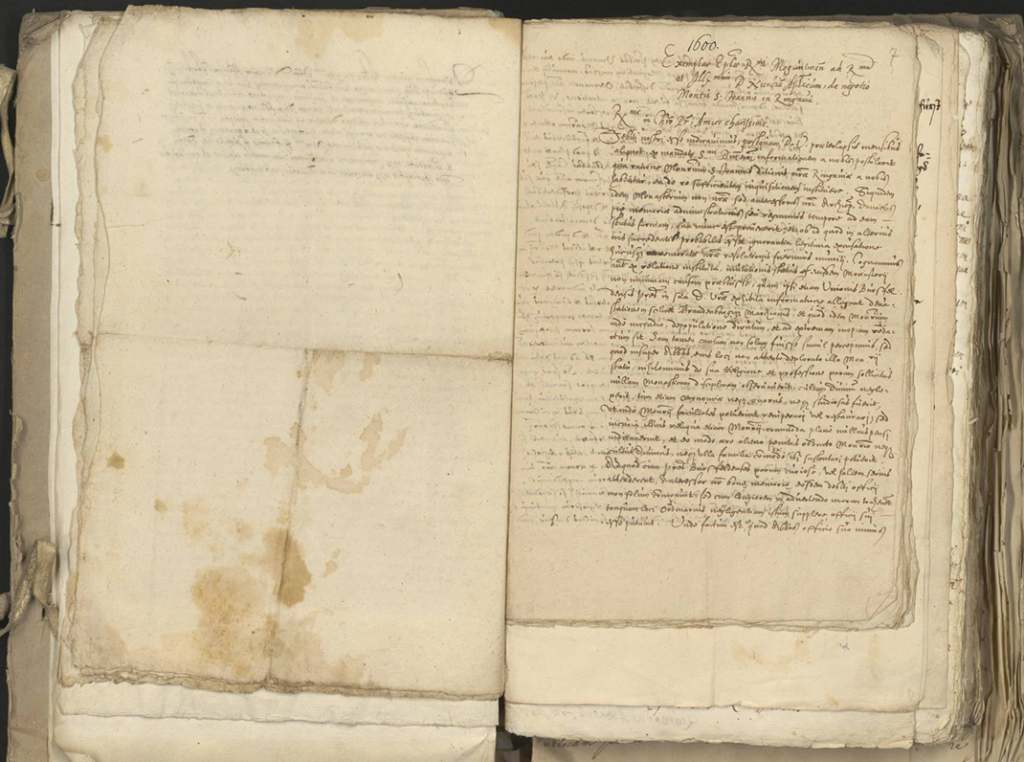
The letter shown here as an example is part of a dispute between the abbots of the Bursfelde Congregation and the archbishop of Mainz over the restitution of the Johannisberg monastery in the Rheingau (Diocese of Mainz). In this letter to the Apostolic Nuncio from 1600, the Archbishop of Mainz, Wolfgang X von Dalberg (in office 1582–1601) reports on the desolate condition of the monastery. The monastery was destroyed in 1552 and dissolved in 1563 by the former archbishop, Daniel Brendel von Homburg (in office 1555–1582). Since 1596, the abbots of the congregation had been trying to bring the monastery back into their union and had also approached the Curia in this regard. The present letter is a reply from Wolfgang X to the Apostolic Nuncio, in which he defends himself against the accusations of the Bursfelde abbots, justifies the behaviour of his predecessor and describes his own: He attributes the establishment of a secular administration not only to the devastation wrought by the Margrave of Brandenburg, but also to the negligence of the former abbot and the inadequate supervision of the Bursfelde Union. He justifies the abbot’s dismissal and the temporary secular administration of the monastery as necessary measures for debt settlement and the restoration of religious life in accordance with the rules. At the same time, he rejects the accusation of having abused the monastery for his own gain and emphasises that he acted lawfully and in the interests of the monastery. Finally, he asks the Nuncio to inform the Bursfelde Union of this view and to prevent further complaints.
Vigilance is evident in several places in this letter: As the archbishop’s vigilance towards monastic conditions, it can be read as a duty of ecclesiastical authority. According to Wolfgang X, however, its absence is the central cause of monastic decline, as he describes how the abbot failed to fulfil his official duties and how the Bursfelde abbots also failed to adequately fulfil their supervisory duties. At the same time, he emphasises that he is willing to re-examine the situation at the monastery should changes become apparent – vigilance is thus understood as a continuous duty.
At the conference “Zwischen Erneuerungswunsch und Traditionsbewusstsein. Klosterreformen im Alten Reich (1400–1700)” organised by Carolin Gluchowski and Marlon Bäumer in March 2024, I met Henrike Lähnemann and applied for a research internship with her. For the Michaelmas term of 2025, I was then given the opportunity to travel to Oxford for three months through this research internship. This time was not only extremely productive for me professionally, but also personally: as a woman with a non-academic and migrant background, it had long been unimaginable for me to be able to live and work here for three months. Now I am faced with the difficulty of summarising the significance of three intense months in just a few paragraphs. It is a task that is actually impossible. However, with the help of a few photographs, I would like to try to at least come close to doing so:
2 Arrival
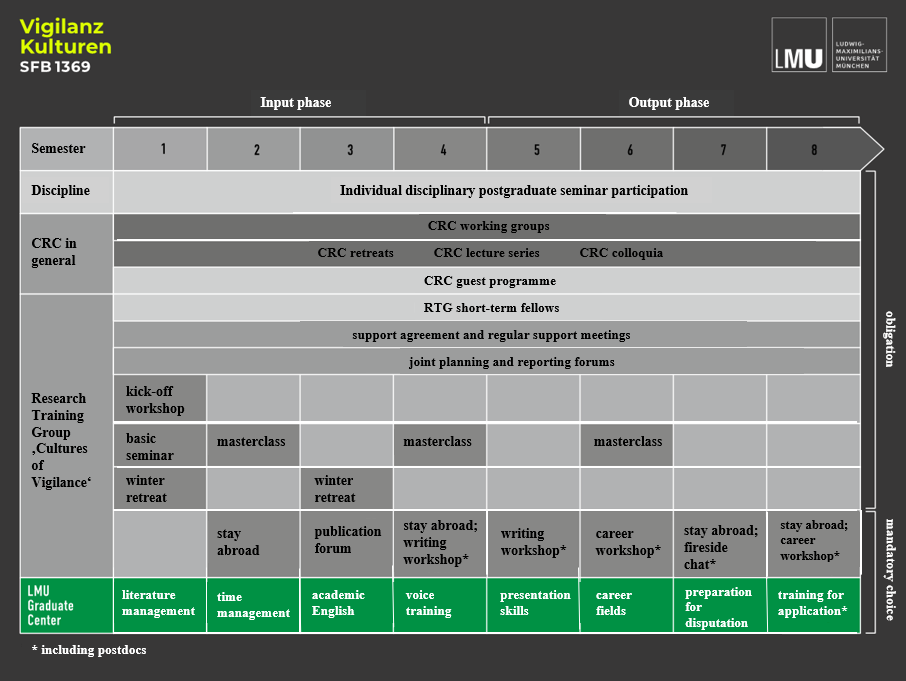
I decided to arrive at the end of September, two weeks before the start of the term, so that I would have some time to find my way around the city and gather my first impressions. I am very privileged to be funded by an CRC in Germany: doctoral students are not employed by the departments but are funded by the German Research Foundation and thus by third-party funds. This meant that I didn’t have to apply for scholarships to be able to afford a stay in Oxford but could be funded by my employer. And within the framework of an SFB, stays abroad are possible; in our case, they are even supported as a possible part of our doctoral programme through the integrated Research Training Group:
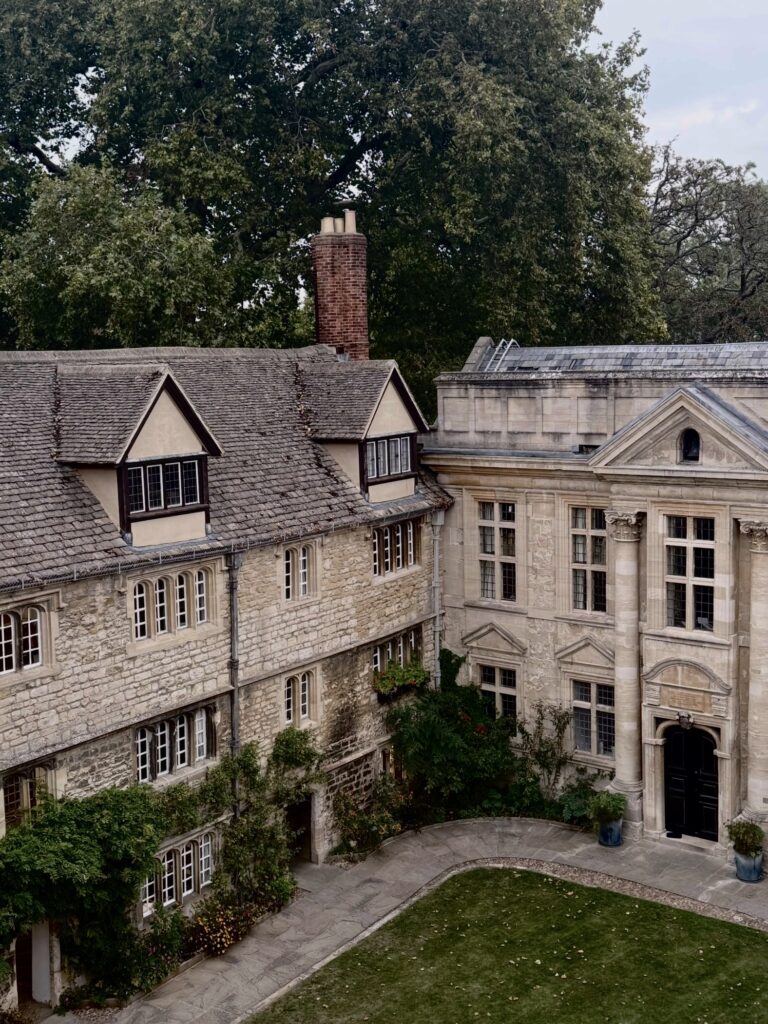
I was accommodated in a private house in New Hinksey, just south of the city centre. The reason for my decision was that I wanted to build a second, non-university environment for myself, where I could experience as much of everyday life in Oxford as possible. And I don’t think I could have made a better decision: my landlord, who also lives in the house and sublets two rooms to guests, is an incredibly open and friendly person who invited me to barbecues with his family and regular music evenings with his friends. Oxford quickly felt like home!
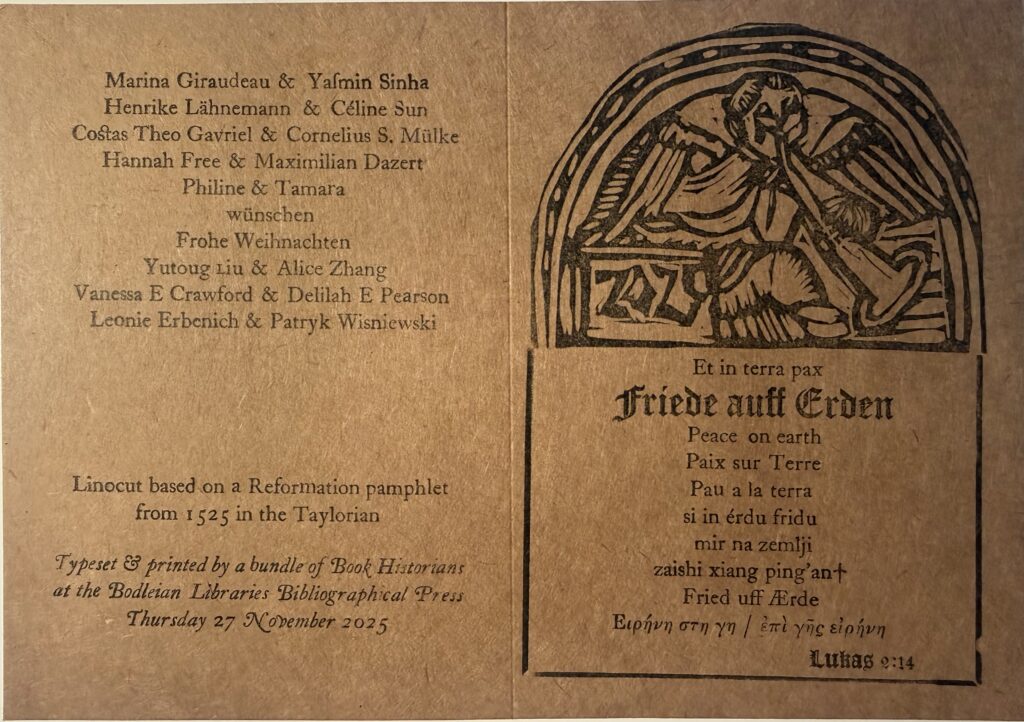
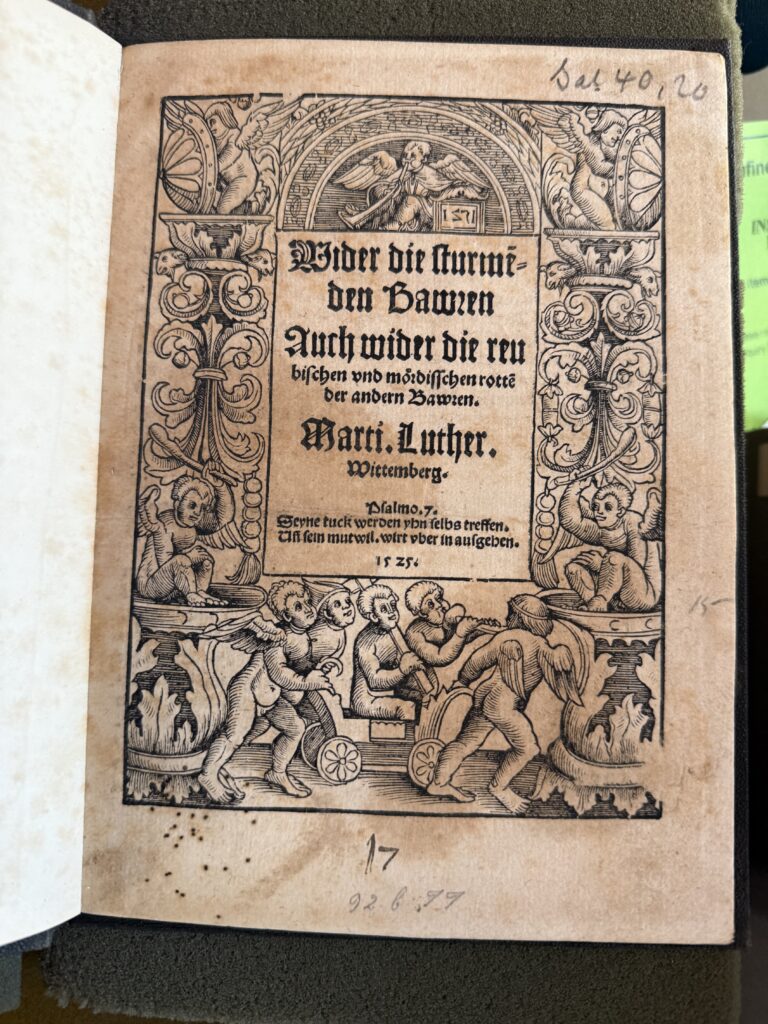
During these last warm and sunny days of late summer, I spent a lot of time exploring the city and its surroundings. The area between Oxford and Hinksey in particular, but also Christ Church Meadow, the University Parks and the paths along the Thames between New Hinksey and Iffley are ideal for walking and running. During this time, I also had the opportunity to participate in the conference “’In our own tongues’: The Medieval Vernacular Bible and its European Contexts”, make initial contacts and friendships, and got to get to know and accompany the participants of the Summer School “Opening the Archives” organised by the Studienstiftung des Deutschen Volkes. The participants’ task was to prepare the digital edition of the pamphlet “Against the attacking peasants” (Martin Luther, 1525): they created the transcriptions, a first draft of the online edition, and curated a small exhibition on the topic in the Voltaire Room of the Taylor Institution Library.
The Michaelmas term 2025 also marked the start of seminars and actual university life in Oxford: through Henrike Lähnemann, Marina Giraudeau, the other intern for the term, and I were affiliated with St Edmund Hall College, and our admission as guest members for this term enabled us to participate in MCR social events. These events, which go hand in hand with belonging to a college, are something I am not familiar with from university life in Germany: Of course, there is also the opportunity here to join a hockey or volleyball group through university sports, go to the gym or go swimming. However, such events are inter-university, as we do not have an equivalent to the colleges. On the one hand, I liked how familiar the environment was, especially for undergraduates, but at the same time, from a German perspective, it is a little strange to be accommodated in college rooms: in Germany, students are not even obliged to live in the city where they study!
Similar to my job in Munich, where I am also involved in the chair’s advanced seminar, I was allowed to participate as an intern in Henrike Lähnemann’s DPhil colloquium in Oxford, where I was able to present my own dissertation project. As an early modern historian with a background in German studies, I particularly benefited from the feedback of the other participants, as most of them have a background in medieval studies and gave me valuable advice on working with different manuscripts. The approach to vigilance being researched by the SFB also met with lively interest and opened up further perspectives: How does our view of the sources change when we look for attention or vigilance in them? What new perspectives open up for us? Where do we encounter limitations when dealing with vigilance? We addressed these and other questions in the discussion that followed my presentation.
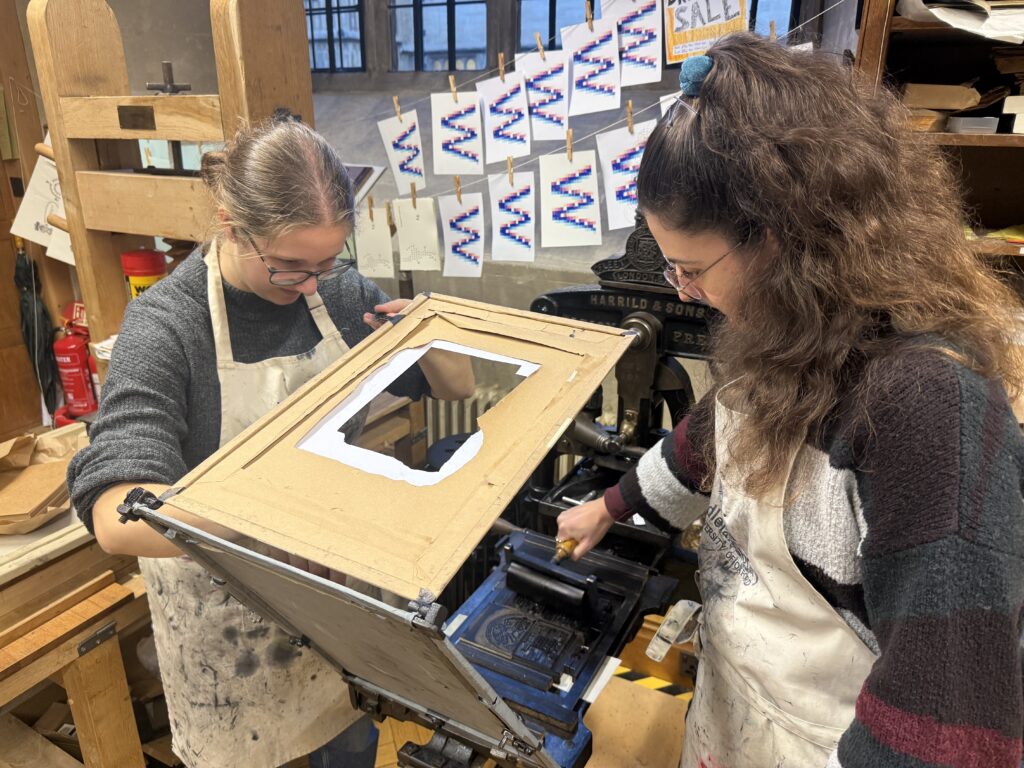
In addition to the colloquium, I participated in the seminar “History of the Book. Method Option 2025/2026”. Under the direction of Henrike Lähnemann, we dealt with different aspects each week of the term: palaeography, book development, book production and printing, textual transmission, the function and structure of libraries, and the growing field of digital humanities are just some of the topics that were the focus of attention. The emphasis was on medieval and early modern works, in particular the aforementioned Reformation publications. What I particularly liked about it, however, was that we were able to work on this seminar very much according to the principle of show-and-tell, which meant we worked in a very practical way and very close to the sources. Henrike Lähnemann invited other academics to many of the sessions, which also brought us into contact with different areas of research and work.
This work was supplemented by the “Medieval German Graduate Seminar” which is jointly organised by the three German medievalists Henrike Lähnemann, Almut Suerbaum, and Annette Volfing, taking place in Michaelmas Term in Almut Suerbaum’s college Somerville, in which we dealt with Ulrich Richental’s Chronicle of the Council of Constance (second half of the 15th century). Here, too, we dealt with different topics each week, and the discussions on the different manuscripts and their characteristics, on the boundary between historiography and literary works, but also on the historical background were particularly beneficial for my own research. These two seminars enabled me to deepen my knowledge of medieval and early modern book production and the critical approach to manuscripts, as well as my background knowledge of the ecclesiastical political circumstances of the 15th century, which ultimately led to the Reformation and thus to my project.
3 Working with early modern printed books and their digital editions
Fig. 7: Woodcut from ARCH.8°.G.1525(28). Upon closer inspection, it is noticeable that the year 1571 is written in the upper third, not 1521.
My research internship in Oxford focused on Reformation pamphlets, especially those by Luther from 1525, which are now held by the Taylor Institution Library. The aim was to bibliographically record, describe, document and compare the copies. It was particularly interesting to see how much such a pamphlet can reveal about the history of its creation and distribution. Whether it is the mirrored year on the woodcut, which indicates that it is a pirated edition, or the condition of the paper, which allows us to make a statement about how often the pamphlet was probably read and commented on – it is hardly possible to get any closer to the history of its reception!
Here, too, it was not difficult for me to establish connections to my research topic and, in particular, to vigilance: Reformation pamphlets can be read as media of heightened attention that respond specifically to perceived grievances, threats and crises. In 1525 in particular, a year marked by uprisings, uncertainty and escalating conflicts, these prints served as normative guidance for their authors and recipients but were also an expression of a changing world. A detailed analysis of the material properties, visual language and textual exaggerations revealed the extent to which practices of vigilance were not only negotiated but also generated. In this sense, the prints can be understood as part of an early modern culture of vigilance in which attention was to be directed, judgement demanded and collective willingness to act established. Furthermore, the comparison between the corpus of letters I am working on for my dissertation project and the printed pamphlets of the Reformation period sharpened my eye for media differences in vigilance practices: while the letters primarily describe a community-oriented, internal vigilance, the pamphlets aimed at public attention. What both have in common is that they provoked reactions and processes of adaptation.
However, I particularly enjoyed working on the online edition, which allowed me to become more familiar with Oxygen and coding in TEI P5 XML. Here, I was able to adapt the translation of the online edition of the pamphlet to the print version. A major highlight of this work was the launch event for the edition on 28 November, where I had the opportunity to read aloud from “Wider die mordischen und reubischen Rotten der Pawren” together with several others.
4 Oxford, snow globes and strolls between libraries and cafés
I was very lucky to be able to experience Oxford in the run-up to Christmas. From mid-November onwards, colourful lights decorated the streets, the many windows of the cafés and shops were decorated for Christmas, and the Oxford Christmas market – which, as a German, made me feel particularly at home – opened its doors at the end of November. From there, you can go straight to Blackwell’s, Oxford’s most beautiful bookshop, and do all your Christmas shopping after work and between mulled wines. The only limit I faced here was the weight of my suitcase: 23 kg as the airline’s limit is really not much after three months in Oxford!
Someone once said to me that Oxford is a bit like a snow globe: a self-contained system, a bubble that extends mainly over the university and forms a world of its own. And that’s true, in a way. Oxford invites you to immerse yourself, drift along and forget the outside world for a while. And, similar to the snowflakes in such globes, the mentality here is not really tangible: I talked to several people about their impressions of the city, many of whom have been living here for several years. What they all had in common was that they incredibly appreciate how much the city thrives academically; it’s almost as if you can watch it grow. This is mainly because research is immensely important and the city has developed and continues to develop around it: researchers come, learn and teach, exchange ideas and leave again, but the network remains. Although the city is not that big at its core, you quickly notice how extensive the network that has formed here is and how it continues to grow. I was told that Oxford is a hub to which many people return at some point, and I like that idea. Apart from the contacts I made during my research internship, I was also able to use the time to meet up again with scientists I already knew from other contexts. So, during these months, I also had the opportunity to closely integrate my research internship with my dissertation project and work on two projects at the same time!
Just as valuable as the contacts I made and maintained are all the libraries there are to explore. Regular spots and get-togethers to work together are great, but seriously: use your reader’s card and visit as many libraries as you can! Work in them, look at the books, borrow manuscripts and take the opportunity to immerse yourself in topics that may not initially have anything to do with your field of research! This opens up so many new project opportunities, and even if you don’t have time for them, working with these sources is helpful as they may reveal new perspectives on your own projects!
In addition to the opportunity to immerse yourself in the sources, you can also take part in the “Medievalists Coffee Mornings” at the Weston Library on Fridays, where you can enjoy coffee or tea and biscuits while listening to a short lecture on selected sources from the Bodleian Collections. The speakers change, so that sources from different eras and disciplines are presented, allowing you to engage in conversation with a wide variety of scholars. A little tip: the terrace, from which you can look out over Oxford, is also well worth a visit in this context!
As a very student-oriented city, Oxford has a multitude of cafés and pubs, all of which are worth trying out. My regular haunts were Jericho, the High Street, of course, as well as the surrounding streets and the area around Cowley Road. At the same time, it should be noted that even the most beautiful cafés and pubs are only half as great without friends. The idle hours of work on the weekends, which you sometimes have to put in, are much easier to bear after a coffee together at “The Independent”, for example! What’s more, the time in between can be put to excellent use to talk to others about your own projects and possible synergies!
P.S.: Coffee stamp cards are really worth it! I collected a few of them myself at my favourite café and got a pumpkin spiced latte or two for free!
5 Farewells and Returns
The twelve weeks I spent in Oxford flew by incredibly quickly. Looking back, this time was not only marked by my own intensive research work, but also by a constant sharpening of my attention: for sources, for methodological questions and for different scientific environments and their social practices. The research internship thus offered me the opportunity to reflect on and further deepen central questions of my dissertation project in a new context. Once again, it became particularly clear to me that vigilance can be understood not only as an analytical concept, but also as an attitude that shapes one’s own everyday academic life – whether in dealing with sources, in exchanges with colleagues, or in exploring new environments. At the same time, I had the opportunity to meet many wonderful people who greatly influenced my stay in Oxford and made this time unforgettable.
What am I taking back with me to Munich from Oxford? In addition to the many books, gifts and memories, there are also ideas for further projects: whether these are ideas for creative writing or for introducing meetings such as the Medievalists Coffee Mornings into my own working environment in Munich – I am looking forward to the coming months, during which I will continue to draw on this stay!
Finally, what could be more fitting than a formal dinner at St Edmund Hall to mark the end of my stay? I was even lucky enough to be invited to the undergraduates’ Christmas dinner. Together with Marina, I had the privilege of sitting at the high table with Henrike Lähnemann, enjoying interesting conversations and experiencing the Christmas traditions of Christmas crackers and singing on chairs!
P.S.: Stamp cards are also worthwhile when it comes to farewells: I have just started a new one at my favourite café, so I definitely have to come back to Oxford! Perhaps this is my personal Oxford equivalent of the coin in the Trevi Fountain – it has worked for Rome in any case!
[1] Brendecke, Arndt: Warum Vigilanzkulturen? Grundlagen, Herausforderungen und Ziele eines neuen Forschungsansatzes. In: Mitteilungen des SFB Vigilanzkulturen (01/2020), p. 11–17, here p. 16 (my translation).
Organisers: Matthew Holford, Andrew Honey, Laure Miolo
Hilary Term 2026, Wednesdays 2.15-3.45pm (see sessions details below). Venue: Weston Library, Horton room. Anyone interested in manuscript studies is welcome. No registration required. For questions, please e-mail laure.miolo@history.ox.ac.uk
The series of seminars has been designed to introduce participants to the various material aspects of the book, thereby laying the foundations for the reconstruction of manuscripts’ production and history. The objective is to provide the indispensable elements for the analysis of the manuscript.
The seminars also provide a forum for specialists from different fields of manuscript studies to share their expertise. The sessions bring together curators, librarians, researchers and conservators to provide a comprehensive understanding of the various components of the codex from diverse perspectives. These components include the writing surface, ink, binding, decoration, manuscript production in its broadest sense, and its provenance. The seminars thus represent a valuable opportunity to demonstrate the necessity of close collaboration between researchers, curators/librarians, and conservators for a comprehensive consideration of the manuscript in its entirety. Such collaboration facilitates a more profound comprehension of the diverse contexts in which the manuscript was created, copied, and utilised.
Wednesday 28 January Writing supports (parchment and paper) and manuscript structure – Andrew Honey & Matthew Holford
Wednesday 4 February Decoration – Martin Kauffmann
Wednesday 11 February Inks and Pigments – Céline Delattre and Robert Minte
Wednesday 18 February Bindings – Andrew Honey
Wednesday 25 February Calendars and time-reckoning – Laure Miolo
Wednesday 4 March Medieval Libraries and Provenance – Matthew Holford and Laure MioloWednesday 11 March Text identification – Matthew Holford and Laure Miolo