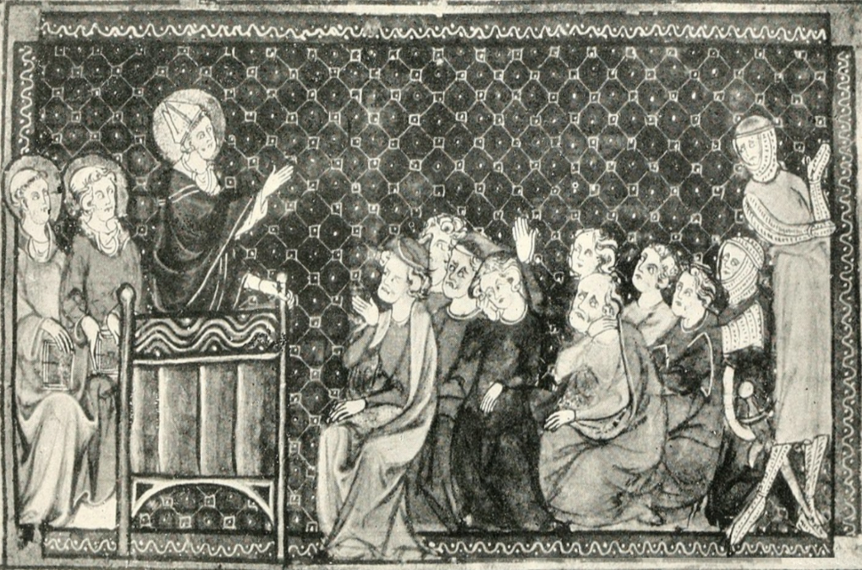
Two Weeks in Wonderland

“OH, I’ve had such a curious dream!” said Alice […]

– Alice in Wonderland (Lewis Carroll)

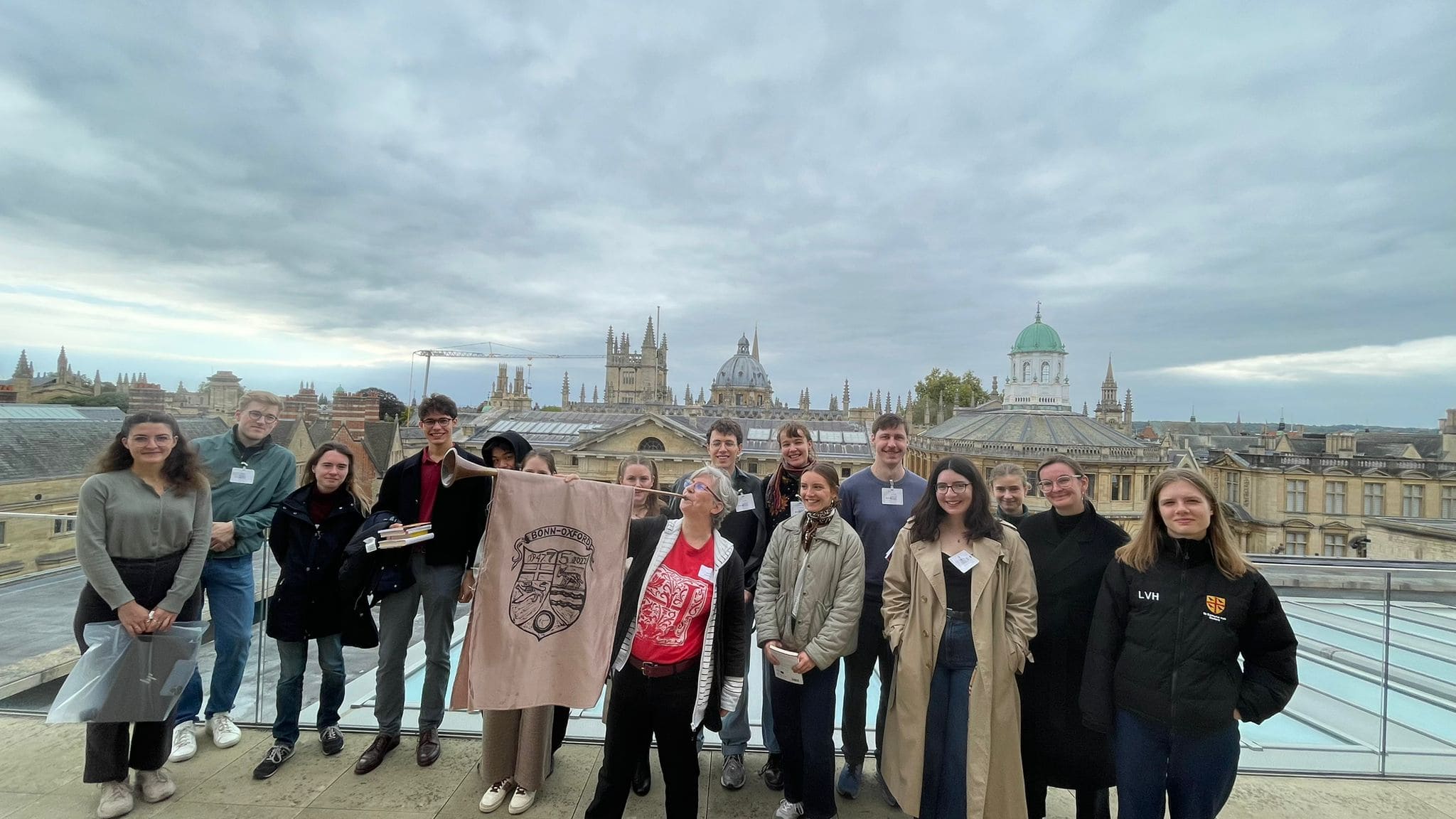
Going back to Germany after my two-week adventure in Oxford, I, just like Alice, felt as if waking up from a magical dream. It is not an overstatement to say that the city has bewitched me and, trust me, you don’t have to be a huge Harry Potter geek (which I nevertheless am) to fall under its spell. No wonder the city served as inspiration for Lewis Carroll‘s most famous novel. Instead of a White Rabbit with a big pocket watch, it was Henrike Lähnemann with her trumpet whose call I followed. Prof. Lähnemann kindly invited me to the XML summer school taking place yearly at St Edmund Hall and to spend another week as her intern at the Sommerakademie of the German Scholarship Foundation
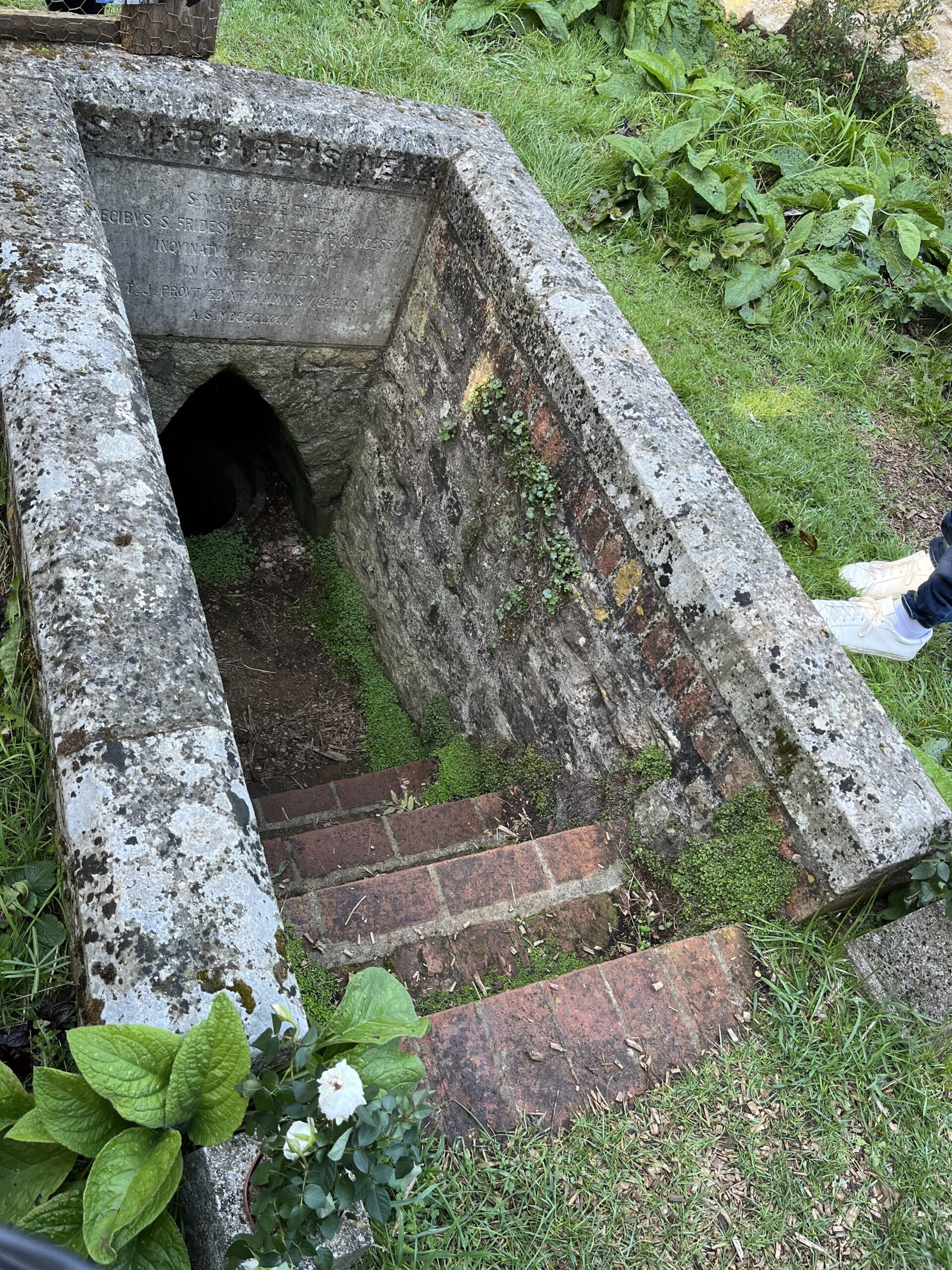
Saint Margaret’s Well in Binsey featuring as
“Treacle Well“ in Alice in Wonderland

“CURIOUSER and curiouser!”

– Alice in Wonderland (Lewis Carroll)

There‘s no better way to describe my time in Oxford. From the start, the theme of my visit was “Looking behind closed doors“. I arrived just in time for the Oxford Open Doors, which take place each year in September and allow the public a sneak peek into Oxford’s Colleges. For me that meant: see as much as you can within one day! I think I almost walked 40 000 steps that day, but the visual enrichment made more than up for the physical fatigue.
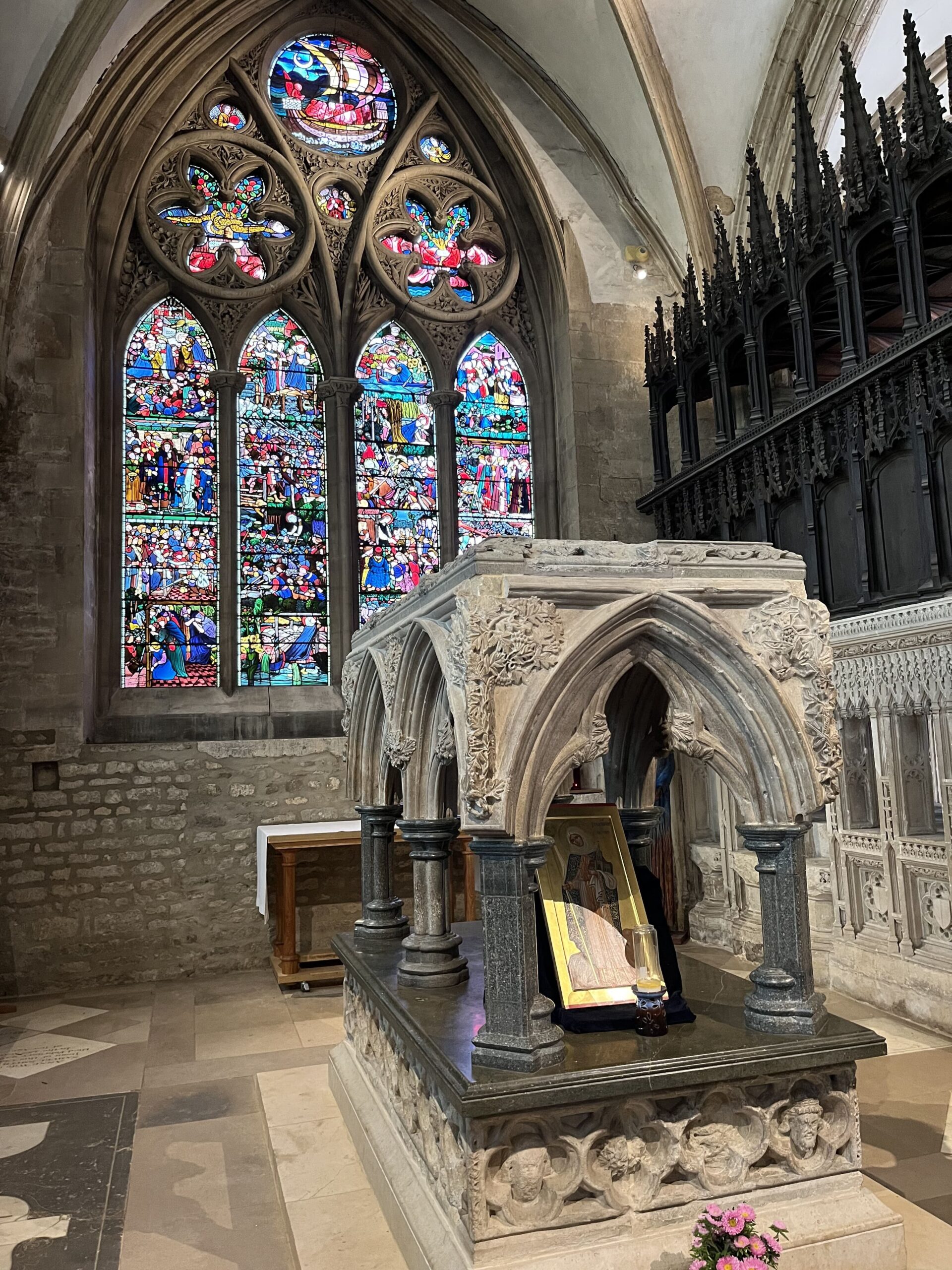
Shrine of St Frideswide in Christ Church Cathedral

While, outside of Open Doors, you can get into some colleges by simply asking nicely or pretending to be a prospective student, you usually need to pay an entrance fee, which can vary from £2 to up to £20, depending on the colleges prestige and their Harry Potter screen-time. The best way to get inside without having to pay is to go to a college chapel service or evensong. No one can fine you for wanting to go to church and no one will come after you if you walk the grounds a little afterwards. (As long as you don’t step on the grass!) Prof. Lähnemann took us to Christ Church Cathedral on the first day of the Sommerakademie, where we were able to enjoy all the pomp and circumstance of an Anglican church service and the angelic voices of Christ Church’s choir.

As the saying goes “When one door closes, another one opens up“, I spent my second week as part of Prof. Lähnemann’s working group “Opening the Archives“. The object was to create a digital edition of Martin Luther’s pamphlet “Wider die mörderischen und räuberischen Rotten der Bauern“ (1525), which is going to be published in November 2025 in the Reformation Series of the Taylor Editions. Together with her colleague Dr Andrew Dunning, Prof. Lähnemann gave us enlightening insights into the history of bookmaking, the collection of Reformation pamphlets in Oxford, and printing practices in the 16th century. We even dabbled a little in some printing work ourselves at the printing workshop of the Bodleian Library.
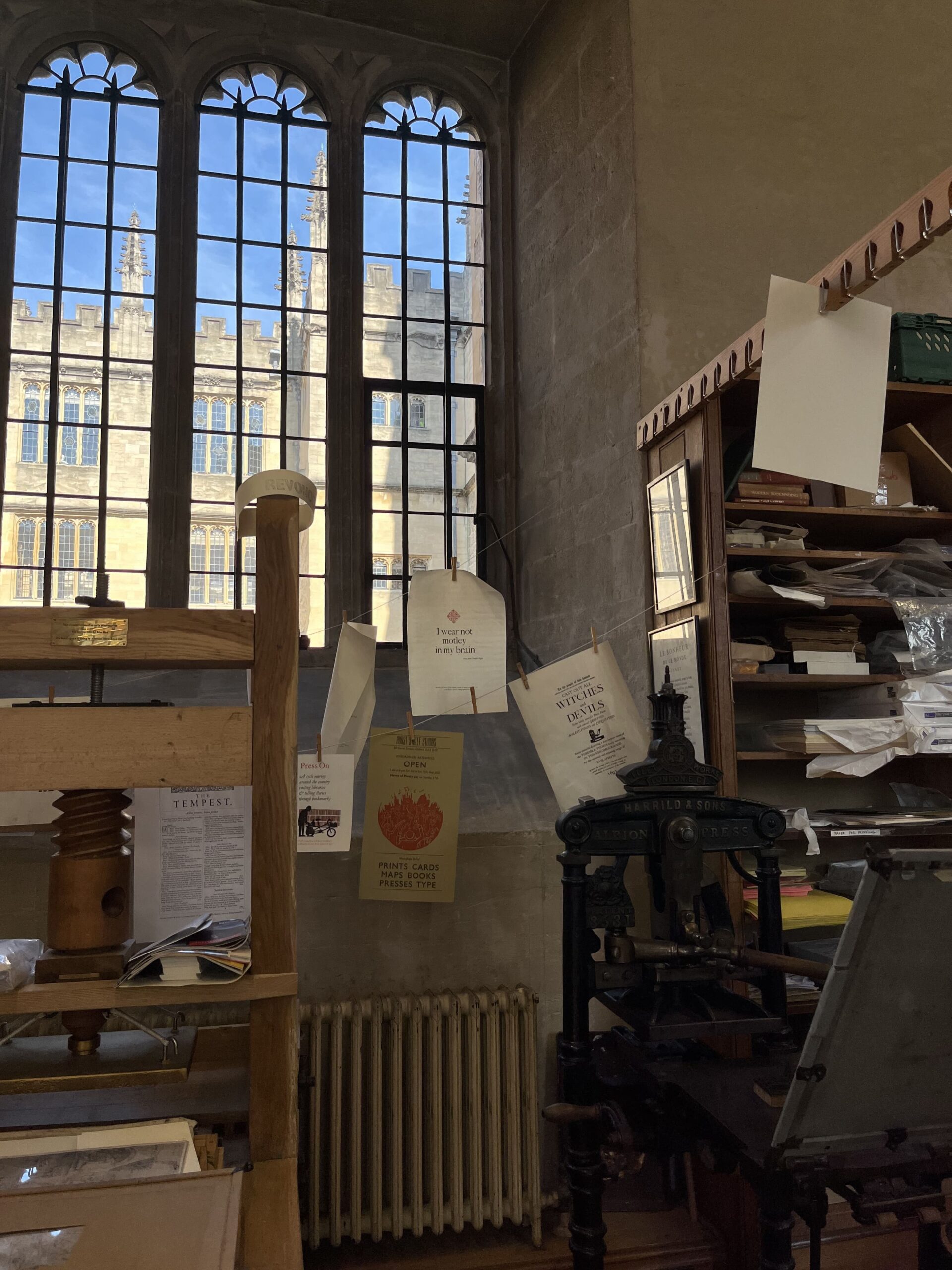
Printing Workshop in the ‘schola musicae’ of the Bodleian Library
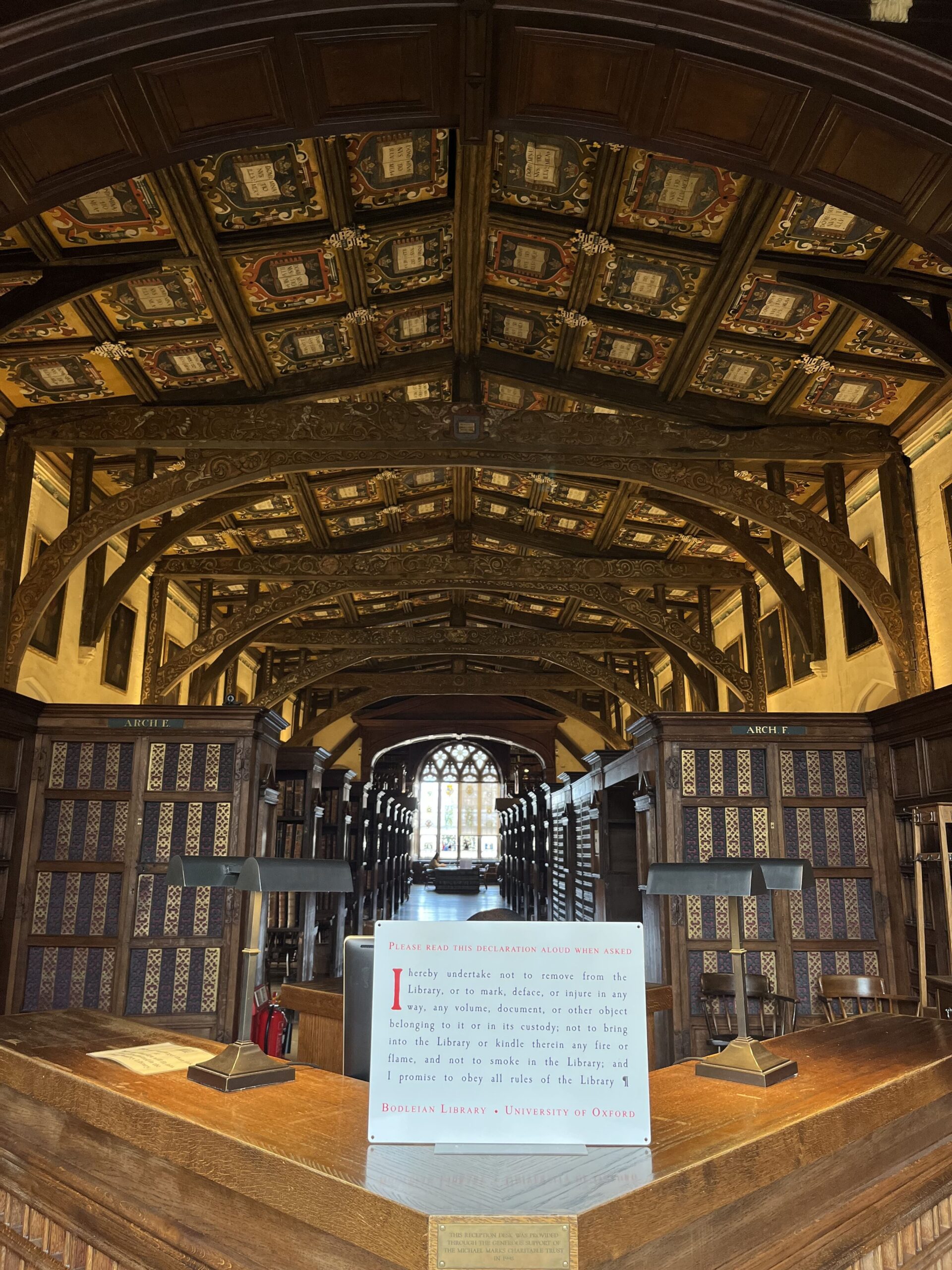
Duke Humfrey’s Library

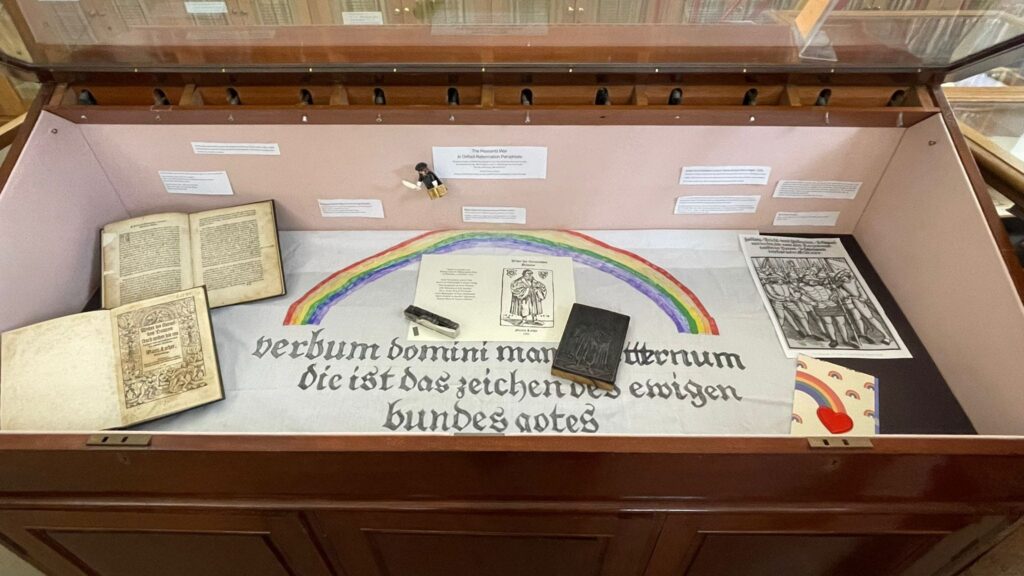
At the end of the week, we had not only gained a better understanding of the Reformation and the Peasant’s War, but, thanks to Emma Huber, the German subject librarian and DH lead at the Taylor Institution Library, also made our own transcription and edition as well as curated an exhibition case at the Taylorian.
One of the key lessons I learned during my time in Oxford is to approach all objects with curiosity and to look closely. There is usually a story behind the smallest and most insignificant-seeming thing – whether it be an old shoe scraper or an inconspicuous pencil marking in a book. Our little group was lucky enough to have access to those parts of the University not open to the public, but many of Oxford’s treasures are not kept under lock and key. The “Treasured“ Exhibition at the Weston Library is a great example of that. Free of charge, you can gaze at various precious specimens of the Library’s collection.

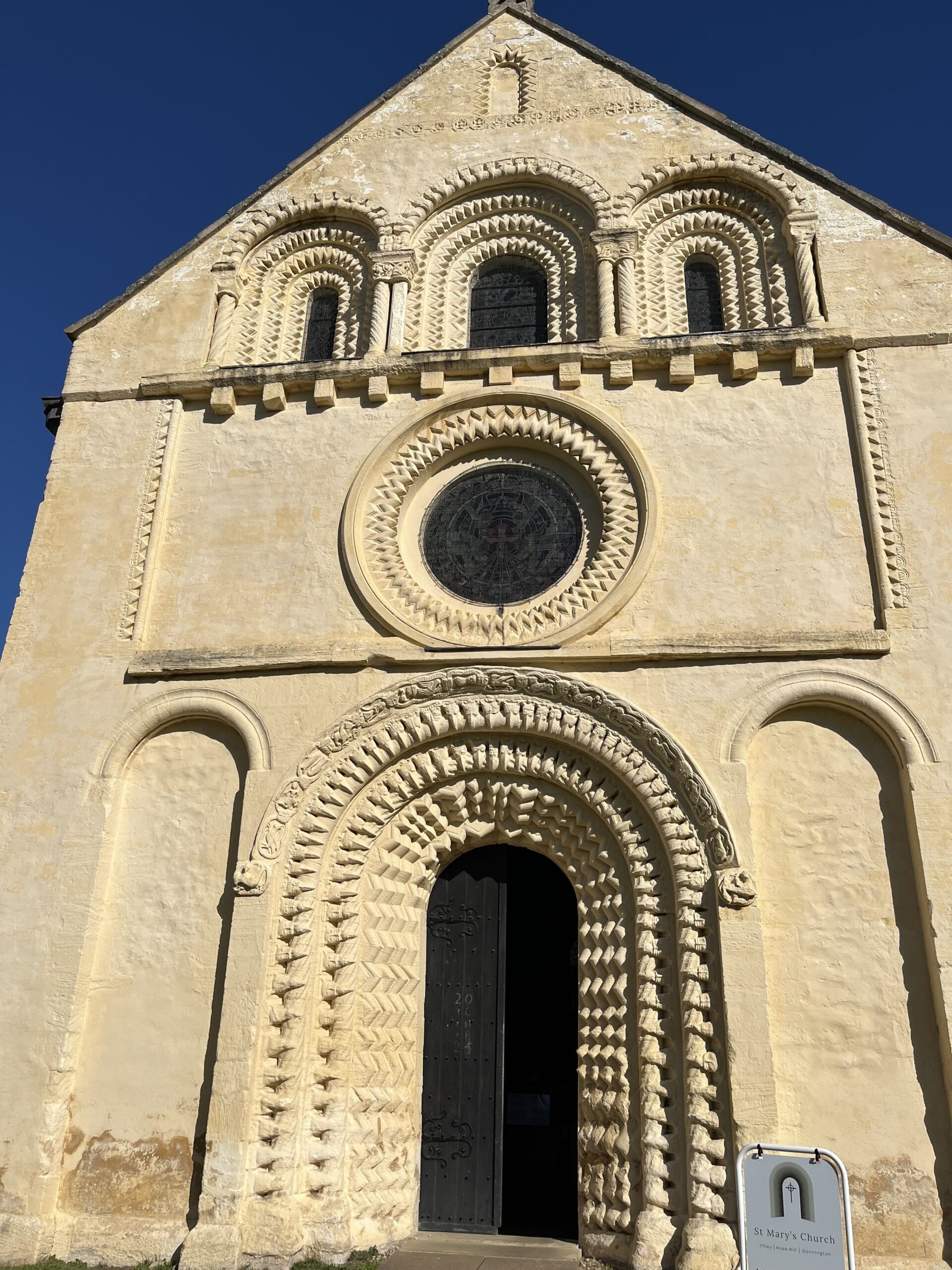
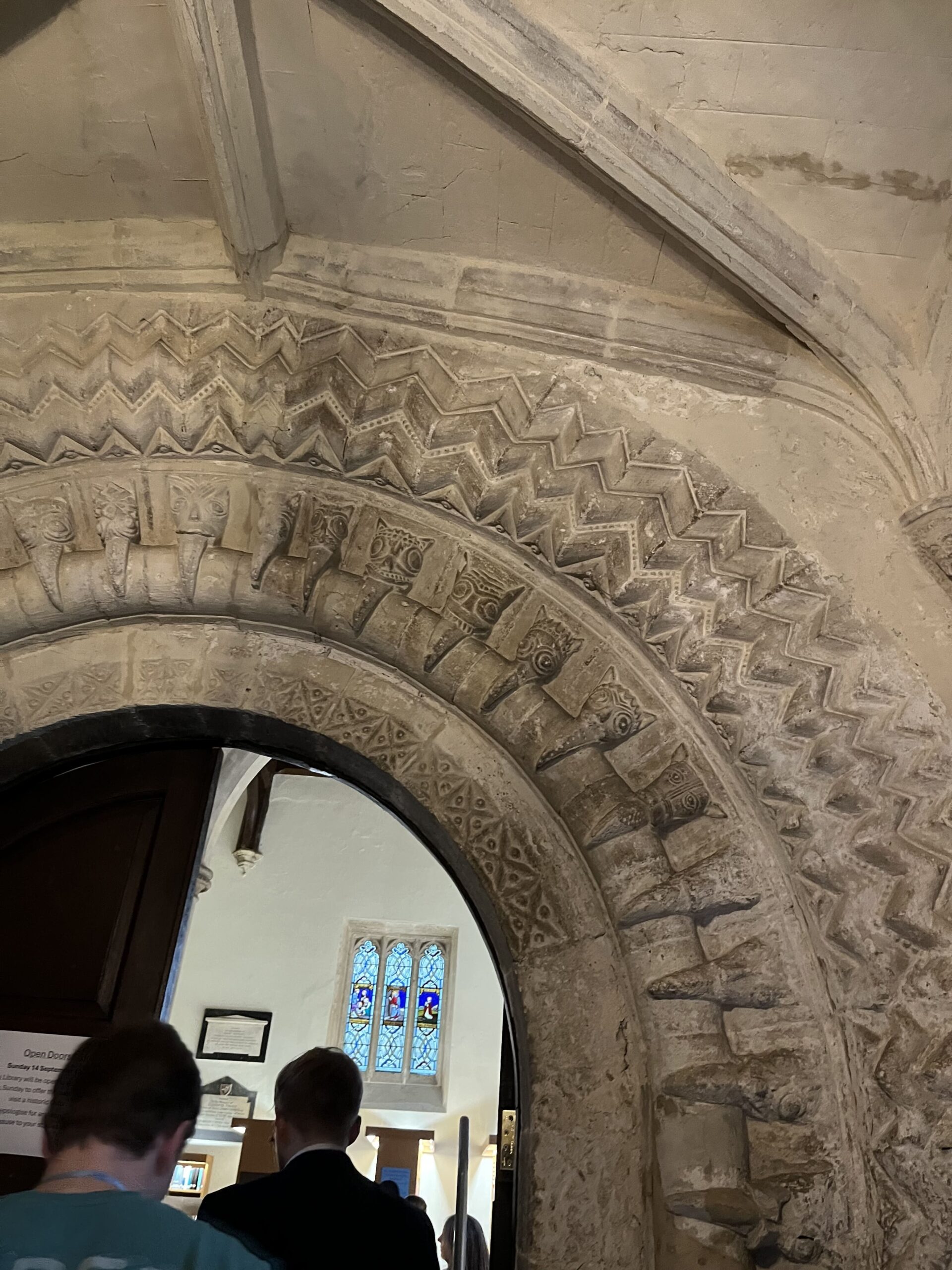
But you don‘t even always need to step inside to discover hidden treasures. Simply by walking through Oxford’s streets with attentive eyes, you‘ll see things that seem to come straight from Wonderland: Gargoyles staring down at you in no way less grotesque than Carroll’s grinning cat; or the beak heads around the entrance of St Peter-in-the-East (St Edmund Hall) and St Mary’s in Iffley, which are – to put it once more in Carroll’s words – “indeed a queer-looking party“.
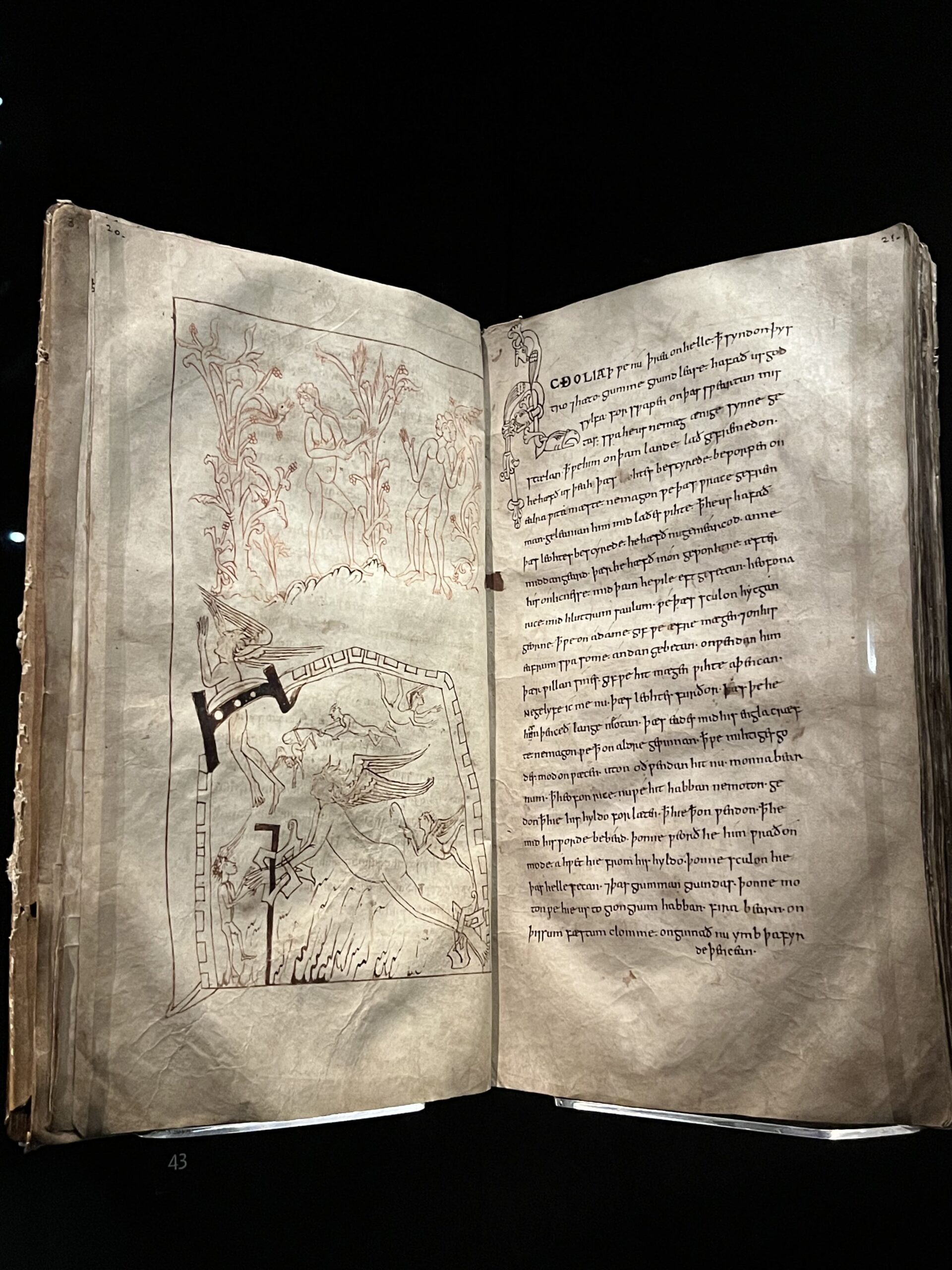
Junius Manuscript at the “Treasured“ Exhibition in the Weston Library
Chevron Ornaments with beak heads at St Peter-in-the-East (St Edmund Hall)
St. Mary’s (Iffley): West entrance with Chevron Ornaments including beak heads

A Mad Tea Party

As Alice learns during her Adventures, it often is not so much about what you do, but who you do it with. It makes a huge difference if you have a tea party with a mad hatter, a March Hare, and a dormouse or with your old aunt Agatha. It’s the people that make an event unforgettable. And that summarizes my summer school experience(s) quite nicely. Especially during the first week at the XML summer school, where I, as a medieval Germanist and foreigner to the digital world, only understood about 30% of what was being taught. However, I met so many fascinating, inspiring people and had interesting discussions, in which new perspectives opened up to me. The same holds for the Sommerakademie of the German Scholarship Foundation: Young people from all different subjects and backgrounds coming together, sharing ideas, knowledge and always a good laugh. That is why I regard tea breaks, lunches and dinners as an essential part of the summer school experience. They give you the chance to connect with other people, socialise, pick up interesting conversations, and, of course, enjoy the excellent food! (In that respect Teddy Hall excelled. But you need to be quick when it comes to pudding, otherwise you might face an empty tray and ask yourself: “WHO stole the tarts?“) Staying on the topic of food and socializing, I would advise everyone to visit the Coffee Mornings at the Weston every Friday at 11:30 am. Alongside tea, coffee and biscuits there is a talk on a different topic every week, so no matter which subject you are coming from, there will be something for you. It is a great opportunity to see some of the unique holdings of Oxford’s libraries and gain an insight into current research projects at the university.

I want to take this opportunity to thank the person who most prominently shaped my Oxford experience: Henrike Lähnemann. One thing is for sure, had I been interning for another Professor, the two weeks would have been less crazy, lacked fun, less memorable. So next time you think you hear the distant call of a trumpet, follow it! It might lead you into Wonderland…

Judith Habenicht is a German and History student at the University in Heidelberg who spent two weeks in Oxford on a placement with Henrike Lähnemann
Medieval Matters, MT25 Week 3

Week 3 is upon us – please find below the weekly offering of events, groups, and opportunities. As always, you can find a complete copy of the Oxford Medieval Studies Booklet here.  Any last-minuted changes will be updated in the weekly blogpost and in the calendar, both accessible via https://medieval.ox.ac.uk/.

Monday

  • French Palaeography Manuscript Reading Group – 10:30, Weston Library (Horton Room)
  • Introduction to Arabic Palaeography – 2:00, Khalili Research Centre
  • Carmina Burana: Graduate Text Seminar – 5:00, Harris Lecture Theatre, Oriel College
  • Medieval History Seminar – 5:00 with drinks reception to follow, All Souls College. Lucy Donkin (University of Bristol) will be speaking on “Ex urbe et ab Hierosolomis: The Materiality and Portability of Place in Pre-Reformation Europe”.

Tuesday

  • Medieval English Research Seminar – 12:15, Margaret Thatcher Centre, Somerville. A range of contributors will be speaking on ‘On the Life and Works of Vincent Gillespie’
  • Latin Palaeography Manuscript Reading Group – 2:00, Weston Library (Horton Room)
  • Medieval Church and Culture Seminar – 5:00, Harris Manchester College. Susanna Heywood (KCL): will be speaking on ‘A Practical Guide to Kingship?: the virtue of prudence in Giles of Rome’s De Regimine Principum’
  • Medieval French Researsh Seminar – 5:00, Maison Française d’Oxford. Prof. Ellen Delvallée (Université Grenoble Alpes) will be speaking on ‘‘Éclats de la Chronique française de Guillaume Cretin: de l’inachèvement aux explorations esthétiques’
  • Old English Graduate Reading Group – 5:15, location TBC, contact Hattie Carter
  • Oxford Architectural and Historical Society – 5:30, Rewley House. Duncan Taylor will be speaking on ‘A New Understanding of Oxford’s Divinity School Vault’

Wednesday

  • John Lydgate Book Club – 11:00, Smoking Room (Lincoln College).
  • Medieval German Graduate Seminar – 11:15, Somerville College.
  • Older Scots Reading Group – 2:30, Room 30.401 in the Schwarzman Centre.
  • Medieval Latin Documentary Palaeography Reading Group – 4:00, online.
  • Late Antique and Byzantine Seminar – 5:00, Ioannou Centre. Stratis Papaioannou (Athens) will be speaking on ‘The Synaxarion of Constantinople as Historiography’
  • Centre for Manuscript and Text Cultures Lecture – 5:15, Memorial Room (The Queen’s College). Daniel Schwemer (Würzburg) will be speaking on ‘Ancient Kings, a New Language (and sometimes wheelbarrows): a decade of field epigraphy at the Hittite capital Boğazköy-Ḫattuša’

Thursday

  • Middle English Reading Group – 11:00, Beckington Room (Lincoln College).
  • Environmental History Working Group – 12:00, Room 20.421 in the Schwarzman Centre. Madeleine Fyles (UToronoto) will be speaking on ‘More than Kindling: Algarrobo Posts and Social Memory on the Peruvian North Coast’.
  • Celtic Seminar – 5:00, hybrid. Jaione Diaz Mazquiaran (Alan R King Etxepare Chair 2025) will be speaking on ‘Language, Beliefs, and Belonging: Immigrant Students in Basque-Medium Education’
  • Medieval Visual Culture Seminar – 5:00, St. Catherine’s College. Hannele Hellerstedt (Ox.) will be speaking on ‘Seeing Double: Visualizing La Cité des dames and La Cité de Dieu‘.
  • Seminars in Medieval and Renaissance Music – 5:00, online. Anne Walters Robertson (The University of Chicago) will be speaking on ‘a cycle of masses for all seasons in the Burgundian court’
  • Spooktacular Manuscripts – 3:00, Visiting Scholars’ Centre (Weston Library). To celebrate Halloween, Alison Ray will present a range of spooktacular medieval manuscripts, from magical spell books and alchemical texts to depictions of black cats and a witches’ sabbath. Costumes are optional! NOTE that a University or Bodleian reader card is required for access, which is via the Readers’ entrance to the Weston Library
  • Compline in the Crypt – 9:30, St Edmund Hall.

Friday

  • Medievalist Coffee Morning – 10:30, Visiting Scholars Centre (Weston Library). All welcome, coffee and insight into special collections provided.
  • Exploring Medieval Oxford through Surviving Archives – 2:00, Weston Library (Horton Room).
  • Oxford Medieval Manuscript Group: Library Visit (Merton) – 5:00. Sign-up required.

Opportunities

Heritage Science and Manuscripts Conference: Programme

New directions in the study of written artefacts from Antiquity to the late Middle Ages.
Organised by the Crafting Documents project (AHRC-DFG) and co-sponsored by the Centre for Manuscripts and Text Cultures, University of Oxford.
13-14 NOVEMBER 2025, SHULMAN AUDITORIUM. THE QUEEN’S COLLEGE, UNIVERSITY OF OXFORD
Register for free here

9:30 Arrival and registration (coffee and tea available for all attendees)
9:45 Welcome
Julia M. H. Smith (Crafting Documents co-PI, All Souls College, University of Oxford)
Martin Kauffman (Head of early and rare collections, Special Collections, Bodleian Library)
Dirk Meyer (Director of the Centre for Manuscript and Text Cultures, The Queen’s College, Oxford)
10:00 Brent Seales (University of Kentucky): UnLost: uncovering lost knowledge from the ancient library of Herculaneum
10:50 Richard Gameson (Durham University): The Hereford palimpsest psalter
11:40 Jess Hodgkinson (University of Leicester)
Insular manuscripts and their readers: using photometric stereo imaging
to study drypoint writing
12:30 Lunch Break
TECHNOLOGIES TO RETRIEVE WRITING
(Chair Lesley Smith, Harris Manchester College, Oxford)
INKS AND PARCHMENT
(Chair Martin Kauffman, Bodleian Library)
2:30 Kristine Rose-Beers (University Library Cambridge)
Early Islamic manuscripts on parchment: surface preparation and
practice-based research
3:20 Andy Beeby (Durham University)
On the variation in the density of writing as seen by multi and hyper-spectral
imaging: looking over the scribe’s shoulder
4:10 Coffee and tea break
5:00 Ira Rabin (Bundesanstalt für Materialforschung und -prüfung)
Ana de Oliveira Dias (University of Oxford)
Ink analysis of early medieval relic labels
Wine reception sponsored by the Centre for Manuscript and Text Cultures,
The Queen’s College, Oxford
(6:00 – 7:00)DAY 2
MATERIAL SCIENCE AND HERITAGE RESEARCH
9:30 Alberto Campagnolo (Katholieke Universiteit, Leuven)
Approaches to heritage science for manuscripts in the Digital Humanities
10:20 Michael Marx, Institut für Studien der Kultur und Religion des Islam
Goethe-Universität Frankfurt / Institute of Advanced Studies Jerusalem
Results of carbondating of early Qurʾānic manuscript and their implications for
our understanding of the history of the Qurʾān
11:10 Coffee and tea break
11:40 Matthew Collins (University of Copenhagen/University of Cambridge)
Proteomics analysis of parchment samples
12:30 Colloquium pause
(Chair Dirk Meyer, The Queen’s College, Oxford)
4:00 Coffee and tea
4:30 Tessa Webber (Trinity College, University of Cambridge)
Early medieval written artefacts: a palaeographical perspective
5:00 Round table discussion
BROADER PERSPECTIVES
(Chair Julia Smith, All Souls College, University of Oxford)

Between bats, bindings, and hidden unicorns

Three reasons to study Palaeography

by Hannah Free (MSt. Medieval Studies 2025)

It was an exciting time being one of this years MML History of the Book students as we met up for the second time this term to have a three hour introduction to medieval Latin Palaeography. Dr Laure Miolo and Dr Alison Ray set up a programme that not only gave a well-rounded overview (even though we know that we barely scratched the surface of what there is to uncover) over everything related to palaeography, but also allowed students to examine exactly what they had just learned on the actual books.

So why would I want to study old books and their handwriting, you might ask? This question seems a little unlikely regarding the fact that you seem to have found this blog and have started to read this very entry – but surely you live a busy life and might think to yourself: “This all seems interesting, but do I really need to concern myself with this?” So here are three of the many reasons, why Palaeography is absolutely worth your precious time:

First of all, there is a lot to do! You can find a wide range of different handwriting starting with the earlier handwritings like the Capital script and the Roman cursive script and ending with the Humanistic script in the 16th century. (Medieval) Latin palaeography presents the opportunity to uncover over a thousand years of written history. So let’s start the journey with an overview over about 700 years in under two minutes, presented by Dr Alison Ray

And let me assure you, there is a lot more to unpack here. How about a roll from the early 16th century (MS. e. Museo 245) for example, that is not only impressive due to its size but also is said to have magical powers. Or how about a so-called bat book (MS. Ashmole 6), that was probably owned by a physician and that could be attached to the belt. Why is it called a bat book? Have a look

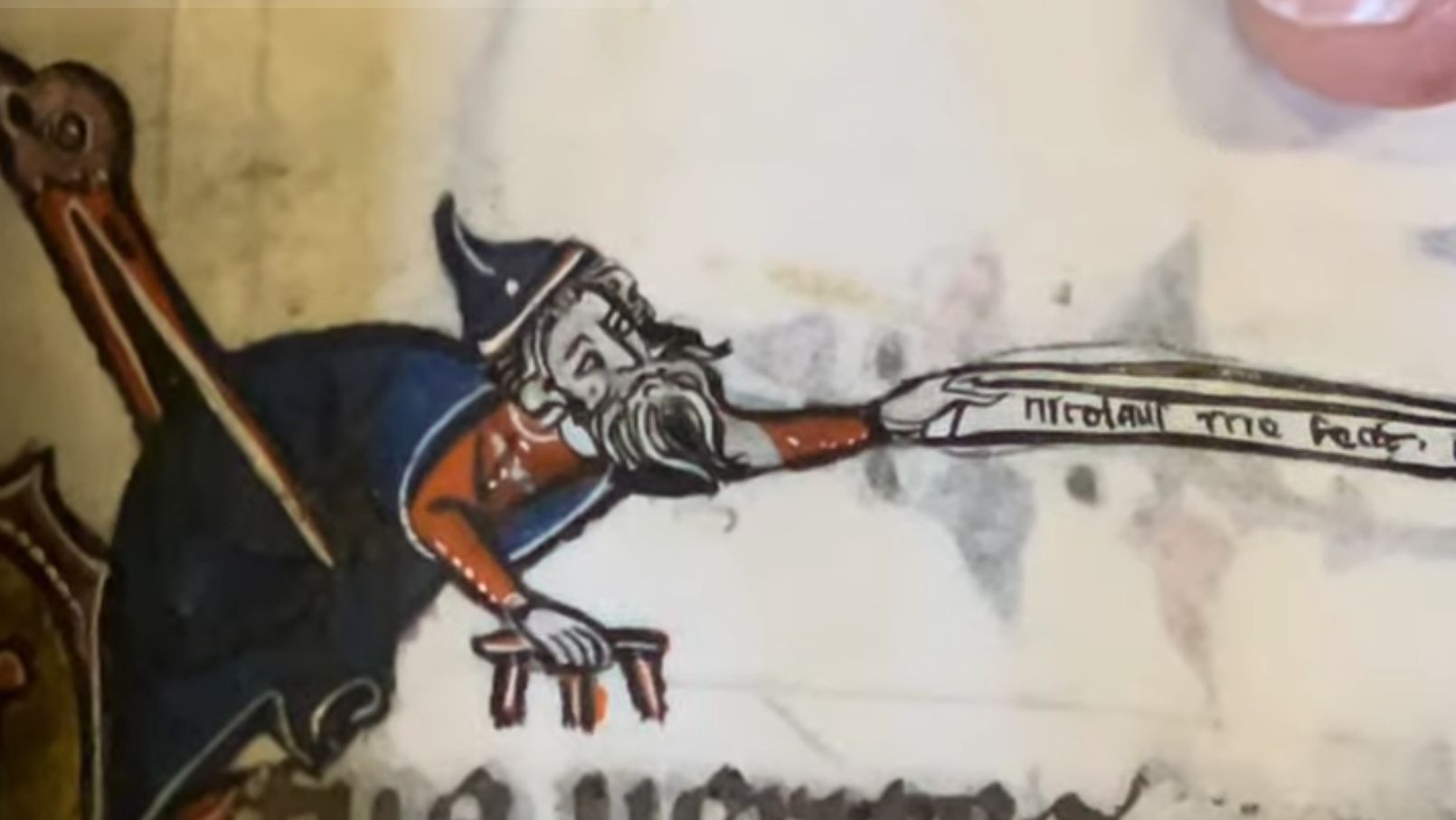
But the journey doesn’t end here as Palaeography entails much more than just the different kinds of books and handwritings. Have you ever gotten tired of looking at letters and words all day long? Well, how about looking at pictures instead, because with Palaeography you can call this research now. And unsurprisingly there is a lot of fun to have with this. How about for example the Aspremont Psalter (MS. Douce 118), where you can find a miniature of one of the illuminators, thus: a medieval selfie (see the header image of the disabled scribe with a Jew’s hat who holds the scroll ‘Nicolaus me fecit qui illuminat librum’ on fol. 142r; it is very small indeed, but the word miniature actually comes from the word minium, which refers to the type of colour that was used to outline the different pictures by the illuminator). Or in case you have ever asked yourself what your urin should and shouldn’t look like, you may (or rather may not) refer to the urin wheel depicted in an Astronomical Calendar from the 14th century (MS. Ashmole 789)

Last but most certainly not least you will not only uncover history on a great scale and be able to look at pretty and fun miniatures, but you will also get to look behind the book and uncover its sometimes very individual story. For example if you shine light on the Liber mortis et vitae (MS. Rawl. D. 403) from the late 15th/ early 16th century with a flashlight, you will find a unicorn shining through the pages. Even though this is great just for any reason, the unicorn here actually serves a function: it is a medieval watermark. So, if you ever wondered why some books have holes in their bindings (see for example MS. Bodl. 192), who the poodlemaster was or how books could be protected during travel (see for example MS. Rawl. D. 403), Palaeography will be the answer to all of your questions

To sum up, a huge thank you to Dr. Laure Miolo and Dr Alison Ray for this wonderful introduction to Palaeography and for giving us so many reasons to study this inspiring subject!

Medieval Matters MT25, Week 2

Welcome to week 2, and the Medieval Matters email – a day early this time to coincide with St Frideswide’s Day! In honour of the occasion, Jesus College has paid for the Pershore Legendary to appear on Digital Bodleian, which includes the most accurate copy of Robert of Cricklade’s Life of St Frideswide. Browse away!

As always, you can find a complete copy of the Oxford Medieval Studies Booklet here.  Any last-minuted changes will be updated in the weekly blogpost and in the calendar, both accessible via https://medieval.ox.ac.uk/.

Monday

  • French Palaeography Manuscript Reading Group – 10:30, Weston Library (Horton Room)
  • Introduction to Arabic Palaeography – 2:00, Khalili Research Centre
  • Carmina Burana: Graduate Text Seminar – 5:00, Harris Lecture Theatre, Oriel College.
  • Medieval History Seminar – 5:00 with drinks reception to follow, All Souls College. Peter Jones (King’s College, Cambridge), will be speaking on ‘Event, story and image in writings of John Arderne (1307-c.1380), English surgeon’.

Tuesday

  • Medieval English Research Seminar – 12:15, Margaret Thatcher Centre, Somerville. David Scott-Macnab (North-West U) will be speaking on ‘Edward, Second Duke of York’s Master of Game: A New Edition for EETS
  • Latin Palaeography Manuscript Reading Group – 2:00, Weston Library (Horton Room)
  • Medieval Church and Culture Seminar – 5:00, Harris Manchester College. John Merrington (All Souls) will be speaking on ‘Reading the Five Thousand: gender, the body and the interpretation of John 6 in medieval Europe’.
  • Medieval French Research Seminar – 5pm at the at the Maison Française d’Oxford. Prof. Johannes Junge Ruhland (University of Notre Dame) will be speaking on ‘The Bookishness of French Prose Histories’.

Wednesday

  • Medieval German Graduate Seminar – 11:15, Somerville College. The topic for this term is Ulrich von Richental, Chronik des Konzils zu Konstanz (1414-1438).
  • Older Scots Reading Group – 2:30, Room 30.401 in the Schwarzman Centre.
  • Medieval Latin Documentary Palaeography Reading Group – 4:00, online.
  • Late Antique and Byzantine Seminar – 5:00, Ioannou Centre. Johannes Pahlitzsch (Mainz) will be speaking on ‘Concepts of Space and Orthodoxy beyond Byzantium’.

Thursday

  • Middle English Reading Group – 11:00, Beckington Room (Lincoln College).
  • Medieval Women’s Writing Research Seminar – 4:00, Somerville College (meet at Lodge). Authorising the Text: including extracts from the prose works of Teresa de Cartagena and Anna Komnene.
  • Celtic Seminar – 5:00, hybrid. Rhys Kaminski-Jones (CAWCS) will be speaking on ‘Bardic liberties: Bardism and slavery in the poetry of Iolo Morganwg’.
  • Guild of Medievalist Makers – 5:30, online. Making Space Session.
  • Oxford University Heraldry Society – 6:30, online. Mike Rumble will be speaking on ‘The Heraldry of Kensington and Chelsea, London’.

Friday

  • Medievalist Coffee Morning – 10:30, Visiting Scholars Centre (Weston Library). All welcome, coffee and insight into special collections provided.
  • Exploring Medieval Oxford through Surviving Archives – 2:00, Weston Library (Horton Room).
  • Memorial Service for Professor Vincent Gillespie – 2:00, Keble College Chapel.
  • Oxford Medieval Manuscript Group Workshop – 5:00, Merton College. Workshop with Joumana Medlej.

Opportunities

MEMRN Winter Conference 2025

Fragmented Worlds, Shared Histories

The MEMRN Committee are delighted to announce the return of the Winter Conference after the huge success of last year’s inaugural in-person event in Norwich. The MEMRN Winter Conference 2025 will be held from the 13th to the 16th November 2025 at the University of East Anglia.

Please find the provisional programme for our conference event below. You can register to attend the conference panels virtually via Eventbrite HERE. Online registrations for the final few in-person spaces will be opened shortly. We hope to see you there!

Thursday 13th November Scheduled Activities
19:00
Norwich City Centre
The Adam & Eve
17 Bishopgate,
Norwich, NR3 1RZ
Welcome to MEMRN’s Winter Conference 2025! 

If you’re arriving early to the conference, we’d like to welcome you to Norwich by heading out together on a sociable crawl of some of Norwich’s oldest and finest pubs. 

We’ll begin our evening at the oldest pub in the city: the Adam & Eve, which dates back to at least 1249! From there, we’ll walk over to the Belgian Monk next to the historic Maddermarket. Try the cherry beer – you won’t regret it! We plan to wind up at the Lamb Inn, located in what was medieval Norwich’s Jewish Quarter. 
Friday 14th NovemberDay OneScheduled Activities
10:00 – 10:10
University of East Anglia 
Congregation Hall 
Room 0.13
Arrival & registration at Congregation Hall, UEA. 

Morning refreshments (tea, coffee and breakfast pastries) will be provided.)
10:10 – 10:20 
University of East Anglia 
Congregation Hall 
Room 0.13
Welcome and Opening Remarks from the CHASE MEMRN Committee.
10:30 – 11:40 
University of East Anglia 

Panel Session One: 
Congregation Hall 
Room 0.13

Panel Session Two: 
The Union Building
Room 1
Panel Session One: Fragmented Religious Communities 
Panel Chair: Freya Laidlow-Petersen

Dr. Danny Buck 
(Independent Scholar)

A Calvinist Bolthole? The Unusual Survival of Great Yarmouth’s Dutch Congregation

Anisia Iacob 
(University of Kent, Kings College London) 

Banned and Burnt: Michael Servetus’ Christianismi Restitutio and its Journey to 16th century Transylvania

Felix Liber
(Independent Scholar) 

Natural Law Amidst a Plurality of Opinions: John Selden and the Agent Intellect

Panel Session Two: Communities in Manuscript
Panel Chair: TBC

Kate Yarbrough
(University of York)

Passionately Made: Reader Additions in the Pavement-Pulleyn Hours, York Minster LibraryMS XVI.K.6

Madeleine Duperouzel
(University of Oxford)

Examining Marginal Women in Late Antique and Byzantine Egyptian Papyri, 4th-7th centuries

Mathilda Linnéa Osborne
(Independent Scholar)

Remembering Husdent: Marginalised Animals and the Fragmented Béroul Manuscript

Emilia Hesler Osztafi
(University of Oxford)

Practical Fragments: Compilation as Craft and Ritual in English Fifteenth-Century Home-Made Notebooks
11:40 – 12:10BREAK
12:10 – 13:20
University of East Anglia 

Panel Session Three:
Congregation Hall 
Room 0.13

Panel Session Four:
Congregation Hall 
Room 0.17
Panel Session Three: Voices from the Margin
Panel Chair: TBC

Conor Byrne 
(University of Southampton)

‘The supreme opportunity to speak’? Queenship, Gender and Agency on the Early Modern Scaffold 

Lucy Ryell
(University of Lincoln)

‘I love my master, and I hate that slave’: Servicing Power and Empowering Service in Early Modern Domestic Tragedy

Costas Gavriel 
(University of Oxford) 

The Politics of Conversion: The Role of the Jewish Orphan in the Memorias of Leonor López de Córdoba

Panel Session Four: Poetical Matter: Alchemy and Anatomy
Panel Chair: TBC

Amelia Ormondroyd-Williams
(Birkbeck, University of London)

The Vegetal Analogy in Early Modern Poetry and Obstetrics

Anna Piper-Thompson
(University of York)

‘When Phæbus with his Rayes Bryghte’: Sir Hans Sloane’s Alchemical Manuscript Collection in Practice

Gabriela Luz 
(University of Birmingham & UNESP, Brazil)

“And this feende, that hadde power to make woman conceive” – The Demonic Seed in Supernatural Pregnancies
13:20 – 14:00Lunch
14:45 – 17:00 

Session 1: Norwich Castle 
Castle St, Norwich,
NR1 3JU

Session 2: Norwich Cathedral
Cathedral Close,
Tombland, Norwich,
NR1 4DH

Session 3: Norwich City Centre

Session 4: The Forum,
Millennium Plain, Norwich
NR2 1BH
Afternoon Exploration Sessions
Session 1: Norwich Castle Museum – Visit to the new gallery of Medieval Life
Join Dr. Tim Pestell, Castle Curator of Archaeology, for a special look around Norwich Castle’s newly redeveloped Norman keep. Redesigned over the course of 7 years, the Norman keep now houses reconstructed royal apartments and the new Gallery of Medieval Life, opened in partnership with the British Museum. You’ll have the opportunity to hear Tim’s unique insights into the challenges of the keep project and enjoy some time exploring the museum independently. 

Please note: Norwich Castle keep is now fully accessible. 

Session 2: Norwich Cathedral Library Workshop and Cathedral Tour
With construction beginning in 1096, Norwich Cathedral has been a site of Christian worship for over 900 years. This visit will include a guided tour of the medieval & early modern highlights of the cathedral building, rounded off with a workshop in the Cathedral library with library curator Gudrun Warren to examine some of the special collections. 

Please note: Norwich Cathedral and its Library are mostly accessible but the main cathedral building has some uneven floors. You can access more accessibility information here: https://cathedral.org.uk/accessibility/

Session 3: Medieval & Early Modern Norwich Walking Tour
Wrap up warm and explore the incredible medieval and early modern city of Norwich with us! Embark on a walking tour of some of the stunning highlights including the medieval church that was home to Julian of Norwich, the glorious guildhall, Cathedral Close, Tombland, and the famously picturesque Elm Hill. 

Please note: Our walking tour route is largely accessible but could be a challenging distance for those with mobility issues. In the event that  the winter weather works against us, we will dip into Norwich cathedral, have a look around, and enjoy a sociable tea & cake in the Refectory instead! 

Session 4: Norfolk Heritage Centre – Special Collections Visit
This session will be based at the Norfolk Heritage Centre at the Forum. Workshop participants will have the opportunity to work with some of the medieval and early modern highlights of the Centre’s special collections and develop book handling and interpretation skills with the experts. The workshop is intended to develop a deeper understanding of palaeography and book history as well as the role of Norwich’s historic library collections across four centuries of public and academic life. 

Please note: The Forum is an accessible venue.
18:00 
Norwich City Centre
The Vault
The Cosy Club, 45-51 London St, Norwich, NR2 1AG
MEMRN Winter Conference Welcome Dinner

Tonight delegates will be invited to gather for an informal dinner at The Cosy Club in Norwich. Head downstairs to our private room in the old bank vault for a relaxed evening of great food, drinks and company! 

Please note that the cost of dinner is not included. As an optional social event, we’ve endeavoured to keep the costs as accessible as possible. 
Our dinner will be served buffet-style in The Vault at £25.95 per head for two courses. Payment will be made individually on the night. Please let us know via the registration form if you have any dietary requirements. 
Saturday 15th November Day TwoScheduled Activities
8:30 – 9:00
University of East Anglia 
Congregation Hall 
Room 0.13
Arrival & registration at Congregation Hall, UEA. 

Morning refreshments (tea, coffee and breakfast pastries) will be provided.)
9:00 – 10:15
University of East Anglia 

Panel Session Five:
Congregation Hall 
Room 0.13

Panel Session Six:
Congregation Hall 
Room 0.17
Panel Session Five: Diplomatic Encounters
Panel Chair: TBC

Teoni Maughan Passereau
(University of Bristol) 

Initiating and Negotiating Franco-English Diplomatic Relations: 1660-1664 

Rima Greenhill 
(Stanford University) 

“Mutual affection”: An overview of Anglo-Russian diplomatic and trade relations, 1601-1617.

Giada Semenzato
(Università di Firenze) 

The Wars of the Roses: An Italian Perspective through Diplomatic and Commercial Networks

Panel Session Six: Narratives of Travel & Encounter
Panel Chair: TBC

Freya Grace Laidlow-Petersen (University of Bangor)

Monks on the Move: Tracing the Paths of Celtic Wandering Friars

Virginia Ghelarducci 
(School of Advanced Study, University of London)

Images of Global Encounters: The Classical Tradition and the Americas in Early Modern Travel Literature

TBC
TBC

Title TBC
10:15 – 10:45BREAK
10:45 – 12:00 
University of East Anglia 

Session 1
Congregation Hall 
Room 0.13

Session 2
Congregation Hall 
Room 0.17
Parallel Workshop Sessions

Session 1: Latin Crash Course
This session is designed to give those who haven’t had much of a chance to study Latin the opportunity to give it a whirl. Our Latin Crash Course will give you the basics of the language along with a bucket full of tips, tricks and resources to help you pursue effective self-directed Latin study. 

Session 2: Palaeography Clinic
Are you struggling with some monstrous palaeography in your research project? This session is an opportunity to outsource your palaeography woes and work through challenging documents together as a group. Bring your toughest examples to this workshop and with the help of a facilitator, work with your fellow delegates to decipher them. 
12:00 – 13:00Lunch
13:00 – 14:10
University of East Anglia 

Panel Session Seven:
Congregation Hall 
Room 0.13

Panel Session Eight:
Congregation Hall 
Room 0.17
Panel Session Seven: Premodern Poetics of Race, Otherness, and Alterity
Panel Chair: TBC

Georgie Anderson 
(University of Kent)

‘Al was his sward wat scaetde dat?’ Medieval Conventions of Blackness in the Middle Dutch Moriaen.

Jessica Weiss-Bahia
(University of Oxford)

Medieval Legacies, Stuart Stages: Race and Gender Fluidity in Court Performance

Anna Mowery 
(Warburg Institute)

Magic, Colonialism, and Enslavement on the Early Modern Stage (1588-1621)

Panel Session Eight: The Fabric of Care: Medicine & Materiality
Panel Chair: TBC

Rachel Dow 
(Birkbeck, University of London)

Linen in Pieces: The Role of Linen in Seventeenth-Century Experience and Imagination

Alice Goldsney 
(University of East Anglia)

Medicine for the Soul at The Great Hospital, Norwich  

Veronika Lahodinski
(University of York)

The Transfer of Uroscopic Knowledge from Medieval Script Culture to 16th Century English-Language Print Culture
15:00 – 17:00 

Session 1: Norwich Medieval Combat Club 
St Lawrence Church, 
31 St Benedicts Street,
Norwich, NR2 4PE

Session 2: Museum of Norwich at the Bridewell  
Bridewell Alley, 
Norwich, NR2 1AQ

Session 3: Norwich City Centre

Session 4: The Shoebox Experiences
21-23 Castle Meadow, 
Norwich NR1 3DH
Afternoon Exploration Sessions

Session 1: Norwich Medieval Combat Club – Demonstration of Medieval Weaponry
Step into the gritty world of medieval tournaments with Norwich Medieval Combat as they showcase the raw intensity of full-contact armoured medieval fighting. This is not reenactment, but real combat in steel. Alongside the clashes, you’ll explore the arms and armour of 14th-century knights and even try your hand at the techniques they once used in tourneys. A rare chance to experience real history at its most visceral!

Session 2: Museum of Norwich at the Bridewell Tour
Situated in the Bridewell, one of Norwich’s grandest medieval flint-walled residences, the Museum of Norwich tells the story of the city’s colourful social history. Your exclusive tour of the Bridewell building includes a rare opportunity to enter the medieval undercrofts which are the largest remaining undercrofts in the city accessible to the public. 

Please note: Unfortunately, the Bridewell undercrofts are not wheelchair accessible.

Session 3: Medieval & Early Modern Norwich Walking Tour
Wrap up warm and explore the incredible medieval and early modern city of Norwich with us! Embark on a walking tour of some of the stunning highlights including the medieval church that was home to Julian of Norwich, the glorious guildhall, Cathedral Close, Tombland, and the famously picturesque Elm Hill. 

Please note: Our walking tour route is largely accessible but could be a challenging distance for those with mobility issues. In the event that  the winter weather works against us, we will dip into Norwich cathedral, have a look around, and enjoy a sociable tea & cake in the Refectory instead! 

Session 4: The Shoebox Experiences Norwich Hidden Street Tour 
Step into the shadows of Norwich’s history with the Shoebox Hidden Street Tour.  Guided by a local storyteller, and history enthusiast you’ll uncover a whole new world hidden beneath The Shoebox Experience’s office on Castle Meadow – where layers of city architecture expose secrets from the 15th century. Situated between the market and the Norman Keep, head underground to discover Norwich’s rich past.

Please note: Unfortunately, this tour is not wheelchair accessible. The Hidden Street is underground and the activity may not be appropriate for those who struggle with dark, enclosed spaces.
18:00 
Norwich City Centre 
The Louis Marchesi 
17 Tombland, 
Norwich NR3 1HR
MEMRN Pub Quiz Night! 
Join us this evening in the loft space at the Louis Marchesi pub in Norwich for the MEMRN pub quiz! Gather your teammates and compete in this MEMs-themed quizzical tournament for the Winter Conference prize!

The Louis Marchesi is a Grade II listed medieval building with an original gothic undercroft situated in the historic heart of Norwich on Tombland plain across from the Cathedral. Food and drink will be available to purchase at the venue. 
Sunday 16th November Day ThreeScheduled Activities
8:30 – 9:00
University of East Anglia 
Congregation Hall 
Room 0.13
Arrival & registration at Congregation Hall, UEA.  

Morning refreshments (tea, coffee and breakfast pastries) will be provided.)
9:00 – 10:10
University of East Anglia 

Panel Session Nine:
Congregation Hall 
Room 0.13

Panel Session Ten:
Congregation Hall 
Room 0.17
Panel Session Nine: Historic Communities, Modern Methodologies
Panel Chair: TBC

Stanislava Lisna 
(University of Oxford)

Translating the Translator: Making Heritage Inscriptions Accessible

Auriel Tiltman 
(University of Lincoln) 

What Remains When We Remove? The Conservation of a 13th Century Funerary Chalice

Natalie Tolentino 
(University of Kent) 

Pentlimentality: Fragmented Afterlives in the Canterbury Passional and Digital Representations of Recycled Material 

Panel Session Ten: Devotional Narratives
Panel Chair: TBC

Lucy Dallas 
(University of East Anglia)

Conflict and Contemplation: Hints of Autistic Patterning in the Relationships and Spirituality of Margery Kempe

Bella Cerulle 
(University of Cambridge) 

Ouercome ase kempe: A Lexical and Semantic Study of Depictions of the Miles Christi in Three Old and Early Middle English Lives of St. Margaret
10:10 – 10:20BREAK
10:20 – 12:00 
University of East Anglia

Session One:
Congregation Hall 
Room 0.17

Session Two:
Congregation Hall 
Room 0.13

Session Three: 
Sainsbury Centre for Visual Arts,
UEA Campus
Wellbeing Workshops

Session One: Make Your Own Medieval Bestiary 
Under the watchful eye of our own fourteenth-century scribe and illuminator, participants in this art-based workshop will be encouraged to draw and paint their own fantastical medieval creatures, learning about the production and conventions of these attractive medieval manuscripts along the way. No previous art experience needed!

Session Two: Writing Historical Fiction – A Creative Workshop
Put your historical research to use in a brand newway through this guided creative writingworkshop. Learn strategies from our UEA Creative Writing facilitators for building rich and believable historical worlds in fiction, grounded in sensory details and a powerful sense of time and space.No previous creative writing experience is necessary.

Session Three: Exploring Living Art – Group Visit to the Sainsbury Centre 
Join your fellow delegates on a group visit to the Sainsbury Centre for Visual Arts, a pioneering art gallery situated on the UEA campus that seeks to redefine our relationship with museums and cultural artefacts. Enjoy an introduction to the gallery’s unique guiding principle of ‘Living Art’ and explore this diverse collection at your leisure. 

You can find accessibility information for the gallery here: https://sainsburycentre.ac.uk/visit-us/#access
12:00 – 13:00Lunch
13:00 – 14:10
University of East Anglia 

Panel Session Eleven:
Congregation Hall 
Room 0.13

Panel Session Twelve:
Congregation Hall 
Room 0.17
Panel Session Eleven: Embodied Masculinities: Encounter and Emotion
Panel Chair: TBC

Srija Dutta
(Independent Scholar) 

Travelling Masculinities: English Perceptions in Intercultural Encounters in Seventeenth-Century India

Olivia Golby-Kirk 
(University of Birmingham)

For Young-men are so false-hearted: Youthful Masculinity from the Perspective of Women

Alyssa Benedetto 
(University of Strathclyde & Aberdeen)

A Tangible Emotional Past in the Death of Roger Mortimer (1231-1282)

Panel Session Twelve: Romance Worlds
Panel Chair: TBC

Irene Lopez-Huicochea
(University of Kent)

The Decaying Corpse of the Empire: A Contemporary Reading of The Ruin

Davide Salmoiraghi 
(University of Cambridge)

Fragmented Selves in Old Norse Chivalric Sagas

Eileen Foy 
(​​Heinrich Heine University Düsseldorf)

Locating Identity, Community and Fellowship in the Winchester MS: Reading Le Morte D’Arthur in its Wider Manuscript Context
14:10 – 14:40BREAK
14:40 – 15:45
University of East Anglia
Room TBC 
Keynote Lecture 

Professor Claire Jowitt
Professor of Renaissance Studies, University of East Anglia

The Gloucester, 1682: History, Artefacts, Significance
15:45 – 16:00 
University of East Anglia 
Congregation Hall 
Room 0.13
Closing Remarks from the CHASE MEMRN Committee
16:00 onwards
Norwich City Centre
Goodbye Social 

Delegates who are staying in Norwich an additional night will be invited to gather in the city to celebrate the close of a successful conference. Keep an eye on the conference WhatsApp and come and join us!

Medieval Matters, MT25 Week 1

Welcome to Michaelmas 2025 and to the definite version of the Oxford Medieval Studies Booklet! And greetings from the Stephen A. Schwarzman Centre for the Humanities. Among the many superlatives it boasts, there can probably be added the claim that this is the largest grouping (a madness?) of medievalists in the world, allowing encounters across the Humanities faculties. We’ll start this year and term in the traditional way with a social in Harris Manchester College on Tuesday of week 1, 13 October, from 5pm – everybody welcome. 

This email will arrive every Monday in your inbox; any changes after that will be updated in the weekly blogpost and in the calendar, both accessible via https://medieval.ox.ac.uk/.

Monday

  • French Palaeography Manuscript Reading Group – 10:30, Weston Library (Horton Room)
  • Introduction to Arabic Palaeography – 2:00, Khalili Research Centre
  • Carmina Burana: Graduate Text Seminar – 5:00, Harris Lecture Theatre, Oriel College
  • Medieval History Seminar – 5:00 with drinks reception to follow, All Souls College. James Miller  (Christ Church, Oxford) will be speaking on “Imagining Monastic Perfection: Benedict, Fleury, and Beyond in the Central Middle Ages”.

Tuesday

  • Medieval English Research Seminar – 12:15, Margaret Thatcher Centre, Somerville. Richard Dance (Cambridge) will be speaking on “Mirror Man: Ormm and his Words”.
  • Latin Palaeography Manuscript Reading Group – 2:00, Weston Library (Horton Room)
  • Medieval Studies Social – 5:00, Harris Manchester College. All welcome – come and meet your fellow medievalists!
  • James Ford Special Lecture 2025 Oxford Centre for Early Medieval Britain & Ireland (EMBI) – 5:15, Shulman Auditorium, Queen’s College. Francesca Tinti (University of the Basque Country) will be speaking on “Long-Distance Travel from Early Medieval Britain”.
  • Old English Graduate Reading Group – 5:15, location TBC, contact Hattie Carter

Wednesday

  • Early Medieval ‘Global Britain’: A Workshop by the Oxford Centre for Early Medieval Britain & Ireland (EMBI) – 9:15, The Memorial Room (Queen’s College). Booking required.
  • John Lydgate Book Club – 11:00, Smoking Room (Lincoln College).
  • Medieval German Graduate Seminar, planning meeting – 11:15, Somerville College.
  • Older Scots Reading Group – 2:30, Room 30.401 in the Schwarzman Centre.
  • Medieval Latin Documentary Palaeography Reading Group – 4:00, online.
  • Late Antique and Byzantine Seminar – 5:00, Late Antique and Byzantine Seminar.

Thursday

  • Middle English Reading Group – 11:00, Beckington Room (Lincoln College).
  • Environmental History Working Group – 12:00, Room 20.421 in the Schwarzman Centre. Stephanie Holt (Oxford) will be speaking on “Curious Minds: Gilbert White and Thomas Pennant”.
  • Celtic Seminar – 5:00, online. Elisabeth Chatel (CRBC) will be speaking on “The Joseph Loth Dilemma: Scientific Authority and Cultural Identity in Brittany”.
  • Old Norse Welcome Event – 6:00, Gardeners’ Arms (Plantation Road).

Friday

  • Medievalist Coffee Morning – 10:30, Visiting Scholars Centre (Weston Library). All welcome, coffee and insight into special collections provided. This week, Christina Ostermann and Henrike Lähnemann will speak on the ‘Girl Who Lived in the Library‘, the memoirs of Luisa Hewitt, born in the basement of the Taylorian in the 1880s
  • Exploring Medieval Oxford through Surviving Archives – 2:00, Weston Library (Horton Room).

Opportunities

Palaeography Offers in Michaelmas 25

There are a number of palaeography offers available for anybody interested in Oxford happening in Michaelmas 2025, coordinated by Dr Laure Miolo, Lyell Career Development Fellow in Latin Palaeography and Dilts Fellow at Lincoln College, historian of late medieval Europe, specialising in manuscript studies and history of early libraries with a special focus on scientific books and practices. Contact her for  any of the below under laure.miolo@history.ox.ac.uk.

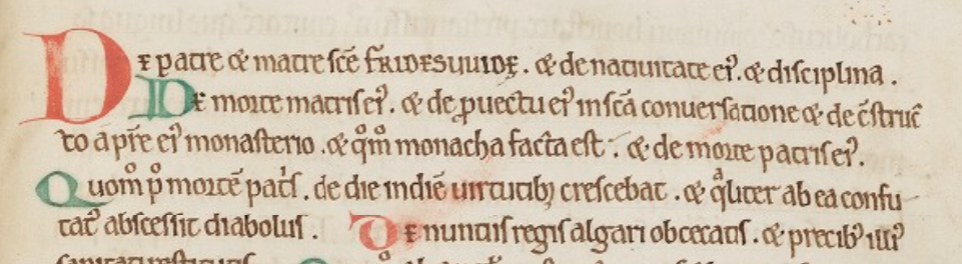
Header Image: Lincoln College/EL/OAS/D1

  1. French Palaeography Manuscript Reading Group, Mo 10.30-12
  2. Exploring Medieval Oxford through Lincoln & Magdalen Archives, Fr 2-3pm
  3. Latin Palaeography Manuscript Reading Group, Tue 2-3.30pm

1. French Palaeography Manuscript Reading Group

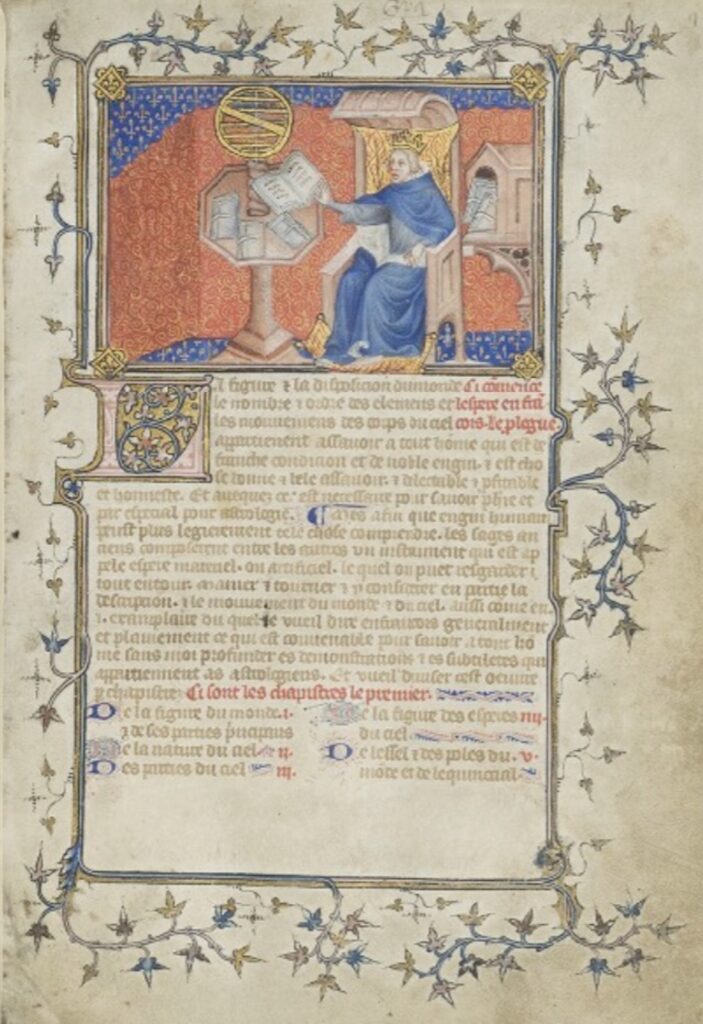
This group is open to anyone with an interest in Old French, Middle French and Anglo-Norman manuscripts. We study and read manuscripts from the 12th century to the 16th century with a special focus on palaeography. We meet every Monday between 10.30am-12pm in the Weston Library. 

If you are interested in joining the group or would like more information, please write to Laure Miolo.

The seminar comprises brief lectures on the morphology and function of scripts, as well as the evolution of script shapes and graphic systems in context, followed by transcription practice using original manuscripts and documents. Sessions are structured around the historical development of scripts, progressing from simpler shapes and strokes with minimal ligatures and abbreviations to more cursive and complex forms. A study of the diverse scripts found between the twelfth and early sixteenth centuries in manuscripts and documents written in Old French, Middle French, and Anglo-Norman — and produced in various geographical areas —will allow participants to gain familiarity with a wide range of scripts and abbreviations. The reading of literary texts in parallel with the analysis of manuscripts and their scripts serves to complement both the lectures and transcription practice.

Oxford, St John’s College MS 164, fol. 1r

2. Exploring Medieval Oxford through Surviving Archives

Every Friday 2-3pm Weston Library (Horton Room)

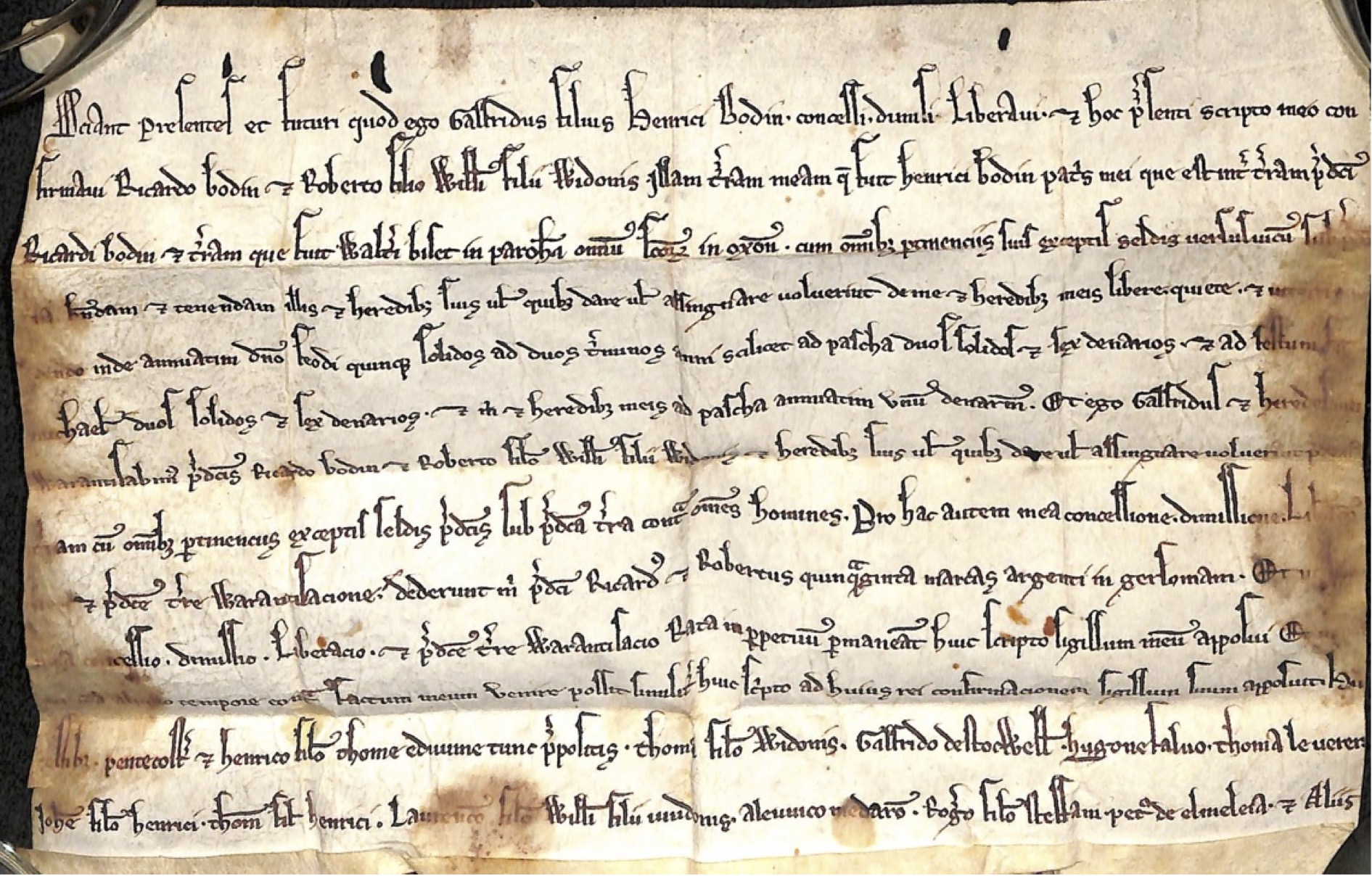
This weekly one-hour seminar offers participants the opportunity to work directly with original documents from various Oxford parishes, held in the Bodleian Libraries. Focusing primarily on thirteenth-century deeds, these documents provide rich insight into everyday life in medieval Oxford. Open to undergraduates, postgraduates, and early career researchers, the seminar welcomes all those interested in working with primary sources and conducting in-depth contextual analysis of historical records

Working individually or in pairs on a self-selected original document, participants will closely examine its physical and material features (such as writing surface, layout, and signs of use), carry out transcription and translation, and identify the individuals and locations mentioned in order to situate the document within its historical context. Particular emphasis will be placed on the seals attached to the documents.

Alongside collaborative work on these unpublished or little-studied sources, participants will gain experience in the digitisation and cataloguing of archival materials, and will have the opportunity to present their research and original documents to a wider audience during a one-day workshop in Trinity Term.

This seminar is held at the Weston Library (Horton Room) in collaboration with Matthew Holford, Tolkien Curator of Medieval Manuscripts. Those who are interested can contact the convenor, Laure Miolo via email: laure.miolo@history.ox.ac.uk. Those who are interested can contact the convenor, Laure Miolo

3. Latin Palaeography Manuscript Reading Group

(advanced beginner, intermediate and advanced levels)

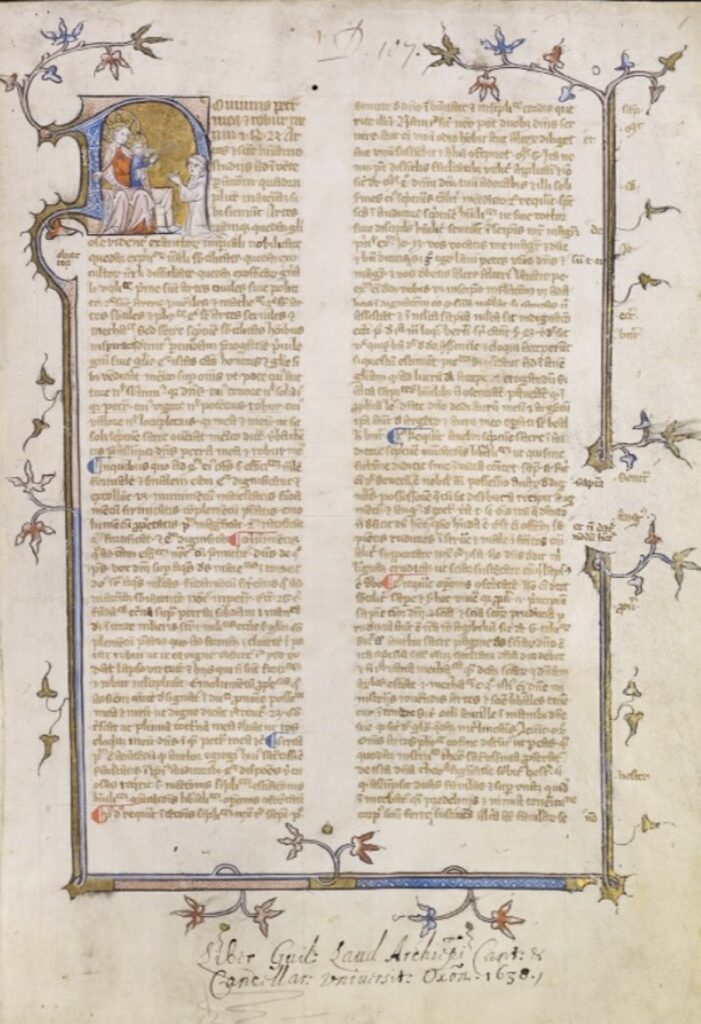
For those wishing to develop, deepen or maintain their skills in Latin palaeography, we meet every Tuesday between 2pm and 3.30pm in the Weston Library (Horton Room or Visiting Scholars Centre). We explore a wide variety of medieval manuscripts and documents dating from the 9th to the 15th centuries. Each session combines hands-on analysis of different scripts, abbreviations, and codicological features. Regular practice is key to building palaeographical skills and gaining confidence in reading a range of scripts, from clear book and documentary hands to more cursive and heavily abbreviated ones. This reading group is designed to introduce the essential features of each script and abbreviation, enabling participants to read and interpret manuscripts directly and with confidence. Those who are interested can contact the convenor, Laure Miolo

Oxford, Bodleian Library, MS. Laud Misc. 562, fol. 1r

The Challenge of Historical Distance: Historicism and Anachronism in the Study of Art

6-7 November 2025
Nederlands Interuniversitair Kunsthistorisch Instituut (NIKI), Florence, Italy (In Person and Online)

How can art historians explore, understand, or even ‘feel’ the material evidence of the past? How can we approach the problem of historical distance, of our anachronistic nostalgia and our intellectual desire for pre-modern periods and artefacts? Can we inhabit the time of past artworks, or do artworks constantly re-construct their own times? And what role do contemporary concerns play in our interpretations of the ancient, medieval, and early modern periods?

Numerous recent publications have explored the study of the past through different lenses. They have complicated the idea of ‘historical contexts’ by showing the ability of artworks to simultaneously refer to various time periods. They have also encouraged cross-temporal and sometimes ahistorical interpretations of premodern artefacts in the light of modern theories and concerns. This conference will bridge the ‘historicist’ and ‘anachronist’ camp in an attempt to theorise the thorny issue of time which sits at the core of both history and art history.

The conference is organised in celebration of the scholarship of Prof. Gervase Rosser and in honour of his retirement from the University of Oxford. One aspect of Rosser’s career that we particularly want to celebrate is his prominence as both historian and art historian, and his inspirational interrogation of both disciplines.

Speakers include: Armin Bergmeier (University of Leipzig); Saida Bondini (Kunsthistorisches Institut in Florenz); Donal Cooper (University of Cambridge); Heiko Droste (Stockholm University); Jas Elsner (University of Oxford); Michael Ann Holly (Clark Institute); Maria Loh (Institute for Advanced Study, Princeton); Keith Moxey (Barnard College); Susie Nash (The Courtauld Institute of Art); Caspar Pearson (The Warburg Institute); Hannah Skoda (University of Oxford); Nancy Thebaut (University of Oxford); Ben Thomas (Trinity College Dublin).

The conference is organised by Costanza Beltrami (Stockholm University), Lia Costiner (Utrecht University), Elena Lichmanova (University of Oxford/British Library) and Michael W. Kwakkelstein (NIKI/Utrecht University).

View the programme here

Click here to register for online attendance via Teams.

Click here to register for in-person attendance at the NIKI, located at Viale Evangelista Torricelli 5 in Florence.

Call for Committee Members – Oxford Medieval Graduate Conference

The Oxford Medieval Graduate Conference (OMGC) is one of the highlights of the graduate academic calendar every year. Over two days, this interdisciplinary conference brings together graduate students from the UK and around the world to present their research on a wide variety of topics from across the Middle Ages. Read a review of the 2025 conference. If you think you might be interested in becoming a committee member and gaining experience organizing conferences, please send an expression of interest to oxgradconf@gmail.com. The committee is also excited to announce that the theme for the 2026 Oxford Medieval Graduate Conference will be Sounds and Silence! Until then, keep an eye on the OMGC website and social media (Bluesky / Twitter) for updates on this year’s conference.