Funded MA and PhD opportunities at Central European University, Vienna

The Department of Historical Studies at Central European University (Vienna, Austria) is pleased to announce its call for applications for the 2025/2026 academic year. The deadline is February 1, 2025

Central European University is a graduate-level, English-language university with a multi-disciplinary Department of Historical Studies that offers the following programs:

• PhD in Late Antique, Medieval and Early Modern Studies (5 fully funded positions) 

• PhD in Comparative History (5 fully funded positions) 

• 1-year MA and 2-year MA in Historical Studies (History track and Late Antique & Medieval Studies track) 

• 2-year MA in Museum Studies 

The department’s programs are accredited in the US and Austria. Further information on the department and its programs can be found here: https://historicalstudies.ceu.edu/.  

CEU provides a variety of need- and merit-based scholarships and various other types of financial support available to students at all levels and from any country (tuition waiver, stipend, housing awards, health insurance coverage): https://www.ceu.edu/financialaid

Interested applicants can contact us at historicalstudies@ceu.edu or join one of our admissions events. For further details and registration, see https://historicalstudies.ceu.edu/recruitment-events.   

University College Dublin PhD opportunity

The College of Arts and Humanities, University College Dublin, Ireland, is pleased to announce a generously funded Ph.D. studentship specialising in Early medieval political and/or intellectual culture (c.500-c.1000 CE) which will be supervised by Dr Megan Welton, Assistant Professor in Medieval History and recently appointed Ad Astra Fellow at the School of History (https://people.ucd.ie/megan.welton).

Deadline: 4 November 2024 by email to megan.welton@ucd.ie.

The studentships are open to EU and non-EU candidates and are for a maximum of four years, renewable each year, subject to satisfactory progress. The award includes full tuition fee waiver, a PhD stipend of €25,000 per annum, and €4,000 per annum towards research costs of the Ph.D.  We anticipate that the successful candidate will start in January 2025.

Please submit the following application materials by email:

  • Personal statement and CV as one document
  • Writing sample (e.g. an essay or section of MA dissertation)
  • Two academic references
  • A proposal (1000-1500 words plus indicative bibliography).

The Selection Panel will shortlist candidates for interview, likely to take place in the last week of November. Successful applicants will be informed by email.

For the application procedure please see the relevant school guidelines below. The outcome of this competition will be communicated directly to all applicants.

Specialisation: Early medieval political and/or intellectual culture (c.500-c.1000 CE)

Proposals for a Ph.D. project in the history of early medieval politics and intellectual thought are welcomed, specialising in one or more post-Roman kingdoms, including (but not limited to) east and west Francia, early English kingdoms, and northern Italy. Proposals that incorporate a comparative approach are encouraged.

In addition to a competitive stipend, the successful candidate also will have access to an annual research budget of €4,000 for archival research in relevant collections abroad or related research expenses.

The UCD School of History stands as one of Europe’s premier centers for historical research, offering a vibrant research community. The School of History is well-connected through its active engagement with international partners and a broad array of UCD research centres and institutes. The successful candidate will join a robust graduate community of early career medieval scholars, from MA students in Medieval Studies in the School of History, to postgraduates and postdoctoral fellows in connected schools in Art History, Archaeology, and Irish, Celtic Studies and Folklore.

As such, interdisciplinary work is welcomed, and candidates from all relevant areas of medieval studies are encouraged to apply.

Call for Podcast Proposals

The Multicultural Middle Ages Podcast Series (see the website here // Twitter: @Podcast_MMA_MAA) welcomes proposals for single episodes to be featured in its fourth season. After three successful seasons, The Multicultural Middle Ages (MMA) will return for its fourth in 2025. Sponsored by the Medieval Academy of America, MMA is an anthology-style podcast that welcomes the global turn in Medieval Studies. This podcast series is a platform from which to continue ongoing conversations and generate new and exciting avenues of inquiry related to the Middle Ages that emphasize its diversity. We seek to highlight thoughtful reflections on culturally responsible approaches to the study of the Middle Ages. This is a space from which to speak to fellow medievalists and, more importantly, the wider public to inform our audience about the multicultural reality of the medieval period and the plurality of voices that comprise the fields of medieval studies. We invite proposals from individuals and collaborators of all ranks and disciplines, including graduate students, for single podcast episodes aimed at fellow medievalists and the wider public.

Possible topics include, but are not limited to, the following:

  • Innovative methodological and disciplinary approaches to the Middle Ages
  • The future of Medieval Studies
  • Research on the multicultural, multiracial, and multiethnic Middle Ages
  • Discussions of recent scholarship
  • Archival discoveries
  • Academic activism and responses to misappropriations of the Middle Ages
  • Pedagogical approaches
  • Medievalisms
  • Medieval culture in contemporary political discourse

Cultural heritage and approaches to curating exhibitions of the Middle Ages

Possible formats may include narrative expositions, interviews, textual analysis, visual analysis, oral performances, and panel discussions. No previous experience with podcasting is required. The Graduate Student Committee of the MAA has hosted several podcasting workshops, which are now available on the MAA YouTube channel. If accepted, an MMA team member will support you through the episode development process and post-production. If you would like our technical assistance to realize your episode, such as facilitating an interview, helping record the episode, or taking care of the audio editing, please make a note of it in your proposal. Your application should include a brief description (500 words) of your proposed episode, noting the following: the chosen topic and its relevance; the plan for adapting the topic to a podcast medium (we encourage 40-50 min. episodes, but also welcome proposals for shorter or longer episodes); and the episode format (interview, narrative, etc.) with an overview of its structure a description of the support you’ll need (if any) from the MMA production team. This information is not binding but will help the committee assess the potential of the project. Please include the name and CV of each author. Submit your proposals and any questions to mmapodcast1@gmail.com and to Loren Lee (lel7qsf@virginia.edu) by October 11, 2024.

The Multicultural Middle Ages Podcast Series Production Team, Will Beattie | wbeattie@nd.edu, Jonathan Correa Reyes | jonatcr@clemson.edu, Loren Lee | lel7qsf@virginia.edu, Reed O’Mara | rao44@case.edu, Logan Quigley | quigleylogan@gmail.com, Website: https://multiculturalmiddleages.com/, X: @Podcast_MMA_MAA, Instagram: @MulticulturalMiddleAgesPod

Introduction to Archival Research

From Domesday Book to the Leveson Enquiry, our historical records offer students a myriad of untapped research opportunities across a wide range of time periods and disciplines. With so many options, however, getting started in the archives can be a daunting prospect. Many students have questions which they are too afraid to ask. How will I know where to go? What do I need to bring with me? How do I find records for my research? How do I order documents? Do I need to use gloves? How can I be sure I’m not wasting my time?

To demystify the research process The National Archives has developed a programme of Archival Skills Training, providing students with the key skills and knowledge needed to undertake academic research using the archives.

This introduction day will explain how to get started with archival research, the importance of knowing the history and structure of a collection to navigate the records, and how to make the most of your time on site.

We will be running this one-day on-site training session on October 1 (BOOK HERE) and December 3 (BOOK HERE), with more sessions in the new year.

Thank you, and we look forward to welcoming you to The National Archives!
All the best,
Kath

Dr Kathryn Maude Team Leader, Medieval Specialists
T: 02083925369 | W: nationalarchives.gov.uk
Twitter: @krmaude @UkNatArchives |Pronouns: she/her
The National Archives, Kew, Richmond, TW9 4DU

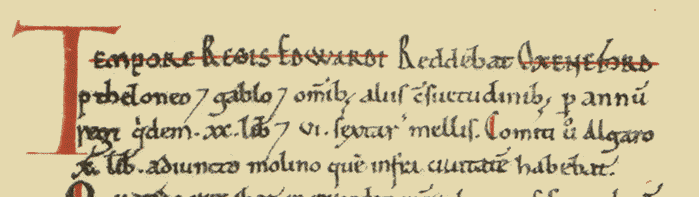
header image: A page of Domesday Book for Oxford, cf. the National Archives guide to the Domesday Book

Short Story Competition: Morgana le Fay

Call for submissions of short stories about Morgana le Fay on behalf of the publisher Flame Tree who are advertising a new hardcover series with myths and short stories. Deadline for submissions is 22nd September 2024

From their website: Discover the mythology of humankind through its heroes, characters, gods and immortal figures. Myths, Gods & Immortals brings together the new and the ancient, familiar stories with a fresh and imaginative twist. Each book brings back to life a classic mythological or folkloric figure, with completely new stories alongside the original tales. New and emerging writers from open submissions, reveal hidden themes, casting fresh perspectives on well-known stories, alongside specially commissioned text on the origins and the cultural background of the mythology. The first four books in the series are MedusaOdin, Circe and Anansi. We’re now opening up submissions for the next two books, Achilles and Morgana le Fay.

Morgana le Fay

Morgana le Fay is a mysterious figure of Arthurian legend, found in Sir Gawain and the Green Knight, Le Morte d’Arthur and a number of other accounts. She is often seen in the context of the men in those myths – a half-sister of King Arthur, a jilted lover of Lancelot, a foil of Merlin – and yet is an extremely powerful character herself. She has deep roots in Celtic mythology and offers a fascinating canvas to be explored. Well known for her magical abilities, including shape-shifting, her complex character oscillates between benevolent healer and malevolent sorceress. Her relationship with Arthur and the Knights of the Round Table is marked by both familial loyalty and deep-seated enmity, making her one of the most enigmatic and multifaceted figures in the Arthurian mythos. Stories submitted for consideration need to explore new angles to the character: have her follow alternative paths, present different viewpoints, imagine new futures, or perhaps pursue story lines that are hinted at in the original tales. Submissions to: Morgana@flametreepublishing.com

Terms:

  • Multiple submissions are fine but must be in separate emails.
  • Simultaneous submissions are fine but you must have the right to license your story in an anthology.
  • For accepted stories we pay Science Fiction & Fantasy Writers of America (SFWA) rates of 8 cents/6 pence per word for original stories, 6 cents/4 pence for reprints.
  • We will aim to read each story and confirm its status within 4 months of the submission deadline.
  • Payment for the chosen stories will be made within 30 days of the final advertised publication date (see our website flametreepublishing.com for details), although some may be paid earlier than that.
  • Submission does not imply the right to publication. Each story will be read and assessed by the selection panel.
  • Let us know in your submission email whether your story would be a reprint or is currently unpublished.

Important Notice about Submissions and Guidelines

We’re always looking for better ways of working so we’ve tweaked our submission process to allow us to read more stories, and spend more time assessing the balance of our books. So follow these rules to avoid your story getting lost in our system!

  • Submissions must use the dedicated email address.
  • The subject line of the email must be the story title.
  • The file with the story must be attached to the email (.docx, .doc or .rtf format).
  • The name of the file must match the name in the subject line.
  • If submitting more than one story, please submit one story per email.

Other useful tips for a more successful submission

  • The file name of the submission must be the story name only.
  • Please just use spaces between words in the title (not _ or – ).
  • If the story name starts with A or The, please use it at the beginning of the file name.
  • If you’d like to add some details about the story, confirm if it’s new or a reprint, or add a short bio of yourself, please add to the body of the email not as an attachment.
  • Story length is most likely to be successful at 3,000-4,000 words, but we will still read stories slightly outside this range.
  • If submitting a story that has recently been submitted to us for consideration to another anthology, please state this in the submission email.
  • Deadline for submissions is 22nd September 2024.

Thank you, and good luck!

Medieval Studies Academic Mentor and Communications Officer

The Humanities Division Interdisciplinary Master’s Programmes are advertising an Academic Mentor & Communications Officer Joint Position for the MSt in Medieval Studies and Oxford Medieval Studies (OMS). The deadline for applications is 2 September 2024. For an insight into the duties involved, read the blog post by two previous postholders, Dr Luisa Ostacchini:  A Medieval Monologium, and Dr Karl Kinsella Heralding Oxford Medieval Studies.

The role of the Academic Mentor is to support the work of the programme convenors by fostering a group identity for the incoming cohort of students. The Academic Mentor will make an important contribution to the experience of students on this course.

The role of Oxford Medieval Studies (OMS) Communication Officer is to prepare the termly Medieval Booklet, send out a weekly news bulletin, and coordinate graduate students working with OMS.

The position will be offered for one year in the first instance. The holder will be expected to work 64 hours during Michaelmas term and 56 hours during each of Hilary  and Trinity terms (for a total of 176 hours over the year).  The hours should be divided flexibly between the MSt and OMS portions of the job, with a typical split of two-thirds MSt and one-third OMS. The remuneration offered is at point 7.1 of the casual pay spine; in 2023-24 this was £18.98 per hour.

Duties of the joint position

The role of the Academic Mentor is to:

  • help foster a sense of group identity and cohesion
  • contribute to the research mentoring and professional development of the students during the course
  • establish an informal space for group interaction

This will involve:

  • directing students towards relevant events and activities and helping them to navigate sources of information, including signposting to relevant learning opportunities and skills development provision
  • providing information and guidance on academic choice, including programme options and further study
  • discussing with students their future plans (whether professional or academic) and offering appropriate guidance by directing students towards relevant offices in the University
  • leading group discussions of academic and professional topics as may be relevant, depending on students’ needs
  • providing appropriate guidance on drafting research proposals for doctoral applications
  • coaching students in study skills (e.g., writing)
  • readiness to serve as ‘a helpful ear’ to students’ academic concerns or anxieties, liaising with the convenors where appropriate and/or where the mentor’s own concerns arise about a student. The mentor will not act as a welfare officer; however, they are advised to consult the convenors or the course administration should welfare issues arise so that students may be directed to the proper sources of support
  • The role will support the more formal work of the programme convenor to whom the Academic Mentor should report regularly and consult for guidance on offering advice to students (e.g., on University procedures)

The above is meant to act as a broad guidance; it is expected that the role will be flexible and responsive to the needs of individual cohorts. 

The role of OMS Communications Officer is to:

  • Prepare the termly Medieval Booklet for publication two weeks before term starts
  • Write and circulate a weekly OMS email news bulletin
  • Coordinate graduate students working with OMS as events and social media officers
  • Help to administer the medieval.ox.ac.uk blog and the mailing list
  • Encourage graduate participation in blogging, application to OMS small grants, and so on
  • Work with the Directors of Oxford Medieval Studies to promote medieval studies

We welcome applications either from postdoctoral candidates, or candidates with relevant experience. Depending on availability and expertise, there might be scope for some collaborative teaching (for which additional payment would be made).

How to apply

Please write a letter of application outlining your suitability for the role, and send it, together with a CV, to interdisciplinary@humanities.ox.ac.uk by 2 September. Please ask two referees to send their references to the same address by the same date. Interviews for shortlisted applicants will take place in late August, and successful applicants will be expected to start from the beginning of Michaelmas term 2024.

The Oxford Medieval Mystery Plays 2025

Call for Actors, Directors, Costume Makers, and Musicians!

Would you like to take part in a medieval dramatic experiment? Directors, actors, costume makers and musicians wanted!

The next cycle is going to take place on 26 April 2025 at St Edmund Hall

These plays were a very popular form of drama in the Middle Ages – with different groups performing short plays telling stories from the Bible. To take part in the next performance, contact Antonia Anstatt and Sarah Ware, Co-Heads of Performance, or email Professor Henrike Lähnemann, Fellow at St Edmund Hall Fellow and Professor of Medieval German Literature and Linguistics, and Professor Lesley Smith, Fellow and Tutor in Politics and Senior Tutor at Harris Manchester College, Co-Directors of the Oxford Medieval Studies Programme at TORCH, under the address medieval@torch.ox.ac.uk.

More information and an overview of what was performed in 2019, 2022, and 2023 at https://www.seh.ox.ac.uk/mystery-cycle

Books for Medievalists

Free books for medievalists! Professor Richard Sharpe (1954–2020) was Professor of Diplomatic in the University and one of the country’s foremost medievalists, whose research ranged from the early Irish church to Anglo-Norman royal acts to the transmission of medieval Latin texts and medieval books and libraries. He was also a large presence in the History Faculty and much involved in graduate tuition. Books from Professor Sharpe’s library are now being offered gratis to local medievalists. A great encourager of others, he would have been delighted to know that his books could be helping the next generation. For more information, please contact Elizabeth Champion to reserve books and arrange collection.

TitleAuthor/Editor
A Culture of Translation: British and Irish Scholarship in the Gennadius Library (1740-1840): 13Lynda Mulvin
Acts of GivingWendy Davies
Anglo-Norman England 1066-1166Marjorie Chibnall
Annuaire de l’nstitut Michel Villey – 2011 Vol 3Olivier Beaud, Denis Baranger
Antiquaries Journal
Antiquaries Journal Vol. LXIX Part II
Antiquaries Journal Vol. LXX Part I AND ii
Archaeologia 1991
Canon Law, Careers and ConquestJorg Peltzer
Carolingian EssaysAndrew W. Mellon
Charles the BaldJanet Nelson
Concise Dictionary of National Biography
Copistia Bologna (1265-1270)Giovanna Murano
Du Burca Rare Books Catalogues 132, 135, 136, 139, 140, 141, and ‘Irishwomen, Children, Education’
Ducal Brittany 1364-1399Michael Jones
Early Medieval ItalyChris Wickham
Early Medieval Spain, 2nd edRoger Collins
FeudalismFrançois Louis Ganshof
Folia CaesarAugustana I
Gaelic Literature SurveyedAodh de Blacam
Hereditas Monasteriorum Vols. 1-8
Hermanthena No. 194 Summer 2013
Ideal and Reality in Frankish and Anglo-Saxon SocietyPatrick Wormald
Il Libro e il Testo Atti del Convegno
Il registro di Andrea SapitiBarbara Bombi
Im Umkreis von AnselmBernd Goebel
Imperial Lives and Letters of the Eleventh CenturyMommsen and Morrison
Introducing the Old TestamentCoggins
Ireland and the Culture of Early Medieval EuropeL. Bieler
John Aubrey and the Advancement of LearningWilliam Poole
Journal of the British Archaeological Association Vols. 156-172
Journal of the British Archaeological Association Vols. 1990-99
Journal of Theological Studies New Series Vol. 35 Part 1
Journal of Theological Studies New Series Vol. 40 Part 1
Journal of Theological Studies New Series Vol. 41 Part 1
Journal of Theological Studies New Series Vol. 41 Part 2
Journal of Theological Studies New Series Vol. 43 Part 2
Journal of Theological Studies New Series Vol. 44 Part 1
Journal of Theological Studies New Series Vol. 45 Part 2
King David: A BiographySteven L McKenzie
La France CistercienneArmelle Bonis
La Vie Religieuse en France au Moyen AgeB. Merdrignac
Lawfinders and LawmakersHelen Cam
Les Origines de la BretagneLeon Fleuriot
Leviticus as LiteratureMary Douglas
Lexicography: An emerging international professionRobert F. Ilson
Magna Commoditas: A istory of Leiden University Library 1575-2005C. Berkvens-Stevelinck
Medieval French BridgesMarjorie Nice Boyer
Montaillou, Village OccitanLe Roy Ladurie
Nederlandse boekgeschiedenisJaarboek Voor
North Country Bishop; A Biography of William NicholsonFrancis Godwin James
Northern History vols. 1966-1995
Northern History, June 1964 February 1969, June 1969
Oxford University Calendar 1999-2000
Oxford University Calendar 2000-2001
Oxford University Calendar 2005-2006
Parliament and Politics in the Age of Churchill and Attlee: The Headlam diaries 1935-51Stuart Ball
Patrology Vol. IVAngelo di Berardino
Place Names of Northern Ireland, County Antrim I, Vol 4
Place Names of Northern Ireland, County Down I Vol 1
Place Names of Northern Ireland, County Down II Vol 2
Place Names of Northern Ireland, County Down IV, Vol 6
Pope John XXII and his Franciscan CardinalPatrick Nold
Proceedings of the British Academi, Bibiographical Memoirs of Fellows Vols. I-XVIII
Proceedings of the British Academy Lectures & Memoirs 1988-2000
Projets de CroisadeJaques Paviot
Province and EmpireJulia Smith
Religion and PowerDouglas Edwards
Royal Historical Society Centenary Guide 1868-1968
Scaliger’s Oriental Legacy in Leiden 1609-2009
Sean, nua agus síoraíocht : Féilscríbhinn in ómós do Dháithí Ó hÓgáinRíonach Uí Ógáin
Small WorldsWendy Davies
Society of Antiquaries of London Annual Report 1990-91
Studies on the Life and Legend of St PatrickL. Bieler
Sussex Archaelogical Collections Vol. 126
The Antiquaries Journal 1991-2019
The Antiquaries Journal Index 61-70
The Barbarian West 400-1000J. M. Wallace-Hadrill
The Christianisation of Latin MetreSeppo Heikkinen
The Dublin ScuffleJohn Dunton
The End of Ancient ChristianityR. A. Markus
The English Historical Review No. 323
The gate of horn: a study of the religious conceptions of the stone age, and their influence upon European thoughtGertrude Rachel Levy
The Irish Contribution to European Scholastic ThoughMcEvoy and Dunne
The Irish Matryoshka: A History of Irish Monks in Medieval EuropeHarkins/OhEarcain
The Kingship and Landscape of TaraEdel Bhreathnac
The Letters of Pierre de CrosWilliman
The Merovingian Kingdoms 450-751Ian Wood
The Settlement of Disputes in Early Medieval EuropeWendy Davies and Paul Fouracre
The Shorter Cambridge Medieval History Vols I and II
The Spanish Kingdoms 1250-1516: Vol. I 1250-1410
The Spanish Kingdoms 1250-1516: Vol. II 1410-1516
Trinity College Cambridge Annual Record 1995-2019
Wadham College Gazette 2017
Wadham College Gazette 2018
William BlackstoneWilfrid Prest

Call for volunteers: The Mary Rose Trust

The Mary Rose Trust which looks after King Henry VIII’s favourite warship, are looking for volunteer speakers across the country who are able to conduct talks on the Mary Rose on our behalf in an authoritative and entertaining way.

The administrator writes: As you will see, I have included links to our website regarding being a Mary Rose Information Group (MRIG) volunteer. Usually, these talks are addressed to Probus and U3A groups and Women’s Institutes, as well as historical and archaeological societies and other interested parties. Talks normally last up to 45 minutes allowing for a 15-minute Q&A session afterwards.

The talks are a means by which we raise donations – normally £50 minimum per talk (although for groups exceeding 100, we would expect larger donations) – with the volunteer speakers receiving no reimbursement themselves apart from their travelling expenses (which are covered by the talk organisers, currently at 45p per mile if travelling by car).

In the information shown below (see first link) it says that volunteers could expect to conduct 1-2 talks per month. As the administrator of the MRIG programme at the Mary Rose Trust I can advise that, in reality, these tend to be far more infrequent – although, this does depend to a great extent on the volunteer speaker. Some speakers will pro-actively engage with local interested groups and generate talks for themselves, while others will be entirely reactive and simply conduct talks as and when requested, which could be as infrequently as one or two in a year.

One benefit of becoming a registered MRIG speaker is that while on the register the MRIG volunteer will have unlimited free of charge access to the museum and will also be invited to many of the special events the museum holds (either at the museum or remotely).

We are happy for anybody who feels appropriately qualified, to speak on our behalf – although we would, of course, have to determine ourselves whether we feel they were suitably qualified – and so this opportunity is potentially open to any member of staff as well as post-grads and even undergraduates who may be interested. Apart from our determining that a candidate has the requisite degree of knowledge, public speaking ability and enthusiasm there are other more practical considerations candidates would need to take into account  – the main ones being the ability to drive, or have access to transportation by car, in order to get to talk venues (quite often located in places poorly served by public transport) and the relative freedom to conduct talks at different times during the day and across the week (many talks, for instance, can take place from midday onwards on weekdays).

For more information on applying to be a Mary Rose Information Group (MRIG) speaker on behalf of the Mary Rose Trust, please see the third section under the heading ‘Volunteering’ at: https://maryrose.org/recruitment/#volunteering

To see the page explaining the role of the MRIG to those interested parties visiting our website please see: https://maryrose.org/information-group/

Poetry in the Medieval World

New TORCH Network approved

by Ugo Mondini

Poetry in the Medieval World is a network that explores premodern literature from a global perspective. Its aim is to address broad questions and seek answers building on contemporary discussions in comparative and world literature through a cross-disciplinary approach.

Our case study is currently poetry between c. 600 and c. 1250 CE. Poetry is a multifaceted phenomenon: it answers to different needs, travels across communities, and undergoes continuous changes. It is rooted in shared culture and knowledge; its intercultural communication or its appreciation by posterity can, at times, fail. There are recurring features: vivid images, complex words and rhythm, but also recitation music and singing. It is an expression of beauty and harmony. Even if poetry requires specialised experts to be scrutinised, yet its study should be easily approachable and crucial to the understanding of premodern literature, but also of literature as a whole. This – and way more – is the realm of poetry the Network will explore.

The Network creates an infrastructure for an open dialogue on medieval poetry with reading groups every two weeks, lectures by national and international scholars, and two annual meetings. The focus of our discussion is the production and transmission of poetry, its historical reception, and the challenges of translating it into modern languages, with a particular emphasis on English.

The Network connects people driven by scholarly curiosity. Therefore, we are extremely keen on receiving expressions of interest for collaboration from people at any phase of their career. If you are interested in this project and want to contribute to it actively, please email Ugo Mondini. The first events in Hillary 2024 will be shared in the coming weeks on the TORCH Networks website and the network’s X account (@PoetryMedieval), both of which are currently under development.

Images:

  1. Fujiwara no Yukinari (Kōzei), Excerpt from Bai Juyi’s “Autobiography of a Master of Drunken Poetry Recitation”
  2. David singing, MS BNF Par. gr. 139, f. 1v