Michaelmas Term is finally here, which means that our Medieval Booklet has now arrived! Inside you will find details of all of the seminars, events and reading groups happening this term, as well as some CFPs and save the dates for future events. Please do peruse and fill your calendars up!
I’d also like to take this opportunity to remind you of our blog, which not only includes an archive of the Medieval Matters newsletters, but also CFPs, posts from Oxford Medievalists, and a handy calendar so that you can always keep an eye on upcoming events and copy the details to your own online calendar. We would love to receive submissions for blog posts, whether these are events, reports on ongoing projects or conferences. If you have an idea for a blog post, please email luisa.ostacchini@ell.ox.ac.uk or lesley.smith@history.ox.ac.uk.
A new term means new faces around Oxford. If this is your first Medieval Matters email, I’d like to extend a warm welcome to the Oxford Medievalist community on behalf of the OMS team! If you are a course convenor for a medieval MSt, please block-enrol your students for the newsletter (or send me names for block enrolling) so that we catch all new MSt and doctoral students in medieval subjects and ensure that everyone receives all of the latest Oxford Medieval updates. If you know of any new medievalists who have joined Oxford and wish to have them added to the mailing list, please do contact me on luisa.ostacchini@ell.ox.uk. Alternatively, anybody can subscribe themselves to the Medieval Matters newsletter via the ‘About’ section of the blog – please do share the link with your incoming students.
Onto the announcements for this week:
Medieval Roadshow: We are still taking submissions for this year’s Medieval Roadshow, which is a great way for all seminar/reading group/medieval event convenors to publicise their wares. Come and give a two-minute in-person advert at this term’s Roadshow: Tuesday 12th October, 5-7 pm, at Teddy Hall. Please email luisa.ostacchini@ell.ox.ac.uk so she can get an idea of who’ll be talking — but if you haven’t ‘booked’ don’t worry – turn up anyway and we’ll fit you in. The Roadshow is an excellent way re-connect with our medieval community after so many months of virtual events. We are also happy to host virtual speakers via a Teams link: if you would like to present, but would prefer to do so remotely, please just let Luisa know so that arrangements can be made.
Oxford Medieval Graduate Conference: We are delighted to announce that the theme of the Eighteenth annual Oxford Medieval Graduate Conference will be Medicine and Healing, and that we are looking for new committee members! Please email oxgradconf@gmail.com, if you are interested!
Oxford Medieval Commentary Network: The first workshop and initial meeting of the Medieval Commentary Network will take place on 9th October, Christ Church, Research Centre., 8:30-5:30pm. Please email medievalcommentarynetwork@gmail.com with any questions and for further information.
Finally, a little wisdom from Alcuin to inspire you this week:
‘o quam dulcis vita fuit, dum sedebamus quieti inter sapientis scrinia, inter librorum copias‘
[‘Oh, how sweet life was, when we sat at leasure amongst the stacks of a learned man, amongst an abundance of books’ Ep. 281 ]
May your Michaelmas term be filled with such joys as these!
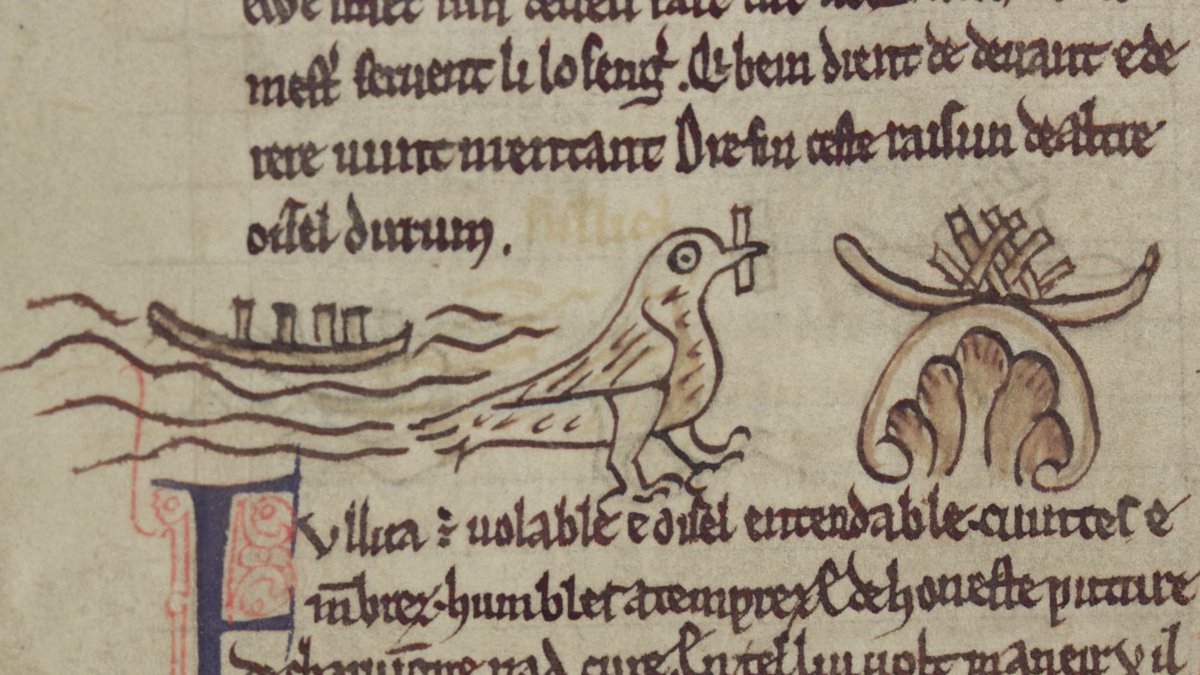
A coot kindly delivers the Michaelmas Term booklet to the email inbox of Oxford’s Medievalists: Merton College, MS 249, f. 10v. [view image and text in the Taylor Edition by Sebastian Dows-Miller https://editions.mml.ox.ac.uk/editions/bestiary/#Fullica
First lines of the Murbach hymns (fol. 122v, Oxford, Bodleian Library, MS. Junius 25).
When? 17th/18th February 2022 (week 5)
What? In this workshop, the fascinating Murbach hymns – a Latin hymnal with Old High German interlinear glosses from the 8/9th century – and their manuscript (Oxford, Bodleian Library MS. Junius 25) will be carefully examined regarding their translation technique, use and function, cultural background and transmission. Expect an afternoon full of presentations and discussions, a peek in the original manuscript and a live recitation of the hymns.
The first workshop and initial meeting of the Medieval Commentary Network will take place at Christ Church, Oxford, on 9 October 2021, from 9am – 5pm. A buffet lunch will be provided. The workshop is free of charge for all participants. This will take place as an in-person workshop (unless government regulations change). Unfortunately we are unable to live-stream the event, but we are hoping to make recordings of some talks available online after the event (subject to speaker approval).
Speakers include Alastair Minnis, Andrew Kraebel, Edit Lukacs, Audrey Southgate, Elizabeth Doherty, Malena Ratzke, Zachary Guiliano, Bond West, Rachel Cresswell, and others. The full conference programme will be available at https://medievalcommentary.network/ by the end of July.
We recognise that the current situation brings with it a great deal of uncertainty regarding travel; if you find you are no longer able to attend, please let us know as soon as possible.
Please email medievalcommentarynetwork@gmail.com with any questions and for further information.
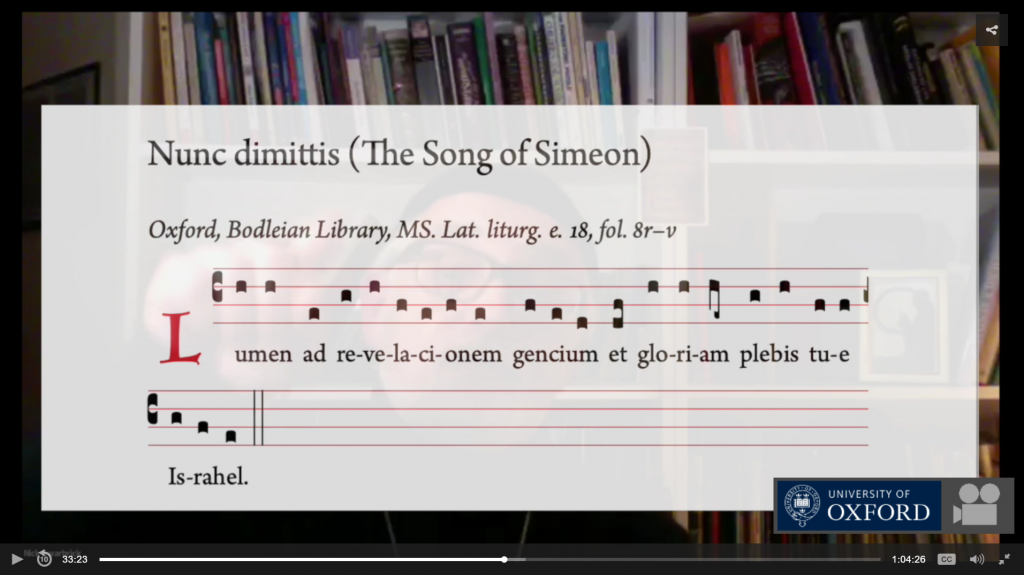
Building on the success of Gregorian chant workshops with manuscripts from the Bodleian Library (Singing Together, Apart 1 and Singing Together, Apart 2 ), a group of Oxford medievalists are offering insights into working with manuscripts during lockdown. Meet some of the manuscripts from the Abbey of Medingen, recently digitized through the Polonsky German project, and sing along to chants from the Easter period. A special focus was on the ‘Exsultet’ which attracted some of the most colourful illumination of the manuscripts as well as detailed devotional instructions in Latin and Low German on how to sing it both out aloud and “on the harp strings of the soul”. Read more on Savouring the Exultet at Medingen in this blog post by Innocent Smith OP for the Polonsky German manuscript digitisation project.
Andrew Dunning, R.W. Hunt Curator of Medieval Manuscripts, showed the Medingen manuscripts at the Bodleian Library live via visualiser from the Weston Library; Zachary Guiliano, Chaplain of St Edmund Hall, Henrike Lähnemann, Professor of Medieval German Literature and Linguistics, and Nick Swarbrick, Gregorian chant instructor, and Connor Wood, Organ Scholar at St Edmund Hall, formed a Schola in the Crypt of St-Peter-in-the-East, the library of St Edmund Hall, and commented on the manuscripts, the music, and their theological significance. Two graduate students working on the Easter prayer books, Carolin Gluchowski and Marlene Schilling, pointed out some of the special nuntastic features of the manuscripts.
This was part of the IMC Leeds Fringe Events but open to all manuscript and music enthusiasts! Music downloads for the event: Nunc dimittis (audience sings the ‘repetitio’ Lumen ad revelacionem gencium as congregational responses); Exultet (audience sings the congregational responses); Victime paschali laudes (audience sings the ‘Christ ist erstanden’ as congregational response and the question of the disciples Dic nobis Maria…)
Instruction for the Medingen Provost when during the ‘Exsultet’ to put the incense into the Easter candle, Bodleian Library MS. Lat. liturg. e. 18, fol. 36v
Anyone who has strolled through Oxford and paused to look up at a college window or church tower will have noticed that the city abounds in medievalist architecture. Oxford’s Gothic Revival buildings are not the only material witnesses testifying to nineteenth-century fascination with medieval-inspired styles and with debates harking back to the medieval period. Textile arts also evince how the Victorians read their own age through past ages, and vice versa. Few textiles exemplify this knitting together of past and present as attractively as the textile treasures in the archive of Pusey House, which was established to commemorate Edward Bouverie Pusey (1800-1882), one of the leaders of the Oxford Movement, Regius Professor of Hebrew and Canon of Christ Church.
(The Oxford Movement was a mid-nineteenth century movement within the Church of England that sought to revive an interest in patristics, the sacraments, and ritual, and generally to restore what they saw as pre-Reformation ideals (another instance of medievalism!)).
(One of the altar cloths we discovered, embroidered by Mother Marian Hughes (1817-1912)
Several months ago, the librarian of Pusey House, Jessica Woodward, and Godelinde Gertrude Perk, a researcher at the Faculty of Medieval and Modern Languages, were discussing textiles, both of us being interested in historical embroidery and other fibre arts. Jessica pointed out that the Pusey House archive holds many textiles, several of which are connected to the Pusey family, but also associated with some of the first Anglican nuns. We agreed that it was a pity these textiles were so little known, not only because they were quite expertly made, but also in the light of their historical importance: the Sisters of St Margaret (who owned the book with the sample) and the Sisters of the Holy and Undivided Trinity (one of whom made the corporal) were among the first nuns in the Church of England since the Reformation. Central figures in the Oxford Movement supported this Anglican revival of monasticism.
The spookiest object in the House: a nun doll dressed in the habit of the Sisters of the Society of the Holy and Undivided Trinity, dressed by Mother Marian Rebecca Hughes (1817-1912)
Jessica and Godelinde brainstormed a little about an exhibition and reached out to a fellow academic at the Faculty of Medieval and Modern Languages, Natascha Domeisen for a first look at the textiles, and finally to the textile conservators of the Ashmolean Museum, who generously offered conservation advice and help displaying the objects. The exhibition would never have been possible without the expertise of Clare Hills-Nova, Sue Stanton, and Sebastian Blue Pin; Sebastian came over several times, analysed the fibres, and displayed the objects beautifully.
While we (Jessica, Sebastian, and Godelinde) studied the textiles in order to select the ones to display (the display case being rather moderate in size), we made several unexpected discoveries: we found a handwritten note sewn onto a cloth, which stated that the set of altar linens had been made by Mother Marian Hughes in 1846, the first Englishwoman since the Reformation to become an Anglican professed religious. According to the note, Dr Pusey had used the set when celebrating mass at home. We then discovered an altar cloth from the same set was still in daily use in the Pusey House chapel, despite it being 175 years old. The letters were also quite illuminating, shedding light upon attitudes about embroidery at that time. Godelinde, for one, was also quite delighted to find that a familiarity with medieval religious iconography will stand you in good stead when deciphering Victorian religious art. However, we were most impressed by the skill of the textile artists and their thematic complexity, as emblematized by the corporal and the sermon case.
This blogpost serves as the online version of the exhibition, but if possible, you are warmly invited to visit the exhibition “Threads of Devotion: Textile Treasures from the Pusey House Archive” which can be seen from the 17th of June to the 9th of July 2021. The exhibition is open Monday to Friday, 9:30-17:25 – you can book a viewing slot at https://tinyurl DOT com/puseyhouselib .
1. Wedding veil
Pusey House Archive, PUS/Veil
Date unknown
Vertical maximum 117 cm, horizontal maximum 122 cm
Lace veil of a cream mercerised cotton ground featuring scalloped edges that frame an embroidered border of repeat pattern wheat and floral motifs. The central field displays clusters of larger floral motifs and singular embroidered flowers. This veil is believed to have been worn by Dr Pusey’s wife, Maria Catherine née Barker (1801–1839), at her wedding in 1828, although the tulle seems more characteristic of the early 20th century. It was presented to Pusey House in 1947 by Mrs Edith McCausland née Brine, Dr Pusey’s last surviving grandchild, who claimed it to be Mrs Pusey’s possession.
2. Letter from Edward Bouverie Pusey to his goddaughter, Clara Maria Hole (later Sr Clara Maria), transcribed by Henry Parry Liddon
Pusey House Archive, LBV 125
Originally written on 3 February 1875 at Christ Church, Oxford
The first page reads:
“There is a large proportion of embroidery in your distribution of time … but, I suppose, that, after the illness which you had some time ago, the quietness of needle work would be very good for the brain. I would only say on this, ‘Do not work against time,’ for this would produce an excitement and hurry which would undo the good of a quiet employment.”
Dr Pusey then goes on to recommend reciting psalms or hymns to prevent overtaxing the brain, but concludes his letter with a more optimistic conceptualization of art, presenting God as carving the artwork of the soul by way of trials: “a block of rough stone would not … mind the blows which indented, in view of the beauty of form which it was to acquire hereafter. And the form which we are to have traced in us, is the image of God.” The goddaughter’s crafting should be as deliberate and careful as God’s is.
Dr Pusey’s letter
Dr Pusey’s anxieties about too much embroidery contrast strikingly with Maria Pusey sending a workbox to her goddaughter and wholeheartedly recommending embroidery. This workbox and its accompanying letter can be seen in the cabinet outside the Pusey House Chapel.
According to the caption, the second page of the letter, now hidden by the first page, recounts how Mrs Pusey ‘had learnt to value needlework when she was ill and was pleased that her goddaughter had asked for the workbox as a present’.
Maria Pusey’s letter
3. Sermon case made for Dr Pusey by an anonymous embroiderer
Pusey House Archive, Object 15
1847
32.5 cm by 25.5 cm
Obverse cover: folded card covered in burgundy silk velvet, edged with twisted braid of metal threads and secured with a whip stitch. The centre of each face bears a cross motif, possibly of palm wood, that is overworked with basket weave type embroidery (replicating cross repetitions) in metal threads, creating a raised emblem. Interior: ground fabric of cream dyed silk embroidered with polychrome silk threads in a floral, foliate and fruit design. The Lord’s Prayer, the blessing and the dedication have been worked in embroidered stitches.
With its raised cross with metal embellishment, the sermon case recalls opus anglicanum, medieval religious embroidery produced in England. Victorians believed these medieval embroideries to be the handiwork of nuns, although they were actually predominantly produced in professional workshops in London. We do not know who made this particular gift for Dr Pusey, but Mother Marian Rebecca Hughes (1817–1912), the first Anglican Sister to take vows since the Reformation, is one likely candidate. She was a friend of Dr Pusey’s who made several embroideries for him during the 1840s (see item 4). If she is the artist, the medieval echoes in this embroidery present her as part of a long lineage of female monastics: she restores a tradition disrupted during the Reformation.
(Note the misspelling of “Christ Church” as “Christ’s Church”)
(Obverse cover)
4. Corporal made by Mother Marian Rebecca Hughes (1817–1912) for Dr Pusey
Pusey House Archive, PUS/Lin/1
1846
25 cm by 25 cm
Ground of plain weave mercerised cotton embroidered with red and blue silks. The outer border exhibits Neo-Gothic text and large Greek crosses worked in raised stumpwork to create a dimensional effect. The central field dedicates patterning to fleurs-de-lis and small Greek crosses executed in a chain stitch which frame the monogram of the Holy Name (IHC, Jesus Christ), again in raised stumpwork technique.
A corporal is a square linen cloth onto which the chalice with wine, the paten (silver plate) with bread, and the ciborium (a container for additional hosts) are placed during the consecration of the bread and wine. This particular corporal gives material expression to Tractarian understandings of the Real Presence in the sacrament. The border reads Hoc est corpus meum quod pro vobis traditur (“This is my body, which is given for you”), the words of the consecration of the Eucharist as given in the first Epistle to the Corinthians (11:24) and recited by the celebrant. The circle surrounding the monogram recalls the host, and the monogram itself also draws attention to the presence of the Incarnate Christ in the sacrament. The fleurs-de-lis (lilies) in Marian blue are a traditional attribute of the Virgin Mary, likewise alluding to the mystery of the Incarnation; the red circles signify Christ’s five wounds and, by extension, his Passion.
This corporal forms part of a set that is now 175 years old. A hand-written note, possibly by Henry Parry Liddon (1829–1890), sewn onto an altar cloth states that the entire set was given by Mother Marian Hughes to Dr Pusey, who would use it when celebrating mass privately. A second, larger cloth is still in use in the Pusey House Chapel, literally threading together Dr Pusey’s devotion and that of the House.
5. Sample card from Liberty’s, inserted (by publisher) into Designs for Church Embroidery by A.R and Alathea Wiel. Chapman and Hall, 1894.
Pusey House Archive, SSM 40/298
1894
Samples of polychrome silk floss embroidery thread (Liberty’s) wound around card. This book was the property of the convent of the Society of Saint Margaret, an Anglican order, in East Grinstead, Sussex. The convent also ran a School of Ecclesiastical Embroidery in London, but the library stamp indicates that this copy of the book was kept in the convent. The Victorian era saw an upsurge of interest in the creation of medievalist vestments and church hangings, which women particularly were encouraged to create. These textiles furnished Gothic Revival churches (omnipresent in Oxford!). The faint pencil markings and numbers signal that the nuns were particularly interested in various shades of gold, frequently found in Victorian church embroideries. This use of colour also harks back to opus anglicanum, once again suggesting that the nuns perceive themselves as stitching together past and present.
Photos by Jessica Woodward, Sebastian Blue Pin, and Godelinde Gertrude Perk. Blog introduction by Godelinde Gertrude Perk, captions by Sebastian Blue Pin and Godelinde Gertrude Perk.
Exhibition credits: Conservation Advice: Sue Stanton, Sebastian Blue Pin, and Clare Hills-Nova Captions: Godelinde Gertrude Perk and Sebastian Blue Pin Display & Publicity: Jessica Woodward
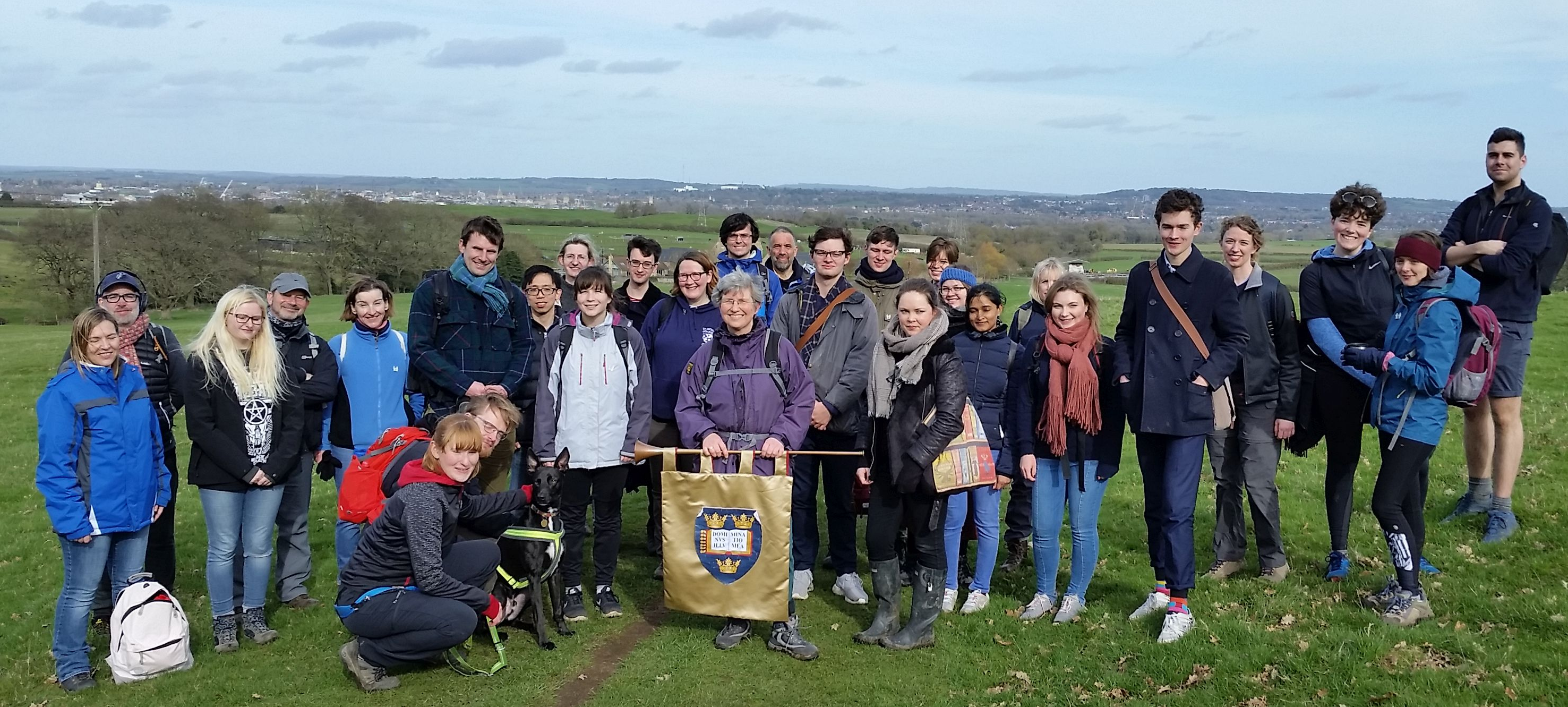
On Saturday the 9th of March, thirty-one pilgrims (and one canine pilgrim companion) met at St Helen’s Church in Abingdon, ready to walk the twelve miles to Christ Church Cathedral in Oxford. Much like the Canterbury Tales, our party was diverse; there were students from across the UK and across disciplines and stages, porters, academics from far and wide and members of the public (one of which who had run a half marathon the very same morning). As a BYOB (Bring Your Own Beliefs) pilgrimage, there were also a range of reasons for pilgrimaging present among our group. This was the start of the Oxford Medieval Studies Pilgrimage Day 2019, a day that would engage with the practice, literature, history and revitalisation of medieval pilgrimage.
At St Helen’s we handed out pilgrim badge replicas, kindly funded by the Oxford Pilgrimage Studies Network, to each of our pilgrims. Beautifully recreated in pewter by Lionheart Replicas, the original badge dated from the fifteenth century and depicted two pilgrims, one male and one female, ready to set out on their walk. After some quick ground rules, some advice for how to make the most of a pilgrimage and a rousing reading of the opening lines to the General Prologue of Chaucer’s Canterbury Tales from Rebecca, we set off on our journey.
Although the preceding week had been plagued with rain and wind, the day was miraculously sunny with only the occasional gusty spell, the perfect walking weather. Our next stopping point was only five minutes away: the Abingdon Abbey buildings. The curator of the buildings, Tim Miller, led us around the surviving buildings of the Benedictine Abbey, including Unicorn Theatre, the Long Gallery and the Chequer. Tim was an excellent guide for us, bringing the stories of the abbey and its uses to life and showing us the most impressive parts of the building, such as the beautifully painted remains of a Tudor room partition decorated with roses and pomegranates.
After leaving Tim, we then had a long walk ahead of us. We walked through the grounds of Radley College and across the countryside until we reached the picture-perfect village of Sunningwell and its church, St Leonard’s, at just past midday. This was our lunch stop, many of the pilgrims pausing to eat their packed lunch in the sunny grounds of the church or enjoying some hot chips and a pint at the local pub. This church is now mostly fifteenth century, but the village and its association with Abingdon abbey traces back far further. It also features a stunning seven-sided porch at its entrance, the victorian stained glass of which was designed by J.P. Seddon.
We then moved off again, quickly looking at the well after which the village took its name. The landscape was a little steeper as we climbed Boar’s Hill, but the view on the descent of Oxford’s ‘dreaming spires’ was worth it, and we then arrived at St Lawrence’s Church in South Hinksey. Father Ben Drury kindly gave us an history of the church and pointed out the distinctive minstrel’s gallery and the little private window for viewing mass.
We then set off on the last part of our walk, trekking over the train lines and the river, then through the outskirts of the city to Christ Church Cathedral – our pilgrims had made it home! We rounded off the walk with Rebecca reading from the Book of Margery Kempe, a moving passage describing how she reaches the English shore after a stormy passage, before our pilgrims dispersed for a well-earned rest.
The last order of the day was a talk from Dr Guy Hayward, co-founder of the British Pilgrimage Trust, at St John’s College. Guy talked about his experience of pilgrimage, its history and how he is working to revive the practice in the UK – the perfect reflective end to the day with the lasting message that we should all work to bring pilgrimage back. If you would like to walk a pilgrimage to Oxford, we encourage you to check out the BPT website http://britishpilgrimage.org/portfolio/five-ways-to-oxford/ and let us know how you get on!
Some feedback from our pilgrims:
‘Talking with people about their different life experiences was enlightening’
‘I think it was great. The highlight for me was doing a journey together with people from different walks of life.’
‘Well co-ordinated, well supported, very friendly. Had a lovely day. One to remember.’
‘Really enjoyed it, would love to do more’
We would like to say thank you to the OMS Small Grant at TORCH for their support, and that of the Oxford Studies Pilgrimage Network. We would also like to say a special thank you to Guy Hayward, Tim Miller, Fr Ben Drury and Robert Culshaw for helping the smooth running of the day, and, of course, our brilliant pilgrims.
Visiting the Ashmolean Museum is one of the many great privileges that the University of Oxford has to offer. One can travel to a myriad of different times and places within its walls, and speaking personally, I am always eager for the encounter with the medieval past made possible through its collections. Recently, Jim Harris, the Andrew W Mellon Foundation Teaching Curator at the Ashmolean, gave the Oxford Medieval Studies Lecture for Trinity Term on precisely this topic. His talk, entitled Museum in the Middle: Medieval Things in a (Still) Medieval University, provided much food for thought about the wonder, loss, and strangeness in both the medieval and the museum.
Wonder
Much of Jim’s teaching is rooted in the medieval collections, which has allowed him to engage both with the material culture of the Middle Ages and with those who study it – us medievalists. In Jim’s words, the “thread connecting medievalists to the past of their study is wonder,” and it is wonder that can be channeled through teaching with objects. As medievalists, this sense of wonder, the idea that knowledge can be derived from studying things we do not know about and do not yet understand, has driven us to acquire the skills to access that knowledge. We have learned new languages, both medieval and modern, how to decipher different scripts and to what location and periods these scripts belong, and how manuscripts were produced, among many other things, to bring us closer to the past that inspires so much wonder in us. Undertaking this learning allows us to further our connection to this past, as medieval people also had to learn new languages, ways of writing, methods of production, and many other skills to create the texts, documents, and objects that are now the subject of our study. Jim stressed that such wonder-motivated learning is not a product of the Early Modern Period or the Enlightenment, but rather is human, and was certainly present during the Middle Ages.
Jim described how teaching with objects can put this sense of wonder back into the curriculum. When we look at objects in ways that make them speak to us, using the skills that our sense of wonder has motivated us to learn, we become connected to a tradition, a history of looking, and the past that we look at is in turn bound to us through this act. Jim made clear that teaching with objects is not about being an art historian or portraying the rare and exceptional as exemplary, but rather about the wonder contained within the everyday and the mundane. Like the sense of wonder that drove us to learn how to communicate with the Middle Ages, wondering at its everyday objects once again brings us closer to the people who made them and to the period in which they lived.
The wonder that object-centred teaching can bring to the study of the Middle Ages speaks to what literary historian Stephen Greenblatt calls the resonance and wonder of museum objects. Greenblatt characterises resonance as the power of an object “to reach out beyond its formal boundaries to a larger world, to evoke in the viewer the complex, dynamic cultural forces from which it has emerged and for which it may be taken by a viewer to stand,” while wonder is an object’s power “to stop viewers in their tracks, to convey an arresting sense of uniqueness, to evoke an exalted attention.” While everyday objects, like the holy water ampulla associable with the Beckett pilgrimage and the pilgrim badge of John Schorne that Jim featured in his lecture, may not cause the viewer to stop in their tracks on display, in Jim’s words these objects become “capable of answering questions beyond what can be shared in a museum label” when they are taken off display and brought into the teaching room.
This can be seen clearly in Jim’s example of a small Limoges pyx, dated to c. 1200, that shows signs of its wear and use. While its well-preserved counterpart can be found on display in the museum, and it has been selected for display because of its condition and beauty, the pyx that Jim uses for teaching, with its worn exterior and signs of copper corrosion, has the potential to reveal more about the lives of medieval people than the one on display. This is because we can interrogate this object in ways that we cannot apply to the example on display: we can look inside this pyx, we can touch it, we can see it up close and from different angles and in different lights; we can ask questions about its manufacture, iconography, and use in devotional practice. While the ways of looking that we can use to interrogate the pyx on display are restricted by its exhibition, the pyx that Jim teaches with, though off display, becomes accessible to us from seemingly endless perspectives.
That this object can be interrogated not only by medievalists and other students of the humanities, but also students of medicine, neuroscience, and psychiatry, makes this what Jim calls an “agile” object with the “capacity to submit to interrogation from any number of disciplines.” In their agility, objects like the pyx cultivate resonance: they reach out to us from the past and can tell us how they were made, how they were used, and what they meant within the world that produced them. The resonance of these agile, everyday objects can stop us in our tracks and inspire our sense of wonder, as their agility allows us to discover their uniqueness and can further connect us to the past that they represent.
Loss
Loss is something that medievalists are often faced with. Whether it be the loss of texts through the deterioration or destruction of manuscripts, the loss of traditions and customs that have faded from memory, or loss due to the simple absence of information, the impact of loss is felt greatly within Medieval Studies. Loss is likewise ever-present in the museum, and Jim spoke of objects of loss: those that have been broken, discarded, or intentionally destroyed, or those that we no longer understand or recognize.
If we look at objects of loss with a sense of wonder, however, their loss can reveal much about the world from which they came. Jim demonstrated this with a small, broken corpus that had been removed from a crucifix, its arms deliberately broken and its feet bent. Jim explained that the stubs of its broken arms had been worn smooth not through cutting or filing but by touch, and when we look at this corpus this way, it reveals itself as a personal devotional object. This broken corpus, and other objects like it, had afterlives beyond their intended uses, and they take on yet another afterlife as museum objects.
When we, as medievalists, study the texts, documents, and objects that bring us closer to the past, these things too take on afterlives as the subjects of our study. Just as the producer of the crucifix to which the broken corpus originally belonged likely did not imagine that their creation would be transformed in this way, the medieval producers of the texts and documents that we study probably did not envision that they would be scrutinized by scholars in countless ways centuries later. We can interrogate these texts and documents from a variety of different perspectives: literary, historical, cultural, social, feminist, queer, ecocritical – the potential is almost endless. In studying the products of the past, we contribute to shaping the afterlife of the Middle Ages.
It is in our scrutiny and interrogation of the past that we will encounter loss, and we require certain ways of looking at what we study in order to see through the gaps. The ways we look at texts and documents are not unlike those that Jim uses to teach with objects like the pyx, as they allow us to extract information, to make new connections, and to expand our knowledge. As sociologist and museologist Tony Bennett says, these ways of looking allow objects “to be not just seen but seen through to establish some communion with the invisible to which they beckon.” Approaching both texts and objects, at times in tandem, from different perspectives allows us to see through to the past, and sometimes loss provides us with another view to the Middle Ages.
Strangeness
The Ashmolean was founded in 1683 by the polymath Elias Ashmole, and as such it is not technically a “medieval” museum. It exists, however, within a medieval university, and Oxford’s “medievalness” helps to remind us that the medieval did not simply stop on New Year’s Day of 1500. One need only to look at Oxford’s buildings and participate in its traditions to see that the medieval is still all around us. Medieval traditions and structures thus continued to shape society and culture long after what is now considered the “end” of the Middle Ages, and as Jim illustrated, this is certainly true of the Ashmolean and its collection.
Elias Ashmole acquired his collection from John Tradescant the Elder and his son, who were interested in gathering together rare and wonderous things from near and far in order to gain knowledge from them. The world in which the Tradescants and their associates were interested, Jim explained, was the world of medieval travel tales, and the medieval therefore had a large role to play in the formation of these early collections. The “medievalness” of the creation of knowledge from the gathering together of strangeness, and the documentation of this collecting, can be seen not only in Jim’s examples of the inventories of the Valois kings, who produced huge and highly detailed catalogues of their collections, but also in cathedral inventories that document the relics, offerings, and even sometimes natural curiosities that they possessed. As vast works of looking carefully and recording what is seen, Jim likened these prolific medieval inventories to the Ashmolean’s own digital archive, which currently makes over 200000 object records accessible online.
As the museum is often viewed as a strictly modern phenomenon, the Middle Ages are generally excluded from discussions of its development and practices. What Jim’s fantastic lecture drove home was that the wonder, loss, and strangeness found in both the medieval and the museum forge a connection between them: the museum can be medieval, and the medieval can be museal. Jim’s example of the Nuremberg Chronicle perfectly illustrates this connection in that it brings together the ancient and the current, the factual and the mythical, in a way that mirrors the museum’s ability to bring together different times and places in a single location. The Nuremberg Chronicle, as a product of the Middle Ages, and the museum are both what Michel Foucault would call “heterotopic,” in that they are capable of juxtaposing, “several sites that appear incompatible within a single space.” As Jim said, “the medieval mind is encompassing, and in itself a museum.”
Jim’s OMS Lecture is a must-see for medievalists and museologists alike. Though the Middle Ages may seem like another world, Jim underscored that the “middle age” between the past and the future is, in fact, now. There is perhaps nothing quite like a global pandemic to highlight just how much is shared between the medieval and the present. As we emerge from the third lockdown and museums reopen, this summer will hopefully allow us to visit the Ashmolean to encounter the wonder, loss, and strangeness of the medieval held therein.
Watch it here:
Bibliography
Greenblatt, Stephen. “Resonance and Wonder.” In Exhibiting Cultures, edited by Ivan Karp and Steven D. Levine, 42–56. Washington and London: Smithsonian Institution Press, 1991.
Bennett, Tony. The Birth of the Museum: History, Theory, Politics. Abingdon: Routledge, 1995.
Foucault, Michel. “Different Spaces.” In Aesthetics, Method and Epistemology: Volume Two, edited by James D. Faubion, translated by Robert Hurley, 178–185. New York: The New Press, 1998.
About the author
Olivia Elliott Smith is a DPhil Candidate at Linacre College and a Social Sciences and Humanities Research Council of Canada Doctoral Fellow. Her research focusses on developing museological and heritage studies approaches to Old Norse literature. She has a background in museology and has worked for the Royal Ontario Museum and the Art Gallery of Ontario.
‘The Evangelist St. Matthew writing, with his symbol the angel’, Book of Hours from the southern Low Countries (f. 18r; detail). Early sixteenth century. Now in Museum Meermanno-Westreenianum, The Hague, RMWW MS 10 E 3. Image: Museum Meermanno-Westreenianum & Koninklijke Bibliotheek, Den Haag. Source: manuscripts.kb.nl; https://manuscripts.kb.nl/show/manuscript/10+E+3; CC0 1.0)
Introduction On a chilly Autumn day, two postdoctoral fellows (Lena Vosding and Godelinde Gertrude Perk) were conversing in their shared office. They were very fond of their group of fellow supervisees, its camaraderie, and the support it provided. Nevertheless, the two early-career researchers still struggled on occasion to improve the argument of the articles they were working on and wanted additional peer feedback and an additional space for sharing ideas. “How about we start a WIP (work in progress) group ourselves?” A pen was seized from a nearby desk, and, after a little brainstorming and scribbling on a scrap of paper, the first outline for Pre-Modern Conversations emerged. Joined shortly thereafter by Lewis Webb from Classics, the duumvirate of convenors became a triumvirate, who quickly submitted a description to the OMS booklet.
What is Pre-Modern Conversations? Pre-Modern Conversations is an interdisciplinary group of early-career pre-modernists, offering an informal, supportive environment for helping each other revise, refine, and complete a work in progress. In the past, we’ve found that whether one works on medieval religion or Republican Rome, one tends to encounter similar theoretical and methodological questions. What is more, the challenges one encounters when writing or revising tend to be similar across fields. We, therefore, defined “pre-modern” very broadly and included any period up to 1800. Since the convenors’ research shared a focus on pre-modern gender, we were particularly interested in hearing from other scholars with a similar or adjacent focus. We had initially decided that the format for the one-hour session would alternate between a presentation to the entire group (for conference contributions) and a discussion of a pre-circulated written text. For Hilary Term, however, the WIPs submitted were mostly written texts, which we discussed in detail, focusing mostly on content and argument.
Tondo of woman with wax tablets and stylus (so-called “Sappho”), VI.Ins.Occ., Pompeii. First century CE. Now in National Archaeological Museum of Naples (inv. no. 9084). (Image: Wikimedia Commons; CC BY-SA 2.0)
Experiences so far To our delight, the four available slots filled up very quickly. Both medievalists and Classicists joined the group, which led to lively interdisciplinary synergy. Topics varied widely, from Roman law and urban space in Asia Minor in the late Antique period through medieval recluses to early-modern refugees and twentieth-century poets, yet similar themes emerged. We also decided to spend the last twenty minutes discussing more general concerns, for instance writing grant applications, and sharing our experiences as ECRs. The phase following one’s DPhil or PhD can potentially feel stressful, precarious, and directionless, and many ECRs feel lost at sea, a problem our friends in the ECR Network of Medieval and Modern Languages also seek to alleviate. A forum for sharing ideas, knowledge, experiences and alternative perspectives can help ECRs find their bearings and navigate this uncertain stage of their career.
Plans for next term We’re thrilled to continue in Trinity Term! We will again convene in weeks 2, 4, 6, and 8 on TEAMS. The programme looks very promising already, but there are still slots left. Interested in joining? Send an abstract (up to 300 words) of your WIP, accompanied by a short biography to lena.vosdingATmod-langs.ox.ac.uk by Friday 30 April. You are also very welcome to participate without contributing a paper.
To celebrate the life and work of Professor Peter Felix Ganz on the centenary of his birth, Oxford medievalist extraordinaire, scholar and ambassador of Anglo-German relationship, a group of Oxford colleagues, friends, former students and family was talking about his scholarly legacy and memories of his life. The event was life-streamed on Tuesday 3 November, 6:30-8pm, via youtube. We would welcome further tributes and memories; please send them Adam Ganz.
Schedule
Introduction – Adam Ganz
Peter Ganz as a German Medievalist – Henrike Lähnemann and Nigel Palmer
Peter Ganz as Mentor – Bryan Ward Perkins
Peter Ganz and Jacob Burckhardt – Nicolette Mout
Peter Ganz as Colleague – Andrew Kahn, Nicholas Cronk, and further Oxford colleagues
About Peter Ganz
Peter Felix Ganz (Mainz, 3 November 1920 – Oxford, 17 August 2006) came to the U.K. in 1938 as a refugee, having been held in Buchenwald concentration camp after Kristallnacht, as he and his family were considered Jews under the Nazi laws. He started to read German at King’s College London, but was soon interned on the Isle of Man. During the war he served first in the Royal Pioneer Corps and then in the Combined Services Detailed Interrogation Centre (The so-called Secret Listeners), listening to captured German Prisoners of War. He was part of the team at Farm Hall listening to the German nuclear physicists including Werner Heisenberg and Otto Hahn as they heard news of the atom bomb at Hiroshima.
He concluded his studies at King’s College London (PhD 1955). After holding lectureships in London, he came to Oxford in 1960 as Reader in German and subsequently Fellow of Hertford College. He was a pioneer of widening participation, part of the small group of Hertford fellows who encouraged applicants from schools who did not usually send pupils to Oxford. In 1972 he was appointed Professor of German and became a Fellow of St Edmund Hall. In 1985 he retired to take up the position of Resident Fellow at the Herzog August Bibliothek in Wolfenbüttel and an honorary professorship at the University of Göttingen (until 1988). His wife Rosemary (with whom he had 4 children) died in 1986. His second marriage to me, a Dutch historian, led him to divide his life between England and the Netherlands.
The subject of his first book (1957) was the influence of English on the German vocabulary, 1640-1815. His interests soon broadened. He edited a number of medieval texts, of which his edition (1978) of Gottfried von Straßburg’s masterpiece Tristan became the best-known. His Oxford inaugural lecture on Jacob Grimm’s Conception of German Studies (1973) showed his own commitment to the study of language in combination with historical investigations. He wrote on Paul Celan, admired Bertolt Brecht, and loved Theodor Fontane. He did not mince his words, though, if he happened to dislike certain literary figures – a fate that befell Thomas Mann. His teaching reflected his exceptional range of interests.
He was instrumental in bringing together the results of Anglo-American and German medieval scholarship through lectures, conferences, and joint publications. With Werner Schröder (Marburg) he set up the Anglo-German Colloquia for German Medieval Studies still the most important forum for the exchange of scholarship in medieval studies between Britain and Germany. He was awarded the German Großes Bundesverdienstkreuz in 1973. Twenty years later he received an honorary doctorate from the University of Erlangen-Nürnberg.
At the Herzog August Bibliothek he founded an international work group for medieval studies. Among its aims were the modernization of the catalogue of the library’s vast medieval manuscript collection and the reconstruction of medieval religious culture in Lower Saxony and beyond. The many visiting fellows found in him a kind, but nevertheless quite challenging interlocutor. The reinvention of the Herzog August Bibliothek as a research centre for European cultural history must partly be attributed to his efforts. The current close collaboration between the Bodleian Library and the HAB through the Polonsky German project would not have been possible if it had not been for this well-established link.
In the seventies he developed an interest in the life and works of the Swiss historian Jacob Burckhardt (1818-1897). He greatly admired Burckhardt for his independent and rigorous scholarship preferring synthesis over narrativism. Ganz devoted his Göttingen inaugural lecture to a rather tongue-in-cheek treatment of Burckhardt’s ambiguous relation to academic society. His edition of Burckhardt’s lectures, Über das Studium der Geschichte (1982), is a masterpiece, and in 2000 the second edition was included in the new Kritische Gesamtausgabe of Burckhardt’s works. His edition of Burckhardt’s medieval lectures was still unfinished at the time of his death.
***
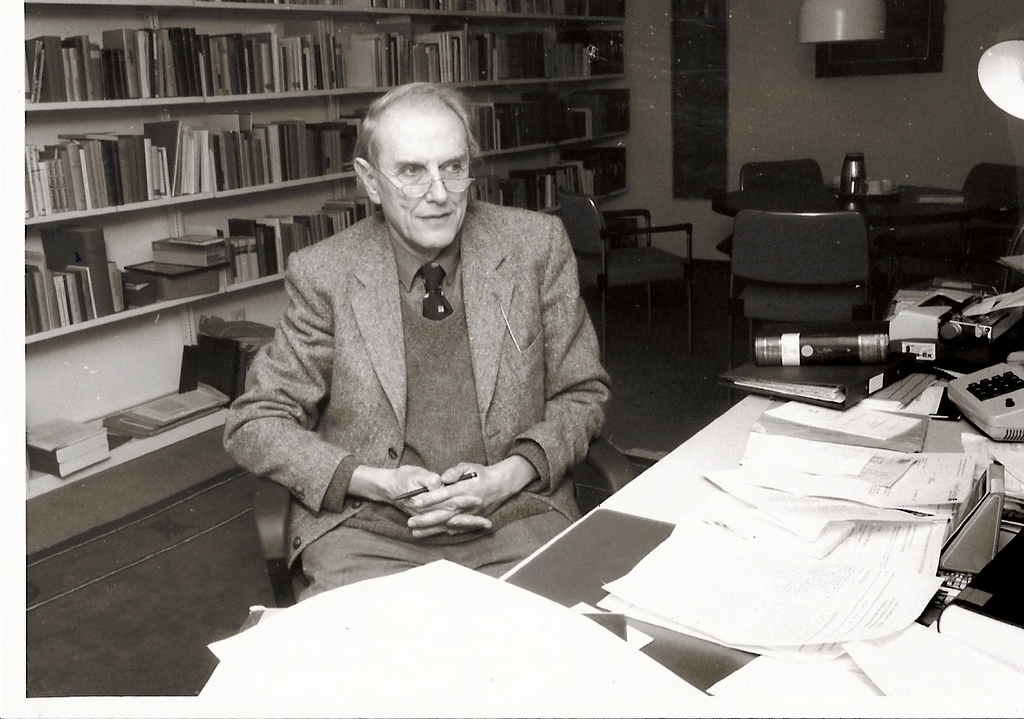
Further reading: Nigel F. Palmer ‘Ganz, Peter Felix’ in ODNB. The blog post was first published by TORCH in November 2020. Picture: Peter Ganz at the Herzog August Bibliothek Wolfenbüttel 1986