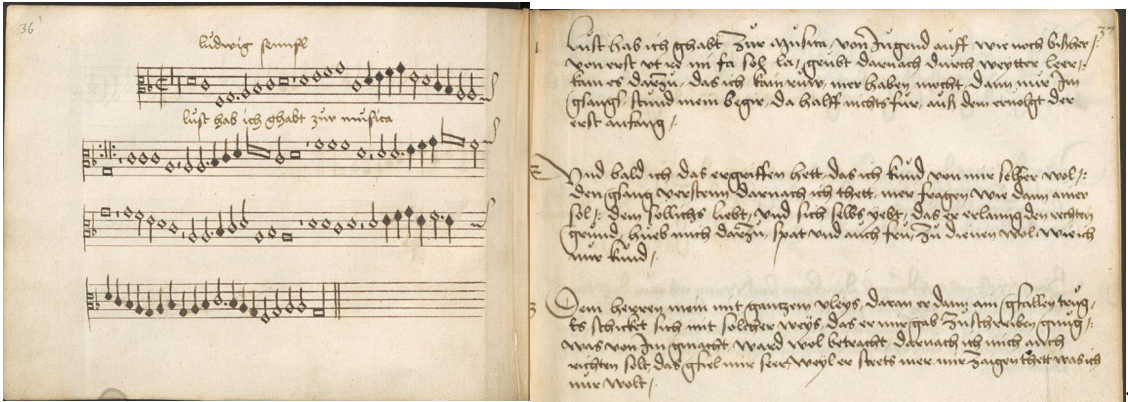
In 1524, the Augsburg organist Bernhart Rem started writing the part books Österreichische Nationalbibliothek Ms. 18 810 from which the songs for the concert are taken. The pre-concert talk will explore the writing and music-making of late medieval Germany. The early 16th-century soundscape was varied and colourful, ranging from street cries, via religious songs in processions and meetings of the Meistersinger, to instrumental music performed by “town waits”, groups of instrumentalists playing for festive occasions. The songs of Ms. 18 810 retain features of this exclusive aristocratic song culture. They might look like pop music with run-of-the-mill lyrics but in fact these are cutting-edge text-musical combinations. Singing about love’s woes and (occasionally) joys, and of how the poet, assuming the persona of a male lover, constantly runs into and (occasionally) overcomes the obstacles society throws in his way, is as noble a pastime as falconry or commissioning costly manuscripts.
On 7 March 2023 (Tuesday of week 8 of Hilary Term for the Oxonians), music editor and viol player David Hatcher, Professor of German Literature & Linguistics Henrike Lähnemann, and singer James Gilchrist met in the Holywell Music Room to discuss the songs of this manuscripts, taking in music, literature and culture in early 16th century Germany.
Pre-Concert Talk recording by Dr Natascha Domeisen for Oxford Medieval Studies
The authors were members of the same courtly circles or, in cases such as Ludwig Senfl’s autobiographical song ‘Lust hab ich ghabt’, even writing texts themselves as singer-songwriters of the period. In line with the poetic habits of the period, they pay more attention to stanza form than to originality of content. Maximilian’s court was an international meeting point: not only would all forms of German dialects have been spoken, but Latin, French, and even English as well; Ludwig Senfl’s teacher Heinrich Isaac was Dutch.
The pre-concert talk also mentioned the autobiographical song Lust hab ich gehabt zur musica, a song in praise of music education which spells in the verse initials the name of its author and composer, LUDWIG SENNFL, and charts his musical training.
Henrike Lähnemann writes: It is appropriate that with James Gilchrist this repertoire is interpreted by a non-native speaker. Coming to the repertoire not from within the system gives performers the advantage over a German singer to be aware of temporal and regional varieties of the language of song. I was delighted when James contacted me via Claire Horáček – alumna of my own College St Edmund Hall – to check out historical pronunciation. It was exciting to go through this repertoire which can only be grasped when spoken out aloud; this is not a text for silent reading!
Concert in the Hollywell Music Room with the Linarol Consort of viols and James Gilchrist (tenor)
Valentine’s Day at the Medieval Church and Culture seminar featured a enthralling talk from Dr Federica Gigante, Curator of the Collection from the Islamic World at the History of Science Museum in Oxford. Federica showed us the many places where Islamic textiles can be found in medieval Christian religious settings – places we’ve all seen, but never realised what we were looking at. Islamic silks were used to wrap saints’ bones, or were depicted as trompe l’oeuil hangings on church walls – such as here in the upper basilica in Assisi:
or even within the frescoes of the life of St Francis:
The images can be linked to surviving Islamic textiles and often feature kufic or pseudo-kufic script in a band along the top, with Islamic religious messages.
Perhaps the most fascinating set of images Federica showed was the depiction of a whole Islamic tent in the chancel of a medieval convent in Ferrara, Sant’Antonio in Polesine – still extant, though with later interpolations:
Why a tent might be painted on the walls of a convent chancel prompted lively speculation from the audience, and we all went away with our eyes opened for when we next spot textiles in churches.
Monday 6 March 2023 (Week 8), 4.30–6pm, at St Edmund Hall, Pontigny Room
In this workshop, we will be offering voice projection exercises and practical advice for the Medieval Mystery Cycle. All actors and directors interested in taking part are invited to attend! Beyond general exercises, there will also be an opportunity to work out staging constellations on site at St Edmund Hall (as well as an opportunity to enjoy tea and cake).
The workshop will be led by Dr Jim Harris, the Medieval Mystery Cycle’s Master of Ceremonies and Teaching Curator at the Ashmolean Museum. Let us know if you’re able to join us by emailing Michael Angerer, the graduate convenor.
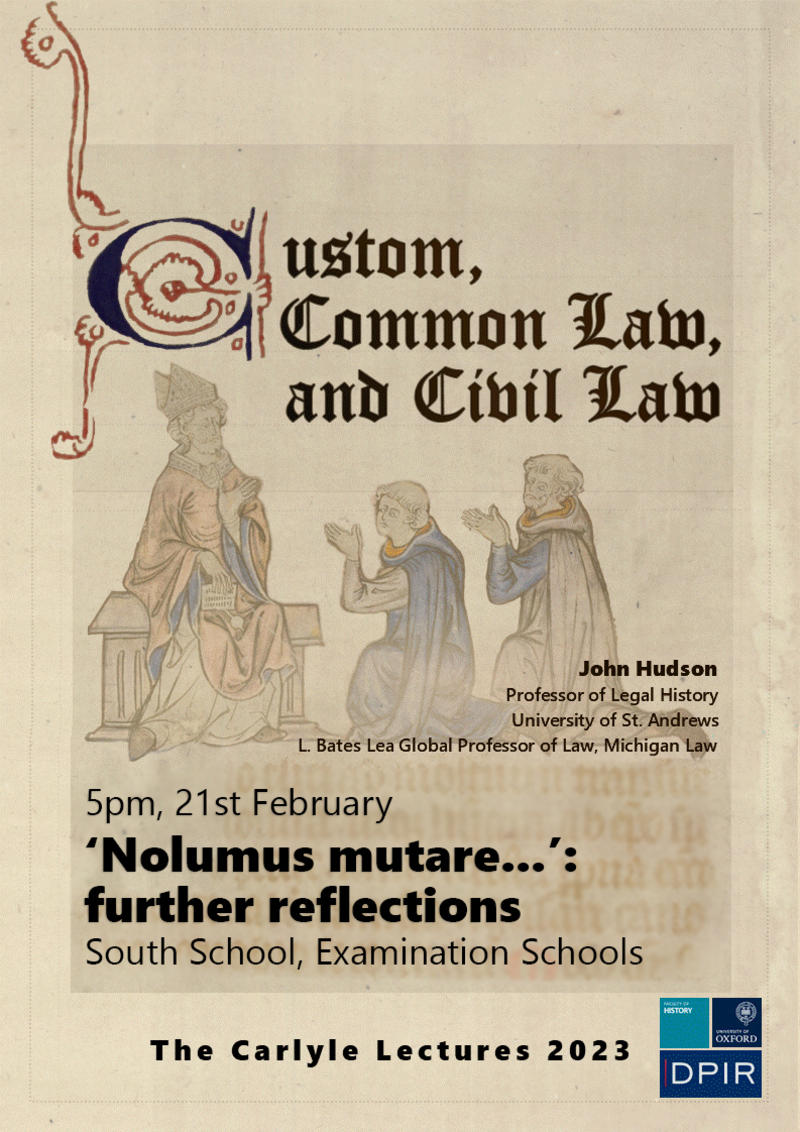
This concluding lecture reflects on the problems and possibilities of comparative legal history before moving on to the differences and similarities in patterns of England, France, and north Italy in the period c.1160-1270.
This lecture explores the ways in which deliberate legal change came to have unintended effects, especially on substantive law. It considers the interplay of legal learning, legal reasoning, and legal change. In so doing, it ponders Sir Henry Maine’s view of substantive law being secreted in the interstices of procedure.
Students will learn about Old Frisian language, text corpus, culture and history in the context of Old Germanic languages. Linguistic comparisons will be drawn between Old Frisian and the other (West) Germanic languages. Settlement history of Frisians in Britain, Old Frisian Law and Literature and Old Frisian manuscripts will be discussed in lectures. Library visits will focus on the Old Frisian manuscripts in Oxford. The OFSS will close with a social day in Oxford. The OFSS is about learning to read Old Frisian and to place Old Frisian in a wider linguistic, literary and historical context.
Who is the summer school for?
The summer school is aimed at students, PhD candidates and early career researchers with an interest in (Old) Germanic languages who want to familiarise themselves with Old Frisian.
What will the day programme look like?
There will be two lectures in the mornings and a translation workshop or library visit in the afternoons. The programme will cover the Old Frisian grammar in lectures by experts in the field and in translation workshops. Students will read Old Frisian texts in the afternoon workshops with help of modern handbooks and learn about the Old Frisian text corpus
By the end of the week, students should be able to translate a medium level Old Frisian text with the help of handbooks and have gained a good level of knowledge of the place and importance of Old Frisian within the Old Germanic language family
A visit to the Bodleian Library will enable students to view the Old Frisian manuscripts that are kept at Oxford.
Prof Andreas Deutsch, Deutsches Rechtswörterbuch, Heidelberg
Dr Peter-Alexander Kerkhof, Frisian Academy, Ljouwert/Leeuwarden
Prof Simon Horobin, University of Oxford
Dr Rafael Pascual, University of Oxford
Mr Hilbert Vinkenoog (YouTube channel History with Hilbert)
Mr Anne Popkema MA, Groningen University
Dr Johanneke Sytsema, University of Oxford
What does it cost?
In person fees: £350 (Early bird rate £300 if booked by May 1st)
Hybrid fees: £150.00
Fees for in person attendance will include
Tuition and workshops
Study materials
Coffee/tea
Daily 3-course lunch
Saturday social activities
Library visits
Conference dinner
Hybrid fees will include access to all streamed lectures and electronic access to the grammar and dictionary during the week.
Accommodation:
Participants can book accommodation in student halls belonging to St Edmund Hall (email address susan.mccarthy@seh.ox.ac.uk first come first served) or find accommodation in another college in Oxford via https://www.universityrooms.com/
For further information about the Summer School please contact: oldfrisian@ling-phil.ox.ac.uk (for all interested) or ofss@rug.nl (for students of Groningen University)
The Fair Field of Folk. Piers Plowman: A Potted Adaptation of the B Text When: 11 February 2023, to be repeated partially during the Medieval Mystery Cycle 22 April 2023 Where: St Edmund Hall, Queen’s Lane, OX1 4AR Oxford
Director: Eloise Peniston
Trailer filmed and edited by Natascha Domeisen, music by Alexander Nakarada
Welcome to our mervelous sweven, the Middle English prose B text of Piers Plowman dramatized and brought to stage by an eclectic mix of English students, medievalists, business students, historians, even a mathematician! Starring
😴 Sòlas McDonald as Will the Dreamer
😜 Jonathan Honnor as Piers Plowman/False Tongue
⛪ Clare-Rose McIntyre as Holy Church
✝️ Chantale Davies as Theology/Priest
🤔 Rei Tracks as Conscience
🌾 Alexane Ducheune as Mede’s Handmaid
👑 Kate Harkness as The King
💃 Eloise Peniston as Envy/Lady Mede
💰 Sabrina Coghlan-Jasiewicz as Simony/Pride
😡 Sonny Pickering as Wrath
👩⚖️ Zelda Cahill-Patten as Civil Law/Covetousness
With original music by Anna Cowan (harp) and Rachael Seculer-Faber; ceremonial trumpet: Henrike Lähnemann, special advice: Jocelyn Wogan-Browne. Supported by Oxford Medieval Studies and St Edmund Hall
Video filmed and edited by Natascha Domeisen, cover image by Duncan Taylor
Plot summary
The play follows a man named Will, who falls asleep beside a stream on a May morning in Malvern Hills with a succession of dreams, beginning with a tower on a hill, a dungeon, and a fair field of folk. On his quest for Truth, Will meets a host of allegorical personifications, wandering through the marriage and later trial of Lady Mede, the confession of the Seven Sins, the Crucifixion, and the Harrowing of Hell. In the midst of all, Piers Plowman emerges, taking only momentary repose from his plough to guide Will towards Truth and, rather scandalously, chastise members of the clergy.
Scenes
Introduction from Holy Churche and Mede Holy Churche and Mede will explain what to expect from our play.
Prologue The bugle breaks through the air, and the dulcet tones of our bard and piper will lead you to a May Morning on Malvern Hills
Holy Churche and Will Will searches for Truth, imploring guidance of Holy Churche. Truth is, of course, that one must Do Well, Do Better, and Do Best.
Lady Mede Mede, the incarnation of financial reward, bribery, corruption, arrives.
Marriage of Mede False and Mede attempt to marry but the King requests their presence at the court, as False is not deemed a suitable husband for the noble lady.
Trial of Mede Mede pleads her case, explaining the importance of ‘mede’ or reward in the world at large.
Seven Deadly Sins Pride, Lechery, Envy, Wrath, Covetousness, Gluttony, and Sloth come and confess their sins.
Piers Plowman Piers Plowman arrives and agrees to show the field of folk where Truth is, if they help him plough his half acre.
Tearing of the Pardon Truth sends a pardon for Piers, however it is discovered not to be a real pardon at all. Piers tears it in two and interprets the Latin better than a priest ever could.
Background
Piers Plowman is an allegorical text that exists in different versions. The A text is the incomplete earliest version, the B text is the most broadly translated and edited, while also being highly scandalous, and the C text is highly censored, notably failing to mention the Peasants Revolt and the Tearing of the Pardon, which our performance presents.
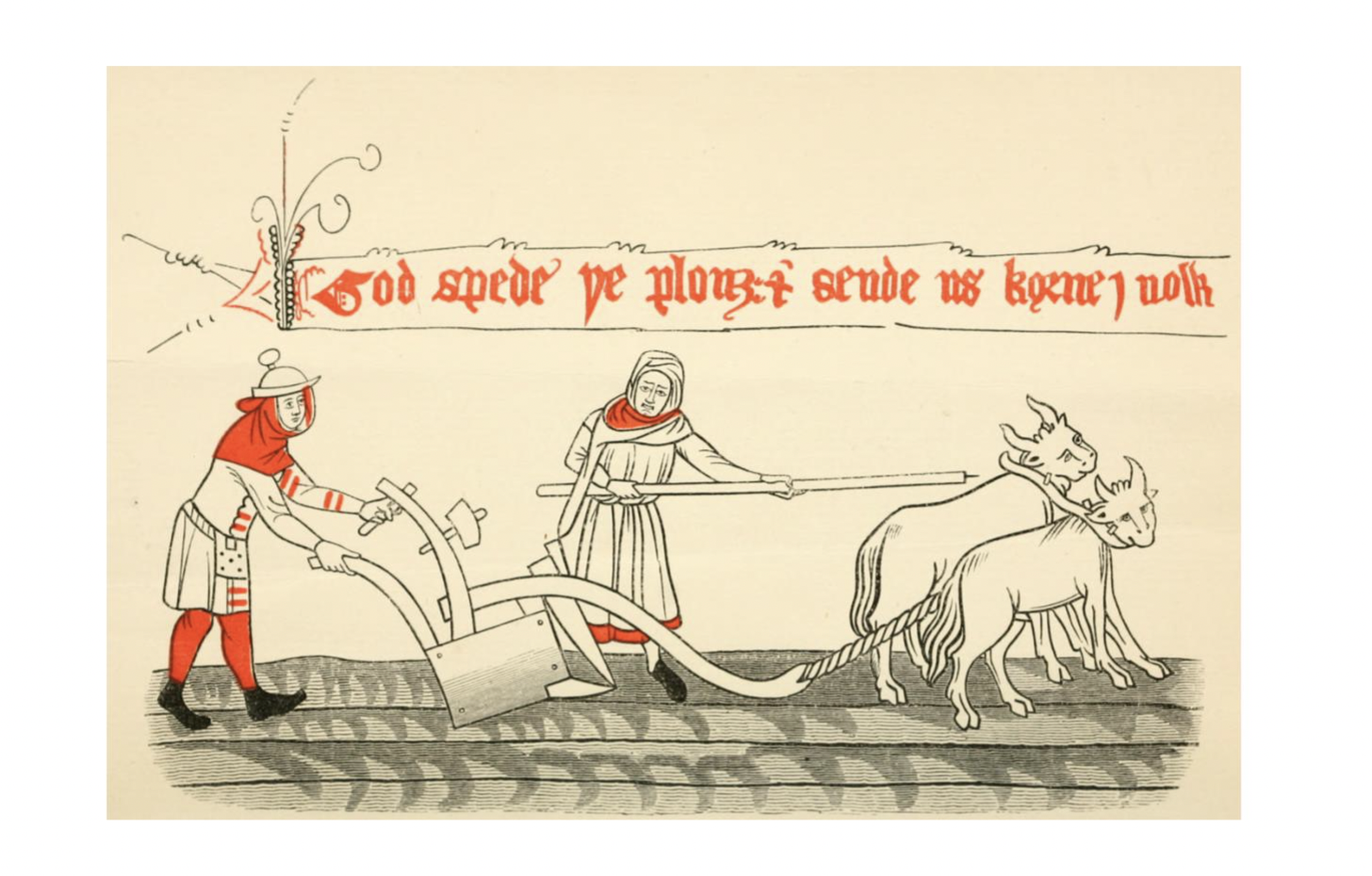
The B text can be approximately dated to 1388, and has quite the volatile position in history, especially in relation to the peasant’s revolt and heresy. While locked inside Maidstone Castle, John Ball penned his radical Letter to Essex Men, citing Piers Plowman and Robin Hood as comrades in the fight. In short, Piers Plowman is a working class hero, a Billy Bragg if you will, representing the right of common man. The concept of class struggle is deeply entrenched into the text, carrying the relics of the Domesday Book serfdom, to the climbing taxes in the midst of the 100 years war, the dwindling population as the Black Death roamed the country. All of these tensions boiled over on the 30th of May, 1381, as John Bampton arrived in Essex to collect unpaid poll taxes. In consideration of 1990 Poll Tax riots, the UK Miners’ Strikes in 1984, and the recently unveiled Strike Laws, clearly class struggle repeats itself. With a ploughman at the helm, the voice of the working people is vital in the text. With all that in mind, sit back, relax, and enjoy the chaos. God spede þe plouȝ!
Director’s Story
Read a full version of Eloise Peniston’s reflection on her blog. Elise writes: I first discovered Piers Plowman at a bus stop. I was characteristically lost with a dead phone and only a charity shop book to keep me company. While no one murmured ‘Thou still unravished bride of quietness’, at me, I was acutely aware of being in the presence of the literary as I thumbed through the wind-swept pages. I was intensely confused, which, at the age of fifteen, I supposed was the hidden intention of all literature. With the charmed hand of A. V. C. Schmidt to guide me, I followed Will fallling asleep. I remember after being “found” an hour later how I, rather breathlessly, recounted the events of the B text to my mother as she, mid-flap, chastised me about reckless spontaneity and the need for charged phones.
At that bus stop, I knew that, by the fortuity of an Oxfam find, I had discovered something wonderful, but I had no idea that seven years later, I would be scavenging liripipes and slit-mittens in an attempt to bring this dream-vision to life. Now, I often take that humble copy with me to Malvern Hills, and it is positively crammed with pressed, may-morning flowers. However, little did I know then how deeply entrenched this text was in the public sphere or about the literary and literal rebellions that have emerged beneath the mouldboard.
From the pen of a man who described Piers Plowman as “not worth reading”, Gerard Manley Hopkins perfectly captured the flesh-good of the text:
And features, in flesh, what deed he each must do – His sinew-service where do.
He leans to it, Harry bends, look. Back, elbow, and liquid waist In him, all quail to the wallowing o’ the plough: ‘s cheek crimsons; curls Wag or crossbridle, in a wind lifted, windlaced – See his wind – lilylocks – laced; Churlsgrace, too, child of Amansstrength, how it hangs or hurls Them – broad in bluff hide his frowning feet lashed! raced With, along them, cragiron under and cold furls – With-a-fountain’s shining-shot furls. Harry Ploughman G. M. Hopkins
This particular poem encapsulates the essence of Piers Plowman: pure inscape, or as Stephen Medcalf calls it, an “extraordinary combination of roughness and a delicate magic.” It is incredibly difficult to describe what happens in Piers Plowman but “churlsgrace” is certainly the perfect descriptor for the essence of the text. A mere ploughman knows the way to Truth and is gracious enough to guide the reader, in return for help in plowing and sowing a half-acre.
Piers Plowman is ultimately a text that encourages mental labour, in a field, at a bus stop, or even in the gardens of St Edmund Hall…
We invite you to toil with us at Teddy Hall. From a tower on toft, a trumpet shall hail the dream, before the gentle plucking of a harp will guide you to sleep. Come and set forth on a dream-pilgrimage, exploring political satire, social upheaval, and spiritual crisis. We hope to see you soon in the fair field. God spede þe plouȝ!
February marks LGBTQ+ history month in the UK. Alcuin, who frequently wrote of his male colleagues with romantic affection, is celebrated by many LGBTQ+ scholars as part of our history. Here are some appropriate words from the 8th Century:
Haec ideo, frater, tibi scripsi, ut scias, si tamen scire potes, qua te caritate diligo; nam me ipsum fateor edicere non posse – fordan etiam nec tu, qua me diligas – Deus scit, qui hanc infudit cordibus nostris.
[I have written you this, my brother, so that you might know how much I love you; for I confess that I cannot express it – and perhaps you too cannot say how much you love me – but God, who poured this love into our hearts, knows it, Ep. 17]
In the spirit of uplifting LGBTQ+ scholars and scholarship, I’d like to bring special attention to one of our newest additions: the Queer and Trans Medievalisms Reading and Research Group, which meets at 3pm on Monday at Univ College, 12 Merton St Room 2 to discuss the wonderful Yde et Olive! All are welcome!
On another note, please keep in mind that over the coming weeks, many seminars, reading groups etc. may be cancelled or postponed at late notice in solidarity with UCU strike action. For all the latest updates, please check our Calendar (on the right hand side of our blog) or Twitter (@OxMedStud). If you are cancelling an event, please let me know so that we can update the community!
ANNOUNCEMENTS:
Registration for the Memorial Event for Nigel F. Palmer is open. To celebrate the life and scholarship of Nigel F. Palmer, Professor of German Medieval Literary and Linguistic Studies at the University of Oxford, Faculty, College and academic community will honour his memory with a symposium, to be held at the Taylorian and the Weston Library on 19-20 May 2023.
Piers Plowman performance on Saturday 11 February, 2-3pm, in St Edmund Hall! This coincides with National Garden opening of the beautiful grounds. The charity donation of £4 includes entry to the play – or write a review (speak to the OBS members at the entrance about how to do this) and you get in for free!
The Dark Archives 19-21 Proceedings: Voyages into the Medieval Unread and Unreadable are going to print this week! The Dark Archives conferences examine the praxis of digitisation and its impact on medieval studies worldwide. To read more about the volume, see the blog post by Stephen Pink and Anthony John Lappin.
EVENTS THIS WEEK:
Monday 6th February:
The Byzantine Graduate Seminar takes place at 12.30-2pm online via Zoom. This week’s speaker will be Daniel Alford (University of Oxford), Adults, Children and Other Animals: The Construction of the Zoroastrian Household. To register, please contact the organiser at james.cogbill@worc.ox.ac.uk.
The Medieval Latin Manuscript Reading Group led by Matthew Holford and Andrew Dunning is meeting as usual via Teamsfrom 1-2pm. We will start with natural history from a medieval encyclopaedia. Sign up for the mailing list to receive updates and the Teams invite, or contact matthew.holford@bodleian.ox.ac.uk or andrew.dunning@bodleian.ox.ac.uk for more information.
The Queer and Trans Medievalisms Reading and Research Group meets at 3pm at Univ College, 12 Merton St Room 2. This week’s theme is Yde et Olive. All extremely welcome! To join the mailing list and get texts in advance, or if you have any questions, email rowan.wilson@univ.ox.ac.uk.
The Medieval Archaeology Seminar meets at 3pm at the Institute of Archaeology, Lecture Room. This week’s speaker will be Prof. Oliver Creighton, University of Exeter, ‘Warhorse: The archaeology of horses in England, AD800-1600‘.
The Medieval History Seminar takes place at 5pm in the Wharton Room, All Souls College and on Teams (Teams link here). This week’s speaker will beJustine Trombley (Durham), ‘Books and the Late Medieval Landscape of Heresy and Inquisition.’. The Teams session can be accessed by logging in to Teams with your .ox.ac.uk account and joining the group “Medieval History Research Seminar” (team code rmppucs). If you have any difficulties please email: medhistsem@history.ox.ac.uk
The Lincoln Leads seminar takes place at 5.30–7pm at Oakeshott Room, Lincoln College. This week’s panel is ‘Love and Other Emotions’, and features Em Horne (MSt in English 650-1550) on emotionality in Old Icelandic Sagas. Book a free place here: https://www.eventbrite.co.uk/cc/lincoln-leads-2023-1539199.
Tuesday 7th February:
The Europe in the Later Middle Ages Seminar will take place at 2–3.30pm in the New Seminar Room, St John’s College. Tea and coffee available from 1.45pm. This week’s speaker will be Cecilia Gaposchkin, Dartmouth, ‘SacralParis and the Capetians‘.
The Medieval German Graduate Seminar will meet at 11:15am in the island room of Oriel College for discussing Heinrich von Neustadt’s Apollonius von Tyrland. If you are interested to join, contact Henrike Lähnemann to be added to the teams chat.
The Medieval Italian Seminar will take place at 2pm at Rees Davies Room, History Faculty. This week’s speaker will be Adele Curness, (Oxford, St John’s), ‘Calabrian Hagiography and Mediterranean Connectivity in the Long Tenth Century’.
GLARE (Greek and Latin Reading Group) takes place at 4-5pm at Jesus College. Please meet at Jesus College Lodge. This week’s text will be Homer, Odyssey, ll. 23–50 & 465–503. All welcome to attend any and all sessions. For more details and specific readings each week, or to be added to the mailing list, email john.colley@jesus.ox.ac.uk or jenyth.evans@seh.ox.ac.uk.
The Medieval Latin Document Reading Group meets on Teams at 4-5pm. We are currently focusing on medieval documents from New College’s archive as part of the cataloguing work being carried out there, so there will be a variety of hands, dates and types. A document is sent out in advance but homework is not expected. Contact Michael Stansfield (michael.stansfield@new.ox.ac.uk) for further details and the Teams link.
The Late Antique and Byzantine Seminar takes place at 5pm at the Ioannou Centre for Classical and Byzantine Studies, 66 St Giles. This week’s speaker will be Yan Zaripov (St Hilda’s College), ‘Theodore Prodromos’ Epigrams on the Old and New Testament: Narrative, Rhetoric, and Classical Mimesis’.
The Medieval English Research Seminar takes place at 5.15pm in Lecture Theatre 2, English Faculty, followed by a drinks reception. This week’s speaker will be Philip Knox (University of Cambridge), ‘Usk’s Books’. All welcome.
Thursday 9th February:
The Oxford Medieval Commentary Network will meet at 12.45-2.15pm in Thatched Barn, Christ Church (by meadow entrance). Free lunch from 12.45, seminar paper begins at 1.15. Today’s speaker will be Jiani Sun, Oriel College, Oxford, ‘The Making of an Autobiography: Reading, Writing, and Shaping the Life of Solomon in Wisdom of Solomon 7–9′. Please direct all questions to cosima.gillhammer:chch.ox.ac.uk, or visit the website.
The Celtic Seminar will not run today due to UCU strike action. The paper by Myriah Williams has been postponed to the autumn.
The Medieval Visual Culture Seminar meets at 5.15pm at St Catherine’s College, Arumugam Building. This week’s speakers are Lauren Rozenberg University College London, ‘In the Flat Round: Brain Diagrams in Late Medieval Manuscripts‘ and Sergei Zotov, University of Warwick, ‘Christian Motifs in Fifteenth-Century Alchemical Iconography‘.
Friday 10th February:
The Medievalist Coffee Morning takes place at 10:30-11.30am in the Visiting Scholars Centre in the Weston Library (access via the Readers Entrance on Museum Road: straight ahead and up two floors!). This week we’ll be treated to a number of Hebrew manuscripts by Dr Thea Gomelauri, among them Bodleian Library MS. Can. Or. 28, 34, 37, 41 and 94 – do come!
Saturday 11th February:
A Fair Field of Folk will be performing The Potted B Text of PIERS PLOWMAN. Come and join our merveillous swevene, 2–3pm at St Edmund Hall, Broadbent Garden (behind the library church of St-Peter-in-the-East). Gardens open 2–5pm as part of the National Garden scheme. Ticket for the gardens £4.00 on the door, includes entrance to the play.
OPPORTUNITIES:
The Vatican Film Library at Saint Louis University invites applications to short-term fellowship programs available for research in its collections. The library holds over 40,000 medieval and Renaissance manuscripts reproduced in microfilm and digital formats. Fellowships are available to graduate students and established scholars regardless of nationality. For further information on application details and submission deadlines, see our fellowship guidelines.
Call for Submissions: The Database of Religious History. The Database of Religious History (DRH) is currently recruiting historians, archaeologists, and religious studies scholars in all areas of expertise (PhD students and above). If you have academic expertise in the history or anthropology of religion, please consider contributing to the DRH. In an effort to build the database in as swift a manner as possible, and improve the quality of any analyses produced with it, the DRH is offering $300 CAD honoraria for each completed entry. If you are a PhD candidate or above and would like to contribute an entry on any religious group, place, or text, please contact Dr. Ian Randall (irandall@mail.ubc.ca) or sign up for the database at https://religiondatabase.org/landing/get-involved and select Dr. Randall as your entry editor. For more information please see here.
CFP: Priests and their Manuscripts in the Holy Land and Sinai (Vienna, 8–10 November 2023). Please send the title of your paper and an abstract (max. 300 words) to Giulia Rossetto (giulia.rossetto@oeaw.ac.at) no later than March 15, 2023. The speakers will be notified by April 15.For full details, see our blog.
I leave you with another quote from Alcuin’s letters, on the power of love, as a little preview for next week’s Valentine’s day:
Dulcedo sanctae dilectionis vestrae omnibus horis etiam et momentis aviditatem pectoris mei habundantur
[The sweetness of your righteous love makes the desire of my heart overflow every hour and every minute, Ep. 78]
May love (of this medieval community and your research) make your heart overflow this week!
[Two medievalists discover that they are birds of a feather] Ashmole Bestiary, Bodleian Library MS. Ashmole 1511, f. 66 v. Viewable in full at Digital Bodleian
We are pleased to announce the Hilary Term Lecture of the Centre for Manuscript and Text Cultures (CMTC). The lecture will take place on WED 1 March, 5-6.30 (UK time) in the Memorial Room at The Queen’s College in the University of Oxford.
Our speaker will be Yannis Assael, Intelligence Research Scientist at Google DeepMind
Title: Predicting the past with deep neural networks
Abstract: Ancient history relies on disciplines such as epigraphy for evidence of the thought, language, society and history of past civilizations. However, over the centuries, many inscriptions have been damaged to the point of illegibility, transported far from their original location and their date of writing is steeped in uncertainty. To address these challenges we present Ithaca, a deep neural network for the textual restoration, geographical attribution and chronological attribution of ancient Greek inscriptions. The goal of this presentation is to demonstrate how recent advances in the field of Deep Learning can assist and expand a historian’s workflow, and highlight the importance of joint interdisciplinary research.
Written by Annabel Hancock (St John’s College, Oxford) Lead Organiser @annabel_hancock
@PremodernTrust
After over a year of preparation, the conference took place on 13-14th January 2023 in the Oxford History Faculty, and it was a great success! We were thrilled to welcome five eminent keynote speakers as well as 26 speakers and 20 attendees. Attendance was truly international with speakers from the US, Taiwan, Israel, Australia, The Netherlands, and Spain, to name a few places. There were also participants from a range of career stages with a large number of postgraduate students and ECRs speaking alongside renowned professors.
The call for papers generated a much greater response than expected, from researchers at a variety of career stages and disciplines. While it led to greater organisational challenges, this led to the decision to run parallel sessions, allowing the acceptance of a greater number of papers and wider conversations. This meant we had panels which focused on trust as an emotion and experience, on trust and its relationship to power, to professions, in trade, credit, and debt relationships, and in spaces and systems.
The keynote speakers acted perfectly to direct the focus of the conference and encourage wide-ranging discussions. Dr Justyna Wubs-Mrozewicz (University of Amsterdam) started us off perfectly, thinking about generalised trust, encouraging us to think about how communities engage with trust in the common good in the medieval city. Professor Teresa Morgan (Yale Divinity School) then encouraged us to think about the ways in which language and meaning develops, showing how ideas of trust in Early Christian faith developed to relate to belief, redefining one’s relationship to God. Dr Nicholas Baker (Macquarie University, Sydney, Australia) then ended the first day perfectly. He showed us that the ways in which merchants thought about time in sixteenth century Italy was deeply complex, looking at the ways in which language related to trust and time expressed anxieties as well as positive hopes. Dr Antonella Liuzzo Scorpo (University of Lincoln) started day two with a look at trust as an emotion, specifically encouraging us to think about the ways in which women took part in the construction of trusted spaces in diplomacy in thirteenth-century Iberia. Our final keynote speaker, Professor Sheilagh Ogilvie (All Souls College, Oxford) delivered a paper encouraging us to think about the voices of premodern people and the ways theories of social capital/networks can hide the darker side of trust communities. She highlighted the ways in which economic approaches to trust can help us to look deeper into the ways in which communities functioned and encouraged us that as historians we have much to add to this conversation.
Papers and keynote talks led to a great number of discussions and engagement with trust across a range of times and places. Perhaps one of the most exciting parts of many conversations was the realisation that though the 54 total participants all worked on varied times and places across the globe, and on various forms of trust, we all had knowledge and ideas that could be related it, and questions that could be the start of new ways of thinking.
There is still much to think about and I know that all participants will be processing the discussions we had for a long time to come. Perhaps one of the main take aways at this early stage is the great power that comes with thinking about trust in the past. Through this focus, we can learn more about the economic, social, and cultural lives of people in premodern Europe, and consider the ways in which rationality and emotions are negotiated.
The organising committee was thrilled to receive much positive feedback, including on social media, from attendees about the event and a great desire for conversations started at the event to continue. This will be an ongoing global network.
This event would not have been possible without a great amount of support and encouragement from friends, colleagues, various members of the History Faculty admin team, and our generous sponsors.