The aim of the MHS Essay Prize is to promote and encourage scholarly research and popular interest in the history of the medieval Mortimer family of Wigmore and its cadet branches, including those of Chirk and Chelmarsh, and the family’s impact on the history and culture of the British Isles. Or the history, geopolitics, topography, laws, economy, society and culture of medieval borderlands, including comparative studies, between 1066 and 1542. Success will garner financial prizes, the opportunity for peer-reviewed publication, membership of the MHS and speaking opportunities. The closing date for entries is 15th February 2026.
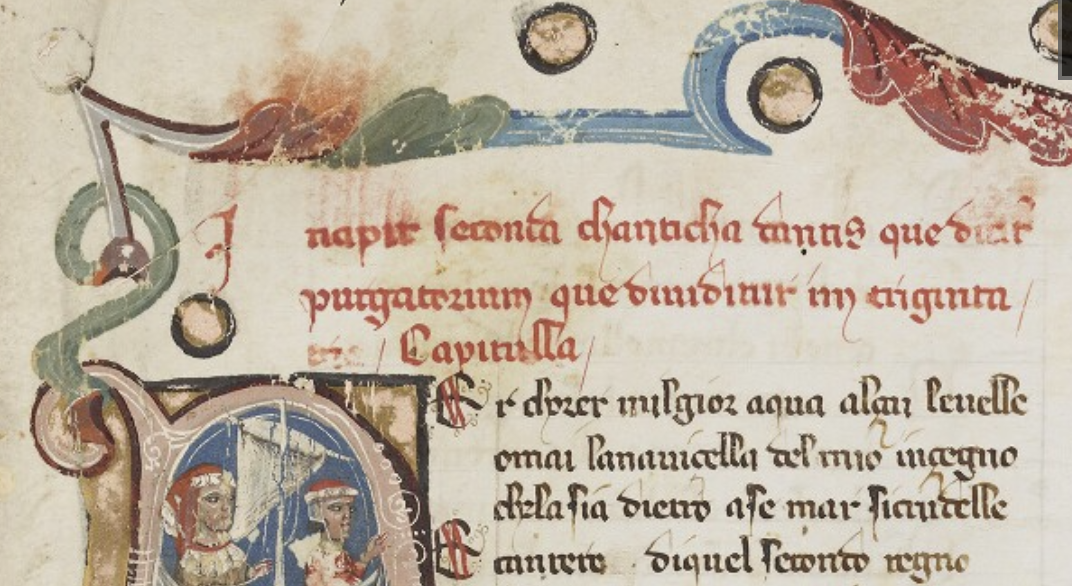
As part of the Italian Research Seminar, Ryan Pepin will speak on ‘Dietro la memoria non può ire’: Copyists’ Slips in the Textual Tradition of the Commedia.
Time and Place: Monday, November 10th (5th week), Taylorian, Room 2, 1-2:30 PM
Abstract: The enormous textual tradition of Dante’s Commedia – over 600 complete manuscripts – is a mine of data on how scribes worked in late medieval Italy. Thanks to the efforts of palaeographers and codicologists over the last twenty years, we have learned about the difference between professional and amateur milieux (Pomaro), the development of collaborative, serial book production in Florence (De Robertis, Ceccherini), copyists’ efforts to compare and correct their texts (Tonello) – even about the ‘habits’ of individual scribes (Marchetti).
This paper studies a type of error which to which Dante’s copyists were especially prone: errors that resulted from a good memory of the poem. By studying scribal innovations that ‘echo’ other lines in the text (Petrocchi), we come as close as we can to early readers’ ear for the poem: what they attended to, how they understood the poet’s style – and even, I will suggest, how they understood the poet’s own compositional practice.
Bio: Ryan is a British Academy Postdoctoral Fellow at the University of York. He is currently studying medieval Latin rhythmical poetry that circulated in Italy during the thirteenth and early fourteenth centuries.
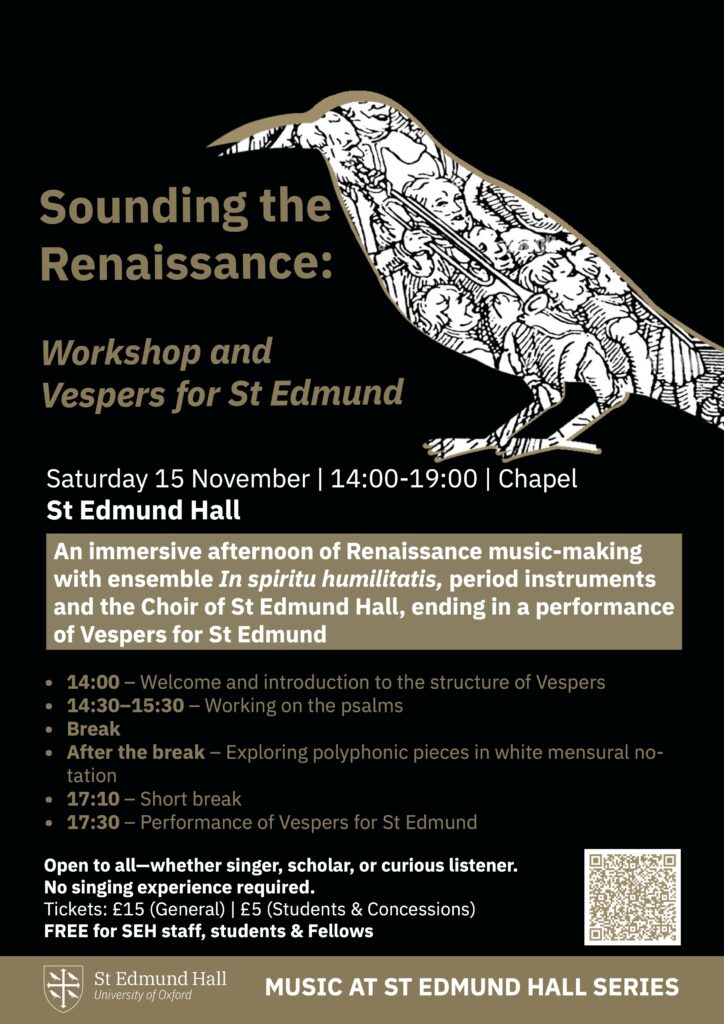
Saturday 15 November | 14:00-19:00 | Chapel St Edmund Hall Open to all, whether singer, scholar, or curious listener. No singing experience required. Tickets: £15 (General) | £5 (Students & Concessions) | free for SEH staff, students & Fellows Register on Eventbrite
The historical wind and vocal ensemble In Spiritu Humilitatis joins the Choir of St Edmund Hall for an immersive exploration of Renaissance Vespers. Reading directly from original choirbooks in white mensural notation, and guided by the sound of cornetts, sackbuts, and voices, participants will rediscover the expressive freedom of improvised polyphony and the luminous sonorities of early sacred music.
While traditional musical education often relies on modern editions, working from original sources opens a world of interpretative freedom. It allows musicians to make their own informed choices about phrasing, accidentals, and flow, rather than relying on an editor’s interpretation. It’s a liberating process. Reading from the sources draws you closer to the composer’s voice, encouraging a more personal, heartfelt performance.
This workshop invites you to experience that process firsthand: to step into the world of a Renaissance choir and take part in the singing of Vespers for St Edmund, Archbishop of Canterbury. Together we’ll explore the structure of the service, learn how to sing psalms in monody and improvise around plainchant, and practise reading from original notation.
Open to all, whether singer, scholar, or curious listener, this participatory event is about discovery, connection, and the joy of music-making. There are no wrong notes, only the opportunity to let your musicianship lead the way.
Here’s how the afternoon will go:
2:00 pm – Welcome and introduction to the structure of Vespers 2:30–3:30 pm – Working on the psalms Break After the break – Exploring polyphonic pieces in white mensural notation 5:10 pm – Short break 5:30 pm – Performance of Vespers for St Edmund
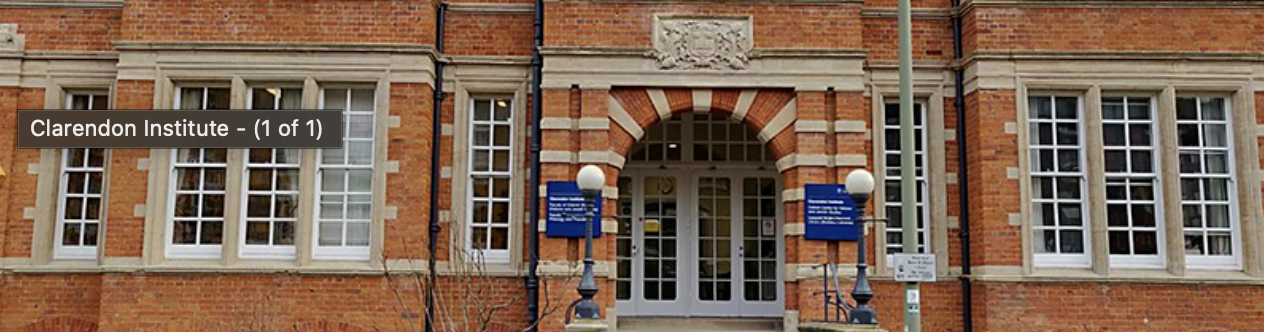
Catherine Lewis Lecture Theatre, Clarendon Institute, Walton Street, Oxford OX1 2HG and online via Zoom: see link below.
Convenors: Judith Olszowy-Schlanger and Joseph O’Hara This reading group is an opportunity to practise reading directly from images of medieval Hebrew manuscripts in an informal setting. No advance preparation is required and all skill levels are welcome!
This year we will look at documents and manuscript excerpts from a broad range of the many genres found in medieval Hebrew texts, including scientific, literary, and legal. We will consider their palaeography, language, and historical context, and learn practical skills for reading unfamiliar handwriting, dealing with damaged texts, and interpreting dates and unusual vocabulary.
There will be coffee, tea and cake from 11am in the Common Room of the Oxford Centre for Hebrew and Jewish Studies for those attending in person.
In Week 5, there will be no reading group but please join the Medieval Anglo-Jewish Texts and History group which will meet in person from 9am to 5pm on Thursday, 13 November.
Please note that in Week 6 (20 November) the reading group will not meet, either in person nor on line. The reading group will resume in Week 7 (27 November).
Introduction to Arabic Palaeography – 2:00, Khalili Research Centre
Medieval Archaeology Seminar – 3.00, Institute of Archaeology, Lecture Room. Wyatt Wilcox will be speaking on ‘Isolated Barrows in Early Medieval England: A Spatial Analysis’
Carmina Burana: Graduate Text Seminar – 5:00, Harris Lecture Theatre, Oriel College.
Medieval History Seminar – 5:00 with drinks reception to follow, All Souls College. Anna Chrysostomides (Queen Mary, University of London) will be speaking on “Non-Binary Gender in Abbasid Baghdad: Reality vs. Fiction”
Tuesday
Medieval English Research Seminar – 12:15, Margaret Thatcher Centre, Somerville. Kathy Lavezzo (U of Iowa) will be speaking on ‘The Darker Side of the Middle Ages’.
Medieval Church and Culture Seminar – 5:00, Harris Manchester College. Clare Whitton (Blackfriars) will be speaking on ‘Resurrecting a Patron Saint: The Feast of San Gennaro in 14th century Naples’
Wednesday
Medieval German Graduate Seminar – 11:15, Somerville College. The topic for this term is Ulrich von Richental, Chronik des Konzils zu Konstanz (1414-1438).
Centre for Early Medieval Britain and Ireland Welcome Lunch – 12.30, Balliol College
Older Scots Reading Group – 2:30, Room 30.401 in the Schwarzman Centre.
Medieval Latin Documentary Palaeography Reading Group – 4:00, online.
Late Antique and Byzantine Seminar – 5:00, Ioannou Centre. Erin Thomas Dailey (Leicester) will be speaking on ‘Why Did the Byzantine Empire Forbid SlaveOwners from Making Eunuchs of their Slaves? Castration, Masculinity, and Identity in Late Antiquity and the Early Middle Ages’
Thursday
Medieval Hebrew Reading Group – 10:00, Catherine Lewis Lecture Theatre, Clarendon Institute and online.
Middle English Reading Group – 11:00, Beckington Room (Lincoln College).
Chronicling the Self: including extracts from the memoirs of Lady Nijo and Leonor López de Córdoba
Celtic Seminar – 5:00, online. Lloyd Bowen (Cardiff) will be speaking on ‘London Puritan networks and the publication of the 1630 Welsh Bible’
David Patterson Lecture – 6:00, Clarendon Institute, Walton St. Dr Emily Rose (Academic Visitor, OCHJS) will be speaking on “A Bleeding Corpse, A Grim Grimm Fairy Tale with Early Modern Shivers: The Dubious Margaret of Pforzheim (1267?), A Singular Female Blood Libel”. In order to participate in this lecture via Zoom, please register at this link.
Latin Compline in the Crypt – 9:30pm, in the crypt below St-Peter-in-the-East, St Edmund Hall
Friday
Medievalist Coffee Morning – 10:30, Visiting Scholars Centre (Weston Library). All welcome, coffee and insight into special collections provided.
Oxford University Heraldry Society Lecture – 4:30, Harris Seminar Room of Oriel College. Professor Yorick Gomez Gane will be speaking on “The Italian Language in British Heraldry,” followed by a drinks reception.
In the second half of the first millennium, the Christian scriptures were produced, circulated, and put to use in a diverse range of forms and contexts. A manuscript may accommodate a single biblical text (the psalter, a gospel, the Apocalypse), a collection of texts (the Hexateuch, the fourfold gospel), or, rarely, a complete “New Testament” or “Bible” in the familiar modern sense. The distinctiveness of a manuscript is determined by its content and textual aFiliation, its palaeographical and codicological characteristics, and its paratextual features – from illustrations of biblical narratives, author portraits, and illuminated lettering to canon tables, capitula, prefatory materials, and glosses. Once in circulation, a manuscript’s contexts of use may include liturgical reading and preaching, meditation and mission, education and scholarship, gift-giving and display. DiFerent uses correspond to diFerent users with distinct and perhaps conflicting priorities and goals. Production and use(s) may occur at the same site or at far distant times and places.
This conference aims to explore topics related to both the physical presentation and the use of scriptural manuscripts produced in the Early Medieval period (c. 500–1000 CE). We welcome paper proposals from scholars working in all areas of this field, including PhD students. Whatever the specific topic, priority may be given to papers that also relate it to the wider focus of the conference on both “form” (or “production”) and “use”. We hope to be able to cover presenters’ full conference costs with the exception of travel.
Titles and Abstracts of proposed papers should be submitted to Lauren Randall (lauren.m.randall@durham.ac.uk), copied to Francis Watson (francis.watson@durham.ac.uk), no later than Monday 17 November. Abstracts should not exceed 150 words. Our current draft schedule can accommodate up to fourteen 45 minute sessions, with a maximum of 25 minutes for the presentation in order to allow substantial time for discussion. There will also be several keynote papers or presentations. Please feel free to contact us if you have any questions about this event!
For information, the context of this event is our sub-project “Text, Format, and Reader”, focused primarily on Codex Amiatinus and funded by the Glasgow-based “Paratexts Seeking Understanding” project (Templeton Religion Trust). We are grateful to our Glasgow colleagues for their support.
Francis Watson (Prof) Lauren Randall (PhD student)