Running the Dark Archives

30 September 2020 Tom Revell Llewelyn Hopwood Sophie Jordan

How to bring light into hidden corners of medieval manuscript studies? “Dark Archives 20.20” provided the opportunity to approach the topic in an innovative, digital-born way. Here two of the Oxford Graduate students who took an active part in the conference reflect on their experience.

Running the Conference Events

Tom Revell, the new Oxford Medieval Studies Events Organiser, writes about his experience of the conference:

Dark Archives 20/20 was the first entirely-virtual conference I’d ever taken a role in running, but the groundwork Dr Pink had already put in organising the programme on the darkarchiv.es site, uploading the recorded papers to YouTube, and using Eventbrite to register attendees, made the day-to-day running of the keynotes, panels, debates and competitions much easier. Zoom’s Webinar functionalities allowed us to schedule all the sessions in advance, as well as implement a captioning software that worked very well. The Webinar’s Host and Co-hosts promoted  necessary speakers for a given session to ‘Panelist’ from the ‘Attendees’ list, and then (alongside a number of other organisers and graduate students from Oxford and from the University of Colorado) we formed a team of moderators who made sure the right people were on screen at the right time, supplemented the questions collected from social media by Llewelyn with questions from the Zoom chat, and generally ensured the smooth running of the live portion of the conference. The Chairs found the role of the moderators to be a great help in allowing them and their panelists to enjoy an as-normal-as-possible experience, complete with question and answer interaction (text and voice) with attendees. Streaming the Compline was a trickier part of my assignment. Zoom has a plug-in that allows impromptu streaming to YouTube, but providing a link to the stream before we went live required a little more preparation. However, the amazing performance of all involved was transmitted live without a hitch, and is now available publicly on the Dark Archives YouTube channel.”

Running the Conference Social Media

Social Media Officer Llewelyn Hopwood, the Social Media Convenor, wrote about his experience:

“Early on, Dr. Pink delegated tasks astutely. I was made an administrator on all platforms used by Dark Archives about a week before the conference began, which meant I could use the full functionality of each platform and see exactly what was going on before and during the conference. As well as being able to manage the discussions over Zoom, we could also oversee everything that was happen on the conference’s Discord channel (which was more popular than I expected) and on Dark Archives’ YouTube channel (I was made a manager, using my own account, as was Tom, using the OMS account). However, as social media officer, most of my work happened before the conference started in earnest. The week beforehand, I galvanized excitement by tweeting out screenshots of some of the pre-recorded talks, and giving countdowns for the registration deadline, for talks going live, and for the beginning of the conference proper. Another task I was given was to administer the questions asked to speakers so that they could be discussed in a smooth and orderly fashion during the live sessions (we prioritised questions that were asked beforehand before going on to questions asked live in the Zoom Q&A or chat function). This involved scouring all the different platforms which participants could use to ask questions (YouTube comments, direct emails, the Discord channel, and, most of all, #DarkArchives on Twitter). I compiled these into separate word documents according to the sessions and sent them to the hosts of those sessions at least a day before their session, with updates every few hours when more came in. During the conference itself, each morning, I would send out a tweet outlining which talks registrants would need to (re)watch before the live sessions that day, and tag the relevant speakers – I also did this, in a slightly longer format, on our brand new Facebook page – and these summarizing tweets proved to be our most popular that week. Indeed, our Twitter account grew a fair amount during the build-up to Dark Archives, allowing us to pass the 3,000 followers mark!

Performing at Compline 

Sophie Jordan, Master student and member of the St Edmund Hall Chapel choir, writes: 

Of the many challenges encountered during the preparation of the Compline service, connecting the ancient crypt of St Peter in the East to reasonably steady wi-fi turned out to be one of the easiest to overcome. After having solved some other technical issues, like the overwhelming echoes coming from the chapel, and having practised singing in split cohorts, the choir had to decide which convention to follow when chanting the Latin text. Any minor disagreement on whether a ‘c’ should be pronounced ‘k’ or like the Italian ‘ch’ became more audible when only a few singers were performing. Then again, if the service had taken place in medieval Oxford, would the words have been heavily anglicised instead? We opted for the more familiar pronunciation and things fell into place in the heat of the musical action. 

I joined Henrike Lähnemann to form the Schola, and together we opened the service. With the few tealights we had lit purely for the purpose of creating a solemn image, our gowned figures cast enormous shadows on the grey stones behind us. Not quite gloomy, though a little on the chilly side, the atmosphere down in the crypt made my last service in Oxford a memorable one. And when our microphone was muted so that the other groups could sing their allocated parts, who could tell whether we were humming along? 

Performing Medieval Studies

By Konstantin Winters

One year in the Medieval Germanosphere, or: Reflections on the strange, yet fitting relationship between language studies and performance art

When I arrived in Oxford one year ago, as an Erasmus intern taken in by Henrike Lähnemann, professor of Medieval German, I couldn’t have imagined how my weekly schedule and the work habits associated with it would turn out to be in the end.

The languages and dialects associated with the term Medieval German are dead, obviously. They are hypostatized as written text, unchanging and lifeless, and your relationship with them will only ever be a one-sided one, as you silently consult the bulky manuscripts in the depths of a library or their digital counterparts somewhere on a badly programmed web page. That was the way I had always treated Medieval Latin – as a fixed and atemporal entity, being a mere tool to express the lofty and otherworldly conceptual reality of theologians and scholars alike.

This began to change, however, when the acting started. There were only small gestures in the beginning, such as reading out loud the texts you were about to discuss in the Medieval German graduate colloquium. That was the ritual to be done at the beginning of each session, and one would have to just go along with the text to make it work. The relationship between language and acting became clearer when it subtly pervaded social events among medievalists, too. Celebrating a medieval compline in the crypt of Teddy Hall’s own St Peter in the East might not be an intuitive choice, – it is dusty, has the narrowest stairway imaginable and there are spiders everywhere! – but it is an authentic choice. And traditionally having one person dress up as St Nicholas at a get-together on the eve of the fifth of December to moderate the performance of the Christmas carols – while at the same time getting a bit tipsy himself from the good German Glühwein – seems to be rather a symptom of a more general phenomenon than just some spontaneous whim at this point. But: why exactly are we doing this?

Performance art is a new means of expression that literature scholars bring to the academic world. Their objection to the old mode of textual reception is that it doesn’t go beyond the abstract, or better: mediated. They want to put the text to action, to act it out, to take from it its mediate status and make it immediate. It doesn’t do, therefore, to just employ a categorial scheme to analyze a given text because every analysis has always already taken away the immediacy of its content. To perform something is the attempt at a mode of presentation capable of transcending the abstract and affecting its recipients in an immediate manner. It is in this theatrical setting that the scholar becomes a director. Of course it is not an academic theatre in the sense of a replacement of the old, but rather a theatre within academia, coexisting with and complementing the old.

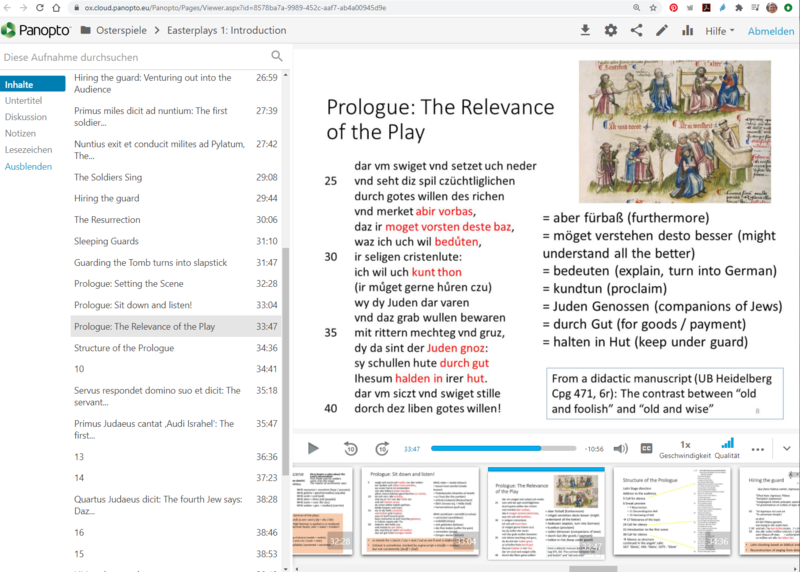
Screenshot of a lecture capture of the Easterplay recordings

Screenshot of a lecture capture of the Easterplay recordings

My year in Oxford continued into January, and Henrike had already planned the next staging. Her Hilary lecture on medieval Easter plays were to be complemented by a two-person performance of the historical screenplay at the end of each session, and I was chosen as the second performer. (Watch the lecture series Easterplays recorded via the university lecture capture system panopto). I didn’t understand most of the textual content as they were written in some long-dead dialects of German I had no idea had even ever existed. Acting it out, however, this changed over the course of the term, as I gradually understood more of it, although in a more intuitive way. Most of the acting dynamics, I felt, didn’t go according to any preconceived plan, but were rather a matter of intuitively playing along. Towards the end of the term I learned about Oxford’s annual Easter play tradition and looked into some of the older performances from earlier years. Guess who was at the forefront every time? Language students. (Watch the Harrowing of Hell in Middle High German on the Mystery Cycle website)

The drama was at the artistic apex of ancient Greece, and no one captured its significance better than Friedrich Nietzsche in The Birth of Tragedy. It is no coincidence that Nietzsche, academically raised as a classical philologist, deliberately chose the novel as his genre of philosophical expression. His radical break with classical philosophy was less motivated by its contents, but more by the means of expression used to convey them. Only a gay science, the old organon of poetry-writing, of literary and dramatic art, would be able to express the human condition, the mode of us humans being in the world, without reducing us to the technical language of ossified metaphysics and morals. Fittingly, Nietzsche’s biggest and best known dispute didn’t involve another philosopher or academic in general, but Richard Wagner, the great German opera composer, for the allegedly heavy and exhausting atmosphere the latter created in his operas. Nietzsche himself prefers the light-hearted comedy, visualizing and detailed staging everything in his Thus Spoke Zarathustra to not only convey his philosophical message – which one may not entirely agree with – but also how it should be presented on stage. Sometimes Nietzsche even creates actor-characters within his literature, overtly hinting at its performative nature and complexifying the actor-character-relationship in the process.

Unfortunately, the real Easter play performance was cancelled due to the COVID19-pandemic steamrolling into each and every corner of society. But performance art as a means of exploration didn’t die then. The performances resumed, albeit in a much smaller fashion, by the end of July when it became possible again to meet up in small groups. By then, the very small performances were all recorded, without any live audience. The recording of the Hans Sachs dialogue between a catholic priest and a protestant cobbler involved a genuine medieval text and was recorded in one take over 45 minutes, though, without any warm-up. Performance art doesn’t need much preparation; it is just a matter of spontaneously going with the flow.

Fictional literature is never completely fixed. It think this lesson can be learned from all that. Every new reading creates its object anew; it is never just a bland repetition of something preexisting. Accordingly, performance art is not a scholarly method, let alone a scientific one. It is a reminder of this very incommensurability of all individual readings if you tried to grasp their essence in an abstract sense. In this eternal recurrence of new and unique readings and performances we do not seek to understand, but rather capitulate before the realization that in the end you can only choose to play along.

***

Konstantin Winters is a doctoral student in medieval history and philosophy at the University of Düsseldorf, editing part of the Commentary of the Sentences by William of Ware, a former Oxford student. During the academic year 2019/20, he worked as an Erasmus+ and DAAD funded intern at the Faculty of Medieval and Modern Languages at the University of Oxford.

Listen to Konstantin Winters…

Exemplary difference: examples in historic music theory

By Adam Whittaker

Reblogged from The Conveyor.

‘Writing about music is like dancing about architecture’, or so the famous phrase goes. And yet, we have been writing about music for centuries. We are fortunate to have such a range of medieval and Renaissance writings on music that survive, from luxurious presentation volumes to scrappy single sheets pasted into miscellaneous collection. Although we often see quite stable transmission of texts across multiple sources (sometimes across centuries), we see much greater variation in the examples and diagrams. These, it seems, were fair game for change, revision, and emendation for specific readerships and local contexts, or simply at the whim of the scribe. My research explores why these differences matter.

In the autumn of 2019 I was in Oxford as the Albi Rosenthal Visiting Fellow in Music at the Bodleian Libraries. During my fellowship, I consulted a number of music theory manuscripts, including MS. Bodley 515 and MS. Digby 90. These manuscripts contain the famous Quatuor principalia musice [Four Fundamentals of Music], most likely authored and/or compiled by the English friar John of Tewkesbury in the late fourteenth century.

First, let’s look at one similarity. Early in the text, the theorist uses a monochord (a theoretical instrument of a single string) to explain the interval of a tone; a musical step in layman’s terms, as though moving from G to A on a piano. Both sources have a functionally similar diagram, even if there are some subtle visual differences.

Trumpet-like diagram of scales of one stringed instrument

Bodleian MS. Bodl. 515, fol. 10r (detail)

cone like diagram showing scales of one stringed instrument

Bodleian MS. Digby 90, fol. 11v (detail)

We can see that both manuscripts show a monochord (horizontal line representing a string); both indicate the interval of a tone between G (low G) and A with an arc labelled ‘tonus’; and both have the indication ‘monochordu[m]’ at the left-hand edge of the diagram. Bodl. 515 shows a more artistic approach to this diagram, with its coloured labels and decorative circles, whilst MS. Digby 90 favours equal tonal spacing with notches. Despite these differences, which might be attributed to scribal taste more than anything else, the reading experience across the two sources is near identical.

However, such similarity isn’t always present. If we look at the depiction of the Guidonian hand – a kind of conceptual map for musical space that is commonplace in music theory texts – we see both similarities and differences. The Guidonian Hand mapped the six-note intervallic pattern (ut-re-mi-fa-sol-la) onto physical locations on the body which a singer could use as a memory aid while they sang. To think about how the Hand works in practice, The Sound of Music’s ‘Do-Re-Mi’ is especially helpful. Let’s consider the diagrams presented in the two sources.

Diagram of a hand, each section of fingers labelled in latin

Bodleian MS. Digby 90, fol. 21r (detail)

Diagram of a hand in red, squiggly lines to the right.

Bodleian MS. Bodl. 515, fol. 23r (detail)

There are some important differences here. You’ll notice that MS. Bodl. 515 is missing labels on joints, whilst these are clearly visible in MS. Digby 90. These are crucial! Without the syllabic markings on the joints of the thumb and fingers, this diagram serves little demonstrative function, beautiful as it is. Such a scenario poses some interesting questions and might have left fifteenth-century readers scratching their heads. Is this just a scribal error? Was this aspect of the diagram to be entered in a different layer? Did the scribe not understand the diagram they copied? Was there an error in the exemplar copy that a scribe couldn’t resolve? What use is the diagram when it is missing such key information?

This last question is of particular importance for the final comparison I want to make here. The relationship between musical durational values is a fundamental building block of music notation. Early musical notations were more context-dependent, with the same note shape being worth two or three counts depending upon the context. Theorists found many intriguing ways to discuss this phenomenon, but the most interesting for the present discussion is the idea of a note value tree.

Some contemporaneous musical treatises refer to the ‘arbor’ of Johannes de Burgundia, a figure about whom we know nothing except for a passing reference to his ‘arbor’ in a musical treatise by Petrus de Picardia (fl. 1250). Both our sources include a diagram of this type, though we see some divergence in approach. In MS. Digby 90, we see the relationships made clear in a quasi-tabular format (largest values at the bottom), with lines connecting the related mensural levels. Working from the bottom up we see that the largest note value divides into three parts, which itself is divided into three smaller parts etc.:

Diagram of upside down family tree like structure

Bodleian MS. Digby 90, fol. 45r (detail)

By comparison, we see something which takes the tree much more to heart in MS. Bodl. 515:

Red family tree in a tree-lile shape

Bodleian MS. Bodl. 515, fol. 49v

The visual appeal of this is important. MS. Bodl. 515 offers hatched details on the trunk of the diagram, with additional coloured detailing which has faded over time. In this way, the longest note becomes the ‘root’ of the tree, and its subdivisions into smaller notes become represented as branches, themselves with sub-branches. Although both sources adequately demonstrate the theoretical point, the subtly different diagrams change the nature of the text–image relationship. The tree-like construction of MS. Bodl. 515 creates a sharp mental picture for a reader to recall. MS. Digby 90, though equally clear, establishes a different mensural picture. These diagrams demand different reading practices and present theoretical material in divergent ways.

My point here is not to assign greater value to either source, but to demonstrate that what might be dismissed as ‘minor scribal variants’ really matter when we consider how a reader might engage with a text in a specific manuscript source. If a diagram containing such foundational information that was common knowledge to expert readers, then why did a scribe go such significant effort to present this in a visually appealing manner? The reader’s experience of the same text in these two sources would have been quite different. Through this lens we begin to see the way that the materiality of music theory texts is at least as important as the contents of the texts themselves, and that the diagrams and examples give us an unparalleled insight into this. These theoretical ideas are alive in the manuscripts that preserve them.

Adam Whittaker is Head of Pedagogy and Lecturer in Music at the Royal Birmingham Conservatoire.

Oxford Old English Work in Progress (WOOPIE) 2020

One unexpected positive from the lockdown has been the large number of online seminars that have sprung up in the absence of the various conferences and other meetings that are the lifeblood of academic research. Linking scholars from all over the world to share research and get feedback on ongoing projects, some of these online seminars have proved surprisingly successful.

After conversations among a group of Oxford Old English scholars back in March, it was decided to set up a small, informal weekly work-in-progress group via the OMS channel on Microsoft Teams. While the initial plan was simply for an internal support group, soon speakers from other institutions were volunteering to give papers and WOOPIE was born. Within weeks numbers had sprung up to a weekly average of 40, with attendees from all parts of the globe tuning in. The seminar has proved popular with graduate students as well as academics all over the world.

So far, we have heard papers on topics ranging from contested readings and the editing of texts to recent archaeological discoveries, from the reception of heroic poetry in local guilds to an eleventh-century chronicler’s special interest in astronomy, from the interpretation of charms and riddles to the surprising role of humour in hagiography. Other presentations have explored the influence of classical and medieval Latin writing on Old English texts, as well as the copying of Latin poetry in manuscript form in early medieval England. WOOPIE continues over the summer, meeting every Monday at 4pm, with a full programme of papers until the end of September. For further details, contact francis.leneghan@ell.ox.ac.uk

Of course, we are all looking forward to getting back to face-to-face conferences and seminars once the pandemic is over. But the success of online events such as this has certainly proved an eye-opener. Perhaps in the future, more events will incorporate an online element, such as streaming a keynote lecture, opening up discussion to a much wider international audience.

Programme

(NB this is subject to change; for up-to-date information, please consult the Teams channel)

20th April: Rachel Burns, ‘A Monastic Micro-riddle in Solomon and Saturn I,

l. 89a: “prologa prim”’

27th April: Francis Leneghan, ‘Dishonouring the Dead: Beowulf and the Staffordshire Hoard’

4th May: Rafael Pascual, ‘Beowulf 501b and the Authority of Old English Poetical Manuscripts’

11th May: Marilina Cesario (QUB), ‘Natural Science in the Peterborough Chronicle’

18th May: Glenn Cahilly-Bretzin, ‘The Case of the Missing Ducks: Thematic Reshaping in the Transmission of the Anonymous Martinmas Homily’

1st June: Mark Atherton, ‘Ælfwine and the guild of thegns: another look at the second half of The Battle of Maldon

10th June: Caroline Batten, ‘Charms and Riddles: Moving Beyond Sound and Sense’

15th June: Emily Kesling (Oslo), ‘The Royal Prayerbook and Intellectual Exchange across the Channel in the Eighth Century’

22nd June: Richard North (UCL), ‘Queen Camilla and Grendel’s Mother’

29th June: Niamh Kehoe (UCC), ‘Fool Steam Ahead: the Role of Humour in the Passion of St Eustace’

6th July: Colleen Curran, ‘Poetic Form and Function in Bede’s Historia Ecclesiastica

13th July: Sarah Barnett, ‘Hypermetricity and Homily: An Argument for Intentional Metrical Oddity in Christ III

20th July: Tristan Major (Qatar University), ‘Ælfric and the Dissemination of Canon Law at Worcester’

27th July: Elisa Ramazzina (QUB), ‘Wætan bestemed, beswyled mid swates gange: Water, Blood, and Baptism in Old English Poetry’

3rd August: Helen Appleton, ‘Folk Horror: Hell in Rogation Homilies’

10th August: Hannah Bailey, ‘St Rumbold in the Borderland’

17th August (NB change of time: 12pm): Georgina Pitt (University of Western Australia), ‘The thing-power of the exquisite Alfred Jewel’

24th August: Matt Coker, ‘A Tragic Sound? Interpreting the tragico sono of Old English Poetry’

31st August: Eleni Ponirakis (Nottingham), ‘The Greeks in Old England’

7th September: Michael Fox (Western), tbc

14th September: Luisa Ostacchini, ‘Imposter Saints and Fraudulent Shrines in Ælfric’s Lives of Saints’

21st September: Amy Faulkner (UCL), ‘Since berofene: Loss of Life and Treasure in Exodus and Beowulf

28th September: Kazutomo Karasawa (Rikkyo Univ.), ‘Borders between the Human and the Monster Worlds in Beowulf’

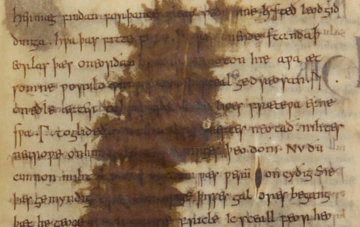
Image Credits: The runic signature of Cynewulf in The Fates of the Apostles, Vercelli Book folio 54r – public domain