Book Launch: Medieval Commentary and Exegesis – Interdisciplinary Perspectives

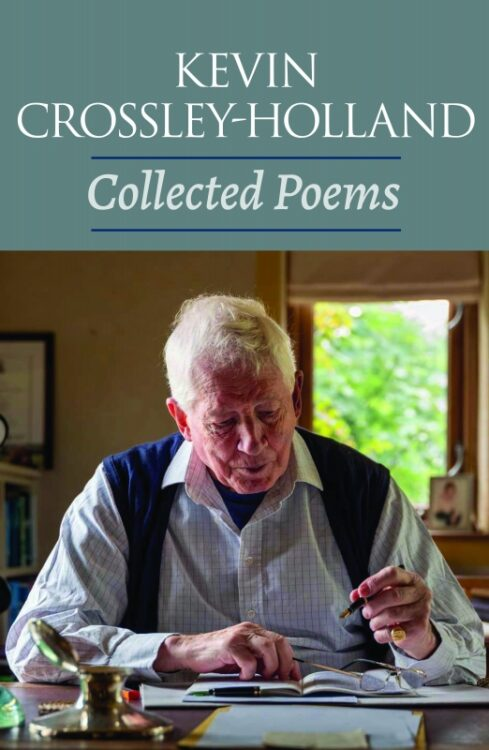
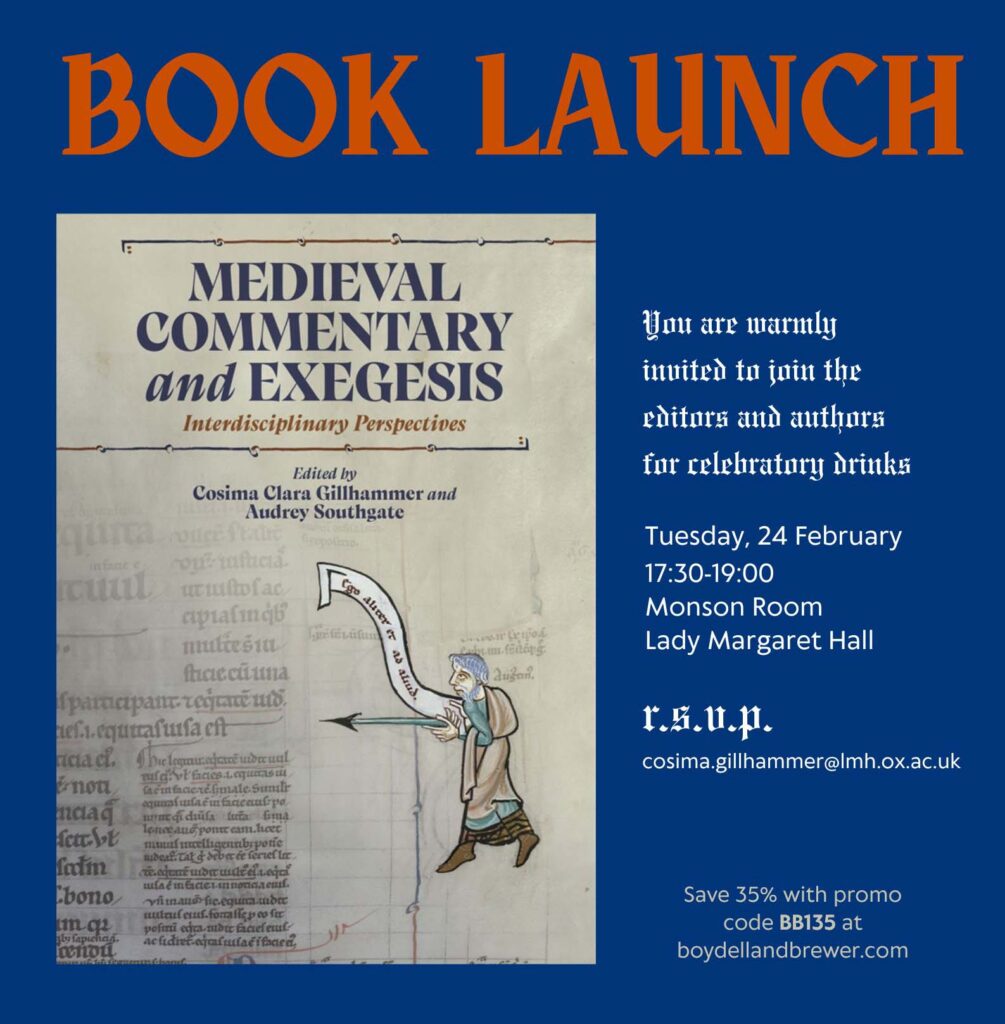
Medieval Commentary and Exegesis: Interdisciplinary Perspectives, ed. Cosima Gillhammer and Audrey Southgate, includes chapters by Alastair J Minnis, Alexandra Barnes, Anna Wilmore, Audrey Southgate, Cosima Clara Gillhammer, David J Elliott, Edit Anna Lukács, Eduardo de Oliveira Correia, Elizabeth Solopova, Jiani Sun, Joshua Caminiti, Lesley Smith, Michael P Kuczynski, Rachel Cresswell, Simon Whedbee, William Marx, Zachary Guiliano.

More information on the volume can be found here. Use the voucher code BB135 for 35% off.

There will be a book launch at LMH on 24 February; all are welcome. For further details see below.

Medieval Matters HT26, Week 1

Welcome to Week 1. Thanks to all those who submitted their events for the upcoming term. An updated version of the OMS Booklet is linked here, and is available on the OMS website throughout the term.

For your diary: The 2026 OMS Lecture will take place on Thursday 19 February 5–6.30pm in the Old Dining Hall of St Edmund Hall. Prof. Ian Forrest (Glasgow) will be speaking on ‘Telling Tails: Weaponizing Gender in the Late Medieval Church‘. Drinks to follow. More information and register for dinner.

Monday

  • French Palaeography Manuscript Reading Group – 10:30, Weston Library
  • Medieval History Seminar – 5:00, All Souls College. John Sabapathy (UCL) will be speaking on “Humanism and bestiality in the land of Cockagne”.
  • Celtic Language Teaching continues throughout the week – please consult the booklet, p. 39 for a full table of dates and locations.

Tuesday

  • Medieval English Research Seminar – 12:15, Room 00.079 (Humanities Centre). Stacie Vos (University of California, San Diego) will be speakin on “Norfolk Broads, or Discovering medieval women with twentieth-century collectives”.
  • Europe in the Later Middle Ages Seminar – 2:00, New Seminar Room, St John’s College. Peregrine Horden and Nicholas Purcell (Oxford) will be speaking on “Beyond the Mediterranean by land and sea: Two medieval cases in a (very) broad context”.
  • Latin Palaeography Manuscript Reading Group – 2:00, Weston Library (Horton Room). Those who are interested can contact the convenor, Laure Miolo.
  • Medieval Church and Culture, theme: TRANSLATION(S) – tea and coffee from 5:00, Harris Manchester College. John Mulhall (Purdue University) will be speaking on “‘Blessings on All the Prophets’: Islamic prayers in the Latin scientific translations of the twelfth century”.
  • Church Historian Pub Night – 6:00 at the Chequers Inn. Contact Rachel Cresswell

Wednesday

  • Medieval German Graduate Seminar – 11:15, Old Library, St Edmund Hall. The first week will be a shortish planning meeting. The topic for this term is the ‘Liederbuch der Clara Hätzlerin’. 
  • Older Scots Reading Group – 2:30, Room 30.401 (Humanities Centre). Theme: ‘Palyce of Honour, Prologue, ll. 1-126’.
  • The Medieval Latin Documentary Palaeography Reading Group – 4:00, online.
  • Late Antique and Byzantine Seminar – 5:00, Ioannou Centre for Classical and Byzantine Studies. John Mulhall (Purdue) will be speaking on “The Republic of Translators: Translating from Greek and Arabic into Latin in the Twelfth-Century Mediterranean”.

Thursday

  • Middle English Reading Group (MERG) – 11:00, Lincoln College, Beckington Room. All are welcome as we read Sir Gawain and the Green Knight: bring any edition of the original text.
  • Environmental History Working Group (EHWG) – 12:30, Room 20.421 (Humanities Centre). Niklas Groschinski (DPhil History) “Environing from Below — Supplications, Denunciations, and Other Sources for Rewriting Early Modern Environmental History”
  • Celtic Seminar – 5:15, Room 20.306 (Humanties Centre) and Online. Brigid Ehrmantraut (St Andrews) will be speaking on “Death of the author? Authorship and authority in the Middle Irish classical adaptations”.
  • The Khalili Research Centre For the Art and Material Culture of the Middle East: Research Seminar – 5:15, The Khalili Research Centre. Yusuf Tayara (Wolfson College) will be speaking on “Timekeeping between art and science: integrated approaches to the history of Mamluk astronomy”.
  • Old English Graduate Reading Group – 5:15. Location is variable so please email Hattie Carter or James Tittering if you’re interested. This term’s text is Apollonius of Tyre.
  • Compline in the Crypt – 9:30, St Edmund Hall. Sung by the College Choir in English

Friday

  • Medievalist Coffee Morning – Friday 10:30, Visiting Scholars Centre (Weston Library). All welcome, coffee and insight into special collections provided.
  • The History of the Bible: From Manuscripts to Print – 12:00, Visiting Scholars Centre at the Weston Library. The theme this week is ‘The Hebrew Bible”. Places are limited. To register interest and secure a place, please contact the lecturer, Péter Tóth.
  • Exploring Medieval Oxford through Surviving Archives – 2:00, Weston Library (Horton Room). Those who are interested can contact the convenor, Laure Miolo
  • EMBI ‘Databases: A Skills Workshop’ has been POSTPONED until Week 4 on 13 February, 16:00-17:15.

Opportunities (see booklet for further details)

A Medieval Saint in the Modern World: Oswald of Northumbria in Words and Music

12 February, 6:15–8pm, The Chapel at King’s College London/River Room, Strand Campus
with Sarah BowdenHannah Conway, Johanna Dale and Hazel Gould

An evening exploring creative responses to medieval saints. The focal point is the world premiere of the new work “My Name is Oswald” by award-winning composer Hannah Conway and writer Hazel Gould. This work draws on stories of Oswald of Northumbria, a significant early English king and pan-European saint, and new research by King’s academics Sarah Bowden and Johanna Dale. The performance will be accompanied by short readings from medieval texts and discussion.

“My Name is Oswald” will be performed by Tim Dickinson (baritone), Peter Sparks (clarinet), Joseph Walters (horn), and Hannah Conway (piano). 

The event will begin with a drinks reception in the River Room at 6:15 p.m., which will also celebrate the publication of Liturgy, Literature and History. Oswald of Northumbria and the Cult of Saints in the Middle Ages, ed. Johanna Dale (Liverpool University Press, 2025). The performance itself will take place in the College Chapel at King’s College London, from 6:45pm. 

Further information and registration link (free): https://www.tickettailor.com/events/kingsartshums/2017759

A Screenshot of the beginning of the "Middle Ages"-Wikipedia article.

Wikipedia Editathon for Medievalists

20 February, 5–10pm, St Edmund Hall (tbc)
with Louise Tjoline Keitsch

This workshop invites everyone – students, researchers, and anyone curious – to take part in a Wikipedia Editathon for Medievalists. Whether you have always wanted to write or improve a Wikipedia article, are looking for a low-pressure way to start writing about your topic, or simply want a productive and enjoyable distraction from exams or papers, this editathon offers a space to do so!

Participants are encouraged to bring a topic they would like to work on: this could be a medieval object, person, concept or manuscript; an existing Wikipedia article that needs improvement; or an article that could be translated into another language. Prior experience with Wikipedia editing is not required – beginners are very welcome. Bringing a few sources is helpful, but online articles or similar are perfectly acceptable starting points.

The editathon is designed as a low-pressure entry. Participants can focus on clarity, structure, and communicating knowledge to a broad audience rather than perfection or originality in the academic sense. Contributions can be published immediately, offering a rare sense of instant gratification alongside meaningful scholarly engagement. Throughout the session, support will be available, either through a short introductory tutorial or hands-on help in small groups, depending on participants’ needs.

Editing Wikipedia means contributing to a vibrant, active community and helping shape what knowledge is publicly visible. Make a public impact, practice digital humanities, be part of a broader effort to make Wikipedia more equitable (for example by addressing the persistent gender gap in biographical articles) and increase the visibility and accuracy of medieval topics on the platform! Please come by to write, to learn, to experiment, and to contribute to shared knowledge – all while eating pizza at 6pm!

Can’t wait to start? Read Help:Getting started with Wkipedia, especially Help:Your first article.

Excellent (German) articles, that are enjoyable to read and can be used as an inspiration – and could be translated ;):

Gebetbuch Ottos III. | Monatsbilder | Haus zum Walfisch

If you have any questions, please send an email to Louise Keitsch at louise.keitsch@kunstgeschichte.uni-freiburg.de

OMS Lecture HT 2026: Ian Forrest

Prof. Ian Forrest (Glasgow): Telling Tails: Weaponizing Gender in the Late Medieval Church

St Edmund Hall, Old Dining Hall

Thursday 19 February 5–6.30pm, followed by drinks

All welcome!

The fringes of the institutional church in the later Middle Ages were difficult to control. Pardoners, summoners, and priests of dubious status caused headaches for bishops and scandalized the public. The stories people told about them often concerned deceptive or ambiguous gender presentation. Touching upon famous fictions like Chaucer’s Pardoner and Summoner, and Pope Joan, the lecture will also examine the political culture of violent direct action against humans and their animals which sought to regulate gender and status at the edges of the medieval clerical estate.

After the talk and the drinks, there will be the opportunity to stay for a buffet dinner a in St Edmund Hall. Please contact Henrike Lähnemann if you would like to take part in this. At 9:30pm, there will be the opportunity to take part in the Compline in the crypt of St-Peter-in-the-East, the library church of St Edmund Hall (more details on that in the current Medieval Studies booklet.).

This is linked with a workshop on Friday 20 February, 10am for the graduate students of the MSt. in Medieval Studies: ‘Fragments and photographs: what are we doing when we try to get close to medieval people?’ which will start using examples from medieval records and Ian Forrest’s account of publishing with the photographer Martin Stott.

Header image: Pope Joan / John VII in the Nuremberg Chronicle (Hartmann Schedel 1494)

Medieval Matter HT25, Week 0

Welcome back to Oxford – I hope you all had a restful vac. Please find below the first draft of the upcoming medieval Hilary Term Booklet, which includes a range of seminars, reading groups and opportunities.

PLEASE:

  • If you have submitted an event, check that the details are correct and  provide any corrections ASAP.
  • Note that a large number of entries have no information (noted by the symbol ##). If you are in charge of one of these events, or have previously been so, please reply to this email address ASAP with further information, or informing us that the event is not running this term.

Finally, a few upcoming events and deadlines for week 0:

  • Medievalist Coffee Morning – Friday 10:30, Visiting Scholars Centre (Weston Library). All welcome, coffee and insight into special collections provided.

History and Materiality of the Book Seminar series

Organisers: Matthew Holford, Andrew Honey, Laure Miolo

Hilary Term 2026, Wednesdays 2-3.30pm (see sessions details below). Venue: Weston Library, Horton room. Anyone interested in manuscript studies is welcome. No registration required. For questions, please e-mail laure.miolo@history.ox.ac.uk

The series of seminars has been designed to introduce participants to the various material aspects of the book, thereby laying the foundations for the reconstruction of manuscripts’ production and history. The objective is to provide the indispensable elements for the analysis of the manuscript.

The seminars also provide a forum for specialists from different fields of manuscript studies to share their expertise. The sessions bring together curators, librarians, researchers and conservators to provide a comprehensive understanding of the various components of the codex from diverse perspectives. These components include the writing surface, ink, binding, decoration, manuscript production in its broadest sense, and its provenance. The seminars thus represent a valuable opportunity to demonstrate the necessity of close collaboration between researchers, curators/librarians, and conservators for a comprehensive consideration of the manuscript in its entirety. Such collaboration facilitates a more profound comprehension of the diverse contexts in which the manuscript was created, copied, and utilised.

Wednesday 28 January
Writing supports (parchment and paper) and manuscript structure
– Andrew Honey & Matthew Holford

Wednesday 4 February
Decoration
– Martin Kauffmann

Wednesday 11 February
Inks and Pigments
– Céline Delattre and Robert Minte

Wednesday 18 February
Bindings
– Andrew Honey

Wednesday 25 February
Calendars and time-reckoning
– Laure Miolo

Wednesday 4 March
Medieval Libraries and Provenance
– Matthew Holford and Laure MioloWednesday 11 March
Text identification
– Matthew Holford and Laure Miolo

Bodleian Library MS. Laud Misc. 165, fol. 17v

Ti Mikkel Workshop and Book Launch

7 February, 11:00-12:30, St John’s College, North Seminar Room, Writer’s Workshop
7 February, 14:00-15:00, Exeter Cohen Quad, Fitzhugh Auditorium, Talk and Book-Signing

To begin Hilary term 2026, the Oxford Writers’ House is hosting the House of the Dragon and A Knight of the Seven Kingdoms writer, Ti Mikkel, for a writer’s workshop and book talk. This day will mark Mikkel’s first visit to Oxford since the Oxford Writers’ House event with George RR Martin on 2 August 2024 at the Sheldonian Theatre, which is available to watch through the Oxford Writers’ House YouTube Channel.

Ti Mikkel’s journey in the world of multimedia writing is fraught with adversity, perseverance, and a little bit luck. She started out by moving to Hollywood with no friends, connections, or suggestions to speak of, but after landing an unpaid internship as Martin’s personal writing assistant, she began to climb the Game of Thrones production ladder, rung after rung. She earned writing credits for House of the Dragon, then production credits on A Knight of the Seven Kingdoms. Now, she is eager to share her knowledge with the young, ambitious writers at Oxford University in whatever way she can.

At St John’s College, Mikkel will conduct a workshop in a round robin style to simulate the real feeling of sitting in a writer’s room. Mikkel will then sit down in conversation with us at the Exeter College Cohen Quad to discuss her debut novel, The Archivist. This literary debut represents the culmination of decades’ worth of writing for Mikkel, and George RR Martin notes that her work has paid off extraordinarily well: “The best debut novel I’ve read in years, a page turner with a fresh and original take on time travel, and all the mystery and romance a reader could want.” This is a rare chance to pull back the red curtain and learn firsthand about a writer’s journey across Bluffton (Indiana), Hollywood, Belfast, and London.

Registration for Ti Mikkel’s workshop and author talk is available through the Oxford Writers’ House Eventbrite. Please note that spaces for the workshop are now extremely limited. If you have any questions, please do not hesitate to get in touch with me. My name is Griffin Gudaitis. I am a recent graduate of the MPhil in English Studies (Medieval Period) from Linacre College, Oxford University, and my email is oxfordwritershousedirector@gmail.com. Thank you!

Funded Doctoral Position: The Seven Sages of Rome

The University of St Andrews in Scotland is currently advertising a PhD scholarship (with 3.5 years’ full funding) for the following project “How to write a global success before print: The paradigmatic case of the Seven Sages of Rome/Sindbad narrative.” Deadline for applications is Sunday 15 February 2026. More information can be found on the St Andrews website

Previous advertisment for a doctoral position in 2024: The research project “The Seven Sages of Rome Revisited: Striving for an Alternative Literary History”  invites applications for one doctoral research associate: FU Berlin advertisement of the position

The project is funded by the Einstein Foundation Berlin as part of the Berlin University Alliance/Oxford University Einstein Visiting Fellowship scheme. The selected postholder will work closely with the PIs of the project, Professor Dr Jutta Eming, Freie Universität Berlin and Dr Ida Tóth, University of Oxford (Einstein BUA/Oxford Visiting Fellow 2024-27). The position is funded by the Einstein Foundation Berlin as part of the Berlin University Alliance/Oxford University Einstein Visiting Fellowships scheme. The Doctoral Research Associate will participate in the project “The Seven Sages of Rome Revisited: Striving for an Alternative Literary History”. The selected postholder will be jointly supervised by the PIs of the project, Professor Dr Jutta Eming, Freie Universität Berlin and Dr Ida Toth, University of Oxford (Einstein BUA/Oxford Visiting Fellow 2024-27).
The research project “The Seven Sages of Rome Revisited: Striving for an Alternative Literary History” focuses on one of the most popular and least studied works of pre-modern world literature. Transmitted in over thirty languages and attested through hundreds of manuscripts and early printed editions, this tradition provides ample scope for exploring the extant material from textual, intercultural, and intersectional literary perspectives. The Einstein BUA/Oxford research project proposes to undertake an interdisciplinary, collaborative and comparative philological, literary, and cultural analysis in Byzantine/Medieval Latin and Medieval German and Early Modern Studies. Its goal is to reassess and redefine the traditional approach to the SSR and to medieval literature in general.

Job description:
The Doctoral Research Associate will study one specific set of motifs – Wisdom, Power, and Gender – that is common to all surviving traditions of the Seven Sages in the German and/or Greek textual tradition. The main duty will be to conduct research on a doctoral project designed along these research lines. The postholder will work under the direction of Professor Dr Jutta Eming and Dr Ida Toth as well as collaborating with the other members of the research group. The postholder will assist in planning and organisation of scholarly events (lectures, seminars, workshops, outreach programmes), in publication projects, and will play a key role in securing the online visibility and digital presence of the project. 
This is an exciting opportunity for a highly motivated doctoral candidate with strong interests in wisdom literature, intersectionality, and concepts of power. The successful candidate will join a team of textual and literary scholars, who play an active role in the current efforts to reassess traditional literary canons and to create an alternative, and much more nuanced, understanding of pre-modern global literary history.

Requirements:
• A Master’s degree qualification (MA, MSt, MPhil or the equivalent) in a subject/field relevant to the Project (German Studies, Byzantine Studies/Medieval Latin)

Desirable:
• Above-average Masters’ degree grade 
• Doctoral project on the Seven Sages of Rome
• Excellent command of the spoken and written English language
• Demonstrable interest in the project’s focus area (Wisdom – Power – Gender)
• Ability to work independently
• Commitment to team-building and teamwork
• Willingness to engage in interdisciplinary exchange

Application materials:
• An application letter/statement of purpose (one page)
• An outline of the planned dissertation project (two pages)
• A curriculum vitae with list of publications (if applicable) 
• Official transcripts of all previous degrees and university diplomas
• A copy of master’s thesis or a sample of written work (max. 25 pages)

How to apply:
Your application materials should state the identifier Predoc_JE_BUA_SSoR_2_24. They should be combined in a single PDF document and sent electronically to Ms Sylwia Bräuer (s.braeuer@fu-berlin.de). Two letters of recommendation from university-level teachers should be submitted separately. They should be addressed and emailed to the project PIs Jutta Eming (j.eming@fu-berlin.de ) and Ida Toth (ida.toth@history.ox.ac.uk).

Report on the Oxford-Berlin Workshop ‘The Seven Sages of Rome as a Global Narrative Tradition’

11-12 November 2022, organised by Ida Toth (Oxford) and Jutta Eming (Berlin)

The Seven Sages of Rome (SSR) is a title commonly used for one of the most widely distributed pre-modern collections of stories, which – remarkably – also happens to be barely known today, even among medievalists and early modernists. Several early versions of the SSR exist in Greek (Syntipas), Arabic (Seven Viziers), Hebrew (Mishle Sendebar), Latin (Dolopathos, Historia septem sapientum), Persian (Sindbād-nameh) and Syriac (Sindbād) as well as in the later translations into Armenian, Bulgarian, Czech, Danish, Dutch, German, English, French, Hungarian, Icelandic, Polish, Russian, Scottish, Serbian, Swedish, Spanish, Romanian, Turkish and Yiddish. The multilingual traditions of the SSR, with their many intercultural links, cannot be adequately understood within the current division of research disciplines into distinct medieval and modern linguistic areas. To mend this deficiency, the workshop has invited specialists in affiliated fields to address the problems of surveying the long history of creative adaptations associated with the SSR. The participants will consider the complexities of the philological, literary, and historical analysis of the SSR in many of its attested versions across the pre-modern and early modern periods. The workshop is envisaged as a forum for a robust discussion on possible ways of advancing the current scholarship of the SSR, and as an opportunity to strengthen the inter-institutional collaboration involving specialists based at the universities in Oxford and Berlin, and more broadly.

The workshop will start with a session in the Weston Library on Friday morning where the group will meet other Oxford medievalists at the Coffee Morning, followed by a view of special collections in the library. While this is for speakers only, their is limited capacity to attend the following talks at the Ioannou Centre. If interested, please contact the workshop co-ordinator Josh Hitt.

FRIDAY, 11 NOVEMBER 2022, THE IOANNOU CENTRE

  • 2 pm – 3 pm: Beatrice Gründler, Kalīla and Dimna – AnonymClassic: Methodology and Practical Implementations (via Zoom, 1st-fl Seminar Room)
  • 4 pm – 5 pm: Daniel Sawyer, Forgotten books: The application of Unseen Species Models to the Survival of Culture (In person, Outreach Room)

SATURDAY, 12 NOVEMBER 2022, THE IOANNOU CENTRE

10 am – 11.30 am

  • Jutta Eming, The Seven Sages of Rome in Literary History and Genre Theory
  • David Taylor, Re-examining the Evidence of the Syriac Book of Sindbād
  • Ida Toth, The Byzantine Book of Syntipas: Approaches and Directions
  • Emilie van Opstall, The Representation of Women in Byzantine Syntipas and Latin Dolopathos

12 pm – 1.30 pm

  • Bettina Bildhauer, Consent in the German Version of the Seven Sages of Rome
  • Rita Schlusemann, Genre, Dissemination and Multimodality of the Septem sapientum Romae, especially in Dutch and German
  • Niko Kunkel, Statistics and Interpretation: Annotating the German Sieben Weise Meister
  • Ruth von Bernuth, Yiddish Seven Masters

4.30 pm: Tea and a guided tour of St Edmund Hall with Henrike Lähnemann

5.45 pm: Evensong at New College

Appendix: List of manuscripts and early printed books in the Bodleian Library:

  • Arabic: Pococke 400
  • Greek: Barocc. 131 and Laud. 8
  • Armenian: MS. Arm. e. 33 and MS. Canonici Or. 131
  • Hebrew (Mishle Sendebar/Fables of Sendebar): MS. Heb. d. 11 (ff. 289-294) and MS. Bodl. Or. 135 (ff. 292-300r)
  • Yiddish: Opp. 8. 1115 Mayse fun Ludvig un Aleksander and Opp. 8. 1070 Zibn vayzn mansters fun Rom
  • Welsh Jesus College MS 111
  • Middle English: B. Balliol College MS. 354
  • English, early printed book: The History of the Seven Wise Masters of Rome. Now newly Corrected better Explained in many places and enlarged with many pretty Pictures etc. London, Printed for John Wright, next to the Globe in Little-Brittain, 1671

Image: British Library, Add. MS. 15685, f. 83r (XIV century, Venice)

Medieval Insular Romance Conference

OXFORD, 8–10 APRIL 2026

Plenary speakers: James Simpson and Carolyne Larrington

Registration is open for the Medieval Insular Romance Conference 2026 at St Hugh’s College Oxford.

We are delighted to have a rich programme with about 50 speakers, addressing many aspects of the conference’s title, ‘Moving Medieval Romance’. The provisional programme is available to view here: MIR26 Programme on Canva To register to attend the conference go to: https://www.oxforduniversitystores.co.uk/conferences-and-events/english-faculty/events/medieval-insular-romance-conference-2026

A limited number of rooms at St Hugh’s College are available for MIR 2026 registered delegates via this link: universityrooms.com/en-GB/eventcode?ec=KX52757&vid=sthughs Other accommodation in Oxford colleges is available via https://www.universityrooms.com

The conference organizers are Lucy Brookes (Merton College, Oxford) lucy.brookes@ell.ox.ac.uk and Nicholas Perkins (St Hugh’s College, Oxford) nicholas.perkins@st-hughs.ox.ac.uk

Illustration: Cristabel and her baby are cast out to sea; from Eglamour of Artois, Oxford, Bodleian Library MS. Douce 261, fol. 39v. Creative commons licence: CC-BY-NC 4.0