Seminars in Medieval and Renaissance Music

We are pleased to announce the seminars for Hilary Term 2026. The seminars are all held via Zoom on Thursdays at 5 p.m. GMT. If you are planning to attend a seminar this term, please register using this form. For each seminar, those who have registered will receive an email with the Zoom invitation and any further materials a couple of days before the seminar. If you have any questions, please send an email to Joe Mason at all.souls.music.seminars@gmail.com; this address is the main point of contact for the seminars. We look forward to an exciting series and hope to see many of you there.

Margaret Bent (Convener, All Souls College)

29 January 2026, 5pm–7pm GMT: Presenter: Kévin Roger (University of Lorraine)
Title: Latin Motets and Literary Networks in the Late Middle Ages: Intertextuality, Rhetoric, and Digital Reading
Discussants: Yolanda Plumley (University of Exeter) and Karl Kügle (Universities of Oxford and Utrecht)

Abstract: Latin motets of the 14th and early 15th centuries preserve one of the most complex bodies of lyric poetry from the Late Middle Ages. While vernacular art was flourishing, these pluritextual works maintained a dense, erudite, and allusive Latin that has long hindered scholarly interpretation. Because their meaning is often obscure, research has traditionally focused on musical structure rather than on the literary strategies that shape the motet as a poetic object.

This paper investigates the modes of textual invention in Latin motets by analysing their intertextual mechanisms, rhetorical organisation, and broader literary framework. It considers the major French sources and examines how composers drew on classical, biblical, and patristic materials, as well as on florilegia and mnemonic practices. Rather than merely identifying quotations, this research seeks to characterise different forms of borrowing (citation, allusion, discursive resonance) and to understand how they evolve across the corpus.

Digital methods play a central role: TEI encoding enables fine-grained annotation of stylistic features and standardisation of data, while NLP approaches, including LatinBERT, assist in detecting textual reuse and semantic patterns at scale. These tools complement traditional expertise, revealing previously unknown intertextual links and restoring the literary richness of this challenging repertoire.

26 February, 5pm–7pm GMT Andrew Kirkman (University of Birmingham)
Title: Made to measure or prêt à chanter? The Court of Wilhelm IV and the Later Alamire Manuscripts
Discussants: Thomas Schmidt (University of Manchester) and Zoe Saunders (Independent scholar)

Abstract: The Alamire codices have traditionally been seen as diplomatic gifts, or at the very least commissions from magnates and super-rich aficionados. This article argues that for most of the later, paper codices at least, the sequence happened in reverse: in other words they comprised workshop material that was first produced and then sold once buyers could be found. The same conclusion prompts also a review of the construction of some of the more elegant, parchment sources, and the proposal that the ‘bespoke’ aspects of such codices may have extended no further than their opening—and hence most immediately visible—pages.

12 March, 5pm–7pm GMT Presenters: Elisabeth Giselbrecht, Louisa Hunter-Bradley and Katie McKeogh (King’s College London)
Title: No two books are the same. Interactions with early printed music and the people behind them

Abstract: The DORMEME project investigates how early modern owners, readers, and users engaged with printed polyphonic music books, focusing on 1500–1545, when music printing introduced new modes of circulation alongside manuscript and oral transmission. This technological shift expanded and reshaped how individuals interacted with music books—as tools for performance and teaching, as collectable objects, and as sites of confessional negotiation. Our project undertakes a copy-based survey of surviving printed polyphonic books across European and North American collections, documenting marks of use and developing case studies that reveal how these books were used, altered, and understood.

This paper presents the project’s first synthetic results. We outline a taxonomy of interventions—textual, musical, material, and paratextual—and consider them in relation to user motivations such as correction, performance facilitation, confessional adaptation, education, personalisation, and proof-reading. Drawing on detailed examples, we examine textual changes in religious motets, musical annotations including crosses, numbers, custodes, and barline-like dashes, and patterns of personalisation that illuminate different types of owners and users. We also address the distinctive role of the proof-reader as the “first reader,” whose interventions bridge production and use. Together, these findings show how annotations can reshape our understanding of early modern musical practice and book culture.

Change of policy on seminar recording

The seminars have taken place on Thursdays at 5 p.m. UK time for over thirty years. When we moved them to Zoom in 2020 during Covid, it soon became clear that in attracting wide global participation, including expertise not available locally in Oxford, they would continue online into the foreseeable future. Many have indicated how much they value these online but ‘live’ opportunities to share and respond to new work, or just to learn from them. We decided from the start not to make them hybrid (which doesn’t facilitate awareness or interaction between the in-person and online participants), not to make them webinars (where there is no interaction with the audience), and not to record them. The reasons for that were to protect unpublished work (we know who has registered and received any associated materials), and to ensure a sense of occasion and enable participation in real time. Much of that would be lost if people could easily listen in at their convenience. We are receiving increasing requests to record the seminars from those who can never come because of conflicting schedules or unfriendly time zones. We are therefore proposing the following change:

  • Where a speaker and the invited discussants are happy to do so, we will record the first hour of the seminar;
  • If the speaker but not the invited discussants are happy to record, only the first half hour may be available;
  • We will not record the second hour of general discussion, as we do not wish to inhibit that discussion, and would need to secure too many permissions;
  • We would make the recording available on the seminar’s YouTube channel at a later date.

This change of policy is intended to serve those whose schedules do not permit them to attend, as well as those who would like to revisit the presentation afterwards. Recordings will not include the general discussion, and may not include the invited discussion. As for the protection of unpublished material: any unauthorised or uncredited ‘borrowing’ can be documented from the availability of the Youtube recording. As not all speakers may want to be recorded, and as it will not be known in advance which seminars will be available afterwards, we still hope to encourage as much attendance in real time as at present.

You can register for the seminar’s YouTube channel here, where any recordings will be uploaded.

All Souls College, Oxford Hilary Term, 2023

Led by Dr Margaret Bent (Convenor, All Souls College, Oxford) and Matthew Thomson (University College Dublin)

The seminars are all held via Zoom on Thursdays at 5 p.m. GMT. If you are planning to attend a seminar this term, please register using this form. For each seminar, those who have registered will receive an email with the Zoom invitation and any further materials a couple of days before the seminar. If you have questions, please just send an email to matthew.thomson@ucd.ie.

Seminar programme

Thursday 26 January, 5pm GMT

Julia Craig-McFeely (DIAMM, University of Oxford)

The Sadler Sets of Partbooks and Tudor Music Copying

Discussants: Owen Rees (University of Oxford) and Magnus Williamson (University of Newcastle)

The digital recovery of the Sadler Partbooks has revealed considerably more than simply the notes written on the pages. Surprisingly more in fact. It has led to a re-evaluation of pretty much everything we thought we knew about the books and their inception, and indeed the culture of music copying in England in the mid- to late-16th century. This paper examines the question of who was responsible for copying Bodleian Library Mus. e. 1–5. Some tempting speculations are explored, and some new paradigms proposed.

Thursday 16 February, 5pm GMT

Martin Kirnbauer and the project team Vicentino21: Anne Smith, David Gallagher, Luigi Collarile and Johannes Keller (Schola Cantorum Basiliensis / FHNW)

Soav’ e dolce – Nicola Vicentino’s Intervallic Vision

The musical ideas and visions that Vicentino sets out in his writings L’antica musica ridotta alla moderna prattica (Rome 1555) and the Manifesto for his arciorgano can only be concretely traced on the basis of a few, mostly fragmentary, surviving compositions. However, the research carried out within the framework of the SNSF-funded research project “Vicentino21” (https://www.fhnw.ch/plattformen/vicentino21/), with the aim of creating a digital edition of Vicentino’s treatise, now provides concrete findings. Using the example of the madrigal Soav’ e dolce ardore (III:51, fol. 67), questions concerning Vicentino’s musical visions and the edition will be discussed.

Thursday 9 March, 5pm GMT

Emily Zazulia (University of California at Berkeley)

The Fifteenth-Century Song Mass: Some Challenges

Discussants: Fabrice Fitch (Royal Conservatoire of Scotland) and Sean Gallagher (New England Conservatory)

Love songs and the Catholic Mass do not make easy bedfellows. The earthly, amorous, even carnal feelings explored in fifteenth-century chansons seem at odds with the solemnity of Christian observance’s most central rite. Recent scholarship has attempted to bridge this divide, showing how some of these genre-crossing pieces conflate the earthly lady with the Virgin Mary, thereby effacing the divide between sacred and secular. But a substantial body of song masses survives whose source material is decidedly not amenable to this type of interpretation—masses based on songs that are less “My gracious lady is without peer” and more “Hey miller girl, come grind my grain”—or, as we shall see, worse. This paper turns an eye toward these misfit masses, surveying the corpus for a sense of what there is—the Whos, Whats, Wheres, and Whens—as a first step toward the Hows and Whys of these puzzling pieces. One particularly tricky example, the mass variously referred to as Je ne demande and Elle est bien malade, suggests that it may be time to replace prevailing sacred–secular interpretative models with a new approach.
History and Materiality of the Book Seminar series

Organisers: Matthew Holford, Andrew Honey, Laure Miolo

Hilary Term 2026, Wednesdays 2.15-3.45pm (see sessions details below). Venue: Weston Library, Horton room. Anyone interested in manuscript studies is welcome. No registration required. For questions, please e-mail laure.miolo@history.ox.ac.uk

The series of seminars has been designed to introduce participants to the various material aspects of the book, thereby laying the foundations for the reconstruction of manuscripts’ production and history. The objective is to provide the indispensable elements for the analysis of the manuscript.

The seminars also provide a forum for specialists from different fields of manuscript studies to share their expertise. The sessions bring together curators, librarians, researchers and conservators to provide a comprehensive understanding of the various components of the codex from diverse perspectives. These components include the writing surface, ink, binding, decoration, manuscript production in its broadest sense, and its provenance. The seminars thus represent a valuable opportunity to demonstrate the necessity of close collaboration between researchers, curators/librarians, and conservators for a comprehensive consideration of the manuscript in its entirety. Such collaboration facilitates a more profound comprehension of the diverse contexts in which the manuscript was created, copied, and utilised.

Wednesday 28 January
Writing supports (parchment and paper) and manuscript structure
– Andrew Honey & Matthew Holford

Wednesday 4 February
Decoration
– Martin Kauffmann

Wednesday 11 February
Inks and Pigments
– Céline Delattre and Robert Minte

Wednesday 18 February
Bindings
– Andrew Honey

Wednesday 25 February
Calendars and time-reckoning
– Laure Miolo

Wednesday 4 March
Medieval Libraries and Provenance
– Matthew Holford and Laure MioloWednesday 11 March
Text identification
– Matthew Holford and Laure Miolo

Bodleian Library MS. Laud Misc. 165, fol. 17v

Seminar in Manuscript Studies and Palaeography

All seminars will take place in the Weston Library, Horton Room, 2.15 – 3.45 on Monday afternoons in 2nd, 4th, 6th, and 8th week. All are welcome; a University or Bodleian reader card is usually required to access the seminar room. Manuscripts will be shown. For further information contact matthew.holford@bodleian.ox.ac.uk or andrew.dunning@bodleian.ox.ac.uk

Hilary Term 2026

Header image: St John’s College MS 167 from Syon Abbey

26th January: ‘Manuscripts in the hands of Franciscus Junius (1591-1677)’, Kees Dekker (Groningen)

9th February: ‘The Bodleian’s Gaignières Collection: A paper museum for Gothic tombs’, Emily Guerry (Oxford)

23rd February: ‘The Bruce Codex (MS. Bruce 96): Answering the Riddles of Coptic Gnostic Manuscript’, Eric Crégheur (Université Laval)

9th March: ‘Pen-Flourishing and the Boundaries of Meaning’, Seamus Dwyer (Cambridge)

Hilary Term 2023

16 Jan. (week 1): Laure Miolo (University of Oxford), “Astronomy and astrology in fourteenth-century Oxford: MS. Digby 176 in context”

30 Jan. (week 3): Laura Saetveit Miles (University of Bergen), “The Influence of St. Birgitta of Sweden’s Revelationes in Late-Medieval England” 

13 Feb (week 5): Sonja Drimmer (University of Massachusetts Amherst): “The ‘Genealogy Industry’: Codicological Diversity in England, c.1400–c.1500.”

27 Feb. (week 7): Laura Light (Les Enluminures), “Latin Bibles in England c. 1200-c. 1230”

Astronomy and astrology in fourteenth-century Oxford: MS. Digby 176 in context

The manuscript Oxford, Bodleian, Digby 176 is a key witness for better understanding the astronomical and astrological practices and innovations of a group of practitioners trained in Oxford around mid-fourteenthcentury. This group of scholars sharing a same background and interest in the ‘science of the stars’ (scientia stellarum) was closely linked to Merton College. Modern historiography mainly tended to focus on the so-called calculatores, eclipsing the scientific activities of this circle of astronomers and astrologers. In this group, Simon Bredon (d. 1372) or William Reed (d. 1385) played the role of patrons, providing subsidies, books and doubtless a scientific expertise. The codex Oxford, Bodleian, Digby 176 is representative of these activities and intellectual exchanges. It also allows to better understand the earliest phase of reception of Alfonsine astronomy in England and the role played by William Reed in this circle. This composite volume assembled by William Reed displays highly sophisticated and cutting-edge scientific innovations fostered by a rapid flow of information and technical data within this ‘community of learning’. Finally, Oxford, Bodleian Library, MS. Digby 176 also raises the problem of the complementary practices between astronomy and astrology, and the growing specialisation of scholars in one or the other of these disciplines.

MS. Digby 176, fol. 71v Almanak Solis 1342

Ti Mikkel Workshop and Book Launch

7 February, 11:00-12:30, St John’s College, North Seminar Room, Writer’s Workshop
7 February, 14:00-15:00, Exeter Cohen Quad, Fitzhugh Auditorium, Talk and Book-Signing

To begin Hilary term 2026, the Oxford Writers’ House is hosting the House of the Dragon and A Knight of the Seven Kingdoms writer, Ti Mikkel, for a writer’s workshop and book talk. This day will mark Mikkel’s first visit to Oxford since the Oxford Writers’ House event with George RR Martin on 2 August 2024 at the Sheldonian Theatre, which is available to watch through the Oxford Writers’ House YouTube Channel.

Ti Mikkel’s journey in the world of multimedia writing is fraught with adversity, perseverance, and a little bit luck. She started out by moving to Hollywood with no friends, connections, or suggestions to speak of, but after landing an unpaid internship as Martin’s personal writing assistant, she began to climb the Game of Thrones production ladder, rung after rung. She earned writing credits for House of the Dragon, then production credits on A Knight of the Seven Kingdoms. Now, she is eager to share her knowledge with the young, ambitious writers at Oxford University in whatever way she can.

At St John’s College, Mikkel will conduct a workshop in a round robin style to simulate the real feeling of sitting in a writer’s room. Mikkel will then sit down in conversation with us at the Exeter College Cohen Quad to discuss her debut novel, The Archivist. This literary debut represents the culmination of decades’ worth of writing for Mikkel, and George RR Martin notes that her work has paid off extraordinarily well: “The best debut novel I’ve read in years, a page turner with a fresh and original take on time travel, and all the mystery and romance a reader could want.” This is a rare chance to pull back the red curtain and learn firsthand about a writer’s journey across Bluffton (Indiana), Hollywood, Belfast, and London.

Registration for Ti Mikkel’s workshop and author talk is available through the Oxford Writers’ House Eventbrite. Please note that spaces for the workshop are now extremely limited. If you have any questions, please do not hesitate to get in touch with me. My name is Griffin Gudaitis. I am a recent graduate of the MPhil in English Studies (Medieval Period) from Linacre College, Oxford University, and my email is oxfordwritershousedirector@gmail.com. Thank you!

Exploring the Medieval Sky

Spring School: An Introduction to the “Science of the Stars” Through Manuscripts and Instruments

Weston Library, 16–20 March 2026

Registration is now open for Exploring the Medieval Sky, a spring school designed for undergraduate and graduate students who wish to explore how medieval people understood the sky —encompassing the visible heavens (stars, planets, eclipses, comets), the theoretical structures used to explain them(cosmology, celestial spheres, planetary models), and the cultural meanings attached to celestial phenomena in art, science, and daily life. Over five days, participants will discover the foundations of medieval astronomy and astrology through a combination of lectures, hands-on sessions with manuscripts and instruments, visits to the History of Science Museum and Merton College OldLibrary and presentations of current research.By the end of the course, participants will have acquired a clear chronological framework for the medieval history of the “science of the stars,” will gain practical experience using an armillary sphere and an astrolabe, and will learn to identify the codicological structure and cultural significance of scientific manuscripts through extensive engagement with materials from the Weston Library’s collections.

The spring school is open to all Oxford undergraduate and graduate students. It is designed as anintroductory course; no prior knowledge is required, only an interest in the history of astronomy, astrology,or manuscript studies.To ensure effective work with rare and fragile historical materials, places are limited. By registering,participants agree to attend the full programme. Registration is free.

Registration deadline: 2 February 2026. To register please email: laure.miolo@history.ox.ac.uk

Organisation: Laure Miolo (Faculty of History, Wadham College) and Alexandre Tur (Bibliothèque nationale de France, Paris).

With the kind participation of: the Centre for the Study of the Book (Bodleian Library), Sumner Brand (History of Science Museum), Matthew Holford (Bodleian Library), Stephen Johnston (History of Science Museum), Michelle Pfeffer (Magdalen College), Julia Walworth (Merton College), Sian Witherden (Exeter College).

Book Launch: Landscapes and Producers in Medieval England

Essays presented to Rosamond Faith

Thursday 4 December – 5.30pm. Main Lecture Theatre, Rewley House. 1 Wellington Square, Oxford, OX1 2JA
The launch of this festschrift for Dr Rosamond Faith will feature an introduction by the editors, an appreciation of the honorand by Professor John Blair (University of Oxford), and commentary by Professor Mark Gardiner (University of Lincoln). A wine reception, with opportunity to purchase copies of the volume, will follow. All are welcome

UArctic Congress 2026

Session 174: Representations of Indigenous Peoples in Medieval Literature

This panel is proposed with acknowledgement of and sensitivity to the historic and ongoing mistreatment of indigenous peoples and their lands. We hope to foster meaningful discussion about representations of indigenous peoples in medieval literature, which has previously and erroneously been presented from a solely white, Christian, Euro-centric perspective. Important work on the Global Middle Ages is seeking to rectify this narrow view of the medieval world, and engagement with the history of indigenous peoples in history and literature is an essential component of such scholarly reclamation.

We invite papers on literary engagements with Sámi, First Nations, and Indigenous Peoples across the globe in medieval texts (c.500–c.1500 CE). Topics may include, but are not limited to:

* Representations of indigenous peoples in literary texts

* Engagement with texts and artworks of indigenous origin

* Ecocritical analysis, particularly in relation to stolen lands and seas

* Movement of peoples across land and sea

* Intersectional identities, such as race, religion, gender, and sexuality

Our aim for this panel is to create meaningful dialogue based on dignity and understanding. Literary and historical sources provide essential windows into past lives, individual and collective, that broaden and deepen our engagement with each other. This panel aims to learn from the past to create a better future.

This session is organised by the UArctic Thematic Network in the Environmental Humanities.

Session 134: The Ocean as a Connector Between People, Places, and Cultures in Literature and History

For as long as people have been travelling, the ocean has served as a powerful connector, facilitating movement, trade, cultural exchange, and conflict, whilst also shaping identities and inspiring artistic expression. It acts as both a physical pathway and a metaphorical space, impacting human societies in profound ways. Literature and historical sources record and explore this impact, showing us the multi-faceted relationships that humanity has with the world’s waters.

In this session, we invite papers that will speak to each other about how different cultures, nations, peoples, and individuals explore these relationships through literature and historical record. Topics may include, but are not limited to:

* Representations of sea travel

* Personifications of the ocean

* Connections and exchanges between characters/historical figures facilitated by the sea

* Identity and nationhood as defined by watery borders

* Metaphorical explorations of personhood through the ocean

We welcome papers from a wide temporal and geographical scope, though we anticipate a focus on the northern seas. With water as a natural conduit, we hope that these papers on humanity’s relationships with and through the ocean will create connections across times and spaces, highlighting the fluid natures of seas and human identities.

This session is organised by the UArctic Thematic Network in the Environmental Humanities.

Session 162: When the waters came: Building resilience to flooding in Arctic communities through flood myths and stories

The Arctic is often described as the canary in the coal mine of global climate change, but melting ice and glaciers are also causing flood risks that are unique to the Arctic and its people. The IPCC Sixth Assessment Report highlights multiple flood hazards, fluvial and pluvial, from permafrost thaw, snow melt, and increased precipitation, while also pointing to growing risks of coastal flooding in Arctic regions caused by retreating sea ice.

Flooding can be undeniably destructive, but research at the University of Hull’s Centre for Water Cultures has highlighted the importance of creativity in our work with flood-risk communities. Using a place-based, participatory approach, we use literature, art, and history to make grand narratives about global flooding locally meaningful. Flooding has always been central to the stories of circumpolar communities, from the myths of the Inuit, Sámi, and Chukchi to the deluge of Ragnarök. Yet in these stories, flooding also marks a new beginning, bringing hope for the future. How can we harness the power of these stories for Arctic communities today?

In this roundtable, we invite researchers, artists, and community practitioners to reflect on the creative potential of flood stories to engage Arctic communities in conversations about flooding. Topics might include:

– The role of traditional flood myths in today’s Arctic communities

– Flooding as a source of inspiration for new stories by Arctic writers and poets

– Case studies of projects that explore creative responses to flooding in community settings

– Multi-media responses to flooding, in music, art, theatre, and film.

This session is organised by the University of Hull Centre for Water Cultures and the UArctic Thematic Network in the Environmental Humanities.

To submit an abstract for any of these sessions, please go directly to the Congress’s portal: https://www.uarcticcongress.fo/programme/call-for-abstract-proposals

Please contact Kirsty Bolton (kirsty.bolton@ell.ox.ac.uk) or Stewart Mottram (s.mottram@hull.ac.uk, session 162 only) with any questions.

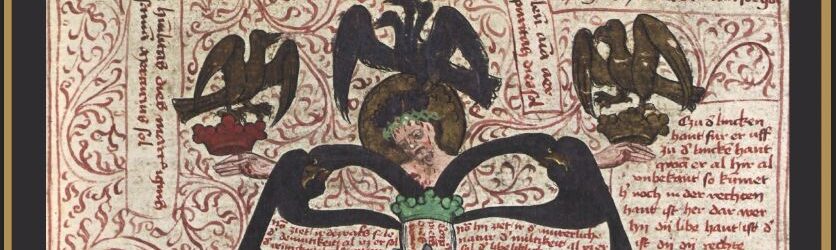
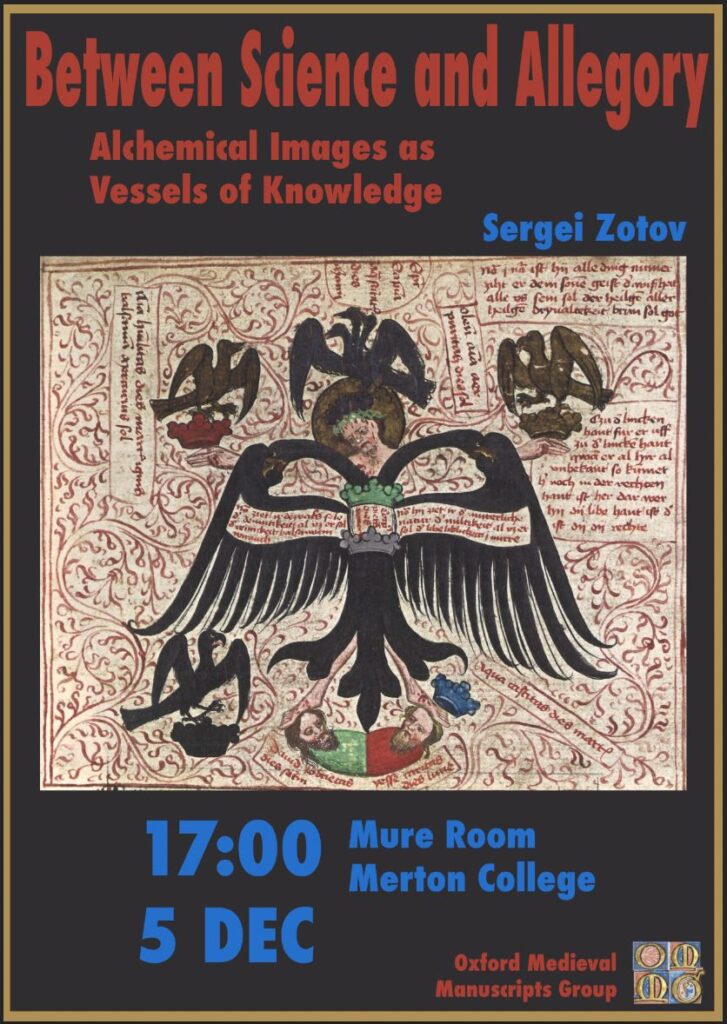
Sergei Zotov: Alchemical Images as Vessels of Knowledge

Merton College, 5 December 2025, 5pm

Join the Oxford Medieval Manuscripts Group for the final event in their Michaelmas Term ’25 programme in the Mure Room at Merton College at 5pm on Friday 5 December (Week 8) where Sergei Zotov (Warburg Institute, London) will speak on ‘Between Science and Allegory: Alchemical Images as Vessels of Knowledge’

The talk examines how alchemical images in medieval manuscripts forged a distinctive mode of knowledge at the threshold of science and imagination. Originating as visual experiments, they developed into a symbolic language that articulated natural philosophy through allegorical form. Far from mere decoration, these images mediated between empirical inquiry and religious, zoological, bodily, or social interpretation — becoming vessels in which medieval science and allegory converged.

For any questions, or to be added to the Oxford Medieval Manuscripts Group’s mailing list, contact Fergus Bovill at oxfordmedievalmss@gmail.com

Medieval Matter MT25, Week 7

Week 7, and the prospects of the vac creeps ever closer! Two particular items of note this week. First, there is no Medieval History Seminar this week. Second, Prof. Roberta Mazza’s lecture for the Centre for Manuscript and Text Cultures has been postponed until next term. If you are looking for an alternative manuscript fix: come to the Medieval Manuscripts Support Group, following the Friday coffee morning this and next week.

As always, you can find a complete copy of the Oxford Medieval Studies Booklet here.  Any last-minute changes will be updated in the weekly blogpost and in the calendar, both accessible via https://medieval.ox.ac.uk/.

Monday

Tuesday

  • Latin Palaeography Manuscript Reading Group – 2:00, Weston Library (Horton Room)
  • Medieval Church and Culture Seminar – 5:00, Harris Manchester College. Mark Vessey (UBC) will be speaking on ‘Some Problems in the Earliest History of the Latin Life of Antony’.
  • Medieval French Research Seminar – 5:00, Maison Française d’Oxford. Prof. Francis Gingrass (University of Montreal) will be speaking on ‘Luttes fratricides dans l’Histoire ancienne jusqu’à César’.
  • Old English Graduate Reading Group – 5:15, location TBC, contact Hattie Carter

Wednesday

  • Medieval Hebrew Reading Group – 10:00, Clarendon Institute.
  • John Lydgate Book Club – 11:00, Smoking Room (Lincoln College).
  • Medieval German Graduate Seminar on the Constance Chronicle – 11:15, Somerville College.
  • EMBI Mapping Workshop – 2:00 in room 00.056 of the Schwartzman Centre. A few spaces are still available – sign up here.
  • Older Scots Reading Group – 2:30, Room 30.401 in the Schwarzman Centre.
  • Medieval Latin Documentary Palaeography Reading Group – 4:00, online.
  • Late Antique and Byzantine Seminar – 5:00, Ioannou Centre. Thomas Laver (Cambridge) will be speaking on ‘Estates, Economy, and ‘Holy Men’ in Late Antique Egyptian Monasteries’

Thursday

  • Middle English Reading Group – 11:00, Beckington Room (Lincoln College).
  • Environmental History Working Group – 12:30, Room 20.421 in the Schwarzman Centre. Meeting details to be announced.
  • Celtic Seminar – 5:00, hybrid. Gwen Angharad Gruffudd & Arwel Vittle will be speaking on ‘‘Dros Gymru’n Gwlad’: hanes sefydlu’r Blaid Genedlaethol’
  • King Faisal Lecture – 5:00, Oxford Centre for Islamic Studies. Professor Muhsin Jassim al-Musawi (Columbia University) will be speaking on ‘The Medieval Islamic Republic of Letters: Arabic Knowledge Construction’. All Welcome. No registration is required.
  • Compline in the Crypt – 9:30pm, St Edmund Hall.

Friday

Opportunities

Medieval Matter MT25, Week 6

An extra large offering of medieval events for sixth week, and a particularly busy Monday! As always, you can find a complete copy of the Oxford Medieval Studies Booklet here.  Any last-minuted changes will be updated in the weekly blogpost and in the calendar, both accessible via https://medieval.ox.ac.uk/.

Monday

  • French Palaeography Manuscript Reading Group – 10:30, Weston Library (Horton Room)
  • Introduction to Arabic Palaeography – 2:00, Khalili Research Centre
  • Medieval Archaeology Seminar – 3.00, Institute of Archaeology, Lecture Room. Roberta Gilchrist will be speaking on ‘The medieval ritual landscape: Persistence and place-making in later medieval England’
  • Historical and Systematic Theology Research Seminar – 3:30, Campion Hall. Professor Thomas Joseph White (Rector of the Angelicum, Rome) will be speaking on ‘‘How can one say that God has become human? John of Damascus and Thomas Aquinas on the Semantics of the Incarnation’
  • Carmina Burana: Graduate Text Seminar – 5:00, Harris Lecture Theatre, Oriel College.
  • Medieval History Seminar – 5:00 with drinks reception to follow, All Souls College. Angus Russell (King’s College, Cambridge) will be speaking on “Between truth and justice: towards an intellectual history of post-Mongol Rus”.
  • History of Liturgy Seminar (IHR) – 5:30, Balliol College and online. Cosima Gillhammer will be speaking on ‘Writing about liturgy for a general audience: some reflections’; Molly Bray will be speaking on ‘Statue Dresses, Rituals and Kinship at Kloster Wienhausen c. 1469-1530’. The poster for the event can be viewed here.
  • Thomistic Institute Lecture – 7:30, Balckfriars. Sr. Catherine Joseph Droste, O.P. (Pontifical University of St. Thomas Aquinas) will be speaking on ‘Virtue and Self-Knowledge in St. Catherine of Siena’

Tuesday

  • Medieval English Research Seminar – 12:15, Margaret Thatcher Centre, Somerville. Caroline Batten (U of Pennsylvania) will be speaking on ‘Vulnerable Bodies: The Old English Verse Charms, Again’
  • Latin Palaeography Manuscript Reading Group – 2:00, Weston Library (Horton Room)
  • Medieval Church and Culture Seminar:  5:15pm, Harris Manchester College (tea & coffee from 5.00). In a change of topic, Alice Rio (All Souls) will be speaking on ‘Otherworldly Tribunals and the State (9-10th c):  Wetti, Theodora, Mulien’.

Wednesday

  • Medieval German Graduate Seminar – 11:15, Somerville College. The topic for this term is Ulrich von Richental, Chronik des Konzils zu Konstanz (1414-1438).
  • Older Scots Reading Group – 2:30, Room 30.401 in the Schwarzman Centre.
  • Medieval Latin Documentary Palaeography Reading Group – 4:00, online.
  • Late Antique and Byzantine Seminar – 5:00, Ioannou Centre. Peter Frankopan and Jonathan Shepard (Oxford) will be speaking on ‘Revisiting the Byzantine Commonwealth: A Discussion’.

Thursday

  • Middle English Reading Group – 11:00, Beckington Room (Lincoln College).
  • Medieval Women’s Writing Research Seminar – 4:00, Somerville College. Including extracts from the letters of Hildegard von Bingen, Catherine of Siena, Violant de Bar and María de Castilla
  • Medieval Visual Culture Seminar – 5:00, Khalili Research Center (NB. change of location). Mariam Rosser-Owen (V&A) & Ashley Coutu (Pitt Rivers) will be speaking on “New directions in the study of ivories from the Islamic world: A talk and handling session” Co-sponsored with the Khalili Research Center.
  • Celtic Seminar – 5:00, hybrid. Roan Runge (Glasgow) will be speaking on ‘‘Turn and face the strange’: Analysing animal species present in medieval Irish narratives of transformation’
  • Multilingual Medieval Compline in the Crypt – 9:30pm, in the crypt below St-Peter-in-the-East, St Edmund Hall (see below).

Friday

  • Medievalist Coffee Morning – 10:30, Visiting Scholars Centre (Weston Library). All welcome, coffee and insight into special collections provided.
  • Exploring Medieval Oxford through Surviving Archives – 2:00, Weston Library (Horton Room).
  • Oxford Medieval Mansucript Group ‘Reading Group’ – 5:00, online. J. E. Murdoch and and Laure Miolo will both present; the deadline for attendance has passed.

Opportunities