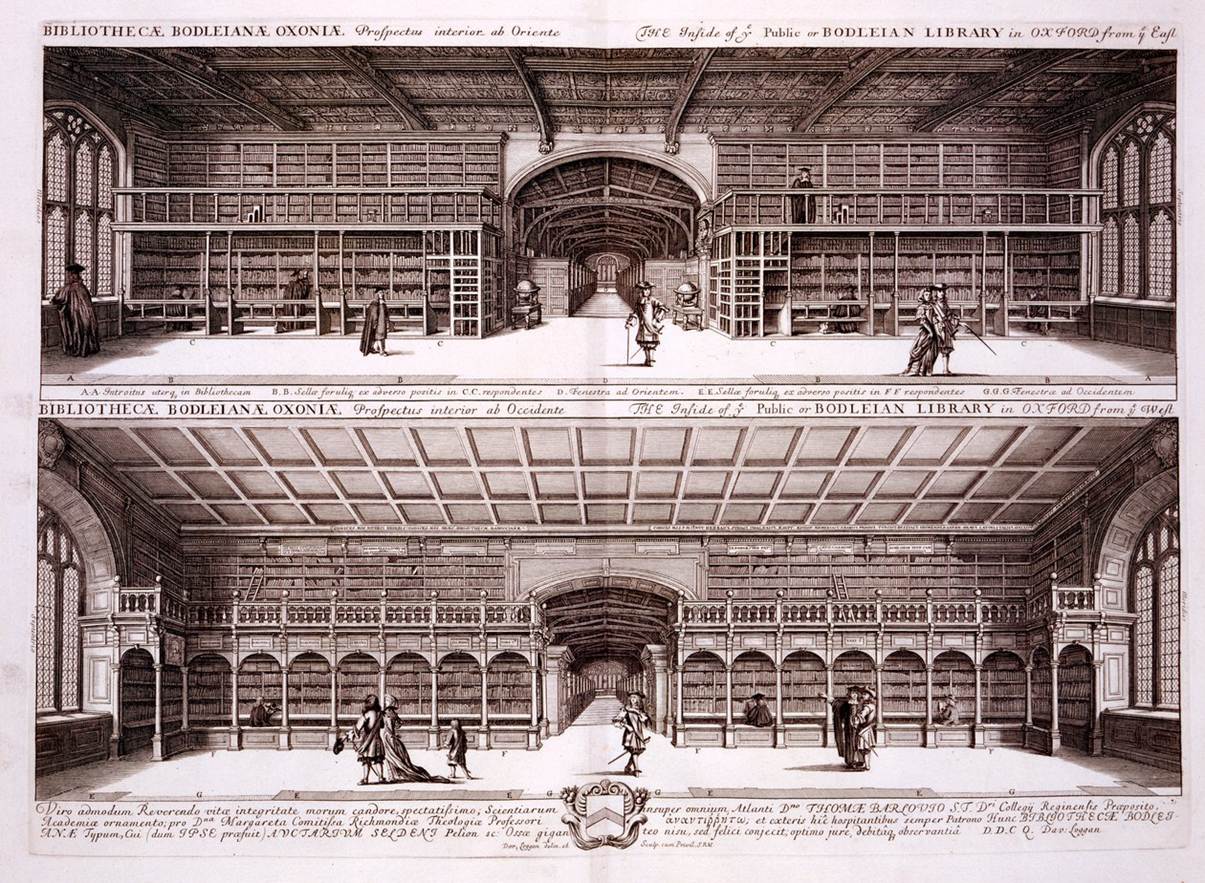
Conference: Oxford, 7-10 July 2027
Franciscus Junius and his Books will be an international symposium focusing on the literary heritage of Franciscus Junius (1591–1677). This philologist was one of the Bodleian Library’s most prominent early modern benefactors. His studies on Old English, Old Frisian, Old High German, Gothic, ‘Runic’, Middle English, Older Scots, Old Norse, and Welsh, and other languages earned him the predicate of “founding father of Germanic philology”. Junius’s books and manuscripts offer a fascinating view of his diverse activities, ideas, and thoughts, which are still of great interest to modern scholars.
Junius’s bequest
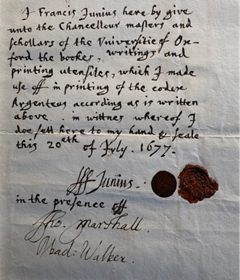
On 20 July 1677, the philologist and art historian Franciscus Junius (1591–1677) bequeathed to the “Chancellour, masters and schollars of the Universitie of Oxford the bookes, writings and printing utensiles, which I made use of in printing of the codex Argenteus”. This bequest is known now as the Junius collection in the Bodleian Library. Together with books and manuscripts elsewhere in Oxford, London and Leiden, the Junius collection in the Bodleian Library documents some four decades of Junius’s intensive research into language, text and etymology, followed by more than a century of intensive usage of the Junius collection.
Franciscus Junius

Born in Heidelberg from French parents, Franciscus Junius grew up in the Netherlands. In 1621 he migrated to England, where he entered the service of the Earl of Arundel and dedicated his studies to art history. His first book, De pictura veterum (1637) was an influential book on pictorial arts and classical literature. The English Civil War occasioned his return to the Netherlands and coincided with his growing interest in the Germanic vernaculars, their origins and interrelations. This interest in languages was to become Junius’s passion: he collected medieval manuscripts, made transcripts of medieval texts, bought relevant printed books and compiled editions, glossaries and etymological studies. For his explorations, Junius exchanged letters with an extensive scholarly network and travelled to Germany, Friesland and Scotland. His latter years brought him to Oxford, with its newly-founded University Press, which he considered the best custodian of his scholarly inheritance. He lies buried in St George’s Chapel, Windsor.
Editions
Junius’s collection of manuscripts and books reflects the diversity of his philological activities. He edited and printed major medieval texts such as the Old English biblical poems from MS Junius 11 (the “Cædmon manuscript”) and the New Testament in Gothic (an extinct Germanic language), in 1665. For the printing of both editions, new letter types had been produced at his own expenses. Other editions were planned, some nearing completion, but did not make it to the printing press. The most impressive among them (MS Junius 13) was the Old High German translation of Tatianus Alexandrinus’s Old High German Harmony of the Gospels, which he prepared for a comparative annotated edition. Similarly significant are the printed books and manuscripts in Old Frisian which Junius collected, transcribed, and intended to edit, and which provided Oxford with several unique documents written in that language.
Transcriptions
For his language studies, Junius made numerous transcripts of texts and glossaries from manuscripts and printed books. Junius’s transcripts include texts that were used in later editions because original manuscripts were lost, such as the Old Frisian legal texts from the Codex Unia and the Old English translation of Boethius’s De consolatione philosophiae. In some other cases editors preferred Junius’s impeccable transcripts to their ancient exemplars.
Glossaries
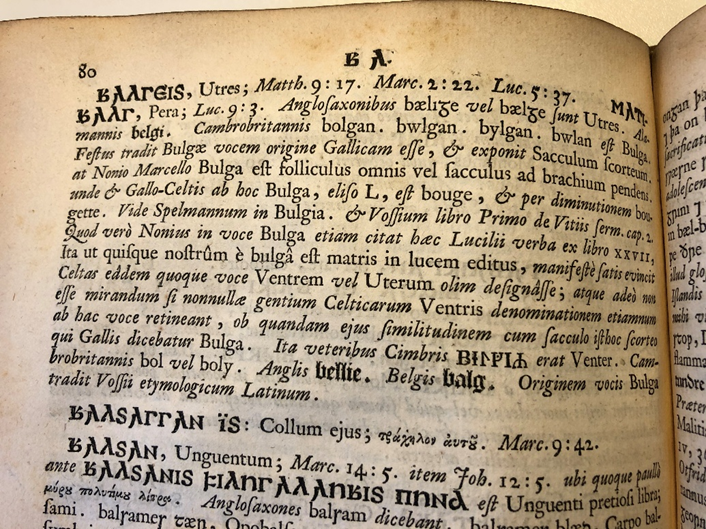
Most famous in his lifetime, however, were Junius’s glossaries and word studies, recorded in many volumes meticulously compiled. Some resemble dictionaries, such as his two-volume glossary of the Old English language (MSS Junius 2 and 3), but many others are testimony to his ability to weave words and citations into extensive etymologies, some of which are philological tapestries that kept growing over the years. Only three etymological glossaries were ever published: the Observationes in Willerami (1655), the Gothicum glossarium (1665), and the Etymologicum Anglicanum, an etymological dictionary of English published posthumously (1743), and edited by Edward Lye. Most of Junius’s etymological glossaries, especially those with Old High German lemmata, remain in manuscript. They are, however, the key to Junius’s thinking about languages and their cohesion, and about Junius’s theological and philosophical ideas which formed the backbone and the motivation to his work.
Junius as a European
Franciscus Junius the younger is a major European humanist and scholar whose reputation as art historian and Germanic philologist has never waned. The 1998 conference in Leiden and the magisterial edition of his remaining correspondence have been major contributions to our knowledge and understanding of the cross-disciplinary international nature of his scholarship. Intensifying our research into his manuscripts and books will not only improve our understanding of Junius as a European scholar but also contribute to a holistic view of a European network of like-minded philologists. (Bremmer, Rolf H., ed. (1998). Franciscus (Du Jon) Junius and His Circle. Amsterdam; Atlanta, GA: Rodopi; Van Romburgh, Sophie G. (2004). “For my Worthy Freind Mr Franciscus Junius”: An Edition of the Correspondence of Francis Junius F. F. (1591-1677). Brill’s Studies in Intellectual History 121. Leiden: Brill.)
Junius and his books
Junius’s manuscripts and books have not yet been studied as an integral archive of multilingual scholarship, but mostly as projects around individual manuscripts, books, languages or national traditions. Our focus on the Oxford Juniana, together with material now in Leiden, London, Friesland and elsewhere, will allow us to reconstruct both Junius’s scholarly library and his bibliographical network. Organising the symposium in Oxford brings together an extraordinary variety of essential expertise in the place where most of Junius’s books are housed and the surviving fonts are stored. Experts in languages and texts, codicologists, historians, librarians and printing specialists will work directly with selected manuscripts and books, compare evidence across collections, and combine philological, codicological, bibliographical and intellectual-historical methods. Their work will improve our understanding of Junius’s contribution to comparative philology, European humanism, and the development of linguistic and cultural identities in early modern Europe.
Organisers
The symposium will take place at the Bodleian Library and St Edmund Hall, Oxford, 7–10 July, 2027, co-organised by Sarah Cusk, Kees Dekker, Simon Horobin, Henrike Lähnemann, Francis Leneghan, Anne Popkema, and Johanneke Sytsema. The symposium is a collaboration between St Edmund Hall, the Bodleian Library and the University of Groningen (The Netherlands), with support from Lincoln College, Magdalen College and St Cross College. The symposium has received financial support from the Groningen Research Institute for the Study of Culture (ICOG); Tresoar Leeuwarden; Ottema Kingma Fûns; Feitsma Fûns; Douwe Kalma Stifting; Professor van Winter Fonds.
Programme
coming soon
Attendance
Anyone is very welcome to attend the presentations, either online (which is free), or on site. For attendance in Oxford, we will have to charge a fee covering lunch and coffee. A registration form will become available soon.