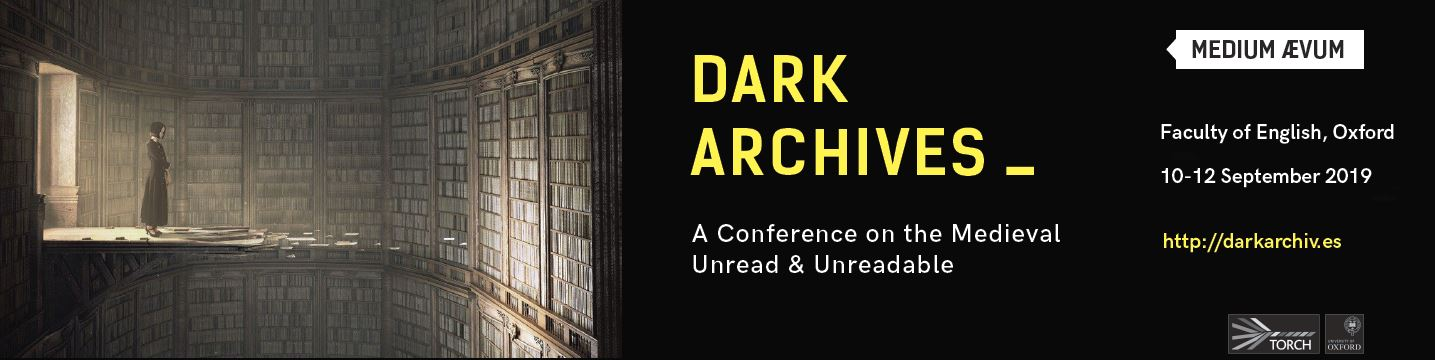
Report on the Dark Archives Conference 2019

For the latest iteration in the conference series, cf. https://medieval.ox.ac.uk/arsinquirendi/

A Conference on the Medieval Unread & Unreadable

THE DARKNESS OF THE MEDIEVAL ARCHIVES, the shadows of the library stacks: too vast for countless lifetimes of scholarship to exhaust? And yet, in our internet era, the accelerating machine-processing of centuries of collected medieval materials and data is yielding ever more detailed, extensive maps of the archive’s extent and  features. The goal of completely surveying the archive, down to every folio and character, is not only increasingly viable but irresistible – and at a time when competence in its languages, diplomatics and palaeography is contracting; for this same process promises new revelations, of unprecedented richness and detail, about the medieval world itself.
      Yet the great irony is that on our new map, the Dark Archives, the medieval unread and unreadable, dwarf all that we currently know, and indeed threaten to paralyse fresh research. In quantity, they encompass the great majority of the millions of known folios and associated records, that remain unread, unscanned and scattered across the world. Who will fund their expensive digitization? What should be prioritized? And to what end, when the mass-transcription and record-creation technologies needed to explore them remain unequal to the task?  Most challenging of all may be owning the shift in perspective that the Dark Archives are forcing upon us: the unsustainably small extent of what we term ‘the medieval’, and the uncertainty over what might succeed it.
Join us this September to crystallize and advance the field at Dark Archives, which is bringing together over 50 of its likely academic and commercial key-holders, from archivists and intellectual historians to machine-learning researchers. General registration now open, and full programme published:

Day 1 (10th September): Mapping the Medieval Graphosphere: What Dimensions, How Composed, Whether Habitable?

Day 2 (11th September): Endless Deserts, Oceans and Mountains: Tackling the Metadata Crisis

Day 3 (12th September): Re-Making Medieval History

along with a range of practical workshops on the latest techniques for Dark Archives discovery on 13th September. 

8:30am to 6:00pm

10th September: Mapping the Medieval Graphosphere: What Dimensions, How Composed, Whether Habitable?

   8:30-9:00am     Coffee and Registration

9:00am to 1:05pm

Manuscripts, Extant and Destroyed

Chair/Respondent: 

  • Nigel Palmer
  • Teresa Webber
  • Eltjo Buringh
  • Utrecht University

Keynote Address: Estimates of Manuscript Numbers

  • Jo Story
  • University of Leicester

Insular Manuscripts: how many and what next?

  • Joanna Tucker
  • University of Glasgow

Survival and loss: working with documents from medieval Scotland

  • Ralph Cleminson
  • University of Oxford

Non leguntur: shedding light on Slavonic sources

  • Adrien Quéret-Podesta
  • Petőfi Sándor School

“Textual ghosts” in the oldest Central European historiography

Coffee

  • Daniel Sawyer

@DE_Sawyer

  • University of Oxford

At Knowledge’s Edge: Lost Materials

  • Krista Murchison
  • Leiden University

(Re)collecting the Archive: Recovering Medieval Manuscripts Destroyed During WWII


Video

  • Henrike Lähnemann

@HLaehnemann

  • University of Oxford

Nuns’ Dust

PDF icon nuns dust handout

  • Gustavo Fernández Riva

@Medieval_Gus

  • FAU Erlangen-Nürnberg
  • Time Machine Organization

Network Analysis of Manuscripts

Questions

1.00pm to 2pm    Lunch

2:00pm to 4:05pm

Neither Parchment Nor Paper

Chair/Respondent: 

  • Graham Barrett
  • Ellie Pridgeon

@consularchivist

  • University of Leicester

The Writing on the Wall: Medieval Painted Inscriptions

  • Maria do Rosário Morujão
  • University of Coimbra

Dark Seals in Portuguese Archives

  • John Hines
  • Cardiff University

Dark Sides of the Runes

  • David King
  • University of East Anglia

The Corpus Vitrearum Medii Aevi

Questions

Coffee

4:25pm to 6:15pm

Why Exalted, Why Neglected?

Chair/Respondent: 

  • Anthony Lappin
  • Anastasia Shapovalova
  • Institut de recherche et d’histoire des textes, Paris

Exploring the Medieval Archives in France

  • Monika Opalinska
  • University of Warsaw

Reconstructing medieval English religious culture: forgotten manuscript sources versus digital media

  • Matthew Holford

@matthewholford

The Least Studied Manuscripts in the Bodleian

  • David Rundle

@DrDavidRundle

  • University of Kent

The Unbearable Lightness of the Archive

Questions

6:15pm to 6:50pm

Drinks Reception

9:00am

11th September: Endless Deserts, Oceans and Mountains: Tackling the Metadata Crisis

  • Will Noel

@willnoel

  • Schoenberg Institute for Manuscript Studies

Keynote Address: Through a screen darkly: the metadata crisis and the authority of the digital image

9:55am to 1:00pm

Achieving Mass Transcription – Ex Machina? Ex Populo? And How Soon?

Chair/Respondent: 

  • Eltjo Buringh
  • Verónica Romero
  • Universidad Politecnica, Valencia

Interactive-Predictive Transcription and Probabilistic Text Indexing for Handwritten Image Collections

  • Achim Rabus
  • University of Freiburg

Training generic models for handwritten text recognition using Transkribus: Opportunities and Pitfalls

  • Vincent Christlein

@v_christlein

  • Friedrich-Alexander University

Scribal identification and document classification

11.10am to 11.25am Coffee

  • Ben Kiessling
  • University of Leipzig

The Limits to Digitization

  • Roger Louis Martinez-Davila

@rogerlmartinez

  • University of Colorado

Massive Open Online Projects to teach palaeographic skills and to prepare manuscript transcriptions

Thought-Game – Build a Universal Manuscript Transcription Platform – Now !

Participants joining the chair & panelists: 

Michael Sargent

Stewart J. Brookes

Emma Goodwin

PDF icon Download Goodwin Dark Archives Poster.pdf (991.16 KB)

12.45pm to 1.55pm Lunch

1:55pm to 4:50pm

How to Organize the Metadata Once We Have It

Chair/Respondent: 

  • Jo Story
  • Toby Burrows

@TobyBurrows

  • Oxford E-Research Centre

Aggregating provenance metadata to reveal the histories of medieval manuscripts

  • Andrew Hankinson

@ahankinson

  • Bodleian Library
  • International Image Interoperability Framework

Discovery through Data: How IIIF shines a light into the dark archive’

  • Debra Cashion

@dtcashion

  • St Louis University

METAscripta

video

3.20pm to 3.30pm Coffee

  • John McEwan
  • St Louis University

Reflectance Transformation Imaging and Medieval Seals

  • Sarah Fiddyment

@drsfiddyment

  • University of York

Manuscript Palaeoproteomics

video

Thought-Game: Devise a metadata system to satisfactorily describe and relate all written medieval materials – Now!

Participants joining the chair & panelists: 

William Noel

Emma Stanford

Gustavo Fernández Riva

4.50pm to 5pm     Coffee

5:00pm to 6:25pm

What Role Archives? (pt. 1)

Chair/Respondent: 

  • Suzanne Paul
  • Carolin Schreiber
  • München, Bayerische Staatsbibliothek

Keynote Address: Bringing the Dark Archives to the Light – Medieval Manuscripts in German Collections in the Digital Age

  • Paul Dryburgh

@pablodiablo74

  • The National Archives, Kew

Peering into an impenetrable gloom and the “tyranny” of digital by design: the future of medieval collections at The National Archives (UK)?

Video

Questions

7:30pm to 9:00pm

Conference Dinner at St. Edmund Hall

9:15pm

Compline in the Crypt of St-Peter-in-the-East (St. Edmund Hall)

PDF icon Download Compline-DarkArchives-SEH.pdf (404.39 KB)

Video of Compline in the Crypt

.. and some footage from the rehearsal!

9:00am to 6:00pm

12th September: Re-Making Medieval History

9:00am to 12:00pm

What Role Archives (pt. 2)?

Chair/Respondent: 

  • Pip Willcox
  • Luca Polidoro
  • University of Florence

The Secrets of the Barberini

  • Laura Light

Manuscripts in Private Hands

  • James Louis Smith

@ScrivenerSmith

  • Trinity College Dublin

Pre-Modern Manuscripts and Early Books in Conflict Zones: An Emerging Network and its Goals

  • Christopher Wright
  • Matteo di Franco
  • University of Cambridge

From isolation to integration: making Greek manuscripts readable

  • Dot Porter

@leoba

  • Schoenberg Institute for Manuscript Studies

Reading Across A Digitized Collection of Books of Hours

Coffee

Roundtable

Participants joining the chair & panelists: 

Suzanne Paul

@suz_paul

Paul Dryburgh

@pablodiablo74

Elaine Treharne

@ETreharne

Robin Darwall-Smith

Carolin Schreiber

Sarah Fiddyment

12.10pm to 1pm    Lunch

1:00pm to 6:00pm

The Future of Medieval Scholarship: Forms, Substance and Means

1:00pm to 3:10pm

The Edition …

Chair/Respondent: 

  • Daron Burrows
  • Michael G. Sargent
  • City University of New York

Hidden in Plain Sight: The Obfuscation of Manuscript Evidence

video

  • Kyle Ann Huskin

@kylehuskin

  • University of Rochester

Shedding Light on Dark Archives: Principles for Editing Recovered Texts

  • Andrew Dunning

@anjdunning

  • University of Cambridge

Opening medieval books and fragments to students with documentary editing

  • Elizabeth Solopova
  • University of Oxford

An Invisible Giant: Editing Neglected Canonical Texts

Questions

Coffee

3:30pm to 4:45pm

… And Beyond

Chair/Respondent: 

  • Roger Louis Martinez-Davila
  • Mark Faulkner
  • Trinity College Dublin

‘Big Dating’ and ‘Bottom-up periodisation’

  • Sarah Savant

@sarahsavant1

  • Aga Khan University

Finding Meaning in 1.5 Billion Words of Arabic: The KITAB Project and Its Aims

  • Julia Craig-McFeely
  • University of Oxford

‘How dark is my archive?’: What lies behind and beyond the face of Musicology’s online archive, DIAMM

Questions

Coffee

4:55pm to 6:30pm

Medieval Capital

Chair/Respondent: 

  • Richard Ovenden
  • Marc Polonsky
  • The Polonsky Foundation

Digitisation of cultural heritage: a funder’s perspective

  • Maja Kominko

The Arcadia Fund

  • Luciano Floridi
  • University of Oxford

Keynote Address: Semantic Capital. Its Nature and Value

Concluding Debate

9:00am to 5:00pm

13th September: Dark Archives Workshops

  • Verónica Romero
  • Universidad Politecnica, Valencia

Hands-on Workshop on Assistive Technologies to Access the Contents of Handwritten Text Manuscripts

PDF icon Presentation

  • John McEwan

@frangelegetege

  • St Louis University

Imaging Seals on a Budget

12pm to 1pm Lunch

  • Roger Louis Martinez-Davila

@rogerlmartinez

  • University of Colorado

Crowdsourcing Manuscript Transcriptions: Opportunities and Challenges using MOOCs, Social Media, and Emerging Platforms

Link to Website

  • Alexander Zawacki
  • Helen Davies

@MedievalZawacki

@helsinhashtags

  • University of Rochester

Multispectral Imaging: Technologies, Techniques, and Teaching

Full Presentation and Slides

Disiecta membra musicae: conference report

27 March 2018 TORCH team

Disiecta membra musicae: conference report

Open any book bound before the 18th century and there is a good chance that you will find fragments cut from another book and re-used to support the binding or to protect the pages from the wooden boards. Often this binder’s waste will be taken from printed books, but in many cases the added strength of parchment made it more effective to chop up a medieval manuscript. A remarkable proportion of medieval binding fragments have musical notation on them—music went out of fashion, liturgies were proscribed, and large choirbooks provided a more versatile format for dismembering than a smaller text-book. Very few complete music books have survived intact from the Middle Ages, and so it is small wonder that musicologists have been working on medieval binding fragments ever since the birth of their discipline. A conference at Magdalen College on 19–21 March 2018 brought together almost 50 specialists to discuss the particular problems raised by disiecta membra musicae.

Margaret Bent opened proceedings with a tour d’horizon of the many vicissitudes affecting manuscripts over time. As founding director of one of the first ever manuscript digitisation projects, DIAMM (the Digital Image Archive of Medieval Music, which in its early days had the specific purpose of gathering images of polyphonic musical fragments, she could demonstrate the range of applications and innovations which have been used to make worn texts visible again, and to connect fragments cut from the same book and now strewn across the world. These techniques reached previously inconceivable levels of sophistication in Julia Craig-McFeely’s presentation on her latest advances in digital restoration.

Several speakers covered the pleasures and pitfalls of gathering information on musical fragments. Paweł Gancarczyk considered polyphonic fragments from late-medieval Bohemia, and the extent to which they can be associated with the Utraquist brotherhoods from which many complete manuscripts survive. Jurij Snoj has systematically searched through all the libraries in Ljubljana, and most other collections across Slovenia, to produce a database listing more than 550 fragments from around 140 manuscripts. A catalogue of a comparable number of sources from Hungary was published in 1981, but many more have come to light since that date, and Zsuzsa Csagány discussed the means of updating the older records for a new database. In the Nordic countries the scale is altogether greater, with some 50,000 fragments now accounted for in databases in Norway, Denmark, Finland and especially Sweden: Sean Dunnahoe provided a helpful overview of what can and cannot be said by means of statistical enquiries of the Swedish database of medieval fragments, MPO (Medeltida Pergamentomslag/Medieval Parchment Cover Database). The biggest project to date, building on the success of the Swiss manuscripts website e-codices, is Fragmentarium, deftly presented by its director Christoph Flüeler.

It was through e-codices that Susan Rankin came across images of an unusual 10th-century fragment used as a wrapper for documents and preserved in the Swiss nunnery of Müstair. In its format and content it relates to no other manuscript, and thereby raises important questions about the assumptions we make when assigning other fragments to particular types of book which happen to survive in complete form elsewhere. David Hiley took a similar line in discussing fragments of saints’ offices, which might have been attached as easily to codices of saints’ Vitae as to antiphoners. In the case of notated songs, Helen Deeming demonstrated that fragments sometimes assumed to be witnesses to a widespread tradition of song anthologies in medieval England are just as likely to have come from miscellanies of prose and verse.

Reinhard Strohm took a seemingly incongruous collection of musical materials in MS 5094 of the Austrian National Library, and demonstrated that there may in fact be more connections between them than first meets the eye. Other presentations included Daniele Sabaino on the annotations to a charter in Ravenna which may well constitute the earliest musical setting of a text in the Italian language. Karl Kügle discussed a newly discovered group of polyphonic fragments in the binding of a manuscript in the Landeshauptarchiv of Koblenz, and the extent to which the binder may have deliberately chosen particular leaves from his pile of binding materials on grounds of the appropriateness of their texts. Christian Leitmeir introduced us to the complex and idiosyncratic programme of dismemberment and rebinding undertaken by Amplonius Rating de Berka in forming his library, preserved to this day in Erfurt. David Catalunya reconsidered the position of ars antiquapolyphony in Castile, in the light of several recently discovered fragments, and later demonstrated his considerable talents as a performer on the clavisimbalum as part of the ensemble Tasto Solo, which provided a superb concert in the evocative darkness of Magdalen chapel under the direction of Guillermo Pérez, interspersing keyboard arrangements from the Faenza codex with madrigals and ballate by Jacopo da Bologna, Landini and others.

The symposium The Study of Medieval Music Manuscript Fragments ca. 800–1500, organised by Giovanni Varelli, took place on 19 to 21 March 2018 in Magdalen College. The full programme is available on the ‘events’ page of the Oxford Medieval Studies Programme. The full booklet with abstracts and further links can be downloaded here.

This conference report was written by Nicolas Bell (Nicolas.Bell@trin.cam.ac.uk). 

Gender and Medieval Studies Conference: Gender, Identity, Iconography

By Rachel Moss

CORPUS CHRISTI COLLEGE, OXFORD: 8 – 10 JANUARY 2018           

The Gender and Medieval Studies Conference is an annual peripatetic event that has been running since at least the late 1980s and traditionally takes place in early January. It welcomes scholars working across the whole Middle Ages and from any discipline. This small but well-respected conference is a key part of the calendar for medievalists and gender scholars alike. The steering committee of GMS asked me if I could host the conference at Oxford, and I was pleased to accept after drafting in Gareth Evans (Faculty of English) as co-organiser, with able assistance from Ayoush Lazikani and Anna Senkiw. Sixty-five delegates, ranging from masters students to tenured professors, from all around the world, eventually made their way to Oxford this January for three days of stimulating discussion on gender and identity in the medieval world.

This year’s theme was Gender, Identity, Iconography. Constructed at and across the intersections of race, disability, sexual orientation, religion, national identity, age, social class, and economic status, gendered medieval identities are multiple, mobile, and multivalent. Iconography – both religious and secular – plays a key role in the representation of such multifaceted identities. Across the range of medieval media, visual symbolism is used actively to produce, inscribe, and express the gendered identities of both individuals and groups. The aim of this conference was to provoke conversations across disciplines and time periods to understand the ways in which gender identity could be understood through image and iconography. We were also committed to providing a conference for everyone: accessible to all academics at any stage of their career in terms of price point, disability access, and in providing a safe and welcoming environment.

Corpus Christi College was an excellent venue, as its auditorium is very accessible and the conference office was very helpful in accommodating all dietary needs. Delegates were pleased to be able to make use also of Corpus’s beautiful historic spaces, such as the dining hall. As early career researchers ourselves, Gareth and I were keen to ensure the conference was affordable, and with support from Oxford Medieval Studies, the Leverhulme Trust, the Society for Medieval Feminist Scholarship and Castle Hill Bookshop we were able to provide a comprehensive programme while keeping the registration fee down.

The Call for Papers attracted a high number of good quality abstracts. We eventually selected thirty-two speakers out of almost ninety abstracts submitted, organised across ten panels over three days. Speakers talked on topics ranging from Amazon queens to public nudity to imperial eunuchs, in panels organised by theme, allowing for some fascinating cross period and interdisciplinary discussion.

We also secured three plenary speakers – Prof Annie Sutherland (University of Oxford), Prof Patricia Skinner (University of Swansea), and in a new initiative, an Early Career Plenary Speaker, Dr Alicia Spencer-Hall (Queen Mary, University of London). GMS has always been committed to supporting early career scholars, and offering a plenary spot to an outstanding early career researcher was a way to further this aim. Feedback on this initiative at the event and on twitter (we extensively covered the event at #gms2018) was extremely positive, and we would like to encourage other conference organisers to consider following our example by establishing an ECR plenary spot.

On top of all these exciting papers, we were able to commission Dr Daisy Black (University of Wolverhampton) to perform Unruly Woman, a riotous, funny and touching one woman interpretation of medieval fabliaux and romances, and with Dr Charlotte Berry hosted a workshop with medieval seals at Magdalen College Library, allowing delegates to get up close and personal with some fascinating gendered iconography in their impressive collection of seals.

The conference wrapped up with a roundtable on teaching medieval gender, allowing for a reflective conversation about how we communicate our research to our students in empathetic, responsible ways (one of our contributors, Dr Laura Varnam, has a great blog post about that session here). It was a fitting end to a conference that, as one attendee put it, left them feeling “empowered, inspired, and happily cocooned within a supportive and fierce community” and another described as “amazing, inspirational and motivational”.

Report by Rachel Moss, Faculty of History

Celts, Romans, Britons: Classical and Celtic Influence in Britain, 55 BC – 2016 AD

By Rhys Kaminski-Jones

This interdisciplinary conference, kindly supported by the TORCH Oxford Medieval Studies Programme, hoped to unite classicists, archaeologists, celticists, historians, and literary scholars in investigating the profound influence of Celtic and Classical heritage on the development of British identity. Three chronologically arranged panels attempted to trace the respective importance of Ancient Britons and Romans in British culture over the centuries, starting in the pre-Roman period and ending in the present day. Covering such a vast expanse of time presented a particular challenge to our medievalists, whose papers were separated from each other by centuries. However, they made sure that medieval legacies loomed large throughout the conference, with ideas about Roman influence in post-Roman Britain and the long shadows cast by medieval origin myths recurring again and again.

The first panel, chaired by Prof. Thomas Charles-Edwards (Oxford), featured Sir Barry Cunliffe (Oxford) on the theory that Celts first emerged in western Europe, Dr. Alex Woolf (St. Andrews) on how a British people might have developed in late antiquity, and Prof. Helen Fulton (Bristol) on the use of Troy by medieval English writers.

The second panel, chaired by Rhys Kaminski-Jones (University of Wales), featured Prof. Ceri Davies (Swansea) on the reception of Trojan origin myths by Welsh renaissance humanists, Prof. Philip Schwyzer (Exeter) on the politics of British antiquity under James I, and Mary-Ann Constantine (University of Wales) on how eighteenth-century travellers to Wales and Scotland imagined the Celtic and Roman past.

The third panel, chaired by Dr. Nick Lowe (RHUL), featured Prof. Rosemary Sweet (Leicester) on how nineteenth-century antiquarians reconsidered Roman Britain as a domestic and commercial society, Dr. Philip Burton (Birmingham) on the complex Celtic themes and echoes in J. R. R. Tolkien’s Middle Earth, and Prof. Richard Hingley (Durham) on how Hadrian’s Wall is used today as a symbol of national division and international co-operation.

The discussion sessions following each panel provided a wide-ranging and cross-disciplinary analysis of this aspect of British identity, touching on the problematic nature of “indigenous” Britishness from the Middle Ages to the present day, the exclusion of women from a male-dominated Celts v. Romans historical narrative, and the role of contemporary heritage bodies in emphasising Celtic or Classical aspects of the British past. The conference was enthusiastically received, with all 60 available places filled, and with the possibility of published conference proceedings being actively considered. The organisers would like to thank everyone involved in making it a success, and especially the Oxford Medieval Studies Programme who helped make it possible in the first place.