“meister, phiff uff, lasz vns springen.” – Maria Magdalena, Frankfurter Passionsspiel 8b (ll. 698–743)
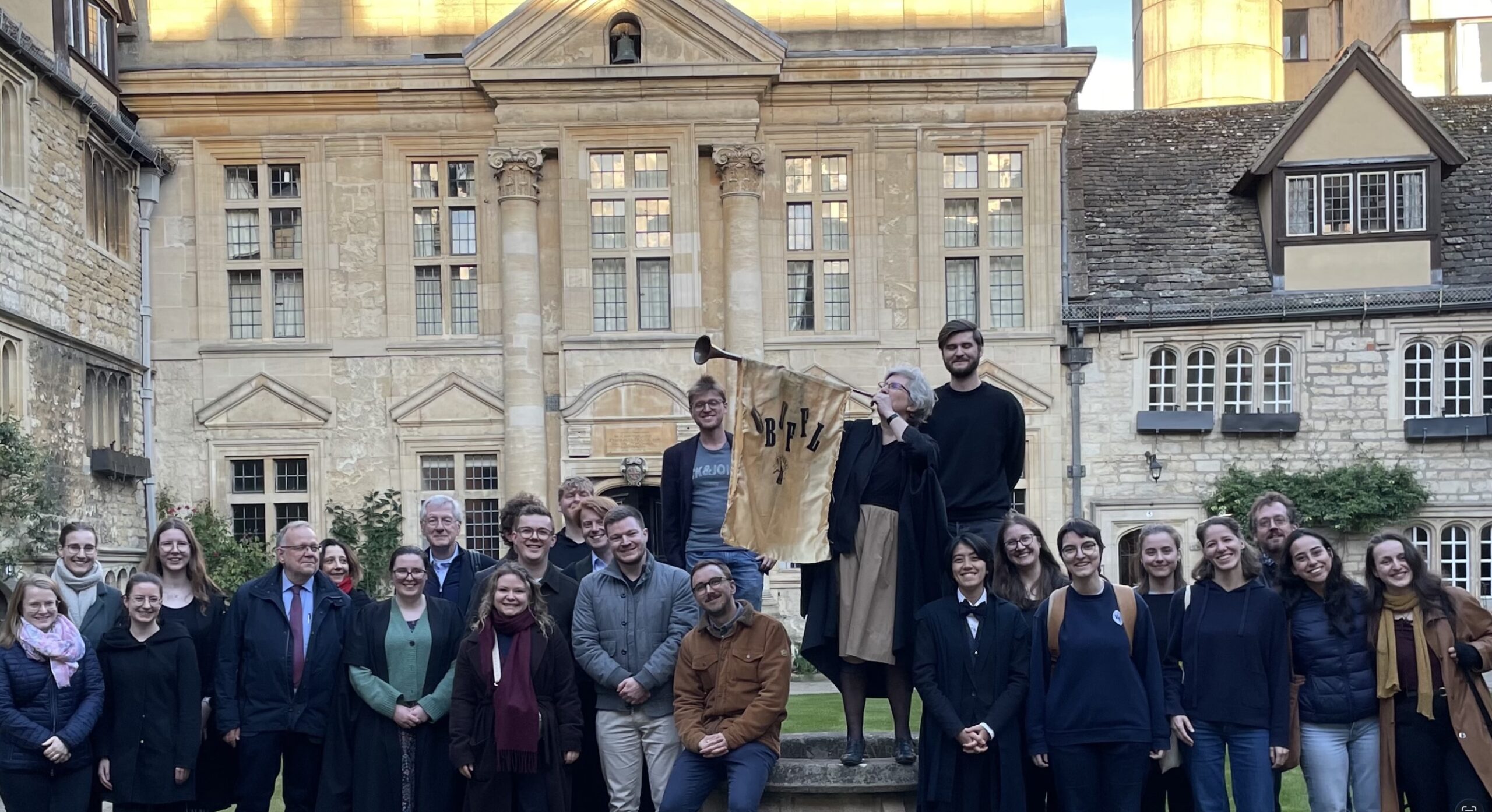
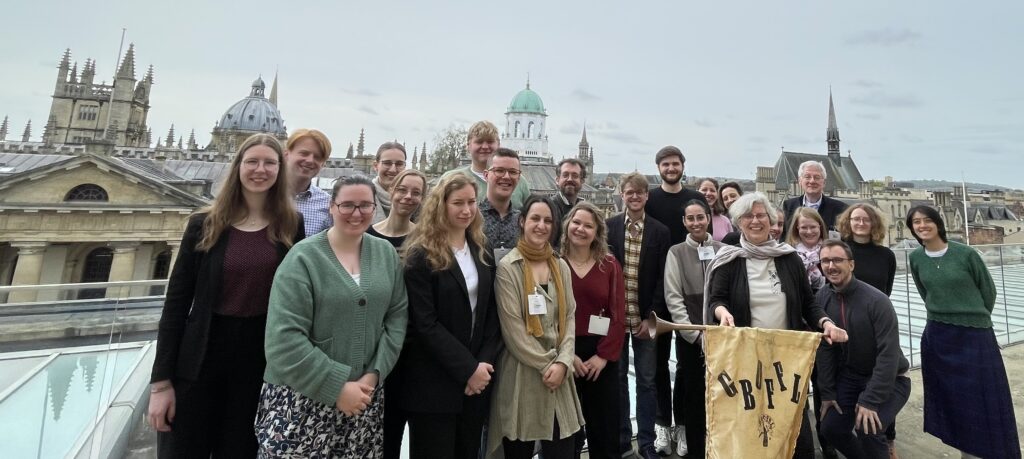
Enough rays to make functional the St Edmund Hall sundial; yellow, orange, and burgundy tulips; the four-note blast of that iconic hunting horn: these signs heralded the beginning of the three-day GBOFFL Conference of medieval Germanists one late afternoon in April.
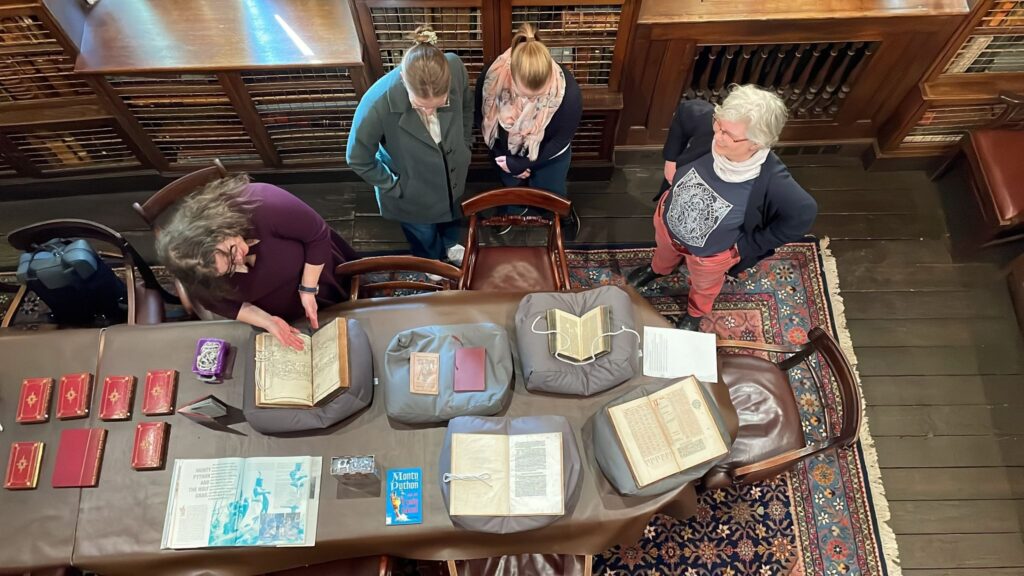
The GBOFFL participants — from universities whose cities make up the abbreviated title, i.e. Geneva, Bern, Oxford, Freiburg (im Breisgau), Freiburg (im Üechtland), and Lausanne — kicked off the conference with a gathering in the cosy, climate-controlled Old Library of Teddy Hall, where they noshed anise cake and perused materials from the Hall’s collection, including a pamphlet on St Edmund and a Monty Python-themed cardboard catapult.
After the reception, and with the rare books safely stowed, the participants poured tea and coffee and partook in analyzing and performing the Passionsspiel, in particular scenes from the Frankfurt and Alsfeld versions which are being prepared for an edition focussing on the life of Mary Magdalen — more on this during a workshop on medieval German drama on 2 May!
With their dramatic prowess soundly proven, the Germanists poured into the Wadham Room of The King’s Arms for a celebratory pint, each looking forward to the schedule of lectures and workshops in the days to come.
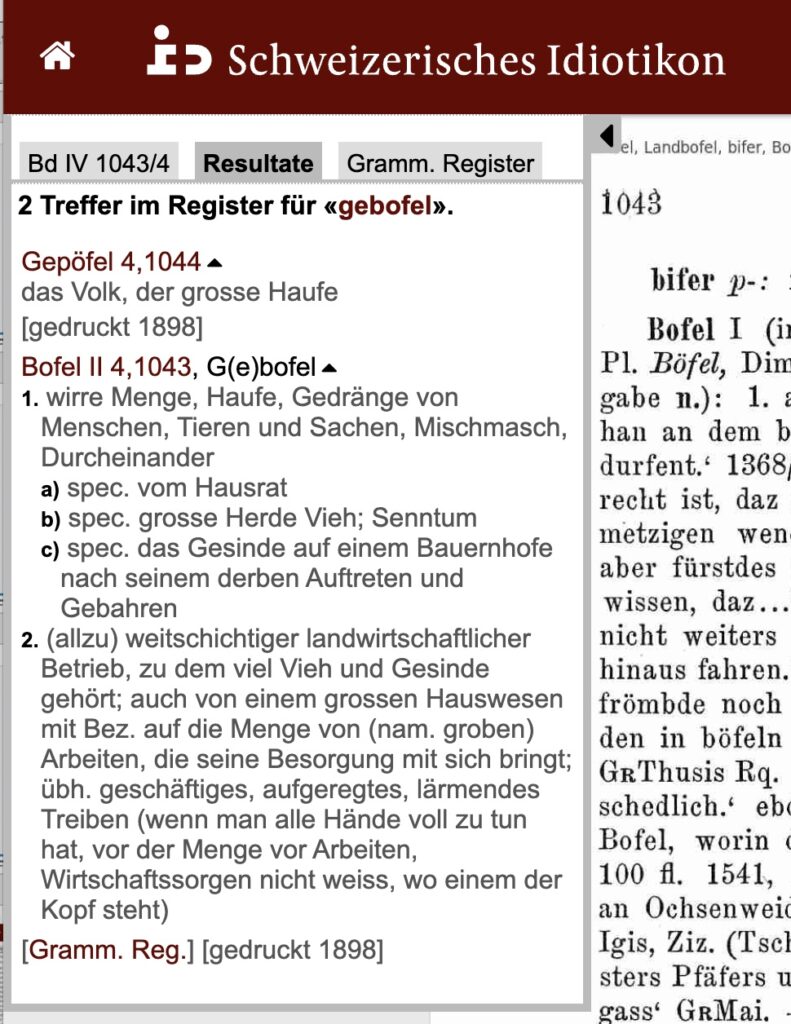
The ninth of April saw a slate of four lectures by graduate scholars Monty Powell, Luke Cooper, Jasmin Eggel, and Felix Stürz. Each prepared a 30–40-minute presentation and fielded questions for the remainder of the given hour. Lively discussions ensued, on the voice of God, on magical poets, on video games, and on many further interesting topics, that are too many to elaborate here (,der zu vil zu schreiben wer’). A surprise lecture was given by Cornelia Herberichs on the etymology of the word GBOFFL, which proved not just to be an acronym, but a Swiss German description of a spirited (if labour-intensive) gathering.
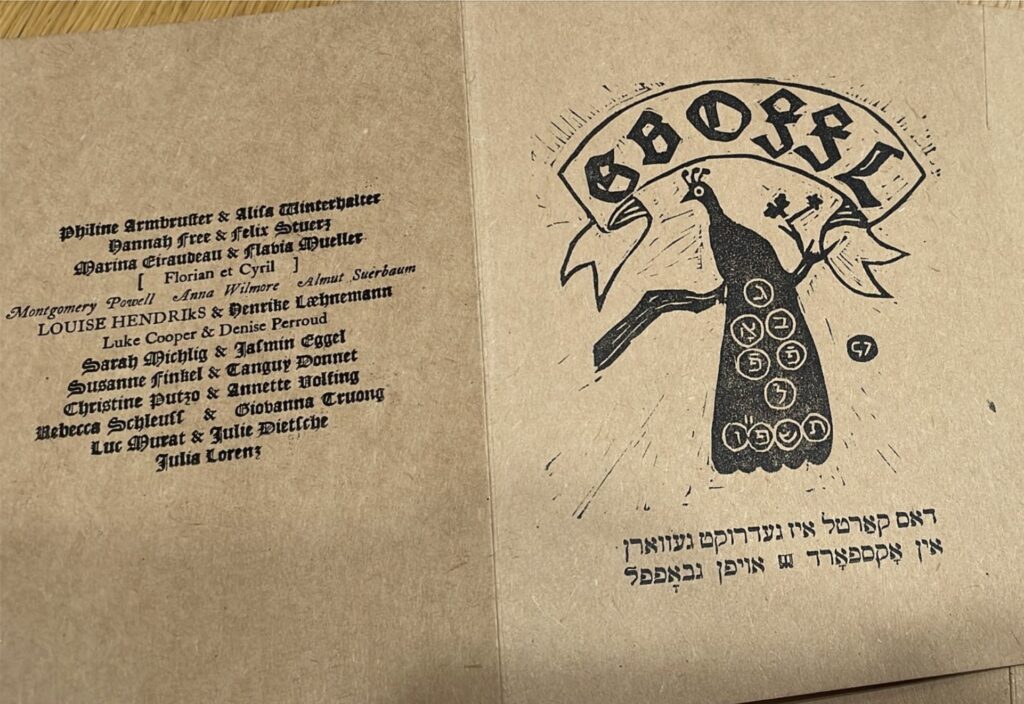
After lunch, doctoral student Giovanna Truong (that’s me) led a workshop on letterpress printing (and early Yiddish typography) in which the GBOFFL participants learned to set their own names in lead type. With the expertise of Richard Lawrence, the Bodleian Bibliographical Press’s master printer, the students and faculty were able to print the list of names on a card alongside a linocut image of a peacock under a GBOFFL banner (designed and produced by yours truly with materials and assistance from Henrike Lähnemann). Some participants also printed t-shirts bearing the unofficial logo.
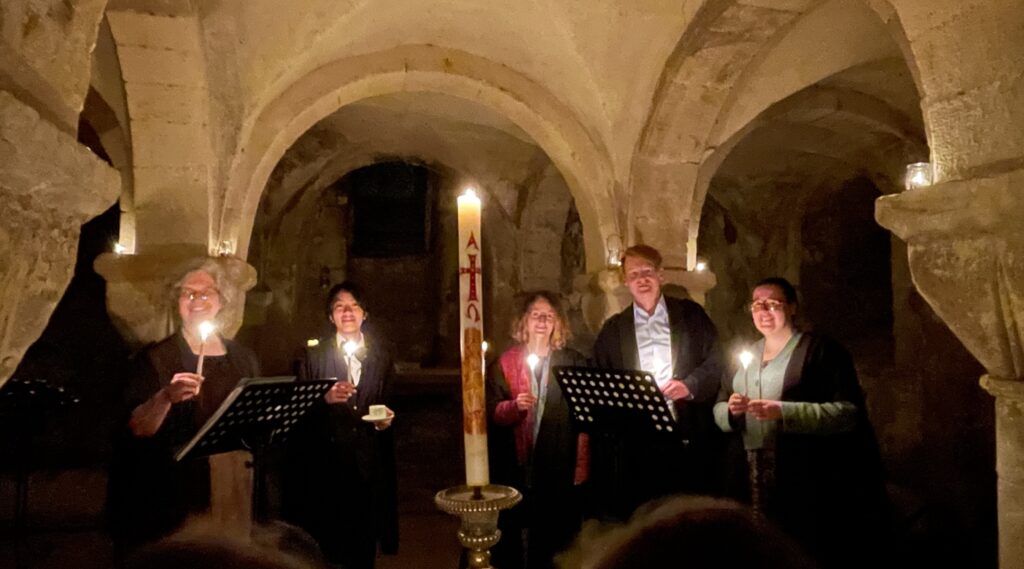
The day ended with a candlelit vegetarian dinner in the St Edmund Hall Old Dining Hall, where joyous chatter could be heard until twilight. Some of the merry group migrated to the Hall’s Crypt, where gowned Oxford scholars sang Compline in Latin and Middle High German around an Easter candle. The evening ended after sundown with the sung prayers of Havdalah, marking the end of the Jewish Passover holiday.
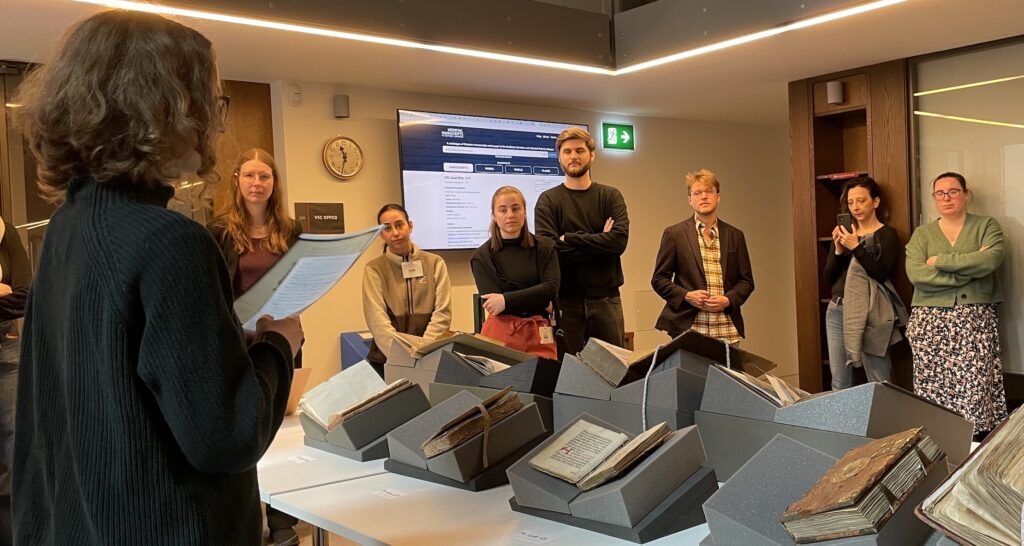
The GBOFFLers returned the next day to Teddy’s Doctorow Hall for an enlivening of the senses — an early lecture by Susanne Finkel on visual poetics in Partonopier and Meliur works. The schedule called for a trip to the Weston Library for the weekly Coffee Morning, this week led by Philine Armbruster, Lucian Shepherd, and Henrike Lähnemann on the topic of manuscript fragments (and, as usual, including a few minutes for gazing at the dreaming spires from the roof terrace).
Manuscripts and Books shown:
- Otto von Passau ‚24 Alte‘: MS. Germ. b. 3, fols 2-3, ed. here https://editions.mml.ox.ac.uk/editions/otto-von-passau/);
- Douce 212 Die vierundczweinczig Altē. od’ d’ guldin tron, GW M28503 Augsburg: Anton Sorg, 10.III.1480. 2° Letter by Wieland Schmidt, Die vierundzwanzig alten Ottos von Passau, Palaestra, 212 (Leipzig, 1938), 231-2 no. 1; See VL VII 229-34. Augsburg: Anton Sorg, 10 Mar. 1480. Folio. Wanting gathering [*] containing the register, sheet [05.6], and gathering [x]
- Boec des gulden throēs of der xxiiij. ouden 1484[X.25] | herlem [J. Bellaert] | (fol.) Auct. 6 Q 5.23 GW M28517 Provenance: Haarlem, Netherlands, Franciscan Tertiary Nuns, S. Anna; inscription on r9r: Dit boec hoert toe den susteren van sinte Marien conuent binnen Haerlem in sinte Jans straet ende heeft ghege[n]en pieternel dirck der Ende marijtgen maertens der onse susteren tot een testement’. Purchased from Asher & Co. for £2.15.0; see Library Bills (1851-5), 77; Books Purchased (1853), 65. O-036 in Bod-Inc
- Die vier und zweintzig Alten. Auffs new gebessert. Vet. D1 c.426, Dillingen: Sebald Meier 1568
2. Der Heiligen Leben
- MS. Germ. d. 1, Part A (ediert von ihr hier https://editions.mml.ox.ac.uk/editions/der-heiligen-leben/ [Beta-Version, wird noch aktualisiert]);
- MS. Laud Misc. 443, Nürnberg, frühes 15. Jh.
Fragments which were previously bound with the Der Heiligen Leben fragments
- MS. Eng. hist. c. 36: summary catalogue, p. 865: was part of a series of unreferenced fragments &c. arranged as Palæographical Specimens, which was broken up in 1895. Now MS. Eng. hist. c. 36.
1) a cardinal’s hat sent to Woolsey by the pope 15 Nov 1515, backed by the Bodleian (?) conservations; this presumably refers to the Cardinal’s hat still held at Christ Church https://www.chch.ox.ac.uk/news/cardinal-wolseys-hat-ipswich
2) etc. mainly early modern letters, some 19th cent
75, 76) list with specimen announcing and recouncing German-Turkish war

Rebecca Schleuß / Henrike Lähnemann: Regelhandschriften
- Augustinerregel: MS. Germ. e. 5 (ediert von Marlene Schilling u.a. hier: https://editions.mml.ox.ac.uk/editions/rule-of-st-augustine/)
- Klarissenregel: MS. Lyell 68 (ediert von Rebecca Schleuß und Cornelius Mülke, geht nächste Woche online)
- Augustinerregel: MS Laud Misc 237 (catalogue entry by Nigel Palmer for Ebersberg, contains also the Oxforder Judeneid)
- Handbuch des Medinger Propsts: MS. Lat. liturg. e. 8
The GBOFFL participants were allowed to stay for an extra hour-long manuscript workshop session with the aforementioned presenters plus Rebecca Schleuss, who showed off manuscripts of nuns’ regulations.
After a lunch out on the town, the digestively sated but intellectually ravenous scholars rounded out the programme with two lectures, by Julie Dietsche and Hannah Free, which drew connections between printed works and manuscripts, and truth, fiction, and fanfiction, respectively. Their energetic presentations were the exclamation point at the end of a packed couple of days.
The group parted under sunny skies, promising to carry the warm, convivial, erudite spirit of the conference to next year’s gathering in Freiburg, Switzerland. Until then — zayt gezunt (be well)!