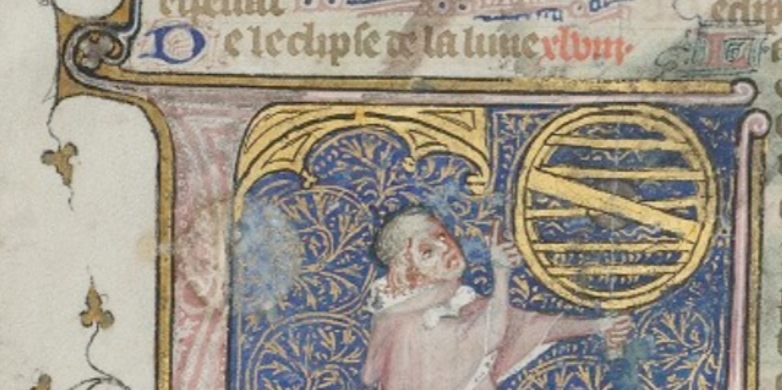
Report on the Spring School ‘Introduction to the “Science of the Stars” Through Manuscripts and Instruments‘
by Louise Tjoline Keitsch (University of Freiburg, Research Intern with Henrike Lähnemann Hilary and Trinity Term 2026)
From 16–20 March 2026, the Spring School Exploring the Medieval Sky: An Introduction to the “Science of the Stars” Through Manuscripts and Instruments brought together participants from a range of disciplines to explore the history of medieval astronomy and astrology through manuscripts, scientific instruments, and material culture. Organised by Laure Miolo (University of Oxford) and Alexandre Tur (Bibliothèque nationale de France), the programme combined lectures and papers, object-based teaching, and hands-on sessions across several Oxford institutions, including the Bodleian Libraries, the History of Science Museum and Merton College.
The week was structured around a progressive introduction to medieval conceptions of the cosmos. Morning sessions established the historical and theoretical foundations of medieval astronomy, tracing developments from the Early Middle Ages and the transmission of scientific knowledge to Ptolemaic cosmology, planetary theory, eclipses, conjunctions, and Renaissance astronomy. These lectures provided participants with the conceptual framework necessary to engage critically with medieval scientific texts and diagrams.
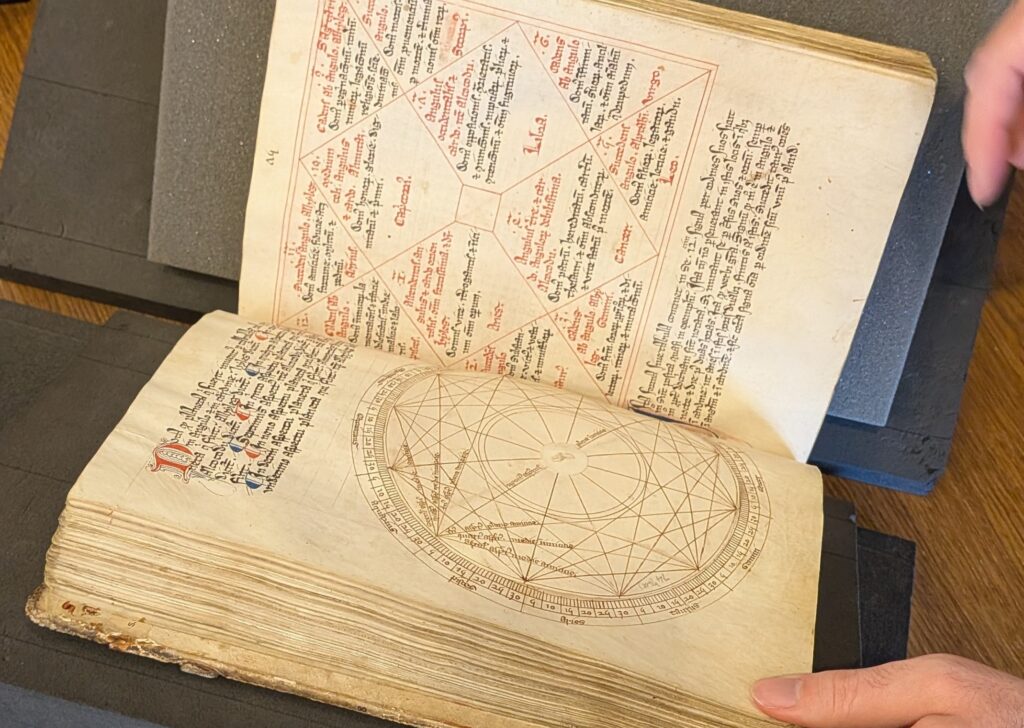
Afternoon sessions complemented this theoretical programme with direct engagement with manuscripts and instruments. Participants examined medieval scientific manuscripts from the Bodleian collections, visited the History of Science Museum and the libraries of Merton College, and took part in practical workshops devoted to astronomical tables, diagrams, and instruments. Additional specialist lectures addressed subjects including the zodiac man, nineteenth-century eclipse observation, astrology in early modern England, and the material transmission of scientific knowledge across different historical contexts.
Rather than using manuscripts and instruments merely as visual aids for scientific concepts, the programme invited participants to approach them as complex historical objects in their own right, in which material form, diagrammatic structure, marginal annotations, and patterns of handling all contribute to their meaning. Direct engagement with original artefacts made it clear how closely the physical examination of sources can reshape our understanding of both the production and transmission of scientific knowledge in the Middle Ages. Bringing together historians, manuscript scholars, librarians, museum professionals, students, and early-career researchers, the Spring School created a collaborative environment in which different disciplinary perspectives could intersect productively. Through its combination of lectures and hands-on work with primary materials, it underscored the importance of interdisciplinary approaches and object-based study for the history of medieval science.
Announcement of the Spring School
Weston Library, 16–20 March 2026
Registration is now open for Exploring the Medieval Sky, a spring school designed for undergraduate and graduate students who wish to explore how medieval people understood the sky —encompassing the visible heavens (stars, planets, eclipses, comets), the theoretical structures used to explain them(cosmology, celestial spheres, planetary models), and the cultural meanings attached to celestial phenomena in art, science, and daily life. Over five days, participants will discover the foundations of medieval astronomy and astrology through a combination of lectures, hands-on sessions with manuscripts and instruments, visits to the History of Science Museum and Merton College OldLibrary and presentations of current research.By the end of the course, participants will have acquired a clear chronological framework for the medieval history of the “science of the stars,” will gain practical experience using an armillary sphere and an astrolabe, and will learn to identify the codicological structure and cultural significance of scientific manuscripts through extensive engagement with materials from the Weston Library’s collections.
The spring school is open to all Oxford undergraduate and graduate students. It is designed as anintroductory course; no prior knowledge is required, only an interest in the history of astronomy, astrology,or manuscript studies.To ensure effective work with rare and fragile historical materials, places are limited. By registering,participants agree to attend the full programme. Registration is free.
Registration deadline: 2 February 2026. To register please email: laure.miolo@history.ox.ac.uk
Organisation: Laure Miolo (Faculty of History, Wadham College) and Alexandre Tur (Bibliothèque nationale de France, Paris).
With the kind participation of: the Centre for the Study of the Book (Bodleian Library), Sumner Brand (History of Science Museum), Matthew Holford (Bodleian Library), Stephen Johnston (History of Science Museum), Michelle Pfeffer (Magdalen College), Julia Walworth (Merton College), Sian Witherden (Exeter College).