On 11 April, the research team working on the Leverhulme-funded project ‘The Literary heritage of Anglo-Dutch relations, 1050-1600’ holds an informal workshop / reading group in the Weston Library at the Bodleian, 14:00-16:00.
The format are three papers by Laura Cleaver (School of Advanced Studies, University of London: ‘Illuminated Manuscripts and the Shaping of English and Flemish Identities’; Thea Summerfield, University of Utrecht, ‘Lodewijk van Velthem on Edward I’), and David Murray (University of Utrecht, ‘The Circulation of Lyrics between England and the Low Countries’).
If you are interested to join the workshop please contact Ad Putter, A.D.Putter@bristol.ac.uk
Date: Monday 11 April 2022 Time: 5.15–6.15pm Location: Lecture Theatre, Weston Library & online Speaker: Professor Kathleen Kennedy, British Academy Global Professor, University of Bristol The event is free but booking for in-person tickets is required. Click here to register for the event
The Masters of the Dark Eyes in England and the invention of the Tudor court artist
This lecture re-examines the corpus of the Masters of the Dark Eyes in England and argues that their work played a part in the developing role of the King’s Painter. In the Netherlands, the Masters of the Dark Eyes were premier decorators of luxurious books of hours. Their English patrons recast the Masters as courtly, Renaissance painters. Moreover, in England the Masters were sometimes primarily miniaturists, and other times valued instead for their border and initial art. Unrecognized before now, the Masters in England completed some commissions without any illustrations at all. Finally, the Masters of the Dark Eyes in England sometimes also partnered with English artists, a direct collaboration illuminating the topic at the heart of the North Sea Crossings: Anglo-Dutch Books and the Adventures of Reynard the Fox exhibition. In proving that Dutch artists could adapt to the wide-ranging artistic needs of the early Tudor court, the Masters of the Dark Eyes in England paved the way for more formal employment of the better-known Horenbout and Holbein.
The lecture will be followed by a drinks reception 6.15-7.15pm for those attending in-person. Attendees will be able to access the North Sea Crossingsexhibition throughout the public event.
The Oxford Centre for Byzantine Research, the Japan Society for the Promotion of Science and the Maison française d’Oxford invite you to attend the hybrid conference Hesychasm in Context: Theology and Society in the Fourteenth Century, Thursday 17th – Friday 18th March 2022. All of the papers will be livestreamed.
To register for the in-person event (including lunches), please email Dr Rei Hakamada (rei.hakamada@theology.ox.ac.uk) as soon as possible, as numbers are limited.
Thursday 17th March Lecture Room, Ioannou Centre for Classical and Byzantine Studies, 66 St. Giles’, Oxford, OX1 3LU
9.00: Welcome
9.15: Rei Hakamada (Okayama University / University of Oxford), Lay Hesychasts? Isidore and Palamas among Lay People
10.00: Mihail Mitrea (Babeș Bolyai University, Cluj-Napoca / Institute for South-East European Studies, Bucharest), Hesychasm and Hagiography in Fourteenth-Century Byzantium [online]
10.45: Coffee
11.15: Ralph Greis (St Joseph’s Benedictine Abbey, Gerleve), The Connection Between Liturgical Theology and Hesychastic Spirituality in the Homilies of St. Gregory Palamas
12.00: Christiaan Kappes (Ss Cyril and Methodius Byzantine Catholic Seminary), Gregory Palamas’s Theotokos in Light of Latin Contacts and his Reception of Latin Literature in Byzantium
12.45: Lunch
13.45: Marie-Hélène Blanchet (CNRS, UMR 8167 Orient et Méditerranée, Paris), John VI Cantacuzene, the Hesychast Crisis and the Latin World: An Ambiguous Strategy
14.30: Judith Ryder (University of Oxford), When To Speak and When To Hold Your Peace: The Conflict between Demetrios Kydones and Philotheos Kokkinos
15.15: Coffee
15.45: Monica White (University of Nottingham), Hesychasm in Rus?
16.30: Norman Russell (St Stephen’s House, Oxford), Engaging with Islam in Late Byzantium: Strategies of Resistance and Accommodation
17.15: Drinks – The Maison française d’Oxford is delighted to offer participants a glass of champagne
Friday 18th March Miles Room, St Peter’s College, New Inn Hall Street, Oxford, OX1 2DL
10.30: Eiji Hisamatsu (Ryukoku University), The Jesus Prayer and Yoga: The Early Literature of Hesychasm and the Svetasvatara Upanishad [online]
11.15: Vassa Kontouma (École Pratique des Hautes Études, PSL, Paris), The Re-enchanted Universe of Iakovos of Nea Skete (19th c.). A Hesychast Response to the Copernican Revolution?
12.15: Final remarks
12.30: Lunch
Image: St. Gregory Palamas, Monastery of Vatopedi, Mount Athos (Creative Commons CCO 1.0 Universal Public Domain Dedication)
On Wednesday 2nd March 2022, the Oxford Medieval Society will hold a panel on medieval plagues.
Professor Mark Bailey (University of East Anglia) will give a talk entitled What did the Black Death do for us? Some answers from England, 1350 to 1400, and Professor Samuel Cohn (University of Glasgow) will speak on Plagues of the Central Middle Ages: The dog that didn’t bark.
The panel will start at 5pm and be held in the North Lecture Room of St. John’s College.
All are very welcome to attend what promises to be a fascinating panel.
Image credit: “The Triumph of Death”, Galleria Regionale della Sicilia, Palermo, courtesy of Wikimedia Commons.
Report on Lucy Pick’s Lecture for OMS: A Guest Blog by Pilar Bertuzzi Rivett
Watch Lucy Pick’s OMS Lecture 2022 here:
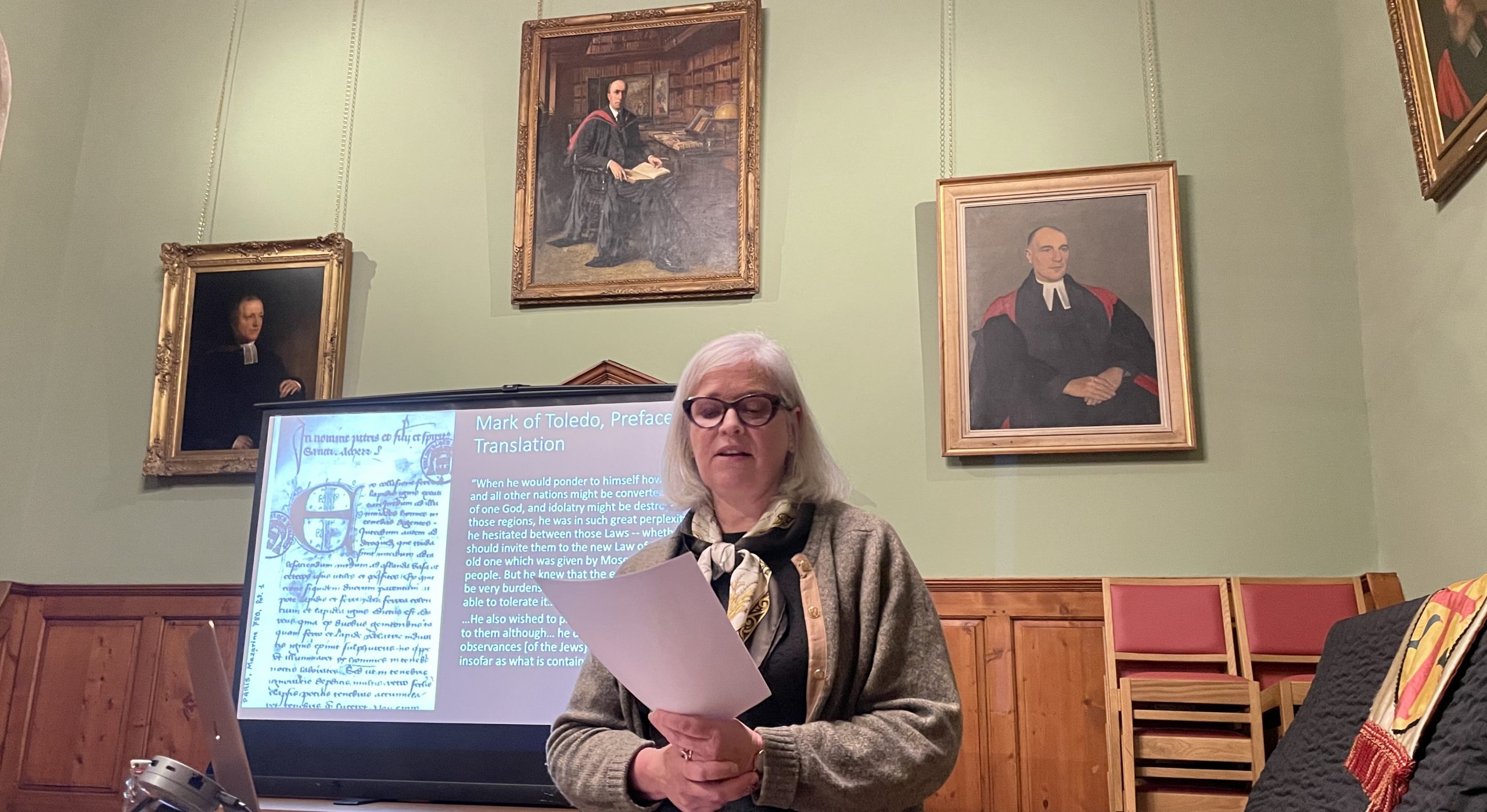
The Oxford Medieval Studies Lecture for Hilary Term 2022 was delivered on 8 February by Professor Lucy Pick, historian of medieval thought and culture, author of Her Father’s Daughter: Gender, Power, and Religion in Early the Spanish Kingdoms (Cornell 2017), Pilgrimage (Cuidono 2014) and Conflict and Coexistence: Archbishop Rodrigo and the Muslims and Jews of Thirteenth-Century Spain (University of Michigan 2004). Professor Pick is a visiting scholar at the Center for Hebrew and Jewish Studies in Oxford, researching the earliest Latin translation of Maimonides’ Guide to the Perplexed.
As a Hebraist and fellow historian of medieval thought, I looked forward to Professor Pick’s take on what Jewish-Christian relationships meant in the case of Maimonides’ Guide to the Perplexed. It is a treat to be able to read a Jewish Medieval author in Latin and since instances of actual intellectual cooperation (especially in the early Middle Ages, which is what I focus on) are very few and far between, I am always curious to learn about them. I was particularly interested in how Professor Pick discovered this cooperation and what method she was going to use in order to flesh it out.
I found that Professor Pick set the scene very aptly when she opened her presentation mentioning that the Guide to the Perplexed “landed in the Latin scholastic world of the thirteenth century like a stick of dynamite.” Maimonides’ synthesis of science, the Law, Greek physics and metaphysics through the lens of the Hebrew Bible was nothing short of “explosive”. He offered a method for assimilating and interpreting the new Aristotle that flooded the schools of the thirteenth century. Did he inspire part of that flood? Did the Guide open up new avenues of thought for Christian readers that could be used as tools in their polemics against the Jews? These were some of the questions that were addressed in her presentation.
In what to me was reminiscent of the Italian school of microhistory, Professor Pick set aside the Christian scholastics of the mid to late thirteenth century, (whose study “used up most of the scholarly oxygen dedicated to Maimonides Latinus”) to focus on a much earlier community of readers of the Guide, one composed of both Jewish and Christians in the city of Toledo. At the heart of her project is the Liber de Parabola (witnessed in only one manuscript, Paris Sorbonne MS 601), the earliest Latin translation of the Guide (Part III, chapters 29-49 in which Maimonides discusses the reasons for commandments). According to Professor Pick, the Liber has not received the attention it deserves, neither as a witness to the Guide nor for its additional content which bears witness to the earliest reception to the ideas of the Guide. She therefore traced these individuals’ contact with the Liber de Parabola to shed light on both positive and negative aspects of its reception by Christians.
The key characters in this “textual community” are Samuel ibn Tibbon, who translated Maimonides’ Guide from Judeo-Arabic into Hebrew; Michael Scot, court astrologer to Frederick II who began his career as a master in Toledo, translating scientific texts from Arabic into Latin and Rodrigo Jiménez de Rada, Archbishop of Toledo, in whose cathedral Michael and Samuel may have met and in whose writings we can trace the earliest evidence of Maimonides’ impact on the Latin world.
Samuel’s contribution to the Liber is easiest to identify: he used his Hebrew translation for the base texts; he drew on his interpretation of Maimonides’ ideas about philosophical and Biblical exegesis and illustrated it with examples from his commentary on Ecclesiastics. He is cited by name at least six times in connection with the readings of the Hebrew Bible and interpretation of Jewish law. Pick believes that these passages reflect oral communication between Samuel Ibn Tabbon and the translator.
Michael Scot’s identity is more difficult to establish and rests on substantial circumstantial evidence. Michael Scot knew the work of Maimonides as he cited him in his “De physionomiae”; he was in Rome at the same time as the Liber de Parabola was dedicated to Cardinal Romanus and first appeared on the historical record in 1215 in Rome, accompanying the entourage of the Archbishop of Toledo at the Fourth Lateran Council. Pick notes that Samuel consulted books by Aristoteles meteorology (some of which Scot translated into Latin) in Toledo at some point between 1204 and 1210, thus Michael and Samuel could plausibly have met and worked together.
Pick also described how Michael Scot became a close associate of Jacob Anatoli while at Frederick II’s court in Naples. Anatoli was Samuel’s son in law, whose philosophical sermons (Malmad ha-Talmidim) recounted conversations with Michael Scot and his knowledge of Maimonides’ work. In one of his sermons on Parshat Nitzavim, Anatoli showed awareness of the Liber de Parabola, inclusive of its structure and introduction and associates it with Michael Scot. Pick very ably showed parallels between Anatoli’s interpretation of Deuteronomy 4:6 with the opening of the Liber de Parabola which contrasts the interpretation of a commandment with the allegory of a parable.
By means of a venn diagram, Pick highlighted the interpenetration of ideas amongst the translators of key works in Toledo, Naples and Provence all of whom were engaged in a parallel set of translations and commentaries on Aristotle’s Meteorology inspired by Part II Chapter 30 of Maimonides’ Guide. Since Part II was not available in the Liber, this suggests a wider diffusion of the Guide in Toledo.
The presentation concluded by showing the “polemical” potential to Christian borrowing of Maimonides’ ideas. The Archbishop of Toledo reacted to Part II Chapter 30 in his Breviarium in which he used Maimonides’ ideas of “principle” and “spirit” to argue for the Christian Trinity. This is an example of how the section of the Guide in the Liber de Parabola was used by later Christians in support of a doctrine of “supersession” rather than fostering a more positive understanding of those who follow God’s commandments, as Jacob Anatoli would have hoped for.
This conclusion was what surprised me most about the presentation. I suppose I approached the topic with the eyes of someone accustomed to the interpenetration of ideas between Christians and Jews of Late Antiquity and the early Middle Ages when it comes to mysticism. However, Professor Pick’s paper showed that by the thirteenth century intellectual cooperation could be both a tool and a weapon. In her own words, “textual community did not mean safety and an exchange of texts could provide ammunition as well as understanding.” In the period of history I focus on, between the ninth and eleventh centuries, both Christian and Jewish polemical tools were still in their pre-scholastic phase; Peter Damian’s work only really impacted Jewish-Christian relations towards the end of my “horizon.” However, the fact that Dante Alighieri put Pater Damian in the highest circles of Paradise, whereas Michael Scot was relegated to the malebolgie of Hell should have alerted me to the fact that there was not going to be a “happy ending” to Professor Pick’s textual community.
Still, any kind of inter-faith intellectual cooperation in the Middle Ages is worth researching because it demystifies some of the myths that surround the history of Christian and Jewish communities. When genuine, as in the case of Pick’s “textual community” or in the case of the Victorines in Paris, cooperation challenges the narrative of Jews and Christians as distinct cultures in “conversation and conflict.” The key takeaway from this paper for my dissertation is that we are better served to approach the history of Jews and Christians in the Middle Ages from an organic model of culture rather than who influenced whom, to borrow from David Biale and Michael Satlow. I admire the way in which Pick focuses on people and their agency and how comfortable she was with admitting that sometimes, as in the case of Michael Scot’s identity, one has to rely on somewhat circumstantial evidence. As medievalists, we do not always find “the silver bullet”; we are dealing with people and sources that existed nearly two thousand years ago. Even the most refined sleuths sometimes build cases on indirect evidence. If we wanted simple, straightforward, direct evidence, we would be statisticians or, worse still, modern historians.
I found that the interdisciplinary, multi-lingual approach in Pick’s presentation fit very well with the remit of the OMS and with our own identity as medieval historians. In Professor Pick’s words, “life is best viewed through more than one window.”
Pick reminded the audience that.
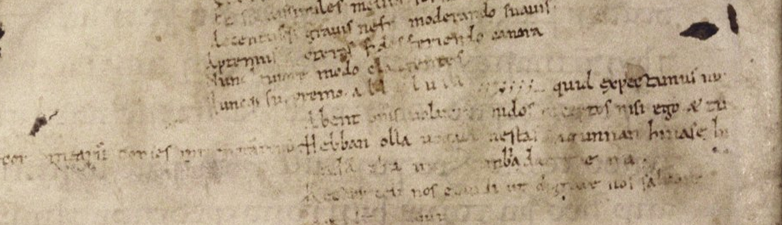
“It has been corrected from my own book. I am Moses son of Rabbi Maimon, the Righteous, of Blessed Memory” Egypt, 1170–80 Handwritten in ink on paper Bodleian Libraries, University of Oxford, MS. Huntington 80
The first meeting of the 2020-2021 Oxford Medieval Studies team, from left to right, top to bottom: Francis Leneghan (Co-Director), Mary Boyle (Mentor for the MSt Programme), Tom Revell (Events Coordinator), Sarah Bridge (Postgraduate Rep), Mark Williams (Director of the Medieval Studies Master Programme), Caroline Batten (Comms Officer and Mentor for the MSt Programme), Scott Moynihan (Postgraduate Rep), Llewelyn Hopwood (Social Media Coordinator), Alexandra Vukovich (Mentor for the MSt Programme), Henrike Lähnemann (Co-Director)
Oxford Medieval Studies has had another hugely productive year, despite – or even partly because of – the pandemic. Following the excellent advice of TORCH’s Nikki Carter, we decided to expand the team to cover different aspects of communication and online events management (see image and the report on the team). Under the stewardship of Caroline Batten as Comms Officer who developed the weekly email into a poetic artform, a whole wassail of postgraduate medievalists pulled the digital strings, commissioned and wrote blog posts, ran conferences, tweeted, recorded roundtables, and in between used every open air medieval venue around Oxford to meet covid-safe in person. A splendid example for this was the ‘Dark Archives 2.0’ conference which kicked off the academic year (read a report by Llewelyn and Tom about their experience in running the conference); Stephen Pink who organised this for Medium Aevum had already in 2019 conceived this as a digital-born conference (http://darkarchiv.es/) so that in September 2020 we were ahead of the learning curve of zoomified academic life. We even dared – and pulled off – a medieval Compline, sung in Latin from five locations around Oxford, including the Norman Crypt of St-Peter-in-the-East, the library church of St Edmund Hall.
The Hilary Term Interdisciplinary Lecture, live streamed via the OMS Youtube channel, was delivered by Prof. William Chester Jordan, as was the reflection by Jim Harris from the Ashmolean on the importance of objects for teaching medieval studies. Together, the videos of the OMS channel attracted several thousand views since its start a year ago. The medieval studies booklets have been downloaded over 1500 times, the weekly newsletter has over 700 subscribers and the twitter feed @OxMedStud is reaching nearly 5,000 followers.
With the new academic year, we are starting to bring back in-person events while continuing with online events for outreach purposes. What definitely will be a live all-sensory event is the second edition of the Medieval Mystery Cycle which is planned for 23 April 2021 and will bring together a dozen different groups of medievalists, performing multi-lingually in various locations around St Edmund Hall. Like 2019, it will be directed by Henrike Lähnemann and Lesley Smith who has also now taken on the role as Co-Director. Also new in the team is Luisa Ostacchini who has taken over the Communications Officer role from Caroline Batten and is making the weekly emails even more colourful with newly captioned snippets from Oxford manuscripts.
Henrike Lähnemann (Modern Languages)
Lesley Smith (History)
A selection of blog posts from the start of the academic year 2020-21: Medieval advice on social distancing, a how-to guide to applying for a PhD and much more
Hyggnaþing (‘Meeting of Minds’): A Graduate Conference in Old Norse Studies took place on the 11th of August 2021. A brand-new conference co-organised by Natasha Bradley, a DPhil student at Lincoln College, Oxford, and Ben Chennells, a PhD student at University College London, Hyggnaþing attracted speakers and attendees from across the globe for a one-day online conference exploring all things Old Norse.
Hyggnaþing was created in response to the isolation that has impacted everyone over this past year and a half. With constant lockdowns, library closures, and restrictions on events, postgraduate study has become even more challenging and isolating, with fewer opportunities for students to engage with the academic community. Hyggnaþing was created with connection in mind, providing a virtual space to build networks and share research in a welcoming environment. For this, Hyggnaþing made use of both Zoom and Wonder, a platform which simulates the experience of an in-person meeting and allows for online ‘mingling’.
After some opening remarks from the organisers, the conference began with a panel on the significance of space in saga literature, chaired by Oxford’s own Olivia Elliott Smith. The first paper was by Grace O’Duffy (University of Cambridge), whose paper explored the development of Hǫttr from Hrólf saga kraka, as he progresses from the bone-pile to a masculine ‘ideal’. Then Mary O’Connor (University of Oxford) spoke about courtly space in two Old Norse riddarasǫgur: Ívens saga and Erex saga.
After a quick screen break, the second session of the day, chaired by Sigrun Borgen Wik (Trinity College Dublin), began with a paper from Basil Arnould Price (University of York). Basil’s paper explored the idea of failure as resistance in Grettis saga and Gests þáttr using queer theory. This was followed by a paper from Caroline Bourne (University of Reading), which reassessed the relationship between Scandinavians and the Gower peninsula in South Wales from the tenth century. The panel was concluded with a paper by Giorgia Sottotetti (Háskóli Íslands), who examined small figurines or ‘pocket-idols’ from Iron Age Scandinavia and analysed how they reflect the religious, social, and political changes within the period.
After lunch, Hyggnaþing resumed with a panel on translation, chaired by the co-organiser Natasha Bradley. The first paper, by Katrín Lísa L. Mikaelsdóttir (Háskóli Íslands), analysed the presence of Norwegianisms in medieval Icelandic manuscripts and how their use changes over time. The second paper of the panel was by Davide Salmoiraghi (University of Cambridge). Davide looked at the reception of the Church Fathers in medieval Iceland, examining the spread of the saints’ cult and its influence on the Norse hagiographies. Luthien Cangemi (University College London) concluded the translation panel with her paper on the transition from the concept of Medicina to Physica in Old Norse sources.
Then followed the mid-afternoon virtual coffee break on Wonder. This allowed attendees to mingle together to get to know each other, moving between groups of people to talk. Some attendees continued their discussions about the conference in a more informal setting, and others struck up new discussions about postgraduate life and their own research.
The final panel of the day was chaired by the conference co-organiser Ben Chennells. It explored the receptions and re-castings of Old Norse literature. The first paper, by Grace Khuri (University of Oxford), examined the Victorian novel Eric Brighteyes by H. Rider Haggard and its use of Old Norse saga sources. Richard Munro of the University of the Highlands and Islands then presented about how to perform an eddic poem.
The keynote lecture, delivered by Dr Sarah Baccianti, a British Academy Newton International Fellow at Queen’s University Belfast, discussed the Old Norse medical charms and healing practices. Exploring material culture and saga literature, Baccianti’s interdisciplinary paper called for a re-evaluation of the distinction between our modern concepts of magic and medicine. The keynote was followed, as with all the panels, by an engaging discussion. An evening social hosted on Wonder concluded the conference.
Hyggnaþing hosted ten speakers, four chairs, and a keynote lecturer, all of whom joined the conference from nine different institutions across the UK and beyond. Seventy-five guests registered to attend, with audience members joining from locations across the globe, from the United States to Australia, to ask questions and make comments that sparked engaging academic discussion. New connections were forged on Wonder and Zoom alike, and the organisers hope that these will be long-lived.
Hyggnaþing is incredibly grateful to Oxford Medieval Studies (OMS), sponsored by The Oxford Research Centre in the Humanities (TORCH) for the funding to cover the costs of the conference. This allowed the registration for the conference to be completely free of charge, creating an accessible and welcoming conference for attendees and helping to foster the thriving academic community, and ‘meeting of minds’, that came together for Hyggnaþing. For more information about the conference, see the Hyggnaþing website: https://hyggnathing.wordpress.com/
The first workshop and initial meeting of the Medieval Commentary Network will take place at Christ Church, Oxford, on 9 October 2021, from 9am – 5pm. A buffet lunch will be provided. The workshop is free of charge for all participants. This will take place as an in-person workshop (unless government regulations change). Unfortunately we are unable to live-stream the event, but we are hoping to make recordings of some talks available online after the event (subject to speaker approval).
Speakers include Alastair Minnis, Andrew Kraebel, Edit Lukacs, Audrey Southgate, Elizabeth Doherty, Malena Ratzke, Zachary Guiliano, Bond West, Rachel Cresswell, and others. The full conference programme will be available at https://medievalcommentary.network/ by the end of July.
We recognise that the current situation brings with it a great deal of uncertainty regarding travel; if you find you are no longer able to attend, please let us know as soon as possible.
Please email medievalcommentarynetwork@gmail.com with any questions and for further information.
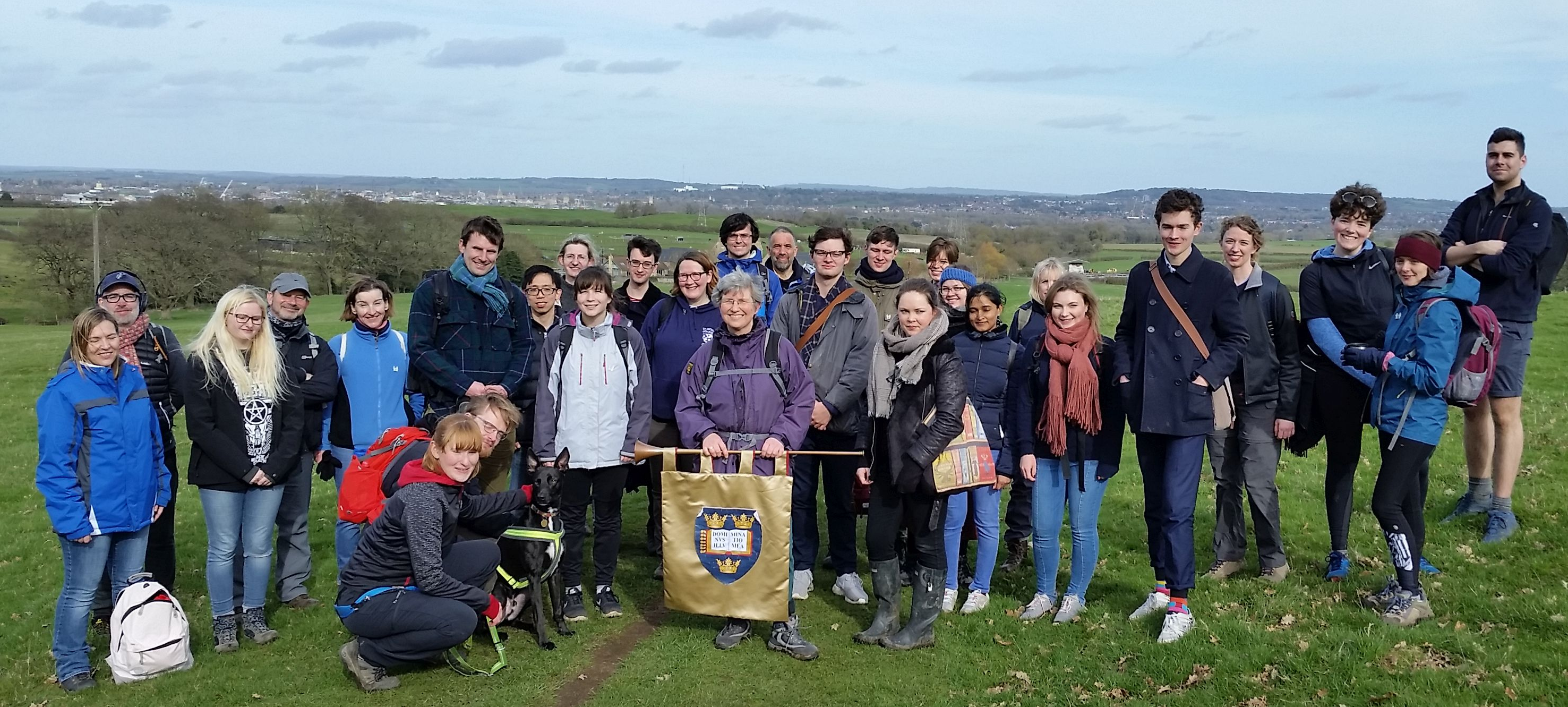
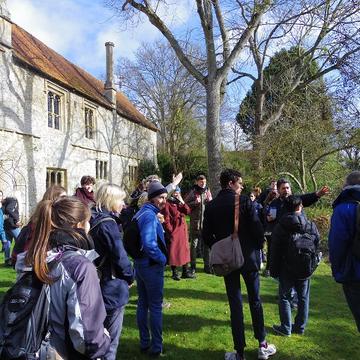
On Saturday the 9th of March, thirty-one pilgrims (and one canine pilgrim companion) met at St Helen’s Church in Abingdon, ready to walk the twelve miles to Christ Church Cathedral in Oxford. Much like the Canterbury Tales, our party was diverse; there were students from across the UK and across disciplines and stages, porters, academics from far and wide and members of the public (one of which who had run a half marathon the very same morning). As a BYOB (Bring Your Own Beliefs) pilgrimage, there were also a range of reasons for pilgrimaging present among our group. This was the start of the Oxford Medieval Studies Pilgrimage Day 2019, a day that would engage with the practice, literature, history and revitalisation of medieval pilgrimage.
At St Helen’s we handed out pilgrim badge replicas, kindly funded by the Oxford Pilgrimage Studies Network, to each of our pilgrims. Beautifully recreated in pewter by Lionheart Replicas, the original badge dated from the fifteenth century and depicted two pilgrims, one male and one female, ready to set out on their walk. After some quick ground rules, some advice for how to make the most of a pilgrimage and a rousing reading of the opening lines to the General Prologue of Chaucer’s Canterbury Tales from Rebecca, we set off on our journey.
Although the preceding week had been plagued with rain and wind, the day was miraculously sunny with only the occasional gusty spell, the perfect walking weather. Our next stopping point was only five minutes away: the Abingdon Abbey buildings. The curator of the buildings, Tim Miller, led us around the surviving buildings of the Benedictine Abbey, including Unicorn Theatre, the Long Gallery and the Chequer. Tim was an excellent guide for us, bringing the stories of the abbey and its uses to life and showing us the most impressive parts of the building, such as the beautifully painted remains of a Tudor room partition decorated with roses and pomegranates.
After leaving Tim, we then had a long walk ahead of us. We walked through the grounds of Radley College and across the countryside until we reached the picture-perfect village of Sunningwell and its church, St Leonard’s, at just past midday. This was our lunch stop, many of the pilgrims pausing to eat their packed lunch in the sunny grounds of the church or enjoying some hot chips and a pint at the local pub. This church is now mostly fifteenth century, but the village and its association with Abingdon abbey traces back far further. It also features a stunning seven-sided porch at its entrance, the victorian stained glass of which was designed by J.P. Seddon.
We then moved off again, quickly looking at the well after which the village took its name. The landscape was a little steeper as we climbed Boar’s Hill, but the view on the descent of Oxford’s ‘dreaming spires’ was worth it, and we then arrived at St Lawrence’s Church in South Hinksey. Father Ben Drury kindly gave us an history of the church and pointed out the distinctive minstrel’s gallery and the little private window for viewing mass.
We then set off on the last part of our walk, trekking over the train lines and the river, then through the outskirts of the city to Christ Church Cathedral – our pilgrims had made it home! We rounded off the walk with Rebecca reading from the Book of Margery Kempe, a moving passage describing how she reaches the English shore after a stormy passage, before our pilgrims dispersed for a well-earned rest.
The last order of the day was a talk from Dr Guy Hayward, co-founder of the British Pilgrimage Trust, at St John’s College. Guy talked about his experience of pilgrimage, its history and how he is working to revive the practice in the UK – the perfect reflective end to the day with the lasting message that we should all work to bring pilgrimage back. If you would like to walk a pilgrimage to Oxford, we encourage you to check out the BPT website http://britishpilgrimage.org/portfolio/five-ways-to-oxford/ and let us know how you get on!
Some feedback from our pilgrims:
‘Talking with people about their different life experiences was enlightening’
‘I think it was great. The highlight for me was doing a journey together with people from different walks of life.’
‘Well co-ordinated, well supported, very friendly. Had a lovely day. One to remember.’
‘Really enjoyed it, would love to do more’
We would like to say thank you to the OMS Small Grant at TORCH for their support, and that of the Oxford Studies Pilgrimage Network. We would also like to say a special thank you to Guy Hayward, Tim Miller, Fr Ben Drury and Robert Culshaw for helping the smooth running of the day, and, of course, our brilliant pilgrims.
Visiting the Ashmolean Museum is one of the many great privileges that the University of Oxford has to offer. One can travel to a myriad of different times and places within its walls, and speaking personally, I am always eager for the encounter with the medieval past made possible through its collections. Recently, Jim Harris, the Andrew W Mellon Foundation Teaching Curator at the Ashmolean, gave the Oxford Medieval Studies Lecture for Trinity Term on precisely this topic. His talk, entitled Museum in the Middle: Medieval Things in a (Still) Medieval University, provided much food for thought about the wonder, loss, and strangeness in both the medieval and the museum.
Wonder
Much of Jim’s teaching is rooted in the medieval collections, which has allowed him to engage both with the material culture of the Middle Ages and with those who study it – us medievalists. In Jim’s words, the “thread connecting medievalists to the past of their study is wonder,” and it is wonder that can be channeled through teaching with objects. As medievalists, this sense of wonder, the idea that knowledge can be derived from studying things we do not know about and do not yet understand, has driven us to acquire the skills to access that knowledge. We have learned new languages, both medieval and modern, how to decipher different scripts and to what location and periods these scripts belong, and how manuscripts were produced, among many other things, to bring us closer to the past that inspires so much wonder in us. Undertaking this learning allows us to further our connection to this past, as medieval people also had to learn new languages, ways of writing, methods of production, and many other skills to create the texts, documents, and objects that are now the subject of our study. Jim stressed that such wonder-motivated learning is not a product of the Early Modern Period or the Enlightenment, but rather is human, and was certainly present during the Middle Ages.
Jim described how teaching with objects can put this sense of wonder back into the curriculum. When we look at objects in ways that make them speak to us, using the skills that our sense of wonder has motivated us to learn, we become connected to a tradition, a history of looking, and the past that we look at is in turn bound to us through this act. Jim made clear that teaching with objects is not about being an art historian or portraying the rare and exceptional as exemplary, but rather about the wonder contained within the everyday and the mundane. Like the sense of wonder that drove us to learn how to communicate with the Middle Ages, wondering at its everyday objects once again brings us closer to the people who made them and to the period in which they lived.
The wonder that object-centred teaching can bring to the study of the Middle Ages speaks to what literary historian Stephen Greenblatt calls the resonance and wonder of museum objects. Greenblatt characterises resonance as the power of an object “to reach out beyond its formal boundaries to a larger world, to evoke in the viewer the complex, dynamic cultural forces from which it has emerged and for which it may be taken by a viewer to stand,” while wonder is an object’s power “to stop viewers in their tracks, to convey an arresting sense of uniqueness, to evoke an exalted attention.” While everyday objects, like the holy water ampulla associable with the Beckett pilgrimage and the pilgrim badge of John Schorne that Jim featured in his lecture, may not cause the viewer to stop in their tracks on display, in Jim’s words these objects become “capable of answering questions beyond what can be shared in a museum label” when they are taken off display and brought into the teaching room.
This can be seen clearly in Jim’s example of a small Limoges pyx, dated to c. 1200, that shows signs of its wear and use. While its well-preserved counterpart can be found on display in the museum, and it has been selected for display because of its condition and beauty, the pyx that Jim uses for teaching, with its worn exterior and signs of copper corrosion, has the potential to reveal more about the lives of medieval people than the one on display. This is because we can interrogate this object in ways that we cannot apply to the example on display: we can look inside this pyx, we can touch it, we can see it up close and from different angles and in different lights; we can ask questions about its manufacture, iconography, and use in devotional practice. While the ways of looking that we can use to interrogate the pyx on display are restricted by its exhibition, the pyx that Jim teaches with, though off display, becomes accessible to us from seemingly endless perspectives.
That this object can be interrogated not only by medievalists and other students of the humanities, but also students of medicine, neuroscience, and psychiatry, makes this what Jim calls an “agile” object with the “capacity to submit to interrogation from any number of disciplines.” In their agility, objects like the pyx cultivate resonance: they reach out to us from the past and can tell us how they were made, how they were used, and what they meant within the world that produced them. The resonance of these agile, everyday objects can stop us in our tracks and inspire our sense of wonder, as their agility allows us to discover their uniqueness and can further connect us to the past that they represent.
Loss
Loss is something that medievalists are often faced with. Whether it be the loss of texts through the deterioration or destruction of manuscripts, the loss of traditions and customs that have faded from memory, or loss due to the simple absence of information, the impact of loss is felt greatly within Medieval Studies. Loss is likewise ever-present in the museum, and Jim spoke of objects of loss: those that have been broken, discarded, or intentionally destroyed, or those that we no longer understand or recognize.
If we look at objects of loss with a sense of wonder, however, their loss can reveal much about the world from which they came. Jim demonstrated this with a small, broken corpus that had been removed from a crucifix, its arms deliberately broken and its feet bent. Jim explained that the stubs of its broken arms had been worn smooth not through cutting or filing but by touch, and when we look at this corpus this way, it reveals itself as a personal devotional object. This broken corpus, and other objects like it, had afterlives beyond their intended uses, and they take on yet another afterlife as museum objects.
When we, as medievalists, study the texts, documents, and objects that bring us closer to the past, these things too take on afterlives as the subjects of our study. Just as the producer of the crucifix to which the broken corpus originally belonged likely did not imagine that their creation would be transformed in this way, the medieval producers of the texts and documents that we study probably did not envision that they would be scrutinized by scholars in countless ways centuries later. We can interrogate these texts and documents from a variety of different perspectives: literary, historical, cultural, social, feminist, queer, ecocritical – the potential is almost endless. In studying the products of the past, we contribute to shaping the afterlife of the Middle Ages.
It is in our scrutiny and interrogation of the past that we will encounter loss, and we require certain ways of looking at what we study in order to see through the gaps. The ways we look at texts and documents are not unlike those that Jim uses to teach with objects like the pyx, as they allow us to extract information, to make new connections, and to expand our knowledge. As sociologist and museologist Tony Bennett says, these ways of looking allow objects “to be not just seen but seen through to establish some communion with the invisible to which they beckon.” Approaching both texts and objects, at times in tandem, from different perspectives allows us to see through to the past, and sometimes loss provides us with another view to the Middle Ages.
Strangeness
The Ashmolean was founded in 1683 by the polymath Elias Ashmole, and as such it is not technically a “medieval” museum. It exists, however, within a medieval university, and Oxford’s “medievalness” helps to remind us that the medieval did not simply stop on New Year’s Day of 1500. One need only to look at Oxford’s buildings and participate in its traditions to see that the medieval is still all around us. Medieval traditions and structures thus continued to shape society and culture long after what is now considered the “end” of the Middle Ages, and as Jim illustrated, this is certainly true of the Ashmolean and its collection.
Elias Ashmole acquired his collection from John Tradescant the Elder and his son, who were interested in gathering together rare and wonderous things from near and far in order to gain knowledge from them. The world in which the Tradescants and their associates were interested, Jim explained, was the world of medieval travel tales, and the medieval therefore had a large role to play in the formation of these early collections. The “medievalness” of the creation of knowledge from the gathering together of strangeness, and the documentation of this collecting, can be seen not only in Jim’s examples of the inventories of the Valois kings, who produced huge and highly detailed catalogues of their collections, but also in cathedral inventories that document the relics, offerings, and even sometimes natural curiosities that they possessed. As vast works of looking carefully and recording what is seen, Jim likened these prolific medieval inventories to the Ashmolean’s own digital archive, which currently makes over 200000 object records accessible online.
As the museum is often viewed as a strictly modern phenomenon, the Middle Ages are generally excluded from discussions of its development and practices. What Jim’s fantastic lecture drove home was that the wonder, loss, and strangeness found in both the medieval and the museum forge a connection between them: the museum can be medieval, and the medieval can be museal. Jim’s example of the Nuremberg Chronicle perfectly illustrates this connection in that it brings together the ancient and the current, the factual and the mythical, in a way that mirrors the museum’s ability to bring together different times and places in a single location. The Nuremberg Chronicle, as a product of the Middle Ages, and the museum are both what Michel Foucault would call “heterotopic,” in that they are capable of juxtaposing, “several sites that appear incompatible within a single space.” As Jim said, “the medieval mind is encompassing, and in itself a museum.”
Jim’s OMS Lecture is a must-see for medievalists and museologists alike. Though the Middle Ages may seem like another world, Jim underscored that the “middle age” between the past and the future is, in fact, now. There is perhaps nothing quite like a global pandemic to highlight just how much is shared between the medieval and the present. As we emerge from the third lockdown and museums reopen, this summer will hopefully allow us to visit the Ashmolean to encounter the wonder, loss, and strangeness of the medieval held therein.
Watch it here:
Bibliography
Greenblatt, Stephen. “Resonance and Wonder.” In Exhibiting Cultures, edited by Ivan Karp and Steven D. Levine, 42–56. Washington and London: Smithsonian Institution Press, 1991.
Bennett, Tony. The Birth of the Museum: History, Theory, Politics. Abingdon: Routledge, 1995.
Foucault, Michel. “Different Spaces.” In Aesthetics, Method and Epistemology: Volume Two, edited by James D. Faubion, translated by Robert Hurley, 178–185. New York: The New Press, 1998.
About the author
Olivia Elliott Smith is a DPhil Candidate at Linacre College and a Social Sciences and Humanities Research Council of Canada Doctoral Fellow. Her research focusses on developing museological and heritage studies approaches to Old Norse literature. She has a background in museology and has worked for the Royal Ontario Museum and the Art Gallery of Ontario.