Professor of Medieval German Literature and Linguistics at the Faculty of Medieval and Modern Languages, Fellow at St Edmund Hall, and Co-Director of Oxford Medieval Studies.
All seminars will take place in the Weston Library, Horton Room, 2.15 – 3.45 on Monday afternoons in 2nd, 4th, 6th, and 8th week. All are welcome; a University or Bodleian reader card is usually required to access the seminar room. Manuscripts will be shown. For further information contact ma*************@************ac.ukor an************@************ac.uk
Hilary Term 2026
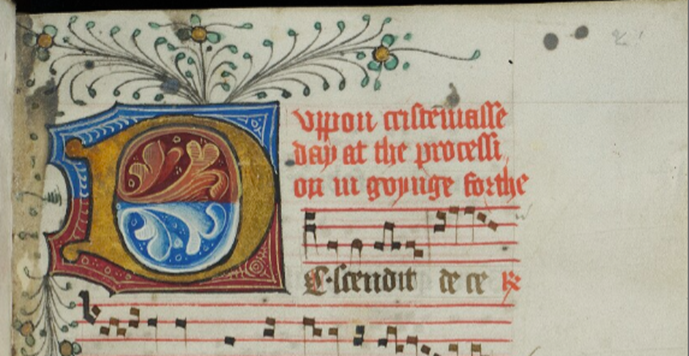
Header image: St John’s College MS 167 from Syon Abbey
26th January: ‘Manuscripts in the hands of Franciscus Junius (1591-1677)’, Kees Dekker (Groningen)
9th February: ‘The Bodleian’s Gaignières Collection: A paper museum for Gothic tombs’, Emily Guerry (Oxford)
23rd February: ‘The Bruce Codex (MS. Bruce 96): Answering the Riddles of Coptic Gnostic Manuscript’, Eric Crégheur (Université Laval)
9th March: ‘Pen-Flourishing and the Boundaries of Meaning’, Seamus Dwyer (Cambridge)
Hilary Term 2023
16 Jan. (week 1): Laure Miolo (University of Oxford), “Astronomy and astrology in fourteenth-century Oxford: MS. Digby 176 in context”
30 Jan. (week 3): Laura Saetveit Miles (University of Bergen), “The Influence of St. Birgitta of Sweden’s Revelationes in Late-Medieval England”
13 Feb (week 5): Sonja Drimmer (University of Massachusetts Amherst): “The ‘Genealogy Industry’: Codicological Diversity in England, c.1400–c.1500.”
27 Feb. (week 7): Laura Light (Les Enluminures), “Latin Bibles in England c. 1200-c. 1230”
Astronomy and astrology in fourteenth-century Oxford: MS. Digby 176 in context
The manuscript Oxford, Bodleian, Digby 176 is a key witness for better understanding the astronomical and astrological practices and innovations of a group of practitioners trained in Oxford around mid-fourteenthcentury. This group of scholars sharing a same background and interest in the ‘science of the stars’ (scientia stellarum) was closely linked to Merton College. Modern historiography mainly tended to focus on the so-called calculatores, eclipsing the scientific activities of this circle of astronomers and astrologers. In this group, Simon Bredon (d. 1372) or William Reed (d. 1385) played the role of patrons, providing subsidies, books and doubtless a scientific expertise. The codex Oxford, Bodleian, Digby 176 is representative of these activities and intellectual exchanges. It also allows to better understand the earliest phase of reception of Alfonsine astronomy in England and the role played by William Reed in this circle. This composite volume assembled by William Reed displays highly sophisticated and cutting-edge scientific innovations fostered by a rapid flow of information and technical data within this ‘community of learning’. Finally, Oxford, Bodleian Library, MS. Digby 176 also raises the problem of the complementary practices between astronomy and astrology, and the growing specialisation of scholars in one or the other of these disciplines.
The University of St Andrews in Scotland is currently advertising a PhD scholarship (with 3.5 years’ full funding) for the following project “How to write a global success before print: The paradigmatic case of the Seven Sages of Rome/Sindbad narrative.” Deadline for applications is Sunday 15 February 2026. More information can be found on the St Andrews website
Previous advertisment for a doctoral position in 2024: The research project “The Seven Sages of Rome Revisited: Striving for an Alternative Literary History” invites applications for one doctoral research associate: FU Berlin advertisement of the position
The project is funded by the Einstein Foundation Berlin as part of the Berlin University Alliance/Oxford University Einstein Visiting Fellowship scheme. The selected postholder will work closely with the PIs of the project, Professor Dr Jutta Eming, Freie Universität Berlin and Dr Ida Tóth, University of Oxford (Einstein BUA/Oxford Visiting Fellow 2024-27). The position is funded by the Einstein Foundation Berlin as part of the Berlin University Alliance/Oxford University Einstein Visiting Fellowships scheme. The Doctoral Research Associate will participate in the project “The Seven Sages of Rome Revisited: Striving for an Alternative Literary History”. The selected postholder will be jointly supervised by the PIs of the project, Professor Dr Jutta Eming, Freie Universität Berlin and Dr Ida Toth, University of Oxford (Einstein BUA/Oxford Visiting Fellow 2024-27). The research project “The Seven Sages of Rome Revisited: Striving for an Alternative Literary History” focuses on one of the most popular and least studied works of pre-modern world literature. Transmitted in over thirty languages and attested through hundreds of manuscripts and early printed editions, this tradition provides ample scope for exploring the extant material from textual, intercultural, and intersectional literary perspectives. The Einstein BUA/Oxford research project proposes to undertake an interdisciplinary, collaborative and comparative philological, literary, and cultural analysis in Byzantine/Medieval Latin and Medieval German and Early Modern Studies. Its goal is to reassess and redefine the traditional approach to the SSR and to medieval literature in general.
Job description: The Doctoral Research Associate will study one specific set of motifs – Wisdom, Power, and Gender – that is common to all surviving traditions of the Seven Sages in the German and/or Greek textual tradition. The main duty will be to conduct research on a doctoral project designed along these research lines. The postholder will work under the direction of Professor Dr Jutta Eming and Dr Ida Toth as well as collaborating with the other members of the research group. The postholder will assist in planning and organisation of scholarly events (lectures, seminars, workshops, outreach programmes), in publication projects, and will play a key role in securing the online visibility and digital presence of the project. This is an exciting opportunity for a highly motivated doctoral candidate with strong interests in wisdom literature, intersectionality, and concepts of power. The successful candidate will join a team of textual and literary scholars, who play an active role in the current efforts to reassess traditional literary canons and to create an alternative, and much more nuanced, understanding of pre-modern global literary history.
Requirements: • A Master’s degree qualification (MA, MSt, MPhil or the equivalent) in a subject/field relevant to the Project (German Studies, Byzantine Studies/Medieval Latin)
Desirable: • Above-average Masters’ degree grade • Doctoral project on the Seven Sages of Rome • Excellent command of the spoken and written English language • Demonstrable interest in the project’s focus area (Wisdom – Power – Gender) • Ability to work independently • Commitment to team-building and teamwork • Willingness to engage in interdisciplinary exchange
Application materials: • An application letter/statement of purpose (one page) • An outline of the planned dissertation project (two pages) • A curriculum vitae with list of publications (if applicable) • Official transcripts of all previous degrees and university diplomas • A copy of master’s thesis or a sample of written work (max. 25 pages)
How to apply: Your application materials should state the identifier Predoc_JE_BUA_SSoR_2_24. They should be combined in a single PDF document and sent electronically to Ms Sylwia Bräuer (s.*******@*******in.de). Two letters of recommendation from university-level teachers should be submitted separately. They should be addressed and emailed to the project PIs Jutta Eming (j.*****@*******in.de ) and Ida Toth (id******@***********ac.uk).
Report on the Oxford-Berlin Workshop ‘The Seven Sages of Rome as a Global Narrative Tradition’
11-12 November 2022, organised by Ida Toth (Oxford) and Jutta Eming (Berlin)
The Seven Sages of Rome (SSR) is a title commonly used for one of the most widely distributed pre-modern collections of stories, which – remarkably – also happens to be barely known today, even among medievalists and early modernists. Several early versions of the SSR exist in Greek (Syntipas), Arabic (Seven Viziers), Hebrew (Mishle Sendebar), Latin (Dolopathos, Historia septem sapientum), Persian (Sindbād-nameh) and Syriac (Sindbād) as well as in the later translations into Armenian, Bulgarian, Czech, Danish, Dutch, German, English, French, Hungarian, Icelandic, Polish, Russian, Scottish, Serbian, Swedish, Spanish, Romanian, Turkish and Yiddish. The multilingual traditions of the SSR, with their many intercultural links, cannot be adequately understood within the current division of research disciplines into distinct medieval and modern linguistic areas. To mend this deficiency, the workshop has invited specialists in affiliated fields to address the problems of surveying the long history of creative adaptations associated with the SSR. The participants will consider the complexities of the philological, literary, and historical analysis of the SSR in many of its attested versions across the pre-modern and early modern periods. The workshop is envisaged as a forum for a robust discussion on possible ways of advancing the current scholarship of the SSR, and as an opportunity to strengthen the inter-institutional collaboration involving specialists based at the universities in Oxford and Berlin, and more broadly.
The workshop will start with a session in the Weston Library on Friday morning where the group will meet other Oxford medievalists at the Coffee Morning, followed by a view of special collections in the library. While this is for speakers only, their is limited capacity to attend the following talks at the Ioannou Centre. If interested, please contact the workshop co-ordinator Josh Hitt.
4 pm – 5 pm: Daniel Sawyer, Forgotten books: The application of Unseen Species Models to the Survival of Culture (In person, Outreach Room)
SATURDAY, 12 NOVEMBER 2022, THE IOANNOU CENTRE
10 am – 11.30 am
Jutta Eming, The Seven Sages of Rome in Literary History and Genre Theory
David Taylor, Re-examining the Evidence of the Syriac Book of Sindbād
Ida Toth, The Byzantine Book of Syntipas: Approaches and Directions
Emilie van Opstall, The Representation of Women in Byzantine Syntipas and Latin Dolopathos
12 pm – 1.30 pm
Bettina Bildhauer, Consent in the German Version of the Seven Sages of Rome
Rita Schlusemann, Genre, Dissemination and Multimodality of the Septem sapientum Romae, especially in Dutch and German
Niko Kunkel, Statistics and Interpretation: Annotating the German Sieben Weise Meister
Ruth von Bernuth, Yiddish Seven Masters
4.30 pm: Tea and a guided tour of St Edmund Hall with Henrike Lähnemann
5.45 pm: Evensong at New College
Appendix: List of manuscripts and early printed books in the Bodleian Library:
Arabic: Pococke 400
Greek: Barocc. 131 and Laud. 8
Armenian: MS. Arm. e. 33 and MS. Canonici Or. 131
Hebrew (Mishle Sendebar/Fables of Sendebar): MS. Heb. d. 11 (ff. 289-294) and MS. Bodl. Or. 135 (ff. 292-300r)
Yiddish: Opp. 8. 1115 Mayse fun Ludvig un Aleksander and Opp. 8. 1070 Zibn vayzn mansters fun Rom
Welsh Jesus College MS 111
Middle English: B. Balliol College MS. 354
English, early printed book: The History of the Seven Wise Masters of Rome. Now newly Corrected better Explained in many places and enlarged with many pretty Pictures etc. London, Printed for John Wright, next to the Globe in Little-Brittain, 1671
Report on an In-Depth Crash-Course on the History of ‘the Book’ with Péter Tóth by Alice Lanyue Zhang (MSt. Modern Languages, 2025)
This session of the History of the Book seminar at the Weston Library, led by Péter Tóth, focused on understanding the development of the Bible in its layout, languages, and content from the very early scrolls to the numerous modern printed editions. Each of the students was asked to bring along an edition of the Bible to compare and contrast what elements might have been retained throughout the traditions and what might have changed in modern printing and editorial practices. This 3-hour-long session was divided into 3 lecture sections looking at different major stages of the Bible in its transmission and production, and each section was followed by a short manuscript viewing session looking closely at Bible copies from different locations and historical periods.
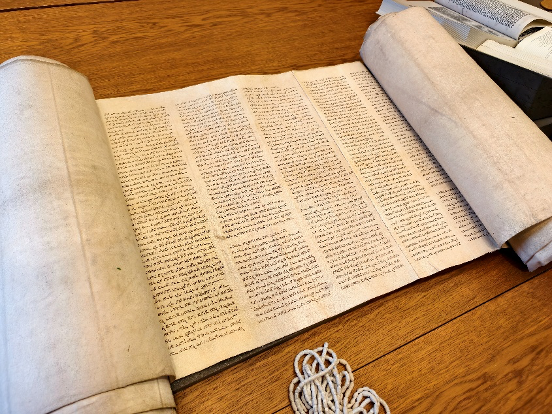
Fig. 1: 16th cent. Torah scroll from China
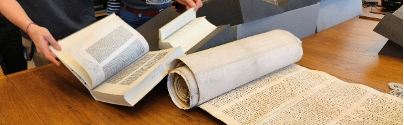
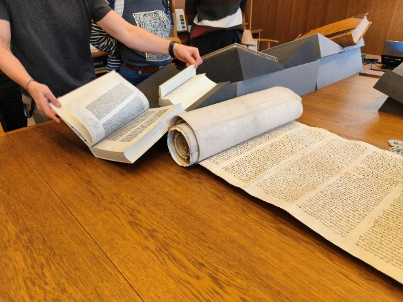
As an introduction to the session, Péter first presented us with three Bible copies representing the two ends of the material history of the Bible. The first item is a massive, carefully made Torah scroll in Hebrew (Figure 1) from, very interestingly, a 16th-century synagogue in southern China by the local Jewish community. Despite the late production, its scroll formatand its content of the Pentateuch make it a perfect indication of what the earliest Hebrew Bible would look like, which has also been proven true by the discovery of the Dead Sea Scrolls. Its painstaking production, substantial size and difficulty of navigation also transformed the very act of reading into a ritual demanding careful handling and a mastery of the scripture. Only selected people are allowed to read the scroll, without direct touching, due to its sanctity. The second item was a facsimile of the Gutenberg Bible, with the last item being Henrike’s Die Bibel in gerechter Sprache(a Bible edition taking linguistic diversity and inclusivity into serious consideration). The former marks the beginning of the printed era of Bible production, whereas the latter marks the latest stage in our time. In contrast to the Torah scroll, the printed books make the Bible a much more open and accessible text with much easier navigation, increased portability and mass production. By laying these items side by side (Figure 2), we directly witnessed the huge transformation that the Bible and its materiality have gone through across history, which is exactly the topic of today.
Figure 2: Hebrew Torah scroll, a facsimile of the Gutenberg Bible and Die Bibel in gerechter Sprache side by side
The first section introduced the first translation of the Hebrew Scripture, i.e. the Septuagint, in Ancient Greek, done by seventy-two (always remember the ‘two’! emphasised by Péter) Jewish Rabbis commissioned by Ptolemy II around the early 3rd century BCE. It marks the beginning of the complete integration of the Old Testament into Hellenic Culture and the following reconciliation between Hellenic Greek mythology and Jewish Monotheism. But more importantly to this session, it also represents the start of the Hebrew Bible reaching outside of the Jewish community, rendered legible and understandable for its new audiences by translation – one of the two crucial elements driving the wide, cross-cultural dissemination of the Bible and its material transformation that came along, as Péter argued. In its own time, the Septuagint already kick-started a wave of translational attempts among native Greek-speakers who were unhappy with the Rabbis’ command over the languages. We see Aquila’s extremely literal translation prioritising the Hebrew syntax, Symmachus’ elegant rendition of the Scripture into Homeric Greek, and Origen’s Hexapla critically comparing all major Bible translations circa 250-60 AD. The Septuagint became even more profoundly influential as numerous scribal practices it took became traditions adopted by many later manuscripts, and various important biblical vocabulary and concepts it established are still deeply embedded in Western languages today.
Show-and-tell at the end of the first session: MS. Gr. Class. a. 1 (frame 9), Facsimile of the Venetus A Ms of Homer’ s Iliad, Facsimile of the Vienna Dioscoros, MS Ms. Auct. T. Inf. 2. 12, Ms. Barocci 15, Ms. Roe 4. Consult https://medieval.bodleian.ox.ac.uk/ for more information about the items presented
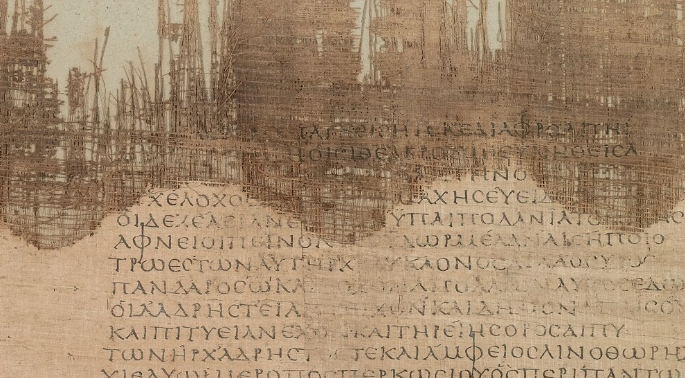
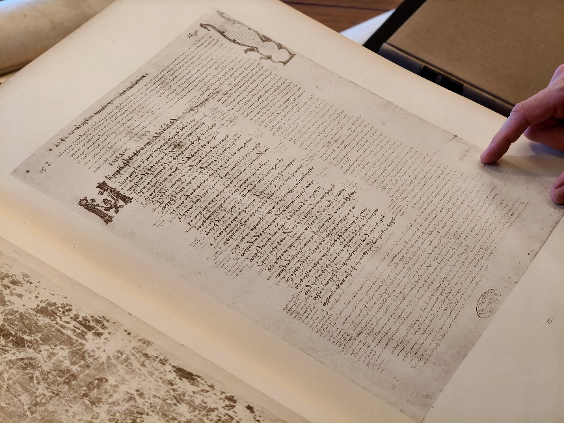
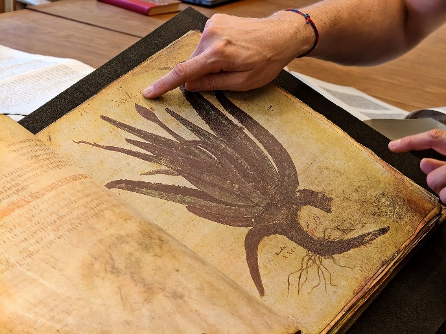
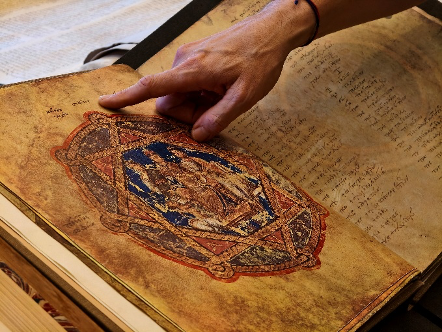
In the following manuscript-viewing session, we began by examining the earliest examples of layout formats in Western tradition. The first example is a fragment of Homer’s Iliad in the form of a luxury papyrus roll (Figure 3), produced roughly in the 3rd century AD. The verses are copied in two columns, annotated critically by the Alexandrian scholars. It shows us some of the earliest efforts to consolidate the Homeric verses and produce a critical school edition, which would become the blueprint for formatting the Greek Old Testament. Péter then presented us with two examples of the ultimate form of this early editorial tradition. The first one is a facsimile of an early 11th-century critical edition of the Iliad(Figure 4), and the second is a facsimile of the Juliana Anicia Codex (Figure 5 & 6). In both examples, we sawthe carefully glossed text being preceded by a series of complementary content: biographiesand portraits of the author, introductory treatises and/or summaries, credits of editors, table of contents, title, etc. We then examined two early codices, one of the Septuagint and one of the Book of Psalms, where we observed the continuation and influences of the editorial and layout practices in the classical texts. With the Book of Psalms, we also found modifications and additions of elements to suit the specific liturgical needs (e.g., calculation tables and calendars). From here, we developed a clear idea of what the early standardised format of the Scripture would look like, which led the way to the next sections focusing on its wider transmission.
Figure 3 Fragmentary papyrus roll of the Iliad, MS. Gr. Class. a. 1 (frame 9)Figure 4 Facsimile of the 11th-century critical edition of the IliadFigures 5&6: Facsimile of the Juliana Anicia CodexFigures 5&6: Facsimile of the Juliana Anicia Codex
The second lecture focused on the second and last core element that drove the transmission of the Bible – the New Testament. It played a crucial role in the process due to its missionary nature to spread Christianity and carried the Old Testament along with it, formulating the Bible we know today. Péter gave us a general introduction to the evolution of the New Testament, where it began as simply a record of Christ’s sayings and teachings. With the evangelists adding context and expanding the text, it developed into the popular genre of gospels that went far beyond the canonical Four Gospels that are now in the Bible. We also saw the emergence of apostolic writings, such as numerous epistles and the Acts of the Apostles. With such a rich pool of literature came the need for solidification. Thus, around the 4th-5th centuries, the canonisation of the New Testament gradually took place. The distinction between ‘canon’, accepted texts and ‘spurious’, rejected texts became common and concepts like the ‘apocrypha’ were established.
What also came with the New Testament is the rise of the codex. Originating from ancient Roman wax tablets, the codex was adopted by Christians as the main format. The change to codex format allowed more writing space, easier navigation for liturgical uses and likely contained an ideological undertone of distinguishing the new Christianity from the pagan scrolls. The material also transitioned from papyrus to parchment due to its durability and reusability, as well as the papyrus shortage at the time. Yet the change of material format doesn’t necessarily entail a change in editorial practices. For instance, in one of the earliest complete Bibles, the Codex Sinaiticus (ca.350AD), it still retained the 8-column layout of the papyrus scroll. At the end of this lecture session, Péter discussed the practical use of the gospel books as a common form of New Testament transmission, in which we saw the development of canon tables that compare the narrative units across the Four Gospels, something we would see very frequently very soon.
Show-and-tell at the end of the second session: Ms. Aeth. c. 2, Ms. Cromwell 16, Ms. Arm. d. 4. Consult https://medieval.bodleian.ox.ac.uk/ for more information about the items presented
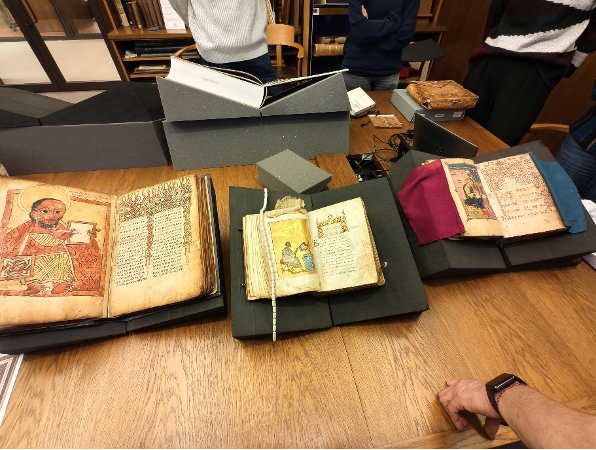
Accompanying the lecture, in the next manuscript viewing session, we saw various copies of the New Testament that were produced in different regions and different periods. As pointed out by Péter, canon tables (sometimes with a user guide) became widely present in almost all gospel books, followed by more ‘traditional’ elements such as a list of chapters, portraits of authors, and abstracts for each book. One of the highlights during this session was the comparison Péter presented with three different codices of the Gospels produced a few hundred years apart: one Ethiopian, one Greek and one Armenian (Figure 7). Each copies are decorated with cultural iconographies in local artistic traditions, yet the layout and format of the codex remained the same. From here, we see with our own eyes the wide, cross-cultural dissemination of the New Testament and the relative stability of itsstandardised textual and material production.
Figure 7: Comparison between three Gospel books, Ms. Aeth. c. 2, Ms. Cromwell 16, Ms. Arm. d. 4. Consult https://medieval.bodleian.ox.ac.uk/ for more information about the items presented
The last lecture focused on the history of the Latin Bible for its profound linguistic, cultural and spiritual influence in the Western world. The need for a Latin Bible started with the Latin-speaking Romans in North Africa around the 2nd-3rd centuries AD due to the limited Greek influence in the area and the increasing demand to understand Christian texts. The translation likely began sparsely with liturgies before developing into full text, as we found notes of oral translation in lines or margins of the Gospel books at the time. The early translations of the Bible were often adapted for regional dialects and corrected against unfounded Greek manuscripts, leading to the mixing of textual traditions and the overwhelming parallel existence of different versions by the 4th century. Therefore, Pope Damasus commissioned Jerome in 382 AD to polish and unify the Old Latin Gospels and later the Old Testament, producing the foundation of a standardised Latin Bible despite its controversial reception. In 585 AD, Cassiodorus and his monastery developed a full Bible based on Jerome’s work, which is preserved in the Codex Amiatinus. Finally, in the court of Charlemagne, with the unification of the Carolingian Empire, a standard full Latin version was produced and successfully circulated across the empire from ca. 800 AD, marking the consolidation of the Vulgate Bible.
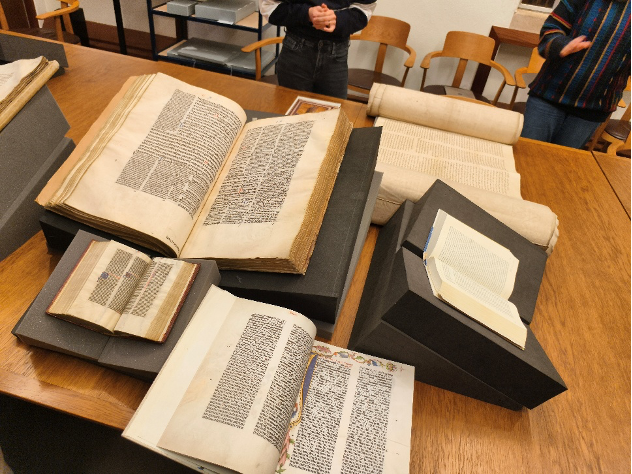
Latin Bible in medieval manuscripts from the Bodleian Library. Consult https://medieval.bodleian.ox.ac.uk/ for more information about the items presented: Ms. Laud. misc. 752 – the Romanesque bible; Canon. Bibl. Lat. 60 – Carolingian gospel book; Ms. Auct. E. inf. 7. – Glossed Bible; Ms. Broxb. 89. 9. – Paris Bible; Facsimile of the Munich copy of the Gutenberg Bible; Bibel in gerechter Sprache
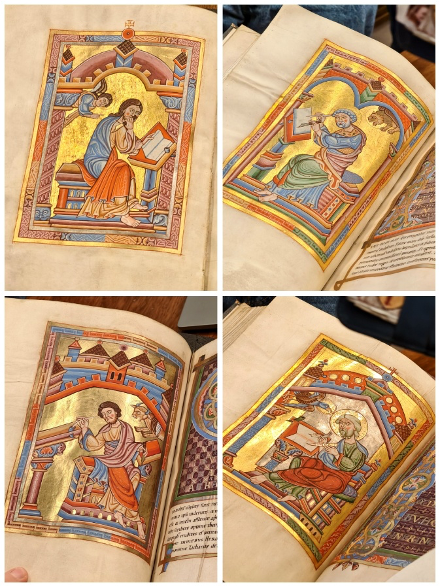
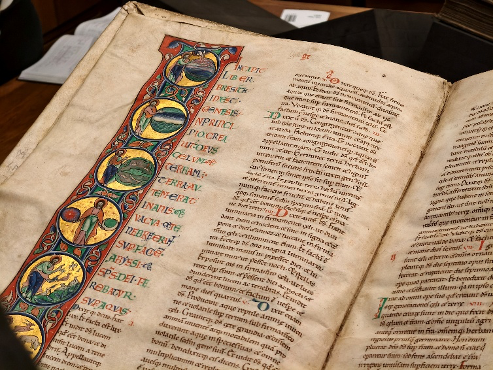
In the final manuscript viewing session, we saw several different copies of the Latin version of the Bible (Figures 8 & 9). In these copies, we continued to see a series of fairly standardised layouts and editorial practices, i.e., all the elements mentioned above, that could trace back to as early as the classical textual traditions and the emergence of practical gospel books. We also examined several beautiful and interesting illustrations. For instance, in a Carolingian gospel book, the portraits of the four evangelists formed a ‘stop-motion’ of the writing process (Figure 10); the historiated initial of Genesis in one Bible codex illustrated the seven days of creation (Figure 11). Eventually, we circled back to the facsimile of the Gutenberg Bible that symbolises the revolution of the printing press, and the beginning of modern Bibles.
And thus concluded the 3-hour journey on the history of ‘the Book’.
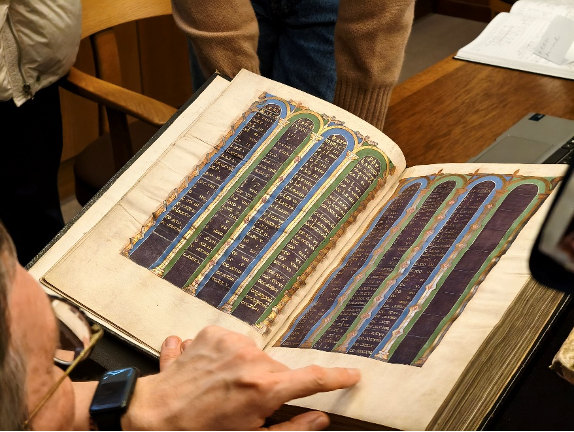
Figure 8: Purple canon tablesFigure 9: Different Bible versions side-by-sideFigure 10: The process of writing formed by the portraits of the four evangelistsFigure 11: The Creation illustrated in the initial ‘I’ of Genesis.
Dusty reading rooms are hardly the place where you’d expect to find cutting-edge technology — but AI researchers and libraries have formed an unlikely symbiosis in the field of Computer Vision, a technology that transforms images into geometrical data. You’ve probably come across this branch of AI in your daily life – e. g. when parking your car with park assist, or identifying a plant via an app, or trying to track down a pair of shoes with google lens. But Computer Vision is also a real gamechanger when it comes to unveiling the History of Books. Humans mostly open books because they want to read the text that’s inside. The absence of this intent in the computational gaze allows for a different focus: Each page becomes first and foremost an image, a surface consisting of shapes and lines that can be measured and compared. Even before the digital age, bibliographers were already looking for ways to see differences between seemingly identical pages: The McLeod Portable Collator for example is a wonderfully eccentric, mechanical device that overlaid two printed pages optically. (More information on library machines can be found on the Bodleian blog)
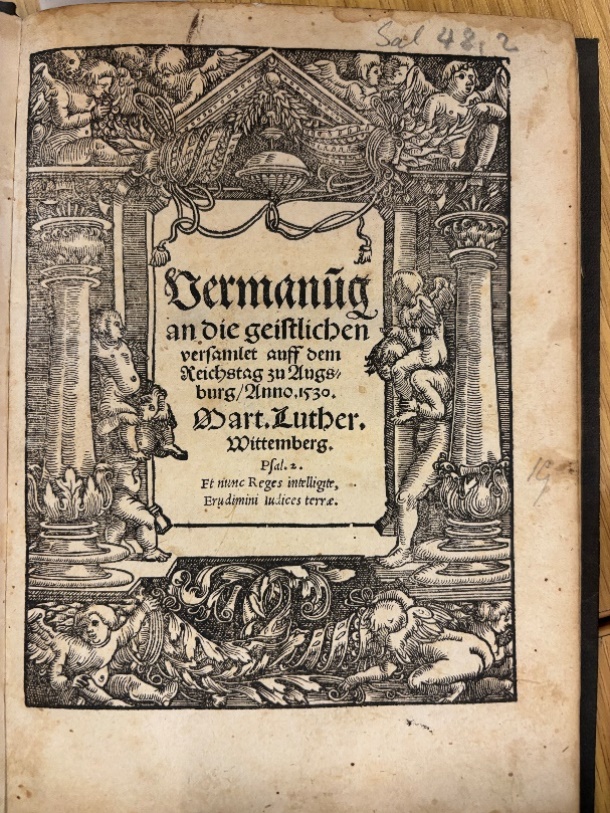
Today, those ingenious optical tools have digital descendants: Software such as ImageCompare, developed by Oxford’s Visual Geometry Group, can compare scans of bookpages and automatically highlight even the tiniest shifts in type, punctuation, or ink. What once required hours of eye-straining concentration can now be done in seconds. Funfact: The beloved “before- after” slide feature on Instagram is only one of several options ImageCompare offers to make it easier to “spot the difference”- for example in these title pages of reformation pamphlets from 1530:
Nevertheless, these tools are not magical “brains in a box” that spit out research results, as Dr Giles Bergel, Digital Humanities Researcher in the Visual Geometry Group Oxford, puts it. They just act as magnifiers that help spotting similarities and differences in material. It’s up to humans to interpret the data: Woodcuts, for example, were often reused across countless editions of books or manuscripts at different times and places. Paradoxically, the newer looking print can sometimes be the older one. Scotland Chapbooks (https://data.nls.uk/data/digitised-collections/chapbooks-printed-in-scotland/) is capable of searching a large dataset for illustrations and visually group them together, allowing researchers to trace how a single woodcut might have changed over time — a crack deepening, a border wearing thin, holes left by a bookworm.
Research Examples
Giovanna Truong, a former History of the Book student, used ImageCompare to identify identical illustrations in two different Yiddish Haggadot-uncovering a link between the two printers of the books based in Venice and Prague.
Blair Hedges, evolutionary biologist at Pennsylvania State University, studied the different patterns of wormholes which appear as white dots on prints and was able to attribute them to two different species of beetles. The holes in the woodcuts revealed how they were spread in Europe at the time, coincidentally strikingly in accordance to the distribution of Catholics and Protestants in Europe…
These examples show how the use of AI reveals formerly invisible patterns that can serve as clues to a book’s life and travels. And it might help to shift the image of dusty librarians and archivist trailing behind their time – as it is actually quite the reverse.
Friday, 28 November, 5-6.30pm Room 2 of the Taylor Institution Library
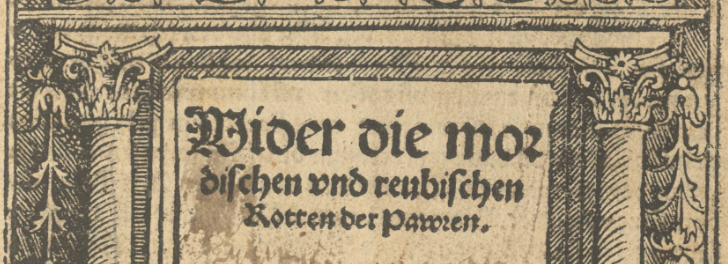
The launch featured a dramatised reading of the text and a display of the Taylorian holdings of German Peasants’ War pamphlets by a group of readers from across the University. The new edition comprises a historical and bibliographic introduction as well as the edition, translation, and facsimile. Open access volume here and a recording.
Introduction by Henrike Lähnemann and Lyndal Roper. Reader in the order of speaking: Henrike Lähnemann, Ryan Hampton, Rahel Micklich, Lyndal Roper, Eddie Handley, Marina Giraudeau, Ararat Ameen, Monty Powell, Georgia Macfarlane, Hannah Free, Victoria Speth, Emma Huber, Tamara Klarić, Timothy Powell
Practice recording of Martin Luther’s pamphlet ‘Against the Bands of Peasants’ by Henrike Lähnemann
1525 was a dramatic year in German politics. The Peasants’ War swept through South and East Germany and mobilised a large number of peasants in support of the movement, and an even larger number on the side of the princes and ruling classes opposing it. Martin Luther, dependent on the princes to realise his Reformation ideas, wrote one of the most vicious pamphlets of his life, attacking the ideas of the peasants, particularly their use of the term ‘freedom’. He defended his own use of the term as pertaining only to spiritual freedom and condemned insurrection in the strongest terms, calling on the princes to “slay, choke and stab” any rebel.
500 years after its first publication, this edition with a new modern English translation, extensive linguistic and historical footnotes, and a comprehensive introduction contextualises the attack, both in terms of its historic significance and its afterlife. As in the previous volumes from the Reformation Series of the Taylor Editions, the text is based on pamphlets from the Taylorian collection which are also provided as facsimiles. The volume is published open access and with additional resources such as an audiobook and ‘fold-your-own-pamphlet’ for both of the copies held in the Taylorian. In the historical introduction, Rahel Micklich discusses in turn the historical background of the Peasants’ War (1), the underlying conflict with radical reformer Thomas Müntzer (2), and the ensuing pamphlet war with the Catholic adversaries of Luther, particularly Johann Cochlaeus. Timothy Powell then looks at the reception of the pamphlet in the GDR who were clearly taking the side of the peasants and of Thomas Müntzer against Luther’s polemic. A book historical chapter follows, examining the contemporary reception of all of Luther’s 1525 pamphlets on the topic as mirrored in the pamphlets held in the Taylorian and in the Bodleian Libraries in Oxford. The introduction is rounded off by a short explanation of the language of the pamphlet, the typographical conventions, and the principles guiding the edition by Henrike Lähnemann, with a comprehensive bibliography on the pamphlet.
Have a look at the digital editions of the two Taylorian copies of Martin Luther’s pamphlet against the peasants. No. 2 also includes the new English translation.
A full list of all Reformation pamphlets in the Taylorian with photographs of their title-pages is available on Taylor Editions website, and links to all published volumes in the three series ‘Treasures of the Taylorian’ is available on the publications website.
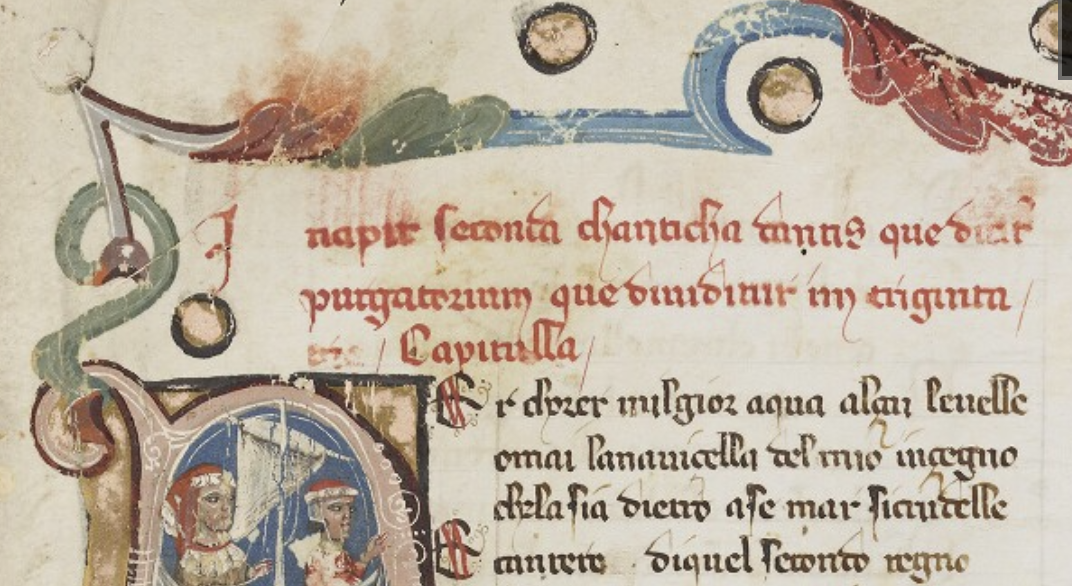
As part of the Italian Research Seminar, Ryan Pepin will speak on ‘Dietro la memoria non può ire’: Copyists’ Slips in the Textual Tradition of the Commedia.
Time and Place: Monday, November 10th (5th week), Taylorian, Room 2, 1-2:30 PM
Abstract: The enormous textual tradition of Dante’s Commedia – over 600 complete manuscripts – is a mine of data on how scribes worked in late medieval Italy. Thanks to the efforts of palaeographers and codicologists over the last twenty years, we have learned about the difference between professional and amateur milieux (Pomaro), the development of collaborative, serial book production in Florence (De Robertis, Ceccherini), copyists’ efforts to compare and correct their texts (Tonello) – even about the ‘habits’ of individual scribes (Marchetti).
This paper studies a type of error which to which Dante’s copyists were especially prone: errors that resulted from a good memory of the poem. By studying scribal innovations that ‘echo’ other lines in the text (Petrocchi), we come as close as we can to early readers’ ear for the poem: what they attended to, how they understood the poet’s style – and even, I will suggest, how they understood the poet’s own compositional practice.
Bio: Ryan is a British Academy Postdoctoral Fellow at the University of York. He is currently studying medieval Latin rhythmical poetry that circulated in Italy during the thirteenth and early fourteenth centuries.
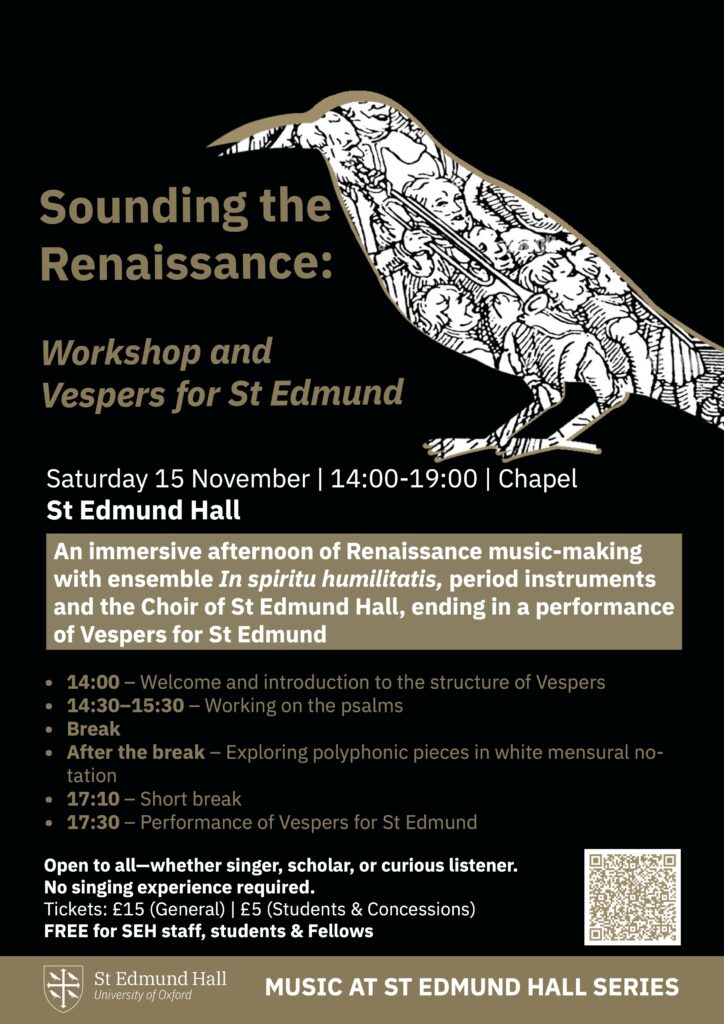
Saturday 15 November | 14:00-19:00 | Chapel St Edmund Hall Open to all, whether singer, scholar, or curious listener. No singing experience required. Tickets: £15 (General) | £5 (Students & Concessions) | free for SEH staff, students & Fellows Register on Eventbrite
The historical wind and vocal ensemble In Spiritu Humilitatis joins the Choir of St Edmund Hall for an immersive exploration of Renaissance Vespers. Reading directly from original choirbooks in white mensural notation, and guided by the sound of cornetts, sackbuts, and voices, participants will rediscover the expressive freedom of improvised polyphony and the luminous sonorities of early sacred music.
While traditional musical education often relies on modern editions, working from original sources opens a world of interpretative freedom. It allows musicians to make their own informed choices about phrasing, accidentals, and flow, rather than relying on an editor’s interpretation. It’s a liberating process. Reading from the sources draws you closer to the composer’s voice, encouraging a more personal, heartfelt performance.
This workshop invites you to experience that process firsthand: to step into the world of a Renaissance choir and take part in the singing of Vespers for St Edmund, Archbishop of Canterbury. Together we’ll explore the structure of the service, learn how to sing psalms in monody and improvise around plainchant, and practise reading from original notation.
Open to all, whether singer, scholar, or curious listener, this participatory event is about discovery, connection, and the joy of music-making. There are no wrong notes, only the opportunity to let your musicianship lead the way.
Here’s how the afternoon will go:
2:00 pm – Welcome and introduction to the structure of Vespers 2:30–3:30 pm – Working on the psalms Break After the break – Exploring polyphonic pieces in white mensural notation 5:10 pm – Short break 5:30 pm – Performance of Vespers for St Edmund
It was an exciting time being one of this years MML History of the Book students as we met up for the second time this term to have a three hour introduction to medieval Latin Palaeography. Dr Laure Miolo and Dr Alison Ray set up a programme that not only gave a well-rounded overview (even though we know that we barely scratched the surface of what there is to uncover) over everything related to palaeography, but also allowed students to examine exactly what they had just learned on the actual books.
So why would I want to study old books and their handwriting, you might ask? This question seems a little unlikely regarding the fact that you seem to have found this blog and have started to read this very entry – but surely you live a busy life and might think to yourself: “This all seems interesting, but do I really need to concern myself with this?” So here are three of the many reasons, why Palaeography is absolutely worth your precious time:
First of all, there is a lot to do! You can find a wide range of different handwriting starting with the earlier handwritings like the Capital script and the Roman cursive script and ending with the Humanistic script in the 16th century. (Medieval) Latin palaeography presents the opportunity to uncover over a thousand years of written history. So let’s start the journey with an overview over about 700 years in under two minutes, presented by Dr Alison Ray
And let me assure you, there is a lot more to unpack here. How about a roll from the early 16th century (MS. e. Museo 245) for example, that is not only impressive due to its size but also is said to have magical powers. Or how about a so-called bat book (MS. Ashmole 6), that was probably owned by a physician and that could be attached to the belt. Why is it called a bat book? Have a look
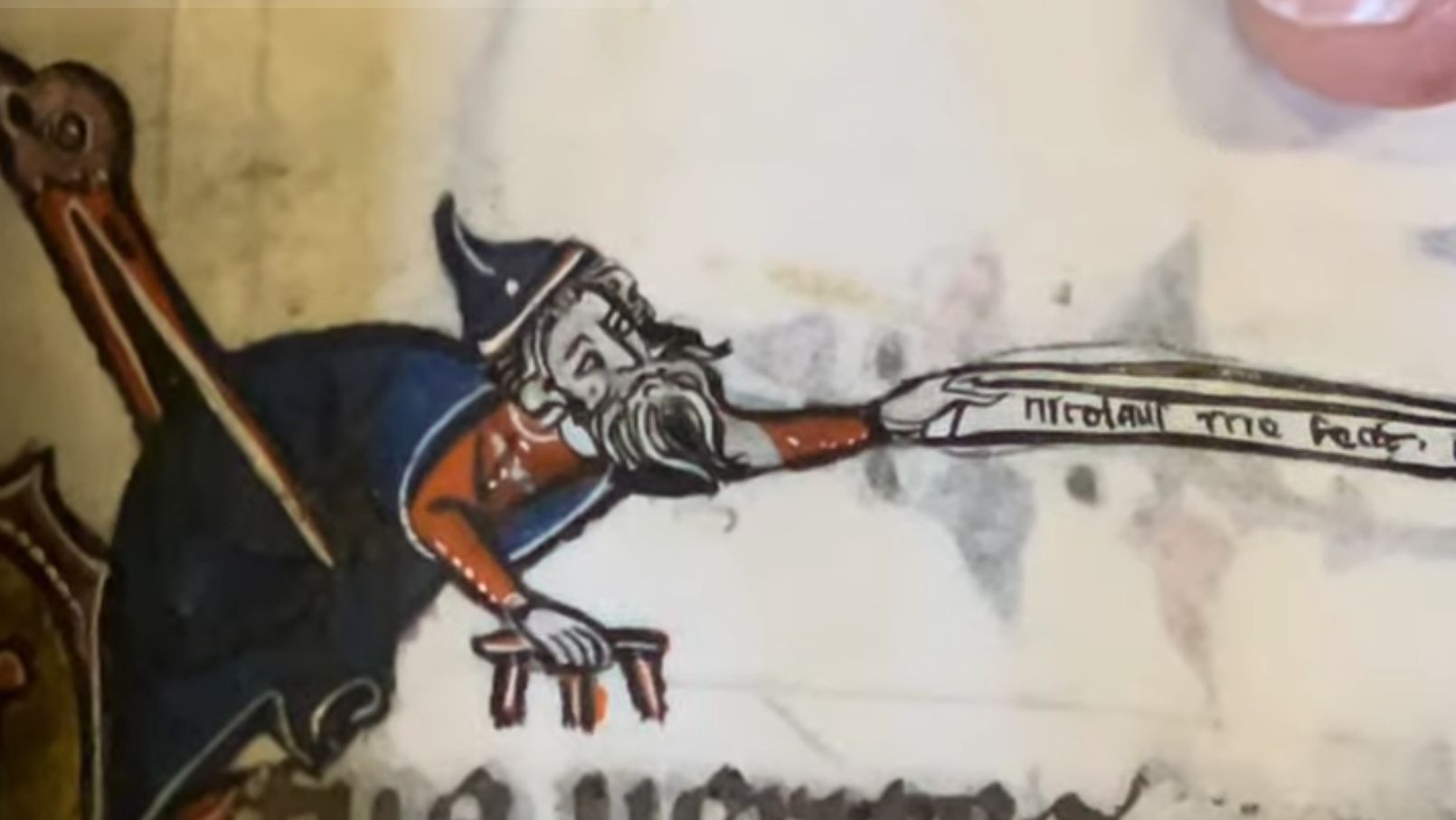
But the journey doesn’t end here as Palaeography entails much more than just the different kinds of books and handwritings. Have you ever gotten tired of looking at letters and words all day long? Well, how about looking at pictures instead, because with Palaeography you can call this research now. And unsurprisingly there is a lot of fun to have with this. How about for example the Aspremont Psalter (MS. Douce 118), where you can find a miniature of one of the illuminators, thus: a medieval selfie (see the header image of the disabled scribe with a Jew’s hat who holds the scroll ‘Nicolaus me fecit qui illuminat librum’ on fol. 142r; it is very small indeed, but the word miniature actually comes from the word minium, which refers to the type of colour that was used to outline the different pictures by the illuminator). Or in case you have ever asked yourself what your urin should and shouldn’t look like, you may (or rather may not) refer to the urin wheel depicted in an Astronomical Calendar from the 14th century (MS. Ashmole 789)
Last but most certainly not least you will not only uncover history on a great scale and be able to look at pretty and fun miniatures, but you will also get to look behind the book and uncover its sometimes very individual story. For example if you shine light on the Liber mortis et vitae (MS. Rawl. D. 403) from the late 15th/ early 16th century with a flashlight, you will find a unicorn shining through the pages. Even though this is great just for any reason, the unicorn here actually serves a function: it is a medieval watermark. So, if you ever wondered why some books have holes in their bindings (see for example MS. Bodl. 192), who the poodlemaster was or how books could be protected during travel (see for example MS. Rawl. D. 403), Palaeography will be the answer to all of your questions
To sum up, a huge thank you to Dr. Laure Miolo and Dr Alison Ray for this wonderful introduction to Palaeography and for giving us so many reasons to study this inspiring subject!
A quick update in the middle of the summer break with a few notices which cannot wait for the start of term.
A very warm welcome to Elizabeth Crabtree, our new Social Media Officer. Read a short blogpost about her interests, and contact her for any news you would like to see spread via the numerous social media channels which OMS operates.
Apply by 12 September to take part in one of the numerous language classes offered by the Oxford Centre for Hebrew and Jewish Studies this Michaelmas for rare Jewish languages (OSRJL).
Attend on 12 September a conference in honour of Peggy Brown (in-person at UPenn or via Zoom). The event will also mark the official launch of the Elizabeth A. R. Brown Medieval Historians’ archive, a new initiative at Penn Libraries to collect the professional papers of scholars of the Middle Ages and of associated professional organizations.
The Latin Hymn as Scriptural Exegesis – from Late Antiquity to the Middle Ages. 25–26 September 2025, Ioannou Centre for Classical & Byzantine Studies, 66 St Giles’, Oxford, OX1 3LU. Registration is free but compulsory. The Latin hymnic tradition is one that spans over a millennium from Late Antiquity through the Middle Ages to the Reformation (and beyond). In that period, there are aspects of it that have remained in many ways stable and enduring, but individual and local contexts and usages at various junctures in its long-lived history have required it to change and to adapt. The corpus also represents a group of texts that would, in many cases, have been very well known beyond the narrow confines of the intellectual and social elite who operated at the highest levels of Latinity and – even if largely penned by incredibly adept Latinists – had a much wider reach than many other Latin texts because of the performed nature of hymns. The relationship of hymns to other exegetical traditions and to the liturgical and para-liturgical contexts in which they were used is also noteworthy.
Call for Papers for Ars Inquirendi, a multi-day joint conference to be held on 4-7 December 2025 (online, with in-person workshops in Stockholm and Oxford), invites demonstrations of all aspects of the nascent art of using LMMs to query the pre-modern – by which we mean, broadly, any Old World cultures before their domination by movable-type print – from pre-modernists already using LMMs, and computer scientists building them, to philosophers and historians of knowledge. Submissions deadline of 30th September. https://medieval.ox.ac.uk/ars-inquirendi-querying-cfp/
Presenting the Guild of Medievalist Makers, co-founded by Eleanor Baker, Kristen Haas Curtis, and Laura Varnam. The Guild was the recipient of an Oxford Medieval Studies Small Grant in Trinity Term 2025 to support the launch of their website and to assist with publicity materials for their first two conference appearances this summer. In this blogpost, Oxford co-founders Eleanor Baker and Laura Varnam introduce the Guild and its activities.
Researcher position: ‘A Quiet Revolution’: Exploring West Horsley Place’s Pre-Modern Landscape. The West Horsley Place Trust has recently received a National Lottery Heritage Fund award for a project titled ‘A Quiet Revolution’, for which they are partnering with the University of Oxford to understand more about the site and its history. We are looking for a skilled and motivated researcher to conduct 239 hours (approximately 30 days) of research on the pre-modern landscape of West Horsley and its historical communities. The role combines desk-based and on-site archival research to produce high-quality outputs in support of a collaborative heritage project. If you are a late stage doctoral or postdoctoral researcher with expertise in medieval and/or early modern landscape history and an interest in working with or in the heritage sector, we’d love to hear from you. More details on how to apply. Deadline: Friday 19th September 2025. Prospective applicants are welcome to direct informal enquiries about the opportunity to Dr Rachel Delman, Heritage Partnerships Coordinator in the Humanities Division (Ra***********@**************ac.uk)
Call for Leeds panel on Writing the Past and Shaping the Future in Thirteenth-Century Norway. In this session we invite papers which address any aspect of the political, legal, cultural, and literary life of the Norwegian court in the thirteenth century. We particularly welcome inter-disciplinary approaches which highlight the intersection of historical and literary trends shaping the political and milieu of the thirteenth century Norwegian court. Please submit an abstract of no more than 250 words by Friday 19 September and a brief biography to both Jonas Zeit-Altpeter and Mary Catherine O’Connor.
I hope you have a good summer and remember that it is never too early to send seminar or event announcements to Tristan Alphey under the Oxford Medieval Studies email!
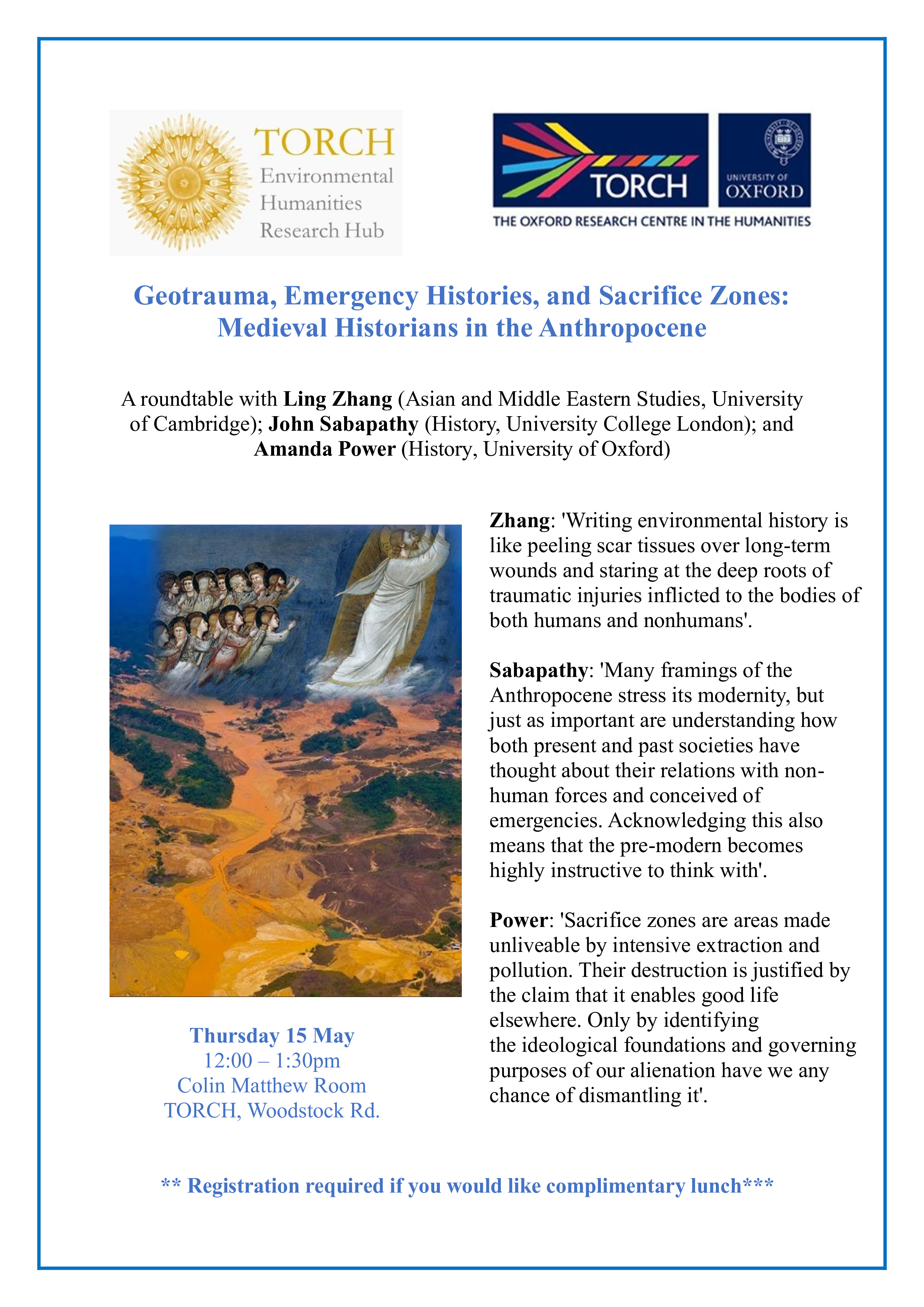
Colin Matthew Room, Radcliffe Humanities, Radcliffe Observatory Quarter Woodstock Road, Oxford, OX2 6GG Register via Eventbrite.
Registration is required only for those who would like lunch. In order to prevent food waste, PLEASE cancel your registration at least 72 hours in advance if you are unable to attend.
A roundtable with Ling Zhang (Asian and Middle Eastern Studies, University of Cambridge); John Sabapathy (History, University College London); and Amanda Power (History, University of Oxford)