The Nuns’ New Year’s Greetings

Wishing all readers a Happy New Year! Post first published on the blog about the Medingen Manuscripts

Sending Christ in the Heart from the Convent of Lüne
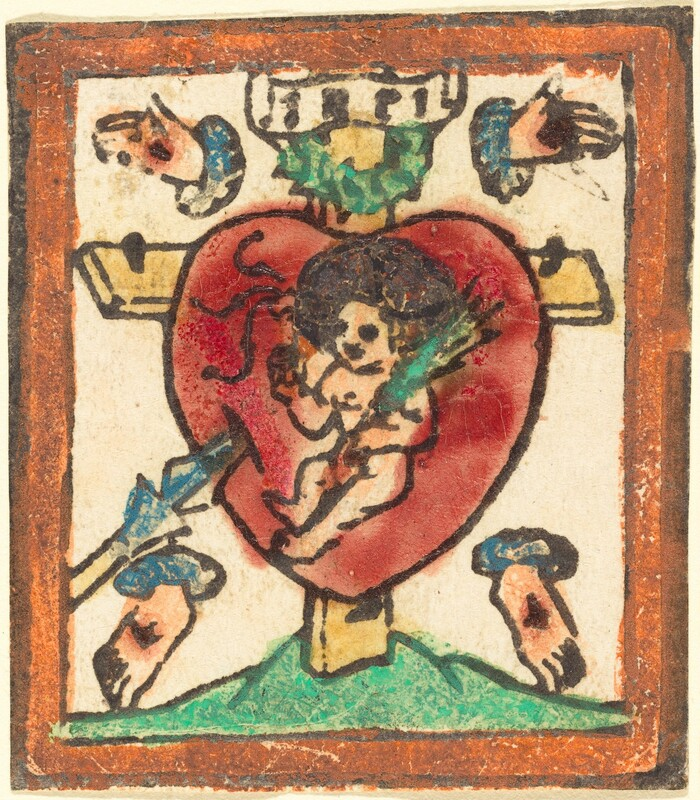
Christ Child in the Sacred Heart, hand-colored woodcut by an anonymous German 15th-century artist, ca. 1475–1480. Rosenwald Collection, National Gallery of Art, Washington (1943.3.526).

On a New Year’s Eve in the first half of the 1480s, two young nuns in the convent of Lüne sat down to write to a woman they admired (letter no. 260 in the first letter book, edited by Eva Schlotheuber and Henrike Lähnemann). Their addressee, the lay sister (conversa) Elisabeth Bockes, had come from the neighboring convent of Ebstorf a few years earlier to help implement the monastic reform in Lüne. She had carried heavy responsibilities pro reformatione, and earned not only a glowing entry in the convent chronicle but personal gratitude from the younger sisters who had grown up under her care. They open their New Year’s letter with warm words:

Alderleveste Elisabeth Bockesken, we danket juwer leve lefliken unde fruntliken vor alle woldath, truwe unde leve, de gy vaken unde vele by us hebbet bewiset van usen junghen iaren wente an dessen dach, sunderken de wile, de gy hir myd us weren pro reformatione, do gy mannighen swaren arbeyt myd us hadden, des we juk nummer to vullen danken kond,

Dearest beloved Elisabeth Bockes, we thank your love kindly and friendly for all the good deeds, loyalty, and love that you have shown to us often and much, from our youth up to this day, especially during the time when you were here with us for the reform, when you had many heavy labours with us, for which we can never thank you enough.

The letter is, very explicitly, about reform: a moment when enclosure, obedience, and common life were being reshaped. But it is also about something more intimate: gratitude, affection across convent walls, and the small things one sends to mark the turning of the year. Along with the letter, the writers enclose two lengths of cloth and, crucially, a little devotional image—a bladeken, a “little leaf”—depicting the Christ Child enthroned inside Christ’s heart. They do not simply mention the image; they script how Elisabeth should use it:

Hirumme, alderleveste, sende we juk an rechter leve en luttik hilgenbladeken, dar vynde gy inne ghemalet dat benediede, sote, gotlike herte uses leven salichmakeres, dat he umme user leve willen openen led myd dem scharpen spere; unde bynnen in dessem herteken syd dat alderschoneste begherlikeste kyndeken Jesus, dat mote juk gheven dor syne hilgen mynscheyt en nye, vrolick, sunt, salich iar; unde allent, wes gy begherende synt, beyde an dem lyve unde an der sele, dat gy sughen moten ute synem honnichvletenden herten den hemmelschen invlote syner gotliken gnade unde soticheyt, so vullenkomelken, dat gy dar ghansliken moten inne vordrunken werden,

Therefore, dearest, we send you, in true love, a little devotional leaf, wherein you will find painted the blessed, sweet, divine heart of our dear Saviour, which he let be opened for love of us with the sharp spear; and within this little heart sits the most beautiful, most desirable little child Jesus, who may grant you through his holy humanity a new, joyful, healthy, blessed year; and everything you desire, both for body and for soul, so that you may draw from his honey-flowing heart the heavenly influx of his divine grace and sweetness, so fully that you might be completely intoxicated by it.

At the end of the letter, the two little sheep in Lüne beg Elisabeth not to forget them but to remember them in prayer. The small image is thus at once a New Year’s gift, a tool for personal devotion, and a material reminder of the bond forged through reform. This is where I want to begin: with a New Year’s greeting that looks, at first glance, not so different from our own good wishes for health, affectionate diminutives, a token of friendship, but that centers on a pierced heart and a child-king seated within it. What happens if we take these New Year’s letters, their devotional images, and their language of hearts and gifts as a starting point for thinking about the intellectual and emotional life of late medieval nuns?

The Letters from the Benedictine Convent of Lüne: Gifts Between Convents

The letter discussed above belongs to the wider “nuns’ networks” of northern Germany. The most important sources for this world are the three Lüne letter-books, which together preserve almost 1,800 letters written or received between roughly 1460 and 1555. These letters cross convent boundaries and weave Lüne into a network of the other Lüneburg convents Ebstorf, Isenhagen, Medingen, Walsrode, and Wienhausen,as well as into circles of lay relatives in town. Many are tied to specific occasions: congratulatory letters for nun’s coronations or birthdays, words of consolation after the death of a convent sister or family member, and seasonal greetings for Christmas and, especially, the New Year.

In the Lüne letters, New Year stands on its own as the key moment for exchanging wishes and tokens (e.g., letter nos. 181–183, 200, 205, 226, 254, 260–262). The emphasis falls less on surprise or abundance than on reciprocity and remembrance—what anthropologists would later call the logic of gift and counter-gift. A gift is rarely a unilateral act; it carries an implicit call to respond, not necessarily with something of equal material value, but with prayer, affection, or loyalty. To modern readers, Christmas is the gift-saturated feast and New Year’s presents are at best an afterthought. In fifteenth-century central Europe, however, the balance often tipped the other way. The practice of New Year’s gifts has deep roots: already in ancient Rome people marked the Kalendae Ianuariae by exchanging strenae—figs, dates, honey, and small sums of money—as good omens for the year ahead. Medieval and early modern sources across Europe still show New Year’s gifts circulating between rulers and courtiers, householders and servants, parents and children. Only gradually, especially from the Reformation onward, did Christmas Eve emerge as a rival occasion for giving.

Many of these Lüne letters explicitly mention small devotional images. Hs. 15, one of the letter-books, refers to about thirty-five such pictures on its own. The letters themselves, however, no longer survive with their original enclosures. The little leaves they describe were meant to be handled, carried, pinned up, kissed, and eventually worn away. To reconstruct what Elisabeth and other recipients might actually have held in their hands, we have to look instead to surviving visual material from neighbouring convents.

At the Cistercian convent of Wienhausen, not far from Lüne, the lifting of the floorboards in the 1950s uncovered around a hundred small devotional images hidden under the choir stalls: tiny sheets of parchment depicting, among other things, the Holy Face, the Risen Christ, the Five Wounds, and the Christ Child seated in a heart. These are precisely the motifs that recur in the Lüne letters. One surviving Wienhausen image shows a Christ Child painted in brown ink inside a red heart, framed by a red inscription. Elsewhere in the convent, a wall painting in the upper west wing of the cloister presents the Heart of Jesus with the Christ Child within, holding the scourging instrument; above hovers a dove and, above that, a scroll inscribed The Christ Child. It is not far-fetched to imagine that the devotional image sent to Elisabeth Bockes looked much like these examples: small, monochrome or sparsely coloured, and tightly focused on a single, emotionally charged motif.

For the purposes of this blog post, however, the precise iconography matters less than the interplay between verbal description and visual prompt. The letters do not merely note that a Christ Child in a heart has been sent. They supply its Passion background (opened with the sharp spear), spell out its emotional effect (honey-sweetness, consolation), and sketch its eschatological horizon (a snow-white soul resting in the wound). The image, in turn, offers the recipient a fixed visual form through which to re-run that script in daily devotion. Text and image, in other words, function as a single devotional package—what we might, borrowing the language of media theory, call a co-authored interface between divine grace and human perception.

“The Fairest Jewel I Know”: Christ as New Year’s Treasure

Christ Child with New Year’s Wish (Schr. 784), hand-colored woodcut (modern restrike) by an anonymous German artist, 15th century. The caption reads fil gvͦt iar ([wishing you a] very good year). Bequest of William S. Lieberman, The Metropolitan Museum of Art, Drawings and Prints (2007.49.526).

The New Year’s wishes go far beyond a mere exchange of greetings. They script the gaze and help foster a shared devotional culture between convents, regardless of enclosure. In another New Year’s Eve letter (letter no. 254), a younger nun at Lüne writes to Elisabeth Bockes again, this time thanking her not only for practical support but also for an exhortation, a spiritual letter from which she has drawn sweetness as a child receives scented roses from its mother. Her heart, she says, has been refreshed thereby.

She then recalls Gregory the Great’s saying that true love proves itself in works and admits she can only partly live up to this ideal. Even so, she resolves to send Elisabeth what she calls the fairest jewel she knows:

Hirumme, karissima Elisabeth Bockesken, so sende ik juk in rechter leve dat aldersconeste, suverkeste, begherlikeste klenade, dat ik wed in hemmel unde in erde, unde dat is Jesus Christus, dat sote kyndeken…

Therefore, dearest Elisabeth Bockes, I send you in true love the fairest, purest, most desirable jewel that I know in heaven and on earth, and that is Jesus Christ, the sweet little child.

The “jewel” is again a devotional image of the Christ Child on a small sheet of parchment, likely similar to the one described in the earlier letter. What matters most is not its artistic sophistication (these images are often described in the letters as little, even crudely painted) but the value conferred on it by language. Strings of superlatives—most beautiful, most pure, most desirable—elevate an inexpensive, fragile object into a jewel worthy of a beloved friend. The New Year’s image becomes a crystallization of affection, of remembered reform, and of the desire to send something that can bridge distance in both space and prayer.

A Golden Heart and a Snow-White Soul
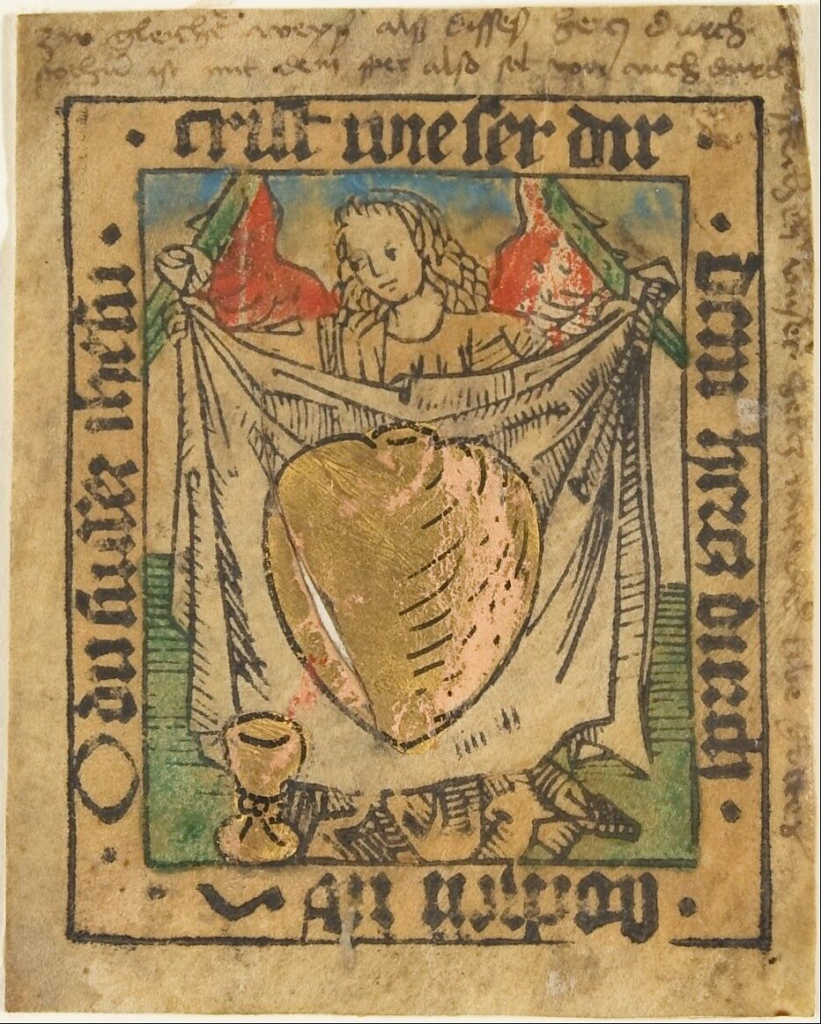
The Sacred Heart on a Cloth Held by an Angel, hand-colored woodcut printed on vellum with gold leaf, by an anonymous Nuremberg artist, ca. 1480–90. Bequest of James Clark McGuire, The Metropolitan Museum of Art, Drawings and Prints (31.54.142).

Another New Year’s letter (letter no. 261), written in the characteristic code-mixing language of the nuns, switching between Low German and Latin, to the younger sister of the sender, a nun in Ebstorf, sends yet another Christ Child in a heart, this time explicitly at the beginning of this new year:

Et in amore eiusdem piissimi salvatoris ac sponsi nostri dirigo vobis illum immensum magnificum regem universe terre quasi parvulum infantulumdepictum in aureo corde ad initium istius novi anni,

And in love for the same most merciful Saviour and our Bridegroom, I send you, for the beginning of this new year, that immense and magnificent king of the whole earth portrayed as a small, tender little child in a gold heart…

Here the heart is golden, and the metaphor unfolds accordingly. By the “sweetness of his honey-flowing humanity, the Child is to gild the addressee with love, both in soul and in body, inwardly and outwardly, so that she may begin the new year renewed in mind and spirit: good, health-giving, prosperous, and peaceful. The writer presses the image further. She hopes her sister will be bound so closely to Christ’s heart in contemplation that she can never be separated from him; that in her final hour her soul will fly, snow-white, through Christ’s side-wound into the golden nest of his heart; and that the bitterness of present death will be transformed into sweetness.

In this short passage, New Year, heart, marriage, death, and resurrection are all folded together. The heart emerges at once as a place of dwelling, a nest for the soul; as a womb or bridal chamber, the intimate space of union between Bridegroom and bride; as a treasury, golden and honey-flowing, a source of gifts for body and soul; and as an anatomical detail grounded in Passion piety, opened by the spear and reached through the side wound. If we think of the intellectual history of the Sacred Heart as beginning with twelfth-century Cistercian and Victorine writers and crystallizing later in early modern French devotion, these Lüne letters reveal a late medieval northern German iteration that is both strikingly visual and strikingly seasonal: the heart as a New Year’s image, carefully painted on a small leaf and mailed across the Lüneburg Heath region.

Hearts as Media of Devotion
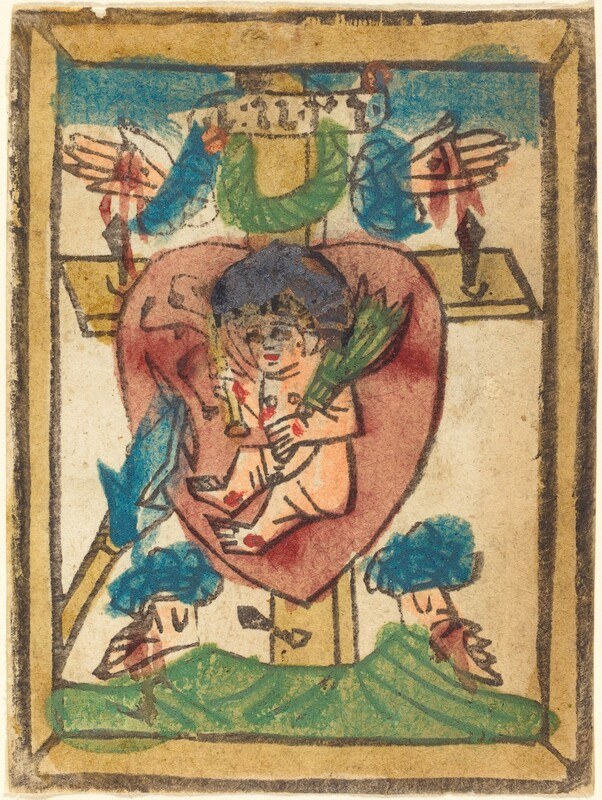
Christ Child in the Sacred Heart, hand-colored woodcut printed in warm black with red, blue, green, yellow, and gold, German, ca. 1450–1470. Rosenwald Collection, National Gallery of Art, Washington (1943.3.527).

What, then, does all this offer to intellectual historians?

These letters first remind us that ideas about the heart, its anatomy, its affective charge, its role in salvation, were not confined to theological treatises. They circulated through small objects, stock phrases, and seasonal rituals. The Lüne writers draw on a shared reservoir of imagery: the opened heart of Christ from twelfth-century mystical theology, the bridal language of Christ as sponsus, the long medieval fascination with Christ’s wounds as entrances to safety and sites of empathy. Yet they recombine these motifs in strikingly specific ways. By tying the heart to the New Year, they turn it into a temporal device, a means of beginning again; by placing the Christ Child within the heart, they fuse Incarnation and Passion in a single image; and by imagining the heart as a golden nest for the soul, they figure the afterlife in profoundly domestic, almost cozy terms.

Second, the letters show how visual and verbal media work together to shape devotion. The images would have been almost meaningless without the accompanying “scripts”: letters that tell the beholder when to look, which body parts to imagine, which biblical stories to recall, and what effects to desire—health, joy, perseverance, a blessed death. Conversely, the letters gain much of their force from the promise of a tangible object. Without a devotional image, a New Year’s greeting remains a courteous text; with one, it becomes a kind of portable altar, a miniature interface between the recipient’s daily life and the mysteries of Christ’s humanity.

Finally, these materials complicate any simple story about enclosure and isolation. The very existence of such rich New Year’s correspondence, replete with gifts, shared images, and carefully crafted devotional language, shows that women’s convents like Lüne and Ebstorf were embedded in dense networks of exchange: textual, material, and emotional. Reform did not close these channels; it reorganized them. not close these channels; it reorganized them.
Exploring the Medieval Sky

Spring School: An Introduction to the “Science of the Stars” Through Manuscripts and Instruments

Weston Library, 16–20 March 2026

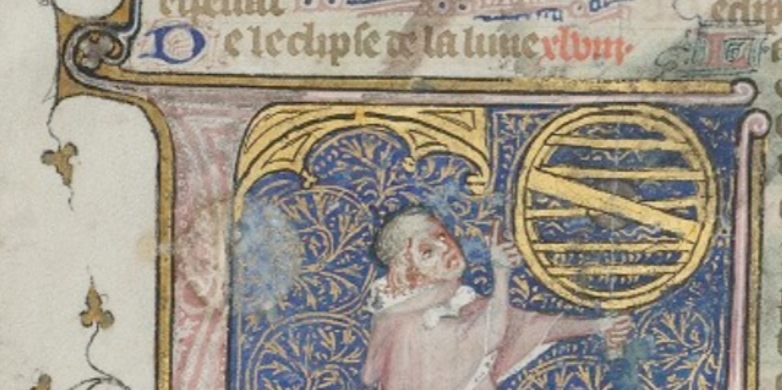
Registration is now open for Exploring the Medieval Sky, a spring school designed for undergraduate and graduate students who wish to explore how medieval people understood the sky —encompassing the visible heavens (stars, planets, eclipses, comets), the theoretical structures used to explain them(cosmology, celestial spheres, planetary models), and the cultural meanings attached to celestial phenomena in art, science, and daily life. Over five days, participants will discover the foundations of medieval astronomy and astrology through a combination of lectures, hands-on sessions with manuscripts and instruments, visits to the History of Science Museum and Merton College OldLibrary and presentations of current research.By the end of the course, participants will have acquired a clear chronological framework for the medieval history of the “science of the stars,” will gain practical experience using an armillary sphere and an astrolabe, and will learn to identify the codicological structure and cultural significance of scientific manuscripts through extensive engagement with materials from the Weston Library’s collections.

The spring school is open to all Oxford undergraduate and graduate students. It is designed as anintroductory course; no prior knowledge is required, only an interest in the history of astronomy, astrology,or manuscript studies.To ensure effective work with rare and fragile historical materials, places are limited. By registering,participants agree to attend the full programme. Registration is free.

Registration deadline: 2 February 2026. To register please email: laure.miolo@history.ox.ac.uk

Organisation: Laure Miolo (Faculty of History, Wadham College) and Alexandre Tur (Bibliothèque nationale de France, Paris).

With the kind participation of: the Centre for the Study of the Book (Bodleian Library), Sumner Brand (History of Science Museum), Matthew Holford (Bodleian Library), Stephen Johnston (History of Science Museum), Michelle Pfeffer (Magdalen College), Julia Walworth (Merton College), Sian Witherden (Exeter College).

Bible Layout Through the Ages

Report on an In-Depth Crash-Course on the History of ‘the Book’ with Péter Tóth by Alice Lanyue Zhang (MSt. Modern Languages, 2025)

This session of the History of the Book seminar at the Weston Library, led by Péter Tóth, focused on understanding the development of the Bible in its layout, languages, and content from the very early scrolls to the numerous modern printed editions. Each of the students was asked to bring along an edition of the Bible to compare and contrast what elements might have been retained throughout the traditions and what might have changed in modern printing and editorial practices. This 3-hour-long session was divided into 3 lecture sections looking at different major stages of the Bible in its transmission and production, and each section was followed by a short manuscript viewing session looking closely at Bible copies from different locations and historical periods. 

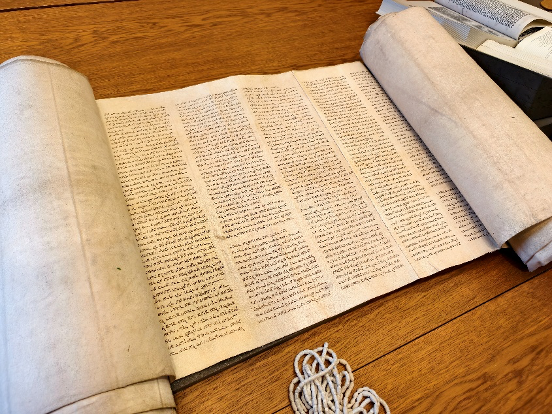
Fig. 1: 16th cent. Torah scroll from China

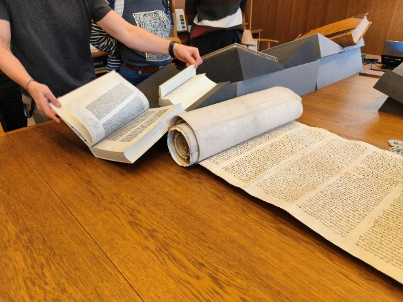
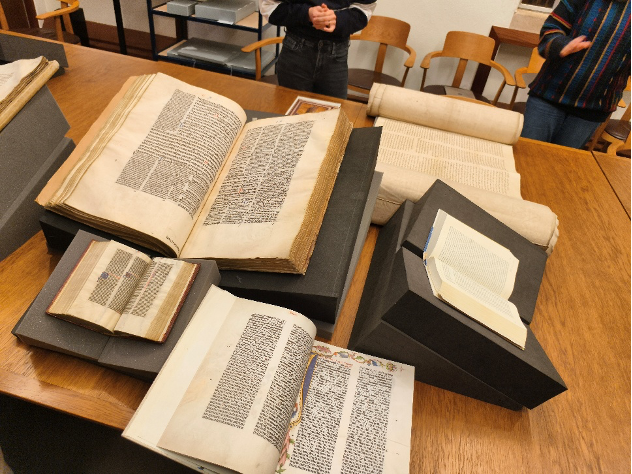
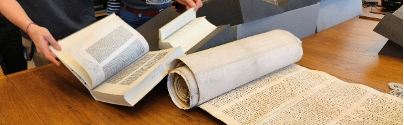
As an introduction to the session, Péter first presented us with three Bible copies representing the two ends of the material history of the Bible. The first item is a massive, carefully made Torah scroll in Hebrew (Figure 1) from, very interestingly, a 16th-century synagogue in southern China by the local Jewish community. Despite the late production, its scroll formatand its content of the Pentateuch make it a perfect indication of what the earliest Hebrew Bible would look like, which has also been proven true by the discovery of the Dead Sea Scrolls. Its painstaking production, substantial size and difficulty of navigation also transformed the very act of reading into a ritual demanding careful handling and a mastery of the scripture. Only selected people are allowed to read the scroll, without direct touching, due to its sanctity. The second item was a facsimile of the Gutenberg Bible, with the last item being Henrike’s Die Bibel in gerechter Sprache (a Bible edition taking linguistic diversity and inclusivity into serious consideration). The former marks the beginning of the printed era of Bible production, whereas the latter marks the latest stage in our time. In contrast to the Torah scroll, the printed books make the Bible a much more open and accessible text with much easier navigation, increased portability and mass production. By laying these items side by side (Figure 2), we directly witnessed the huge transformation that the Bible and its materiality have gone through across history, which is exactly the topic of today. 

Figure 2: Hebrew Torah scroll, a facsimile of the Gutenberg Bible and Die Bibel in gerechter Sprache side by side

The first section introduced the first translation of the Hebrew Scripture, i.e. the Septuagint, in Ancient Greek, done by seventy-two (always remember the ‘two’! emphasised by Péter) Jewish Rabbis commissioned by Ptolemy II around the early 3rd century BCE. It marks the beginning of the complete integration of the Old Testament into Hellenic Culture and the following reconciliation between Hellenic Greek mythology and Jewish Monotheism. But more importantly to this session, it also represents the start of the Hebrew Bible reaching outside of the Jewish community, rendered legible and understandable for its new audiences by translation – one of the two crucial elements driving the wide, cross-cultural dissemination of the Bible and its material transformation that came along, as Péter argued. In its own time, the Septuagint already kick-started a wave of translational attempts among native Greek-speakers who were unhappy with the Rabbis’ command over the languages. We see Aquila’s extremely literal translation prioritising the Hebrew syntax, Symmachus’ elegant rendition of the Scripture into Homeric Greek, and Origen’s Hexapla critically comparing all major Bible translations circa 250-60 AD. The Septuagint became even more profoundly influential as numerous scribal practices it took became traditions adopted by many later manuscripts, and various important biblical vocabulary and concepts it established are still deeply embedded in Western languages today. 

Show-and-tell at the end of the first session: MS. Gr. Class. a. 1 (frame 9), Facsimile of the Venetus A Ms of Homer’ s Iliad, Facsimile of the Vienna Dioscoros, MS Ms. Auct. T. Inf. 2. 12, Ms. Barocci 15, Ms. Roe 4. Consult https://medieval.bodleian.ox.ac.uk/ for more information about the items presented

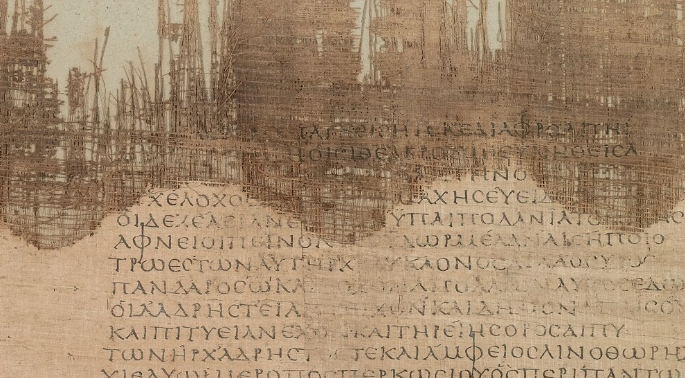
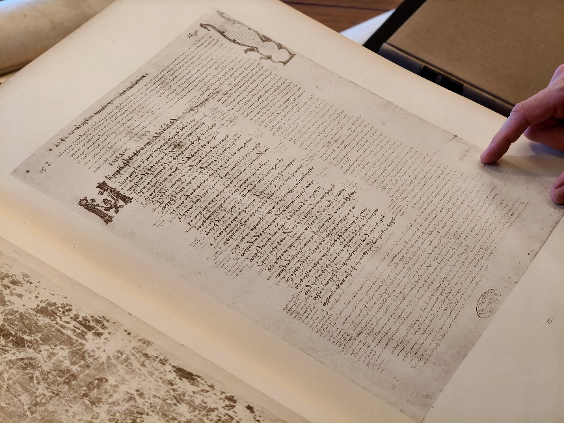
In the following manuscript-viewing session, we began by examining the earliest examples of layout formats in Western tradition. The first example is a fragment of Homer’s Iliad in the form of a luxury papyrus roll (Figure 3), produced roughly in the 3rd century AD. The verses are copied in two columns, annotated critically by the Alexandrian scholars. It shows us some of the earliest efforts to consolidate the Homeric verses and produce a critical school edition, which would become the blueprint for formatting the Greek Old Testament. Péter then presented us with two examples of the ultimate form of this early editorial tradition. The first one is a facsimile of an early 11th-century critical edition of the Iliad (Figure 4), and the second is a facsimile of the Juliana Anicia Codex (Figure 5 & 6). In both examples, we sawthe carefully glossed text being preceded by a series of complementary content: biographiesand portraits of the author, introductory treatises and/or summaries, credits of editors, table of contents, title, etc. We then examined two early codices, one of the Septuagint and one of the Book of Psalms, where we observed the continuation and influences of the editorial and layout practices in the classical texts. With the Book of Psalms, we also found modifications and additions of elements to suit the specific liturgical needs (e.g., calculation tables and calendars). From here, we developed a clear idea of what the early standardised format of the Scripture would look like, which led the way to the next sections focusing on its wider transmission.

Figure 3 Fragmentary papyrus roll of the Iliad, MS. Gr. Class. a. 1 (frame 9)
Figure 4 Facsimile of the 11th-century critical edition of the Iliad

The second lecture focused on the second and last core element that drove the transmission of the Bible – the New Testament. It played a crucial role in the process due to its missionary nature to spread Christianity and carried the Old Testament along with it, formulating the Bible we know today. Péter gave us a general introduction to the evolution of the New Testament, where it began as simply a record of Christ’s sayings and teachings. With the evangelists adding context and expanding the text, it developed into the popular genre of gospels that went far beyond the canonical Four Gospels that are now in the Bible. We also saw the emergence of apostolic writings, such as numerous epistles and the Acts of the Apostles. With such a rich pool of literature came the need for solidification. Thus, around the 4th-5th centuries, the canonisation of the New Testament gradually took place. The distinction between ‘canon’, accepted texts and ‘spurious’, rejected texts became common and concepts like the ‘apocrypha’ were established.

What also came with the New Testament is the rise of the codex. Originating from ancient Roman wax tablets, the codex was adopted by Christians as the main format. The change to codex format allowed more writing space, easier navigation for liturgical uses and likely contained an ideological undertone of distinguishing the new Christianity from the pagan scrolls. The material also transitioned from papyrus to parchment due to its durability and reusability, as well as the papyrus shortage at the time. Yet the change of material format doesn’t necessarily entail a change in editorial practices. For instance, in one of the earliest complete Bibles, the Codex Sinaiticus (ca.350AD), it still retained the 8-column layout of the papyrus scroll. At the end of this lecture session, Péter discussed the practical use of the gospel books as a common form of New Testament transmission, in which we saw the development of canon tables that compare the narrative units across the Four Gospels, something we would see very frequently very soon. 

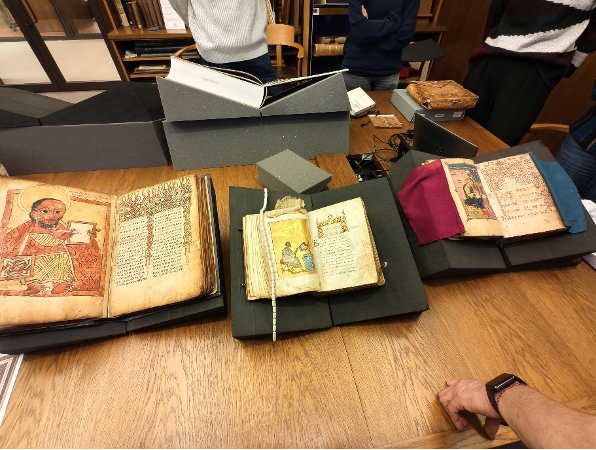
Show-and-tell at the end of the second session: Ms. Aeth. c. 2, Ms. Cromwell 16, Ms. Arm. d. 4. Consult https://medieval.bodleian.ox.ac.uk/ for more information about the items presented

Accompanying the lecture, in the next manuscript viewing session, we saw various copies of the New Testament that were produced in different regions and different periods. As pointed out by Péter, canon tables (sometimes with a user guide) became widely present in almost all gospel books, followed by more ‘traditional’ elements such as a list of chapters, portraits of authors, and abstracts for each book. One of the highlights during this session was the comparison Péter presented with three different codices of the Gospels produced a few hundred years apart: one Ethiopian, one Greek and one Armenian (Figure 7). Each copies are decorated with cultural iconographies in local artistic traditions, yet the layout and format of the codex remained the same. From here, we see with our own eyes the wide, cross-cultural dissemination of the New Testament and the relative stability of itsstandardised textual and material production. 

Figure 7: Comparison between three Gospel books, Ms. Aeth. c. 2, Ms. Cromwell 16, Ms. Arm. d. 4. Consult https://medieval.bodleian.ox.ac.uk/ for more information about the items presented

The last lecture focused on the history of the Latin Bible for its profound linguistic, cultural and spiritual influence in the Western world. The need for a Latin Bible started with the Latin-speaking Romans in North Africa around the 2nd-3rd centuries AD due to the limited Greek influence in the area and the increasing demand to understand Christian texts. The translation likely began sparsely with liturgies before developing into full text, as we found notes of oral translation in lines or margins of the Gospel books at the time. The early translations of the Bible were often adapted for regional dialects and corrected against unfounded Greek manuscripts, leading to the mixing of textual traditions and the overwhelming parallel existence of different versions by the 4th century. Therefore, Pope Damasus commissioned Jerome in 382 AD to polish and unify the Old Latin Gospels and later the Old Testament, producing the foundation of a standardised Latin Bible despite its controversial reception. In 585 AD, Cassiodorus and his monastery developed a full Bible based on Jerome’s work, which is preserved in the Codex Amiatinus. Finally, in the court of Charlemagne, with the unification of the Carolingian Empire, a standard full Latin version was produced and successfully circulated across the empire from ca. 800 AD, marking the consolidation of the Vulgate Bible. 

Latin Bible in medieval manuscripts from the Bodleian Library. Consult https://medieval.bodleian.ox.ac.uk/ for more information about the items presented: Ms. Laud. misc. 752 – the Romanesque bible; Canon. Bibl. Lat. 60 – Carolingian gospel book; Ms. Auct. E. inf. 7. – Glossed Bible; Ms. Broxb. 89. 9. – Paris Bible; Facsimile of the Munich copy of the Gutenberg Bible; Bibel in gerechter Sprache

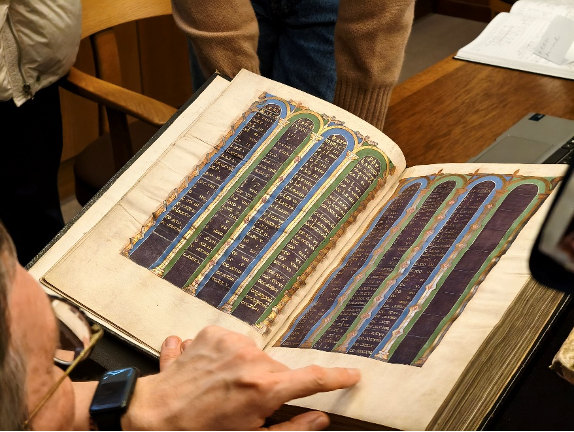
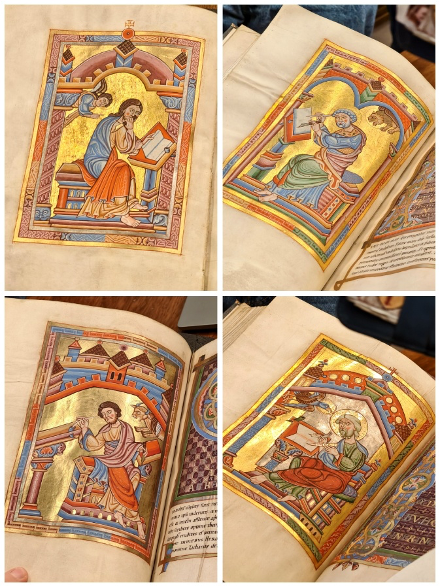
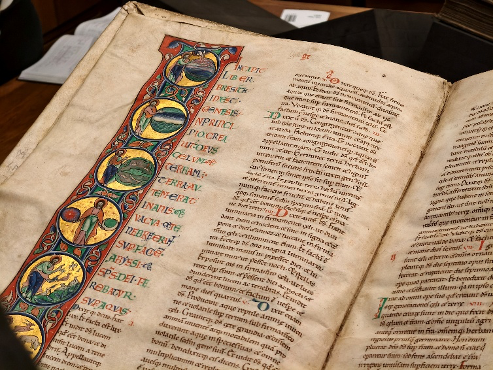
In the final manuscript viewing session, we saw several different copies of the Latin version of the Bible (Figures 8 & 9). In these copies, we continued to see a series of fairly standardised layouts and editorial practices, i.e., all the elements mentioned above, that could trace back to as early as the classical textual traditions and the emergence of practical gospel books. We also examined several beautiful and interesting illustrations. For instance, in a Carolingian gospel book, the portraits of the four evangelists formed a ‘stop-motion’ of the writing process (Figure 10); the historiated initial of Genesis in one Bible codex illustrated the seven days of creation (Figure 11). Eventually, we circled back to the facsimile of the Gutenberg Bible that symbolises the revolution of the printing press, and the beginning of modern Bibles. 

And thus concluded the 3-hour journey on the history of ‘the Book’. 

Figure 8: Purple canon tables
Figure 9: Different Bible versions side-by-side
Figure 10: The process of writing formed by the portraits of the four evangelists
Figure 11: The Creation illustrated in the initial ‘I’ of Genesis.