Term draws near. Please send all entries for next term’s OMS booklet to medieval@torch.ox.ac.uk, by Wednesday of -1 week at the latest (1st October). Until then, please see below a number of upcoming deadlines and opportunities:
CFP: CHASE Medieval and Early Modern Research Network (MEMRN) postgraduate conference – deadline 12 September. More info here.
Oxford School of Rare Jewish Languages classes. The deadline to apply is 12 September at 12 noon UK time. More info here.
The Medieval Academy of America’s podcast series The Multicultural Middle Ages is accepting episode proposals for their 5th season. More info here.
CFP: Cambridge Medieval History Graduate Workshop. Deadline 29th September. More info here.
Applications are open for the John W. Baldwin Post-Doctoral Fellowship. The Post-Doctoral Fellow will be a scholar whose research aligns with the goals of the study of “Europe in the world” and who has demonstrated evidence of innovative methodologies. Deadline 10th Nov. More info here.
The West Horsley Place Trust seeks a researcher. More info here.
The Cambridge Medieval History Graduate Workshop is inviting paper submissions for Michaelmas term 2025.
We host presentations on the cultures, economies, literature, material cultures, politics, thought, religions, and reception of the medieval world, which we define as broadly as possible as the global period between c.500 and c.1500. We welcome interdisciplinary scholarship and encourage submissions which stretch our conception of ‘medieval’ in time or space, from late antiquity to modern reception and from Scandinavia to the Middle East and beyond, or which deal with the practice of medieval history.
These short 15–20-minute workshop papers are excellent ways to share your work, gain presentation experience, and receive constructive feedback in a supportive environment run for and by graduate students. In terms of scope, we are looking for focused studies that offer snapshots into ongoing graduate research, and particularly encourage primary source work and case studies, rather than sweeping overviews of large topics or summaries of entire dissertations/theses.
We welcome submissions from Master’s and PhD students from any discipline or university, but especially encourage graduate students based in or around Cambridge to submit. Accepted speakers will have the opportunity to be featured on our blog, Camedieval. The Workshop meets alternate Thursdays, 4–5 :30pm, with the option of virtual attendance on Microsoft Teams for audience members. In each session we will have two 15–20-minute papers, followed by in-person socialising and refreshments.
Please send abstracts of not more than 250 words and a short bio by 29th September 2025 to: cambridgemedieval@gmail.com
November (14th-16th) at the University of East Anglia. Deadline: Friday (12th September).
The CHASE Medieval and Early Modern Research Network (MEMRN) are delighted to share the details for our second annual in-person Winter Conference. Join us from the 14th – 16th of November at the University of East Anglia and online for three days of panels, social events, workshops, networking sessions, and adventure in the historic city of Norwich.
The Call for Papers and details on how to apply to speak at the event are included below and are also now available via the MEMRN website and our social media. The deadline for submitting an abstract is Friday 12th September. We look forward to seeing you there!
Call For Papers: Fragmented Worlds, Shared Histories
We, the committee of the CHASE Medieval and Early Modern Research Network (MEMRN), are overjoyed to announce the return of our Winter Conference this year between the 14th and 16th November.
Join us at the University of East Anglia and online for three exciting days of workshops, papers, social events, and adventure through the historic cathedral city of Norwich. We welcome papers on a range of topics within medieval and early modern studies for this interdisciplinary conference, including:
* History and politics * Philosophy and theology * Literature, drama, performance culture and music * Latin and vernacular languages * Art history, architecture and archaeology * Manuscript studies and book history
For this year’s conference, we particularly encourage papers engaging with marginalised histories and communities, global intercultural contact and exchange, or conflict and diplomacy.
We invite abstracts of up to 250 words for individual research papers of twenty minutes in length (or 700 words for a panel of three people presenting on a particular subject or sub-theme).
The CHASE MEMRN conference remains open to all UK and overseas postgraduates. This includes independent scholars who are unaffiliated at this time. When submitting your abstract, please include your institution (if applicable) and, if from a CHASE-affiliated university institution, whether or not you are directly funded by CHASE.
All proposals should be emailed to chasememrn@gmail.com by Friday 12th September with the subject line ‘Conference Paper Submission’ and your name. Priority will be given to those available to present in-person, but remote presentation applications will also be considered.
Please feel free to contact the MEMRN team via email or social media DM with any questions you may have. We look forward to welcoming you to Norwich as part of this proudly CHASE-funded event.
‘In our own tongues’: The Medieval Vernacular Bible and its European Contexts’ is organised jointly by the Oxford and Augsburg research teams of the ‘Medieval Vernacular Bibles as Unity, Diversity and Conflict’. The project is based at the universities of Oxford and Augsburg and is supported by the UK-German Funding Initiative in the Humanities (Arts and Humanities Research Council and Deutsche Forschungsgemeinschaft) and the Bavarian Academy.
Compline based on the translations and manuscripts discussed at the conference. Text booklet
As part of the conference, we will be hosting the following session on Wednesday 1st October 2025:
3pm-5pm Bodleian Library, Lecture Theatre Chair:Andrew Dunning (University of Oxford)
Elizabeth Solopova (University of Oxford), Welcome
Hannah Schühle-Lewis (University of Oxford), ‘Þe pope, maister of bischopps’: Translating an Episcopal Oath in 1380s England
Michael Kuczynski (Tulane University), Hebrew and Greek Words in the Wycliffite Bible
10.30am – Coffee
11am-12.30pm St Stephen’s House
Chair: Nadine Popst (University of Augsburg)
Domenic Peter (University of Augsburg), ‘Als Daniel gesprochen hat’: The Book of Daniel in the Work of the Austrian Bible Translator and Beyond
Stefanie Katzameyer (University of Augsburg), ‘Ungefüerte pfaffen’, ‘Stiffter alles kriegs vnd streytz’, ‘Discipuli Antichristi’: Criticism of the Clergy by the Austrian Bible Translator, Austrian Heretical Movements, and the Wycliffites
Angila Vetter (Hamburg University), Modelling Lay Authority in Digital Editions: When the Austrian Bible Translator Invokes Wolfram von Eschenbach
1-2pm Lunch at St Stephen’s House
Afternoon: Walk to the Norman church of St Mary, Iffley, with Henrike Lähnemann, followed by viewing of the Old Library, St Edmund Hall.
Evening: Buffet dinner, followed by Compline in the Norman Crypt of St-Peter-in-the-East (library church of St Edmund Hall).
1 October
9am-10.30am St Stephen’s House
Chair: Catherine Mary MacRobert (University of Oxford)
Kateřina Voleková (Charles University / Czech Language Institute), Old Czech Glosses on the Psalms in Latin Biblical Dictionaries
Andrea Svobodová (Czech Language Institute), Colophons in Late-medieval Bohemian Biblical Manuscripts
Katarzyna Jasińska-Różycka (Institute of Polish Language, Polish Academy of Sciences), Scriptural Echoes in the Prologues to Medieval Dictionaries: Motifs, Citations, and Inspiration
10.30am – Coffee
11am-12.30pm St Stephen’s House
Chair: Freimut Löser (University of Augsburg)
Vladimir Agrigoroaei ( CNRS / Centre for Medieval Studies, Poitiers), The Cultural Implications of God’s Preference for the French Speech in the Old Testament Poem Written by Évrat (Late–Twelfth Century)
Corentin Delattre (University of Poitiers / Centre for Medieval Studies, Poitiers), ‘To furnish the priests to maintain the law’: Structures and Contents of London, British Library, MS Arundel 230
Ágnes Korondi (Fragmenta et Codices Research Group of the Hungarian Research Network, National Széchényi Library), Converting the Gospel of Nicodemus into a Sermon: The Old Hungarian Adaptation of the Apocryphon and its Latin Homiletic Background
1-2pm Lunch at St Stephen’s House
3pm-5pm Bodleian Library, Lecture Theatre
Chair:Andrew Dunning (University of Oxford)
Emily Davenport Guerry (University of Oxford),MS. Duke Humfrey c. 1:Illuminating the French New Testament and its readers, from Jean le Bon to Duke Humfrey
Freimut Löser (University of Augsburg), MS. Laud Misc. 479: The Paradisus-collection
Henrike Lähnemann (University of Oxford), MSS. Bodl. 969-970: A Fifteenth-century German Bible
Catherine Mary MacRobert (University of Oxford), MS e Mus. 184: The Vicissitudes of the Church Slavonic Psalter
Elizabeth Solopova (University of Oxford), MS. Bodl. 441: Gospels in Old English
7pm Conference Dinner at St Stephen’s House
2 October
9am-10.30am St Stephen’s House
Chair: Vladimir Agrigoroaei (CNRS / Centre for Medieval Studies, Poitiers)
Ana-Maria Gînsac (Institute of Interdisciplinary Research, Alexandru Ioan Cuza University of Iași), The Practice of Alternative Translation in Two Seventeenth-century Romanian Psalters
Ileana Sasu (University of Tours), Translating Saint Audrey:Images, Motifs, and Cultural Adaptations Across Europe
Élisa Marcadet (University of Tours), From Latin to Middle English: Vernacular Adaptations of Psalm 135 in the Surtees Psalter
10.30am – Coffee
11am-12.30pm – St Stephen’s House
Chair: Ian Johnson (University of St Andrews)
Ondřej Fúsik (Charles University and National Library of the Czech Republic), Latin Gerunds and Gerundives and their Old English Translational Equivalents as Evidenced in Old English Biblical Translations
Audrey Southgate (University of Oxford), Wyclif on Scripture and Islam
Mishtooni Bose (University of Oxford), The Sword of Solomon: John Bury, Reginald Pecock and the Authority of Scripture
1-2pm Lunch at St Stephen’s House
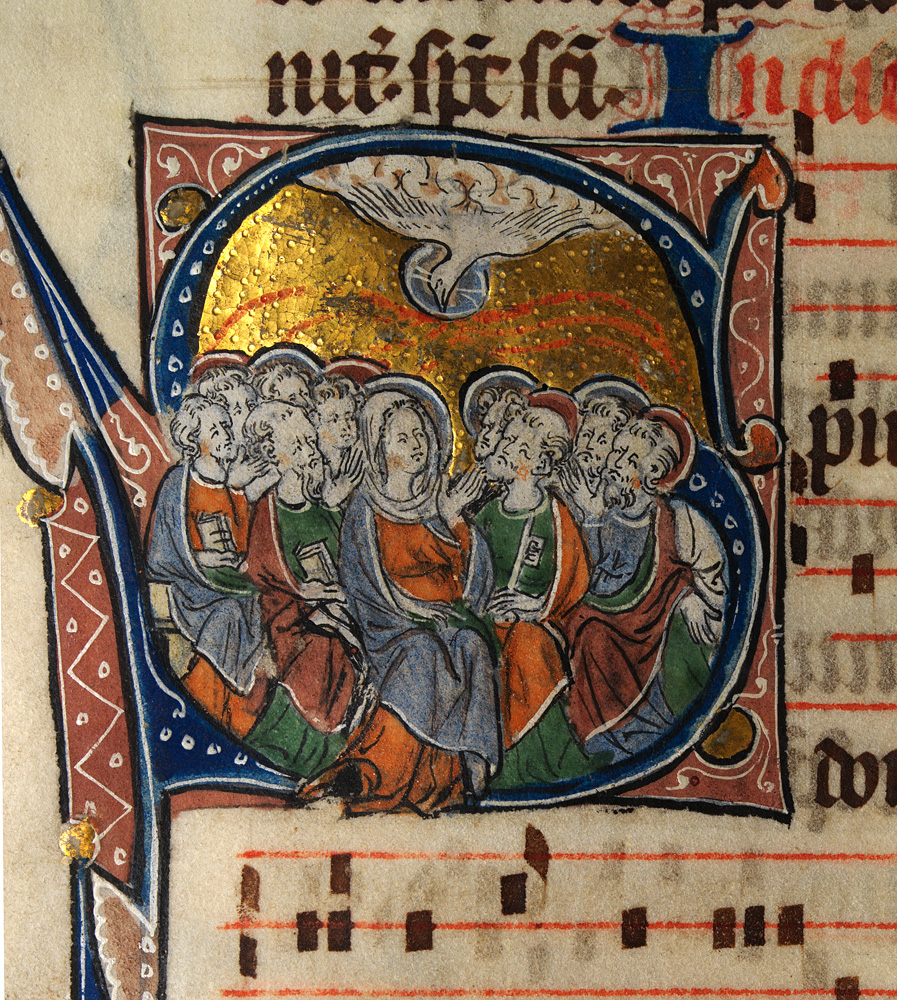
Image credit: Pentecost, Sherbrooke missal, fol. 169v, c. 1320
Time marches ever on, and the new term is on the horizon.
It will soon be time to put the next iteration of the OMS booklet together. If you are organising a seminar series, reading group, or one-off event (conference, medievally-themed social event, workshop etc), please email the details to medieval@torch.ox.ac.uk ASAP. If you are still awaiting confirmation on the finer points of your event (eg. paper titles), please send a place-holder email so that an entry can be made in preperation.