The new Introduction to Middle High German by Howard Jones and Martin H. Jones (OUP 2024) is a dedicated student edition of The Oxford Guide to Middle High German, designed for taught courses and self-study. It provides an accessible overview of the grammar and lexis of the language suitable for introductory-level students and includes thirty extensively-annotated texts with explanatory notes suitable for use in teaching. It is accompanied by a companion website which gives open access to further online resources for the study of Middle High German.
Introduction to the workshop by Howard Jones and Henrike Lähnemann
The workshop was designed as a test case to show ways of using the ‘Introduction’ within a university setting or for self-study . Participants got access to the online version and worked with it in groups ranging from beginners to experts on aspects of Middle High German. The “Translathon” consisted of a group competition to translate and comment on passages of the Middle High German text ‘Helmbrecht’.
Translatathon with six competing groups, translating lines 984 to 1035, featuring
00:00 Group 1: Nicholas Champness, Nina Cornell, Philip Flacke, Anna Vines 00:38 Group 2: Sharon Baker, Monty Powell, Willa Stonecipher, An Van Camp 01:14 Group 3: Theodore Luketina, Daniel Ruin, Nina Unland, Hestia Jingyan Zhang 02:04 Group 4: Reuben Bignell, Greta Evans, Andreas Groeger 03:01 Group 5: Joshua Booth, Lia Neill, Catriona Robertson 03:49 Group 6: Isabelle Gregory, Wilfred Lamont, William Thurlwell
The workshop took place on Saturday 2 November 2024, 2-6pm, Taylor Institution Library, Room 2, University of Oxford. Participants were students from first-year undergraduate to doctoral level – a range of people, in fact, who wanted to acquire, practise, and improve their knowledge of Middle High German. No previous knowledge of Middle High German was required. Organisers Sarah Bowden, Howard Jones, and Henrike Lähnemann
During the Medievalist Coffee Morning on Friday, 21 June 2024, Henrike Lähnemann launched her new book The Life of Nuns. Love, Politics, and Religion in Medieval German Convents, Cambridge: Open Book Publishers 2024, open access: https://www.openbookpublishers.com/books/10.11647/obp.0397 To purchase a paper copy with a 20% discount, use the code LONHL_24 at checkout
Medingen O1: Bodleian Library, MS. Lat. liturg. f. 4: Prayer book: Easter (end 15th to early 16th cent.), fol. 174v: the community of nuns; fol. 288r: Music notation
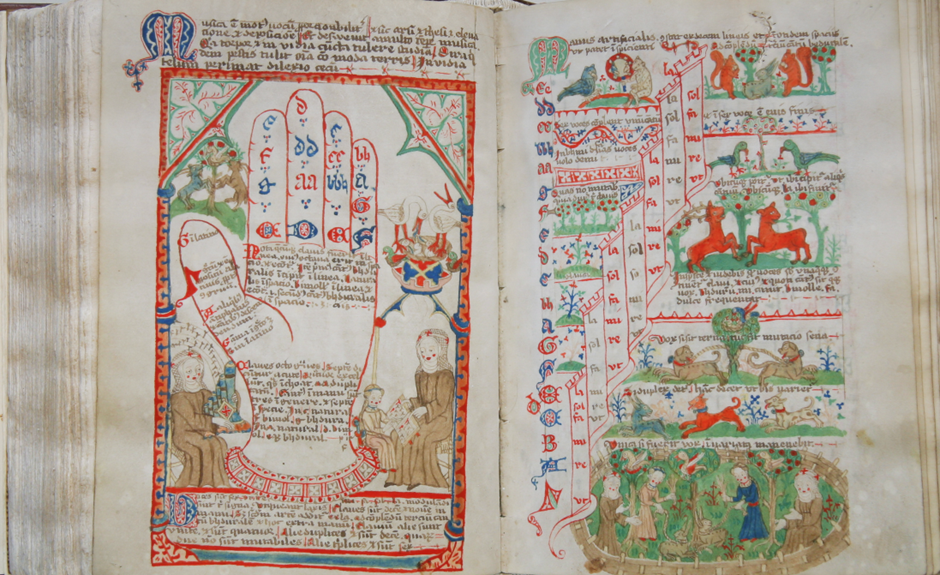
Medingen O2: Bodleian Library, MS. Lat. liturg. e. 18: Manual for the Medingen Provost (1472/1479), fol. 36v/37r: liturgical drawings; fol. 47vb: Harrowing of Hell initial
Medingen O4: Bodleian Library, MS. Don. e. 248: Psalter by Margarete Hopes (early 16th cent.), fol. 173r: Harrowing of Hell; fol. 196r: Resurrection
Rule of St Clare: Bodleian Library, MS. Lyell 68, 1457
Following this, there was a presentation by Stacie Vos (Ann Ball Bodley Visiting Fellow in Women’s History) talk about Women doing medieval studies in the early 20th century. Stacie reflected on the legacies of several early-20th-century women medievalists who pursued academic and extra-academic careers. She started the group ‘Enclosure’ which January 2021 to February 2024 was hosted at the Faculty of Medieval and Modern Languages under enclosure.mml.ox.ac.uk, now archived at the Bodleian Library Web Archive.
***
It all started with a mistake: ‘Der Spiegel’, a widely read news magazine in Germany, ran a double-spread article on the big research project which Eva Schlotheuber and I direct, the edition of 1.200 letters from the Benedictine convent Lüne in North Germany. In the interview for it, we had talked about how important education by the nuns was for the ‘Lehrkinder’, children educated at the convent. The girls would come into the community, aged 7 to 9, and then get a thorough grounding in a wide range of discipline such as music, as pictured in the scene from a text book from Kloster Ebstorf.
Teaching Music in the Convents (Ebstorf, Klosterarchiv V 3, 15th century, fols 200v–201r)
Der Spiegel’ turned our phrase of ‘Lehrkinder’ into ‘die Kinder der Nonnen’ (the children of the nuns) – hinting at sex and scandal behind convent walls (in 2/2020 ‘So colourful was the life of nuns in the Middle Ages’).
This sparked further media interest and the Ullstein publishing house approached us because it had piqued their interest. When we explained that the attention-grabbing headline about “the nuns had children” was based on a misunderstanding, they were slightly disappointed – but then offered us the opportunity to set the record straight. And, arguably, what we could offer was much more exciting: the colourful and detailed accounts of lively, intellectual, strategic, argumentative, powerful women, shaping religion and politics of their times, looking after the girls (despite or even because they were their spiritual and not biological daughters!), negotiating business deals, writing, painting, composing and influencing the way we live today through their books, songs, and art.
‘The Life of Nuns’ tries to capture the richness of the life of these medieval nuns by incorporating as much primary source material as possible. Each of the big topics – such as Education, Music, and yes: Love and Friendship – starts with an account taken from the diary of a nun who lived at the end of the 15th century in the convent St Crucis in Braunschweig. The anonymous author covers the high feasts – celebrating the entry of new nuns, welcoming illustrious visitors – and the everyday mundane events – lice, Lebkuchen (gingerbread), laundry. And we end every of our chapters with the presentation of a significant art work from the convents: the impressive wall paintings done in the 14th century by “three nuns all called Gertrud” in Wienhausen, the largest medieval world map in Ebstorf (30 goatskins sewn together), tapestries, statues, stained glass, the oldest spectacles in the world (fallen through the floorboard cracks in the nuns’ choir) – an embarrassment of riches from a world that few people even know existed. That is particularly true for an Anglophone audience since so much of the evidence is lost due mainly to the dissolution of the monasteries but also a repurposing of surviving architecture and treasures. Compare Kloster Wienhausen and Godstow Abbey: in Wienhausen we have got the full set of monastic buildings, cloisters, huge grain stores, cells, corridors, imposing Gothic nuns choir and more – and everything that furnished it: stained glass, wall paintings, sculptures, down to the different set of dresses for the statues.
The Cistercian Convent of Wienhausen from the South: Magazine (left) and Nuns’ Choir. Photograph: Henrike Lähnemann
Filming at the ruins of one Godstow Abbey near Oxford
In Godstow, on the other hand, we can sense the dimensions of its former power by looking at the impressively long surrounding wall of enclosure and glimpse some of its stylish beauty from the ruined chapel at the back – the rest is only possible to reconstruct from scant archival evidence. Looking at the German counterparts, who shapeshifted through the Reformation, transforming into Protestant female communities who still look after the rich tapestry of medieval life, offers the chance to rectify this in part – and encounter the Life of Nuns at their fullest, mystical, worldly, polyphonous and very much relevant still today.
The Medieval Women’s Writing Research Group Conference 2024 will be held on 18th June 2024 with the theme of “Exchanging Words” in Room 2 of the Taylor Institution Library both in person (presenters/attendees) and online (attendees).
Tuesday 18 June 2024, 9am – 5pm Online and In-person, Room 2, Taylor Institution Library, Saint Giles’, Oxford OX1 3NA Free but registration required Register here for in-person attendance – Sold out Register here to join the conference online Online registration closes 15 minutes before the start of the event. You will be sent the joining link within 48 hours of the event, on the day and once again 10 minutes before the event starts.
The aim of this conference is to explore the concept of exchange, whether it be textual or material, to, for and between women in the global Middle Ages. As a research group based upon the concept of exchanging ideas, we wish to explore medieval women’s own networks of exchange and transmission, and the influence of this upon both the literature and culture of the period as well as the present day.
We are delighted to present the programme for the day:
9:00-9:30 Registration 9:30-9:45 Welcome and Opening Remarks 9:45-11:15 Session 1 “Scholarly Networks” Katrin Janz-Wenig (SUB Hamburg) & Lenka Panušková (The Czech Academy of Sciences) | Communication Strategies Through Change: Translations, Compilations and Ekphrasis Ved Prabha Sharma (Independent Researcher) | Women Scholars and Knowledge Exchange in Medieval Indian shāstrārth Tradition Tatiana Barkovskiy (University of Cambridge) | A Beguinian Learning Network, or How to Approach ‘Medieval Women Mystics’ as Philosophers 11:15-11:45 Break with Refreshments 11:45-13:15 Session 2 “Relationships With and Between Women” Costas Gavriel (University of Oxford) | Gaining the Queen’s Confidence: The Relationship Between Leonor López de Córdoba and Catherine of Lancaster, Queen of Castile Lucia Akard (University of Oxford) | Talking About Rape and Exchanging Knowledge in Medieval Dijon Meg Greenough (Independent Researcher) | The Wilton Matrix: Mothering in Goscelin of Saint Betin’s Liber Confortatorius 13:15-14:30 Lunch Break Exploring the Taylorian’s Treasures, with Professor Henrike Lähnemann (University of Oxford) 14:30-15:45 Keynote Address Professor Diane Watt (University of Surrey) | Medieval Women Writers: Troubling a Feminist History of British Women’s Writing 15:45-16:15 Break with Refreshments 16:15-17:45 Session 3 “Nuns’ Words” Francesca Maria Villani (University of Bari) | Eloise’s Psalmody: Body and Voice Through the Epistles Jane Bliss (Independent Researcher) | The Nun Changes her Library Book Hilary Pearson (Independent Researcher) | Teresa de Cartagena’s Models of Female Authority 17:45 Closing Remarks 18:00 End of Conference
The research group and the conference are generously funded by The Oxford Research Centre in the Humanities (TORCH) and their “Critical-Thinking Communities” Initiative.
Putting a halt to in-person events, face-to-face conversations unmediated by a digital screen, and forcing people around the world to re-think how the interacted with each other, COVID-19 also placed a stranglehold on much academic dialogue and conferences experiences. One of the victims of the pandemic era was the Cambridge, Oxford, and London Symposium on Old Norse, Old English, and Latin (COLSONOEL). The last COLSONOEL was due to take place in St. John’s College, University of Oxford in May 2020 but which was sadly cancelled due to COVID-19 restrictions.
In 2024 a new committee at the University of Oxford, headed by Natasha Bradley, and comprising of Ashley Castelino, Simon Heller, and Mary Catherine O’Connor, took up the reins to bring this symposium back to life. In the spirit of its return to the world of conferences and academic discourse, the theme of COLSONOEL 2024 was ‘Rebirth, Renewal, Renaissance’. This symposium for post-graduate students and early career researchers was set up as a supportive and welcoming academic environment for presenters to test new ideas and to share their research. And it is in this vein, that COLSONOEL began again and hopes to continue for many years to come.
COLSONOEL 2024 kicked off on a wet and dismal Friday 3rd May in St Hilda’s College in the Garden Room Suite, which transformed into an exciting day of papers and conversations. Exquisite views stretching over Oxford with its dreaming spires rising to the rain-sodden heavens framed the speakers and their presentations at St Hilda’s as we welcomed ten speakers from Oxford, Cambridge, and Birkbeck.
Considering the question of reception and intertextual relationships in the first session, David Bond West opened COLSONOEL with his paper on ‘Rhetorical Storytelling in Bergr Sokkason’s Mikjáls saga’. Moving from Old Norse to Old English, Mingwei Lu examined the relationships between psalms and elegies in the paper ‘“Hu lange wilt þu, Drihten” – A Comparison of Religious Revival in the Old English Psalms and the Old English Elegies’. Leaping forward to the modern era, Emily Dixon asked what it meant to think through soil and landscapes in her paper ‘Rebirth through soil: The earth of Tolkien’s Middle Earth, Beowulf and The Wanderer’.
Following this line of movement to earth-centred evidence and thinking about what can be uncovered through archaeology, Katie Beard opened the second session with her investigation into amulets, ‘Armaments as Amulets in Old Norse in Old Norse Literature and Archaeology’. Daisy Bonsall worked through the theme of the conference in thinking about the multiple uses and re-purposing of textiles in Anglo-Saxon England in ‘A Case for Regifting: Reusing Textiles to Create and Renew Connections in Anglo-Saxon England’.
The inter-relationship of life and death and the possibility of comparing through these ontological concerns took centre stage in session three as Alexia Kirov discussed images and themes of birth and death in ‘Re: birth and death – from (pre-)cradle to grave in Early English Literature’. What are the appropriate responses to the death of king and what is the emotional performance a poet may engage in when his king dies? Molly Bovett looked at some of these questions and more in ‘The Death of the King in Hallfreðar saga vandræðaskálds’. Staying in the realm of Old Norse literature but migrating from the historical world of medieval Norway and Iceland to the world of the mythological texts, Kendra Nydam closed the third session with her paper ‘Thrice-burnt, Thrice-born: Revisiting the Fateful Role of Gullveig in Norse Mythology’.
How different medieval historians and societies think about and write about the past formed a key concern of the concluding papers in the fourth and last session of the day. In ‘Reviving the Gothic Past and justifying a Swedish present in the Festum patronorum regni Suecie’ Adrián Rodríguez turned attention to historiographical concerns in fifteenth-century Sweden. Moving one last time from Scandinavia back to medieval England, Emily Clarke gave the closing paper ‘Reforming the Past: History and Antiquarianism in the English Benedictine Reform’.
An intellectually curious atmosphere and friendly environment created a fertile and productive day of discussions in the form of question-and-answer sessions after the papers as well as more informal conversations in the tea breaks and lunch. The COLSONOEL Committee would like to thank everyone who attended this year’s symposium. We would also like to extend a special thanks to our sponsors, Oxford Medieval Studies and TORCH, who made COLSONOEL 2024 possible. We look forward to the return of COLSONOEL 2025.
Practices of Contrafacture in Monophonic Song (1150–1550)
When: 20 June 2024 (week 9), 10am-7pm Where: Committee Room, Faculty of Music Convenor: Philip Wetzler
Looking at different repertories of monophonic song between 1150 and 1550, the aim of this workshop is to explore different approaches to the widespread spectrum of practices and concepts of contrafacture: composing new texts for pre-existing melodies. The fact of a song being a contrafact will not be taken as a result but as a starting point for further inquiries. In this workshop we will encounter similarities, analogies, and differences between different regions, languages, genres, and times between 1150 and 1550, looking at Trouvère, Sangspruch and Minnesang, religious song (geistliches Lied), Meistersinger and puy societies.
The schedule will be split into two parts: the first half is reserved for presentations of individual papers with a following discussion, in the second half we will collectively examine and interpret further selected case studies. Anybody interested is welcome to attend the presentations and take part in the discussions. If you want to attend or if you have questions, please email Philip Wetzler.
The workshop is generously funded by the Evangelisches Studienwerk Villigst e.V.
Preliminary schedule with provisional titles
10:00 – 10:30 Coffee/Tea
10:30-11:00 Introduction
11:00 – 11:45 Joseph Mason, Satire, allusion, erasure: approaches to contrafacture in trouvère songs of war
11:45 – 12:30 Philip Wetzler, From Contrafact to Practices of Contrafacture: Middle High German Sangspruch and Practices of Contrafacture
12:30 – 13:30 Light Lunch Break
13:30 – 14:15 Anna Wilmore, Ludic Lyrics: Play and Piety in Marian Contrafact
14:15 – 15:00 Agnes Rugel, “geistlich lieder, doch in weltlichen weysen”. How practices of contrafacture structure the landscape of religious songbooks in late medieval Germanspeaking areas
15:00 – 15:30 Tea/Coffee Break
15:30 – 17:00 Collective Discussion of Case Studies
17:00 – 17:30 Tea/Coffee Break
17:30 – 18:30/19:00 Collective Discussion of Case Studies
19:00 Dinner (self-paying)
Image from the Hohenfurt Songbook (Hohenfurter Liederbuch), fol. 65r, Hohenfurt / Vyssí Brod (Bohemia), Stiftsbibliothek Ms. 8b
CAT is back! After a successful run in June 2023, artist in residence at the Physics Department Pam Davis has developed a second art-piece ‘Conversations Across Time’. Free tickets for the performances moving from the Ashmolean to a second secret hidden location are available via the website https://www.citizensai.com/
Dates: June 15th (preview at 11am – 1:20pm) | June 15th | June 16th
Schedule: 15:20 Meet on the steps at the Ashmolean Museum 15:30 Prequel 16:00 Departure for Scene Two 16:15 Scene II is in a Quantum Anomaly [hidden location] 17:40 End | Conversation to Follow
Players: Giovanni De Felice, Sirui Ning and, Juliette Imbert, PDK, Costi Levy, Directors:PDK and Costi Levy Composer: Cheryl Frances-Hoad
From the announcement in 2023: What do horses, medievalists, black hole orbits, boardrooms, and quantum computers have in common? Inspired by the Medieval Mystery Plays, artist in residence at the Physics Department Pam Davis has developed an art-piece ‘Conversations Across Time’ which links medieval theatre, women in science, and Quantum future.
Tuesday 4 June 2024, 12 noon–4PM Lecture Room 6, New College, Oxford
We are delighted to announce New College Library’s upcoming exhibition ‘Mythical and Monstrous: Fantastical Creatures at New College Library’.
Hunt for weird and wonderful beasts in items from the College’s fabulous special collections, from dragons and unicorns, to centaurs, blemmyes, and merpeople.
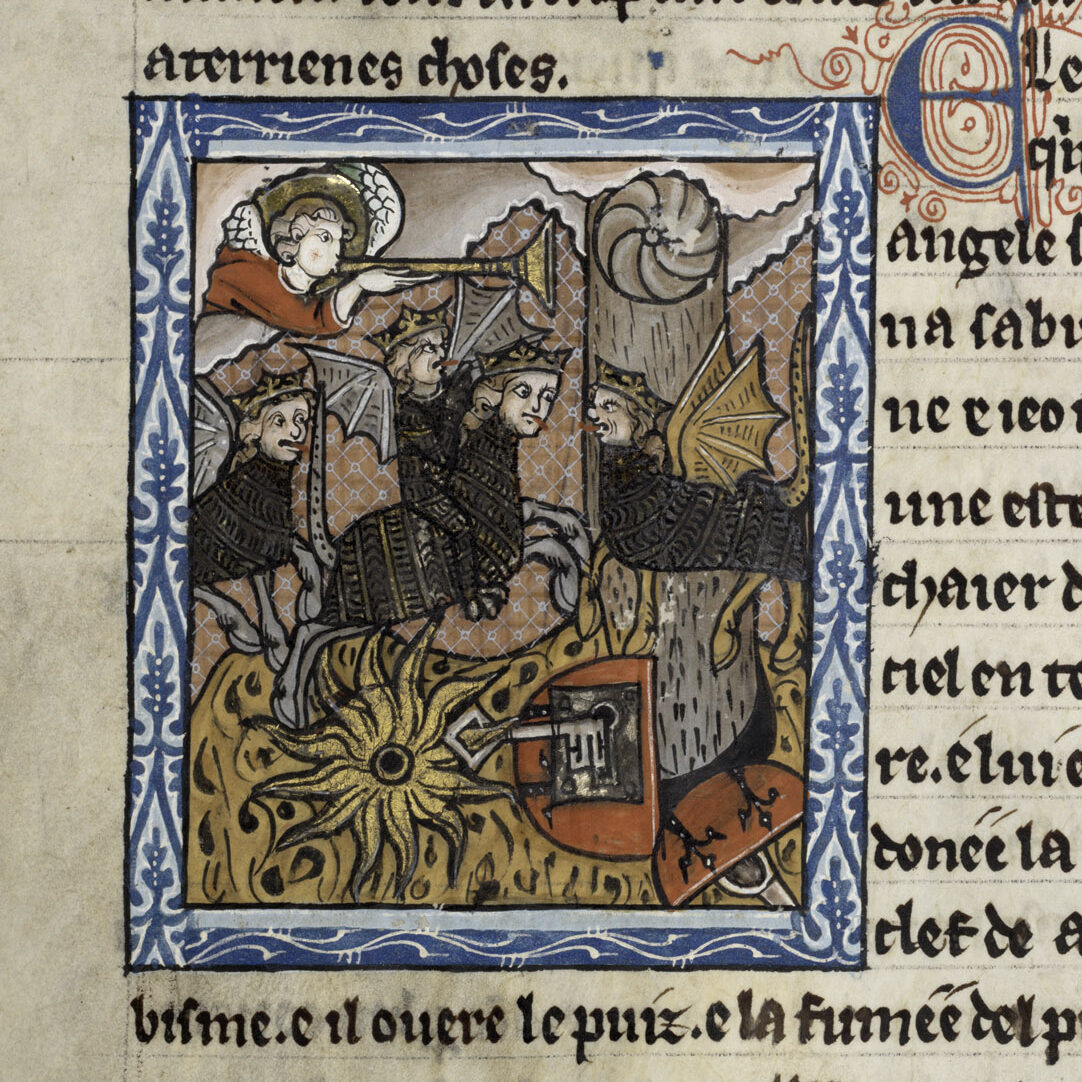
Among the wide variety of items on display will be a beautiful thirteenth-century Psalter, a fantastic fourteenth-century apocalypse manuscript, a famous fifteenth-century chronicle, and a spectacular sixteenth-century astronomical text.
Discover how depictions and understandings of mythical monsters changed over time and explore what these creatures reveal about how people saw themselves and the societies in which they lived.
New College Library, Oxford MS 284, f. 21rNew College Library, Oxford MS 65, f. 30 r
The exhibition is free and open to all. Signs will be in place to direct visitors to the exhibition from the Porters’ Lodge, located halfway down Holywell Street.
Wednesday, 29 May 2024, 5.15-6.45 UK time Memorial Room: The Queen’s College, Oxford
Dr Peter Tóth (Cornelia Stark Curator of Greek Collections at the Bodleian Libraries, Oxford) will speak on “In Quest of a Medieval Best-Seller: The Authorship of the Meditationes Vitae Christi” as term lecture for the Centre for Manuscript and Text Cultures
The Meditationes Vitae Christi, an anonymous medieval retelling of the life of Christ, appended with a number of extra and emotional details, has been described as the single most influential Franciscan text of the Middle Ages. A real best-seller that has come down to us in hundreds of manuscripts and versions in Latin and almost all the vernaculars of Medieval Europe. The text is known to have exercised an immense influence on Western spirituality and devotion and had decisive impact on Renaissance art and played pivotal role in the evolution of medieval Passion Plays and European theatre in general. Despite this enormous significance, the origin, date and authorship of the work has remained obscure and been in the focus of heated scholarly debates. After a brief survey of the problems of the text and the current scholarly consensus about its origins, the present paper will make an attempt to identify the author of the text and reconstruct its adventurous early history to explain its subsequent anonymity.
Image: Meditationes vitae Christi. English translation by Nicholas Love. Bodleian Library MS. Hatton 31, fol. 28v, mid-15th century. On medieval.bodleian.ox.ac.uk
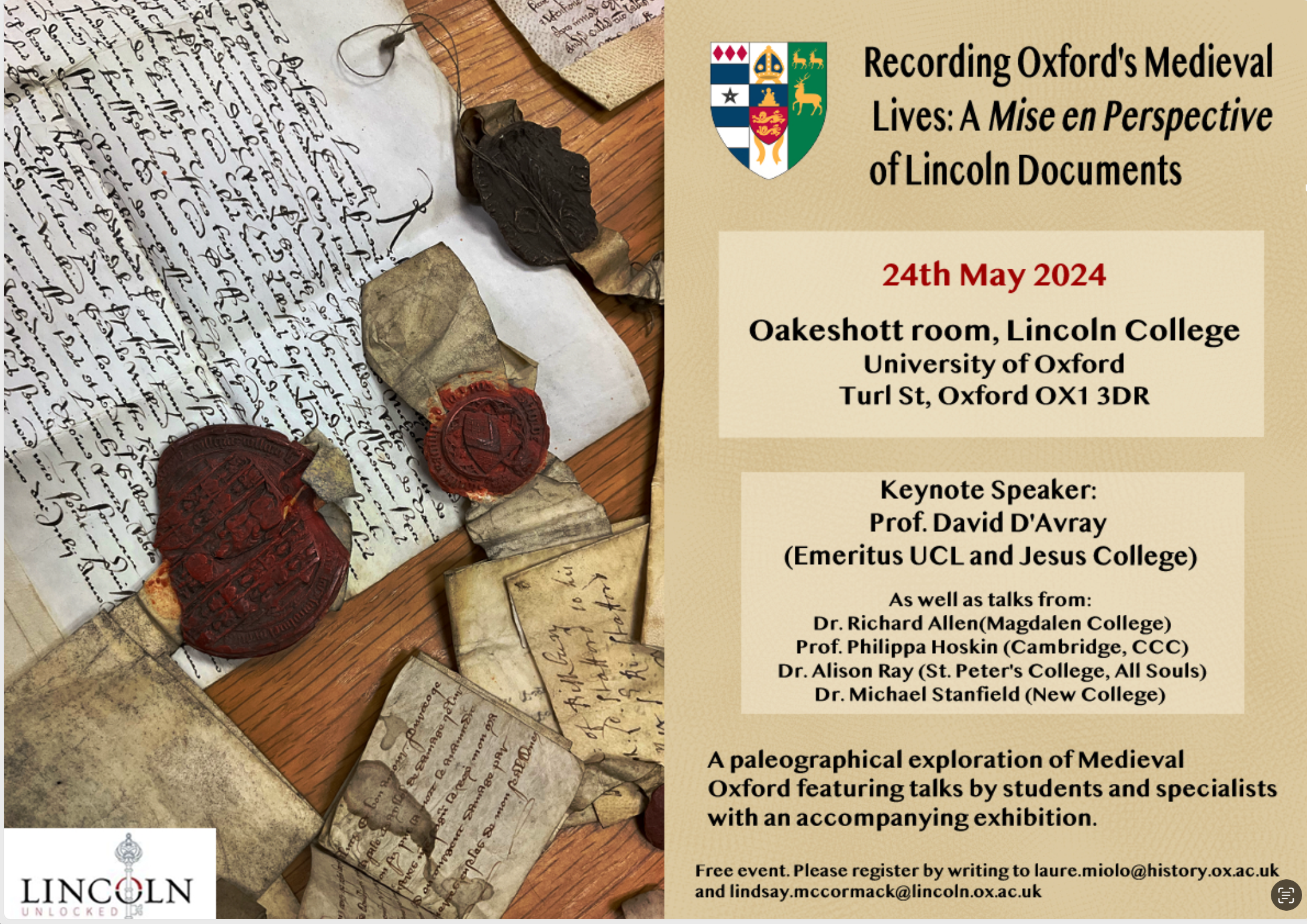
A one-day conference, Recording Oxford’s Medieval Lives. A Mise en Perspective of Lincoln Documents, as part of the seminar started in October, Exploring Medieval Oxford through Lincoln archives.
The conference in the Oakshot Room of Lincoln College featured student presentations on their year-long research into Lincoln’s medieval documents, alternating with academic papers. Anyone with an interest in the history of medieval Oxford and medieval documents in general was welcome. Organised by Laure Miolo and Lindsay McCormack (Lincoln College Archivist).
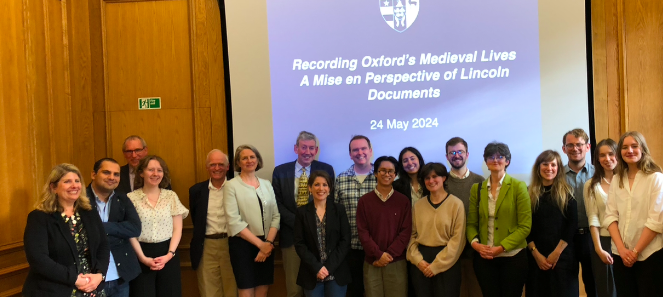
The presenters and other participants
10.00 Prof. Henry Woudhuysen (Rector of Lincoln College) Welcome words
10.15 Dr. Laure Miolo & Lindsay McCormack (organisers – Lincoln College) The seminar Exploring Medieval Oxford through Lincoln Archives
10.30–11.15 Dr. Alison Ray (St Peter’s College and All Souls) Archival sources for the medieval Oxford book trade
11.15–11.30 Break & refreshments
11.30–11.55 Tabitha Claydon, Claire Holthaus and Sam Oliver Their current research on medieval documents from All Saint’s Parish
11.55–12.10 Cory Nguyen and Charlie West Their current research on medieval documents from All Saint’s Parish
12.10–12.55 Dr. Richard Allen (MagdalenCollege, Oxford) ‘Qui scripsit hanc cartam’: Charters and their Scribes through the Archives of Magdalen College, Oxford (c.1100–c.1300)
13.00–14.00 Lunch break
14.00–14.15 Keely Douglas and Maria Murad Their current research on Anglo-Norman documents from Lincoln
14.15–14.30 Srija Dutta and Victoria Northridge Their current research on medieval documents from All Saint’s Parish
14.30–15.15 Prof. Philippa Hoskin (Fellow Librarian of the Parker Library, Corpus Christi College, Cambridge) Stamps of approval: the meaning of seals on medieval documents
15.15–15.30 Mehmet Tatoglu and Lucy Turner Their current research on medieval documents from All Saint’s Parish
15.30–15.45 Break & refreshments
15.45–16.30 Dr. Michael Stansfield (New College, Oxford) The Archival Ambition of William of Wykeham
16.45–17.00 Jess Hind and Lika Gorskaia Their current research on medieval documents from All Saint’s Parish
17.00–18.00: Break and drinks reception
18.00–18.45 Keynote lecture Prof. David d’Avray (UCL / Jesus College, Oxford) Comparative diplomatic: papacy and English royal government
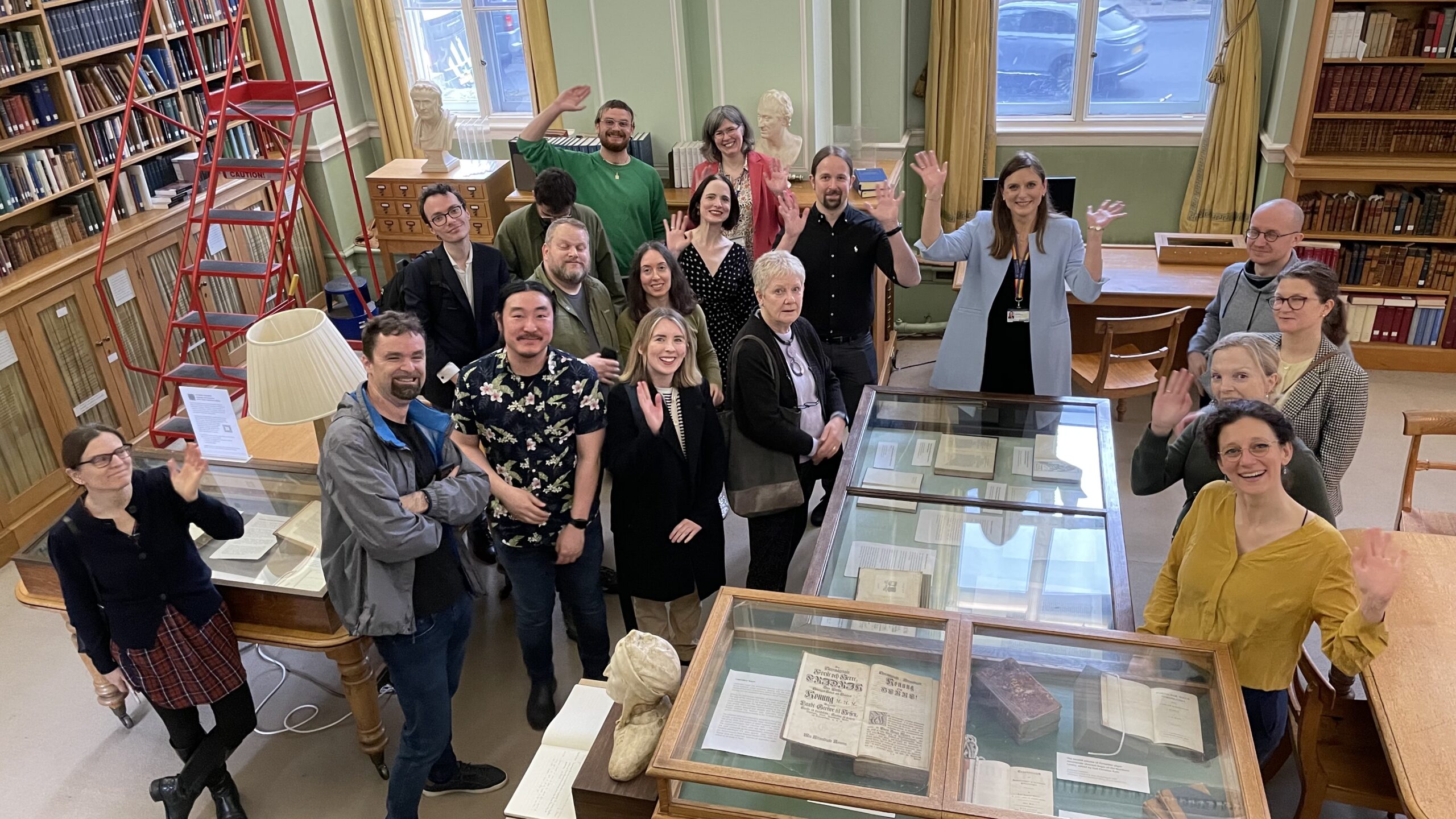
This blog post and book display in the Voltaire Room between 3 and 10 May is a showcase of the excellent range of books on Old Norse-Icelandic language and literature held at the Taylorian. The display accompanies the launch of new digital editions of three versions of an Old Norse-Icelandic saga,Hrómundar saga Greipssonar, in the Taylor Editions series, and the release of an open access study of the saga’s transmission history,Lost but not forgotten: The saga of Hrómundur and its manuscript transmission, by Katarzyna Anna Kapitan.
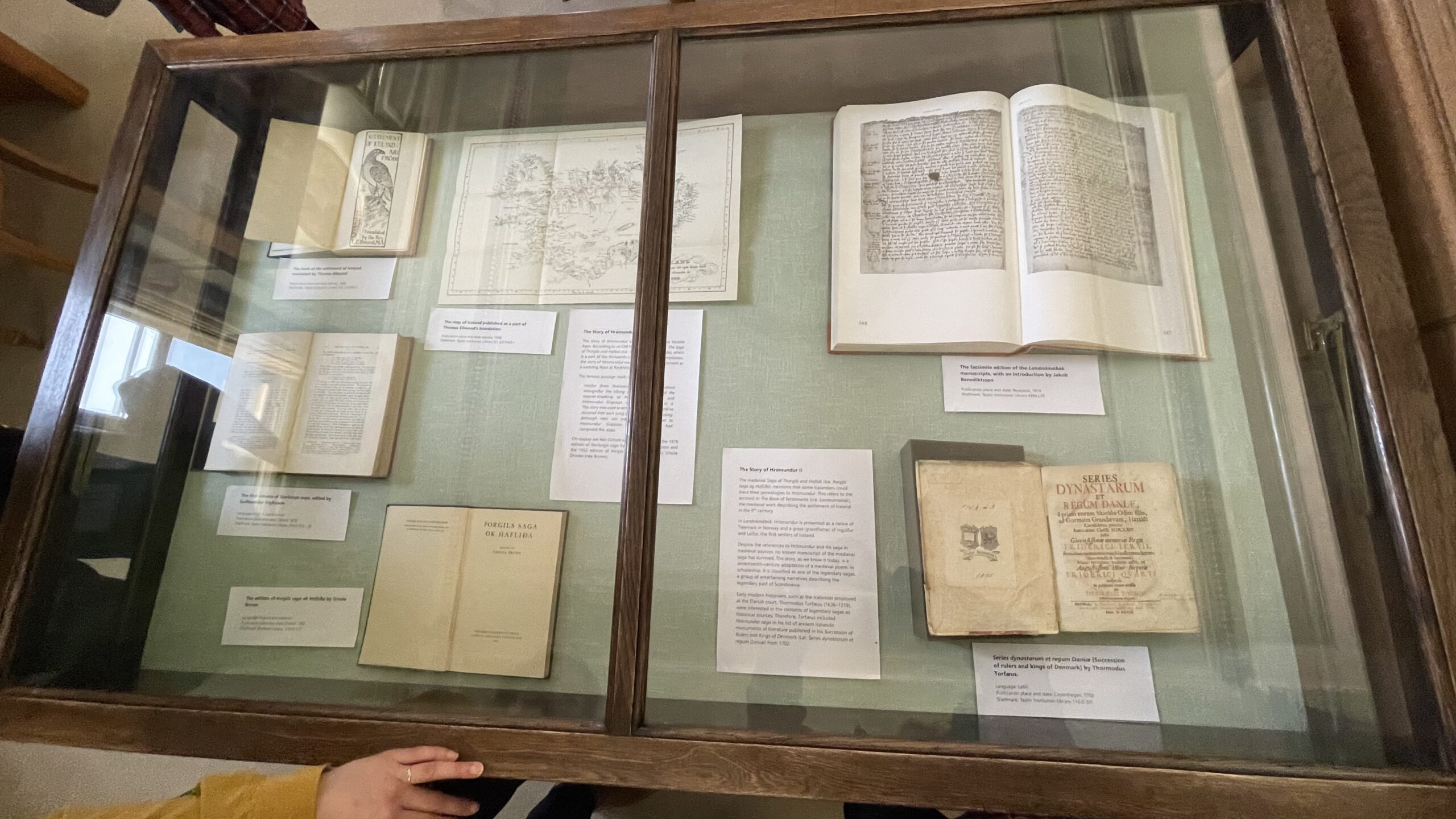
To limit the number of books on physical display, the exhibit was structured around three themes: Icelandic Language and Literature in Oxford, The Story of Hrómundur, and Legendary Sagas. All items on display are from the holdings of the Taylor Institution Library, unless otherwise specified on the label.
Panel 1: Icelandic Language and Literature in Oxford
The first book on the Icelandic language published in Oxford appeared in 1688. It was a reprint of the 1651 Copenhagen edition of the first early modern grammar of Icelandic by Runólfur Jónsson (d. 1654), an Icelander educated at the University of Copenhagen. At Oxford, the first formal lectureship in Old Icelandic was established in 1884, to which Guðbrandur Vigfússon (1827–1889) was appointed. Guðbrandur, born and raised in Iceland moved to the UK to supervise the completion of the Icelandic–English dictionary, initiated by Richard Cleasby (1797–1847). He was awarded an honorary M.A. degree by Christ Church in 1871. In Guðbrandur’s memory, the Vigfusson Readership in Ancient Icelandic Literature and Antiquities was established at Oxford, and in 1976 the first woman was elected to this readership, Ursula Dronke, née Brown (1920–2012). Ursula held a professorial fellowship at Linacre College and is best known for her work on the Poetic Edda. In her early days, she was a fellow at Somerville College, where she wrote her B.Litt. thesis on The Saga of Thorgils and Haflidi (Ice. Þorgils saga og Hafliða), the published version of which is on display here along with some of Guðbrandur’s most important works.
Recentissima antiquissimæ linguæ septentrionalis incunabula [The Most Recent Cradle of the Most Ancient Northern Language] by Runólfur Jónsson Language: Latin Publication place and date: Oxford, 1688 Shelfmark: Taylor Institution Library 9.E.9.B(2)
An Icelandic-English Dictionary by Richard Cleasby and Guðbrandur Vigfússon Language: Icelandic and English Publication place and date: Oxford, 1874 Shelfmark: Taylor Institution Library REP.M.113
An Icelandic Prose Reader by Guðbrandur Vigfússon and Frederick York Powell Language: Icelandic and English Publication place and date: Oxford, 1879 Shelfmark: Taylor Institution Library RHO 053 r.9
Panel 2. The Story of Hrómundur
The story of Hrómundur existed already in the Middle Ages. According to an Old Norse-Icelandic saga, The Saga of Thorgils and Haflidi (Ice. Þorgils saga og Hafliða), which is a part of the thirteenth-century Sturlunga compilation, the story of Hrómundur was recited for entertainment at a wedding feast at Reykhólar in the year 1119.
The famous passage reads as follows: Hrólfur from Skálmarnes told a story about Hröngviður the Viking and King Ólafur and the mound-breaking of Þráinn the berserk and Hrómundur Gripsson, with many verses in it. This story was used to entertain King Sverrir, and he declared that such lying sagas were most amusing. Although men can trace their genealogies to Hrómundur Gripsson, Hrólfur himself had composed this saga.
On display are two Oxford editions of the saga: the 1878 edition of Sturlunga saga by Guðbrandur Vigfússon and the 1952 edition of Þorgils saga og Hafliða by Ursula Dronke (née Brown).
2.1 The first volume of Sturlunga saga, edited by Guðbrandur Vigfússon Language: English and Icelandic Publication place and date: Oxford, 1878 Shelfmark: Taylor Institution Library (RHO) 053 r. 35
2.2 The edition of Þorgils saga og Hafliða by Ursula Brown Language: English and Icelandic Publication place and date: Oxford, 1952 Shelfmark: Bodleian Library 27855 e.57
The medieval Saga of Thorgils and Haflidi (Ice. Þorgils saga og Hafliða) mentions that some Icelanders could trace their genealogies to Hrómundur. This refers to the account in The Book of Settlements (Ice. Landnámabók), the medieval work describing the settlement of Iceland in the 9th century.
In Landnámabók, Hrómundur is presented as a native of Telemark in Norway and a great-grandfather of Ingólfur and Leifur, the first settlers of Iceland.
Despite the references to Hrómundur and his saga in medieval sources, no known manuscript of the medieval saga has survived. The story, as we know it today, is a seventeenth-century adaptation of a medieval poem. In scholarship, it is classified as one of the legendary sagas, a group of entertaining narratives describing the legendary past of Scandinavia. Early modern historians, such as the Icelander employed at the Danish court, Thormodus Torfæus (1636–1719), were interested in the contents of legendary sagas as historical sources. Therefore, Torfæus included Hrómundar saga in his list of ancient Icelandic monuments of literature published in his Succession of Rulers and Kings of Denmark (Lat. Series dynastarum et regum Daniæ) from 1702.
2.3 The book of the settlement of Iceland, translated by Thomas Ellwood Publication place and date: Kendal, 1898 Shelfmark: Taylor Institution Library ICE.2.D.THO.1
2.4 The map of Iceland published as a part of Thomas Ellwood’s translation Publication place and date: Kendal, 1898 Shelfmark: Taylor Institution Library ICE.2.D.THO.1
2.5 The facsimile edition of the Landnámabók manuscripts, with an introduction by Jakob Benediktsson Publication place and date: Reykjavík, 1974Shelfmark: Taylor Institution Library M94.L35
2.6 Series dynastarum et regum Daniæ [Succession of rulers and kings of Denmark] by Thormodus Torfæus. Language: Latin Publication place and date: Copenhagen, 1702 Shelfmark: Taylor Institution Library 110.D.3(I)
Panel 3. Legendary Sagas
Legendary sagas (Ice. fornaldarsögur) are a group of Old Norse-Icelandic prose narratives dealing with the early history of mainland Scandinavia, before the unification of Norway and the settlement of Iceland in the 9th century. Among the best-known examples of legendary sagas is The Saga of the Völsungs (Ice. Völsunga saga), which has a famous counterpart in the Middle High German epic poem Nibelungenlied; The Saga of Rolf Kraki (Ice. Hrólfs saga kraka), which narrates material related to the Old English poems Beowulf and Widsith; and The Saga of Ragnar Lodbrok (Ice. Ragnars saga loðbrókar), which gained international fame thanks to the TV series Vikings. The Icelandic name fornaldarsögur, assigned to this group of texts, is derived from Fornaldar sögur Nordrlanda, the title of the 1829–1830 edition of select Icelandic sagas by the Danish philologist Carl Christian Rafn (1795–1864). The composition of Rafn’s work was highly indebted to the work conducted by his predecessors, especially the Swedish philologist Erik Julius Björner (1696–1750) and the Danish linguist Peter Erasmus Müller (1776–1834). On display here are important volumes of legendary sagas edited by all three of them.
3.1 Nordiska kämpa dater [Deeds of Nordic Heroes], edited by Erik Julius Björner Language: Icelandic, Swedish, and Latin Publication place and date: Stockholm 1737 Shelfmark: Taylor Institution Library 108.I.14
3.2 The second volume of Sagabibliothek [Saga Library] by Peter Erasmus Müller Language: Danish Publication place and date: Copenhagen 1818 Shelfmark: Taylor Institution Library 106.D.6
3.3 The second volume of Fornaldar sögur Nordrlanda [Ancient Sagas of the Northern Lands], edited by Carl Christian Rafn Language: Icelandic Publication place and date: Copenhagen 1829 Shelfmark: Taylor Institution Library N.S.12.ADDS.F.24