CfP: Medieval Germany Workshop

The deadline for proposal submissions is 15 February 2026.

29 May 2026, German Historical Institute in London
Organised by the German Historical Institute London and the German History Society

This one-day workshop on the history of medieval Germany (broadly defined) offers an opportunity for researchers from Europe and the wider English-speaking world to meet at the German Historical Institute in London. Participants will be able to discuss their work in a relaxed and friendly setting and to learn more about each other’s research.

Proposals for short papers of 10–15 minutes are invited from researchers at all career stages with an interest in any aspect of the history of medieval Germany. Participants are encouraged to present work in progress, highlight research questions and approaches, and point to yet unresolved challenges of their projects. Presentations will be followed by a discussion.

Participation is free of charge and includes lunch and dinner. The GHIL and the GHS will also provide a contribution towards travel expenses. Accommodation costs cannot be reimbursed. Support is available for postgraduate and early career researchers: up to £150 for travel within the UK (excluding London) and up to 300€ for an economy round trip from Europe. Please indicate your interest in travel support in your application.

We look forward to reading your proposals. Please send your submission—which must include a title, an abstract of c.2000 words, and a biographical note of no more than c.1000 words—to Thomas Kaal: t.kaal@ghil.ac.uk. Questions about all aspects of the workshop can also be sent to Marcus Meer: m.meer@ucl.ac.uk.

Students and researchers interested in medieval German history are also very welcome to attend and listen to the presentations. There is no charge for attendance, but pre-booking is essential. If you would like to attend as a guest, please contact Kim König: k.koenig@ghil.ac.uk.

There will be two plenary speakers as respondents, one of them Henrike Lähnemann who recently gave the annual GHIL lecture:

A Medieval Saint in the Modern World: Oswald of Northumbria in Words and Music

12 February, 6:15–8pm, The Chapel at King’s College London/River Room, Strand Campus
with Sarah BowdenHannah Conway, Johanna Dale and Hazel Gould

An evening exploring creative responses to medieval saints. The focal point is the world premiere of the new work “My Name is Oswald” by award-winning composer Hannah Conway and writer Hazel Gould. This work draws on stories of Oswald of Northumbria, a significant early English king and pan-European saint, and new research by King’s academics Sarah Bowden and Johanna Dale. The performance will be accompanied by short readings from medieval texts and discussion.

“My Name is Oswald” will be performed by Tim Dickinson (baritone), Peter Sparks (clarinet), Joseph Walters (horn), and Hannah Conway (piano). 

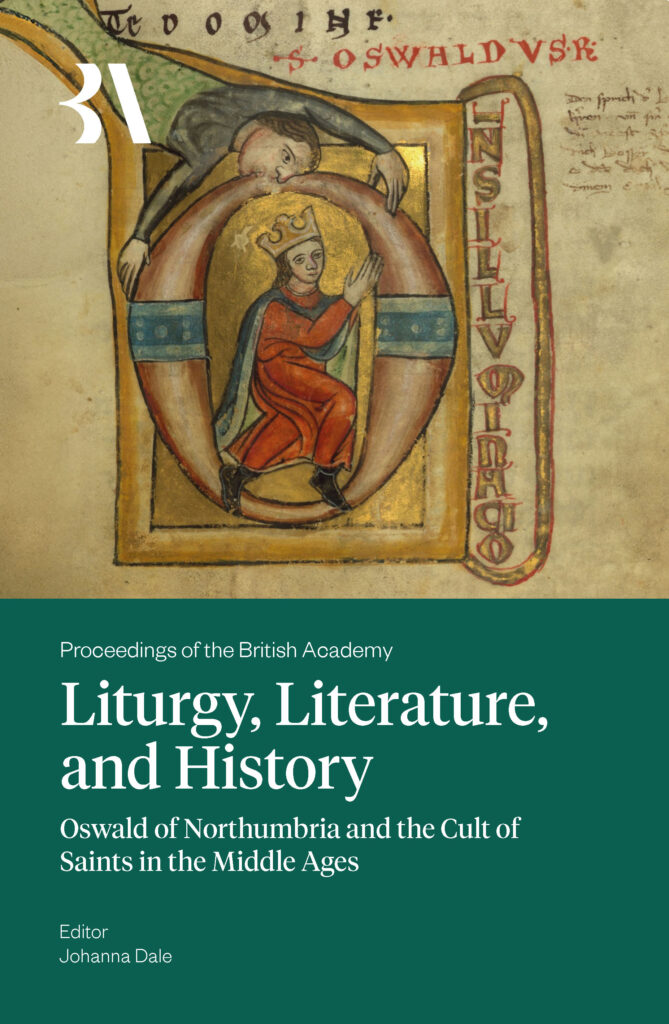
The event will begin with a drinks reception in the River Room at 6:15 p.m., which will also celebrate the publication of Liturgy, Literature and History. Oswald of Northumbria and the Cult of Saints in the Middle Ages, ed. Johanna Dale (Liverpool University Press, 2025). The performance itself will take place in the College Chapel at King’s College London, from 6:45pm. 

Further information and registration link (free): https://www.tickettailor.com/events/kingsartshums/2017759

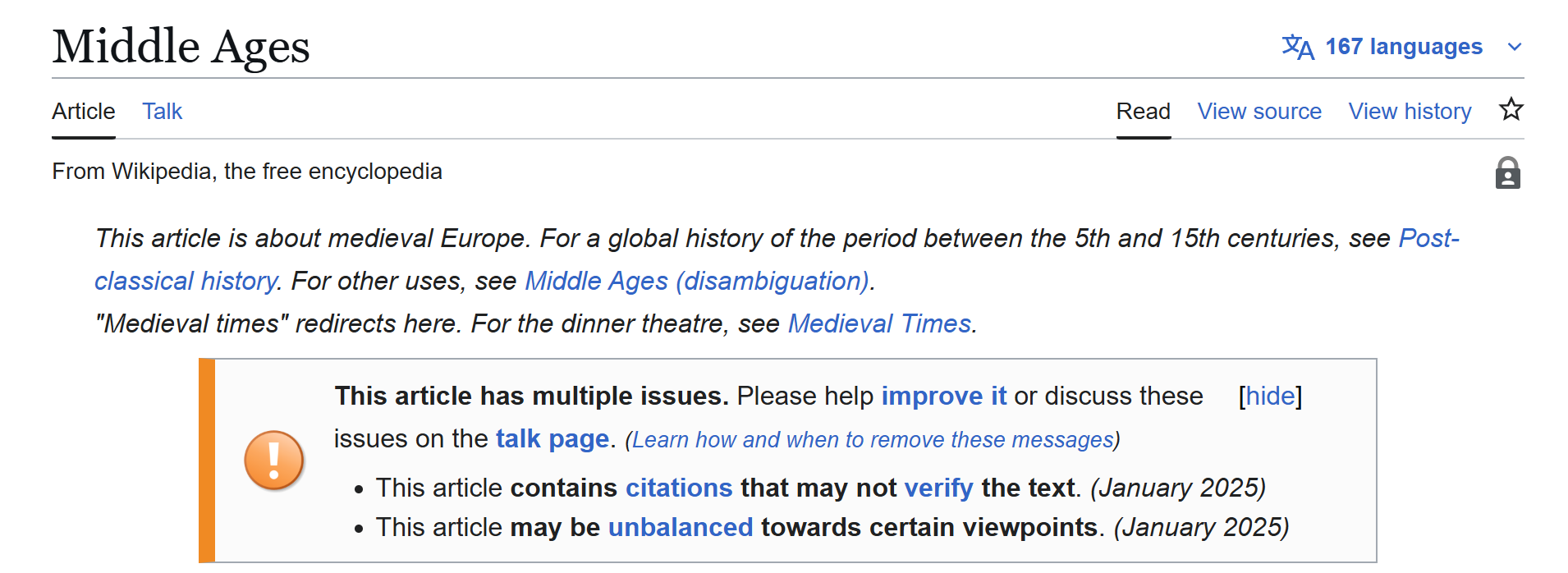
A Screenshot of the beginning of the "Middle Ages"-Wikipedia article.

Wikipedia Editathon for Medievalists

20 February, 5–10pm, St Edmund Hall (tbc)
with Louise Tjoline Keitsch

This workshop invites everyone – students, researchers, and anyone curious – to take part in a Wikipedia Editathon for Medievalists. Whether you have always wanted to write or improve a Wikipedia article, are looking for a low-pressure way to start writing about your topic, or simply want a productive and enjoyable distraction from exams or papers, this editathon offers a space to do so!

Participants are encouraged to bring a topic they would like to work on: this could be a medieval object, person, concept or manuscript; an existing Wikipedia article that needs improvement; or an article that could be translated into another language. Prior experience with Wikipedia editing is not required – beginners are very welcome. Bringing a few sources is helpful, but online articles or similar are perfectly acceptable starting points.

The editathon is designed as a low-pressure entry. Participants can focus on clarity, structure, and communicating knowledge to a broad audience rather than perfection or originality in the academic sense. Contributions can be published immediately, offering a rare sense of instant gratification alongside meaningful scholarly engagement. Throughout the session, support will be available, either through a short introductory tutorial or hands-on help in small groups, depending on participants’ needs.

Editing Wikipedia means contributing to a vibrant, active community and helping shape what knowledge is publicly visible. Make a public impact, practice digital humanities, be part of a broader effort to make Wikipedia more equitable (for example by addressing the persistent gender gap in biographical articles) and increase the visibility and accuracy of medieval topics on the platform! Please come by to write, to learn, to experiment, and to contribute to shared knowledge – all while eating pizza at 6pm!

Can’t wait to start? Read Help:Getting started with Wkipedia, especially Help:Your first article.

Excellent (German) articles, that are enjoyable to read and can be used as an inspiration – and could be translated ;):

Gebetbuch Ottos III. | Monatsbilder | Haus zum Walfisch

If you have any questions, please send an email to Louise Keitsch at louise.keitsch@kunstgeschichte.uni-freiburg.de

Medieval Church and Culture Seminar

Tuesdays. Meeting from 5pm; papers begin at 5.15pm

Tuesdays, Charles Wellbeloved Room, Harris Manchester College

Tea & coffee from 5pm; papers begin at 5.15pm

Everyone is welcome at this informal and friendly graduate seminar

Week 1                        Medieval Church and Culture Social

17 January                   Come along for tea, coffee, and biscuits in the Charles Wellbeloved Room from 5pm-6pm. A chance to share ongoing research, catch up informally, and give suggestions for themes and speakers in coming terms. All are welcome. 

Week 2                        David d’Avray (UCL)

24 January                   The medieval legacy (to 1234) of the first decretal age (c. 400)

Week 3            Susannah Bain (Jesus)

31 January                   Maps, Chronicles and Treaties:  defining political connections in late-thirteenth-century northern Italy                                    

Week 4                        Mary Hitchman (Wolfson)

7 February                   Martyred Mothers: Augustine’s sermons on Perpetua and Felicitas

Week 5                        Federica Gigante (History of Science Museum)

14 February                 Islamic spoils in a Christian context: the reuse of Islamic textiles in Medieval Italian churches

Week 6                        Laura Light (Les Enluminures)

21 February                 The Paris Bible:  what is it, and why its name matters

Week 7                        Bee Jones (Jesus)

28 February                 Bernard’s ‘barbarians’: the Irish in the Life of Malachy

Week 8                        Henrietta Leyser (St Peter’s) and Samuel Fanous (Bodleian Library)

7 March                       The Vision of the Monk of Eynsham

Convenors:Lucia Akard (Oxford SU);  Sumner Braund (St John’s), Bee Jones (Jesus), Lesley Smith (HMC)

Programme Trinity Term 2021

Everyone is welcome at this informal and friendly graduate seminar. This Trinity Term, as always, MCC will feature presentations from the 2020-21 Medieval Studies MSt cohort on their upcoming dissertations. on teams (click on this link to join)

Convenors: Sumner Braund (St John’s), Amy Ebrey (St John’s), IanMcDole (Keble), Lesley Smith (HMC)

Week 2 (4 May): Pilar Bertuzzi Rivett (Lincoln): Ten Names, One God: Exploring Christian-Kabbalistic affinity in a Christian hymn of the twelfth century
Samuel Heywood (St Peter’s): The Finnish Product: translation and transmission of Luther’s hymns in Finland and Sweden

Week 3 (11 May): Jennifer Coulton (Wolfson): Tongue-tied and Legal Loopholes: binding motifs in Early Medieval England
Florence Eccleston (Jesus): The Emotional and Embodied Experience of the Seven Deadly Sins, c.1350-c.1500

Week 4 (18 May): James Tomlinson (Magdalen): The Relationship between Music and Architecture in Late Medieval Creativity: structure, allegory, and memory
Irina Boeru (Wadham): At the frontier of the known world: cartographic and heraldic encounters inLibro del Conosçimiento de todos los Rregons et Tierras et Señorios que son por el mundo, et de las señales et armas que han

Week 5 (25 May): Arielle Jasiewicz-Gill (Oriel): Lay Devotion and Performative Identity in the Fifteenth Century
Florence Swan (Wolfson): The devel of helle sette his foot therin! A literary historical analysis of the cook in late medieval England

Week 6 (1 June): Thomas Henderson(Linacre): Twelfth-Century Mathematical Thinking: an anonymous fractions treatise, Oxford, Bodleian Library, MS Auct. F.1.9