International Conference in Cerisy-la-Salle and Caen (9-13 June 2027)
Organisation : Pierre Bauduin, Alban Gautier, Marie-Agnès Lucas-Avenel
(Université de Caen Normandie, Centre Michel de Boüard – CRAHAM)
We do not know exactly the date of William the Conqueror’s birth. It seems that the
future Duke of the Normans and King was born between mid-1027 and mid-1028. His
mother’s name – Arletta or Herleva – is mentioned only in much later sources; as for
his father, Duke Robert ‘the Magnificent’, he had but recently succeeded his brother
Richard III, who had died on 6 August 1027 in circumstances that remain uncertain.
The year 1027 was rich in political events. On Whitsun Day (14 May), the young Henry
– that is, the future Henry I, King of France – was anointed in Rheims, his father King
Robert II being still alive. Forty years after Hugh Capet’s accession, the new Capetian
monarchy was now firmly established and its legitimacy was no longer disputed.
Several princes of the realm, including Richard III, attended the ceremony. Not long
before, on Easter Day (26 March), Emperor Conrad II had been crowned in Rome.
This new emperor inaugurated a new dynasty, that of the Salians, having succeeded
Henry II, last of the Ottonians, who had died without an heir in 1024. This succession
had been disputed, particularly in Italy, but Conrad had been able to curb opposition
and receive the imperial crown. Among the princes who attend the event was Cnut the
Great, King of the Danes and of the English. In a letter addressed to his Insular subjects
during his stay in Italy, Cnut told of his pride for participating in the event and being
received by grandees from all Europe, and he also mentions the fact that it was for himan occasion to visit Rome as a pilgrim, something he had wanted to do for a long time.
This visit may be seen as a climax in the reign of the Danish king, who had become
one of Europe’s most powerful rulers. His power was by then undisputed in England,
where he had been able to coopt some of the country’s elites: Earl Godwine, one of
his most prominent supporters, had married one of the king’s kinswomen and their
second son, the future King Harold II, had been born a few years earlier. Cnut had
himself married Emma of Normandy, the widow of his Anglo-Saxon predecessor
Æthelred II and the sister of Richard II of Normandy (which made her young William’s
great-aunt), and their son Harthacnut was then still a young boy. Emma’s children from
her earlier marriage, including the future Edward the Confessor, were then refugees at
the Norman court, where they probably had many occasions to meet William in the
years of his childhood. But at that time, they were no major threat to Cnut, who
focussed on other plans: the main one was to establish control over Norway. It was
done the year after (1028), when some of the Norwegians rebelled against their king
Olaf Haraldsson, who was defeated in the battle of Stiklestad and forced to flee. If we
are to believe William of Jumièges, Olaf had actually been baptised in Rouen in the
mid-1010s; after his death in 1030, he was considered a martyr and rapidly became
Norway’s national saint. If we take this game of chronological concordances a little
further, the year 1027 was also that of the deaths of Gaimar III of Salerno, one of the
first Southern Italian princes who called upon Normans, and of Romuald of Ravenna
(on 19 June), that is St Romuald, founder of the order of the Camaldolese hermits, a
reformer of Western monasticism who probably influenced the spirituality of John of
Ravenna… who himself succeeded William of Volpiano at the Norman abbey of
Fécamp in 1028.
A broader perspective over the fifteen of so years that surround the year 1027/8 allows
us to mention the following events: the death of Emperor Basil II, one of the most
important Byzantine rulers, in December 1025; the disintegration of the Umayyad
Caliphate of Cordoba in 1031; Richard of Verdun’s great pilgrimage, which brought
700 pilgrims (including Normans) to the Holy Land in 1026; King Sigtrygg Silkenbeard
of Dublin’s own pilgrimage to Rome in 1028, in the wake of which, having returned via
Cologne and Canterbury, he founded the bishopric of Dublin; the deaths of Wulfstan II,
archbishop of York (28 May 1023), of Fulbert of Chartres (10 April 1028) and of
Adalbero of Laon (27 January 1030), three of the most important ecclesiastical and
intellectual figures of the time. Several major construction works in Western Europe
were also started in the same period, including the abbey church in Fleury (SaintBenoît-sur-Loire) after the fire of July 1026, the cathedral of Speyer (one of the grandest Romanesque buildings) around 1030, and the abbey church of Mont-SaintMichel in 1023 (which was the subject of a recent conference in Cerisy).
These few events, all taking place around the time of William’s birth, are enough to
show that the world in which the future duke and king was born was characterised by
interacting relationships and dynamics. Of course, nobody at that time could have
guessed that here and then were woven the threads of events and motions that would
span the next century, nor would they have anticipated the connexions which today’s
historians see between them.
Our conference will draw inspiration from the methods of so-called ‘connected history’,
here simply defined as an approach that aims to establish links between different
national or regional historical traditions which have long remained isolated and tries to
avoid a perspective that would focus exclusively on Normandy or France. We want to
stress mobilities and their consequences, connexions and transfers between diverse human communities. Because of this global perspective, we do not wish to exclude
any discipline or methodology (history, art history, archaeology, philology…) that helps
exploring this world in which William was born. This is also why we wish to gather
scholars from many horizons, countries and disciplines, in order to discuss the
following topics.
1/ Knowing about the world
Geographical knowledge was not, in the early eleventh century, as reduced as it has
been said to be. In the Islamic world, in the Latin West or in Byzantium, representations
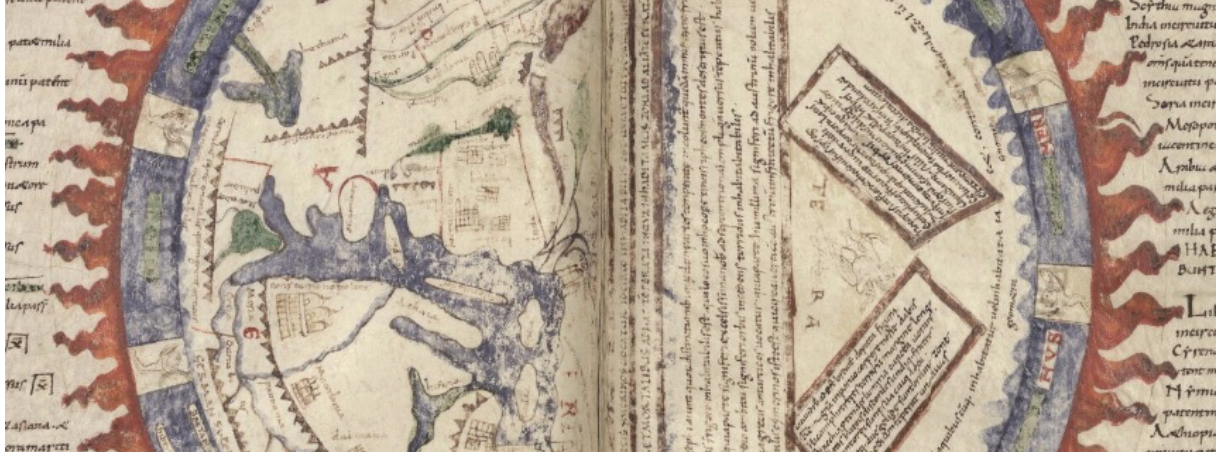
of the earth are known both in maps and texts. The British Library’s ‘Cottonian World
Map’ was made around 1025/1050; it is roughly contemporary with the Bibliothèque
nationale de France’s ‘Saint-Sever mappa mundi’, illustrating a manuscript of Beatus
de Liebana’s Commentary on the Apocalypse. More broadly, in the century that ended
with the First Crusade, knowledge of the world informed Western representations of
the Other – Eastern Christian, Muslim, Jewish or pagan – that were undergoing radical
transformation. We particularly aim to understand how the Normans and the
populations with whom they came into contact perceived each other. By the late the
tenth century, members of Rollo’s dynasty were still regularly perceived and
stigmatised as descendants of pagan pirates of the North, but they increasingly
appeared as Latin Christians like any others, even as models of Christian behaviour.
Proposed themes:
- Knowledge of the world.
- Cartography.
- Knowledge and representations of Others.
2/ Moving through the world
Many roads allowed travellers from Normandy to reach other regions, and the Normans
were keen to use them. There were maritime roads towards Britain, Ireland or
Scandinavia, but towards Aquitaine, Iberia and, beyond that, the Mediterranean –
especially Southern Italy, Byzantium and the Holy Land. There were also roads over
land and up and down rivers, and travel often combined several means of transport.
We will follow attested circulations and retrace the itineraries followed by people,
commodities and ideas. We also wish to focus on the places where connexions were
made and on the people who enabled them, especially in the case of Normans: in an
English lawcode that mentions Norman merchants in London in the first decade of the
eleventh century, or in Warner of Rouen’s poem Moriuht, in which Rouen is shown to
be a port where slave trade was still in operation. Pilgrimage routes are also among
those we want to highlight: to Rome of course, but also to Puglia and Monte Gargano
(where the cult of St Michael echoes contemporary developments in Normandy), to
Compostela (where pilgrimage to St James’s relics precisely took off in the eleventh
century), to Constantinople (where a wealth of relics attracted people in ever greater
numbers) and to Jerusalem (and here we should not forget that Duke Robert the
Magnificent died in 1035 while he was travelling back from the Holy Land).
Proposed themes:
- Itineraries, routes over sea and land.
- Circulations, connexions, networks.
- Trade.
- Pilgrimages.
3/ Places, gender, life and death
Rodulfus Glaber’s terrifying pages on the famine of the years 1031 to 1033 remind us
of how precarious life was then for most of the population. The economic and
demographic balances of the time, and the growth that characterised the West in the
Central Middle Ages have all been reconsidered through new approaches based on
notions of need, resources and the relationship between humans and their
environment. The role played by lordship and coercion, work and the peasantry’s
initiative, technology and innovation, money and its circulation are also among the
factors that should be interrogated. Varied approaches of ‘material culture’ have
revealed new issues, which open more generally to questions about the relationship
between humans and objects. Archaeological sites, newly excavated and published,
help us answer them and bring new informations on conditions of life and residence:
among them, the fortified settlement of Colletière in Charavines (Isère), occupied
between 1006 and 1040, the castrum of Andone (Charente), abandoned in the 1020s,
or the moated residence of Pineuilh (Gironde)… Both in urban and rural settings,
churches and their cemeteries were increaslingly polarising the lives of communities.
Exchanges and connexions between the living and the dead remained a crucial
preoccupation of kin- or church-based groups. Thousands of charters record gifts
made to ecclesiastics ‘for the sake of souls’ (pro anima) or in memory of founders,
donors and their families. It is well-known that women played an important role in such
memorial practices, and the conference will allow participants to explore more broadly
their agency in the social changes of the time. Here, William’s birth may not be such a
significant date, but the perspectives explained above are an occasion to develop
comparative studies which will place Normandy in broader contexts.
Proposed themes:
- Connexions with the environment.
- Material culture.
- Ways of life, settlements.
- Connexions with the dead and the other world; memory of the deceased.
4/ Believing, thinking, creating
Even if the pagan beliefs and rituals imported by Scandinavians in the tenth century
do not seem to have survived in Normandy, the duchy probably was not immune from
what Dominique Barthélemy has called ‘the great awakening of heresy’: indeed, the
whole kingdom was concerned in the early eleventh century, for instance when the
‘Orléans heretics’ were denounced in 1022, as told by Rodulfus Glaber or Ademar of
Chabannes. There was also a movement towards reform of Benedictine monasteries
in the spirit of Cluny: in Normandy with William of Volpiano and his successors, but
also beyond the eastern and north-eastern borders of the kingdom with Richard of
Saint-Vanne in Verdun and Abbo Poppo in Stavelot. A new ecclesiastical elite worked towards the consolidation of lay power, weaving networks of confraternity and fostering
exchanges in the fields of liturgy, ideas, sciences and arts. This was also a time of
development for episcopal schools, for copying and illuminating religious and nonreligious manuscripts, and for creating new works in the fields of theology,
historiography and poetry: we may mention here again Fulbert of Chartres and
Adalbero of Laon, to whom Dudo of St Quentin dedicated his prosimetrical and
panegyrical history of the earliest Norman dukes. New architectural technologies were
also experimented at that time, for example in the abbey church of Mont-Saint-Michel
(the construction of which began in 1023) or in the cathedral of Chartres (the
restoration of which started in 1024). The conference will allow participants to question
or revisit beliefs and categories of thought, spiritual and intellectual debates, traditions
and innovations in literature and the arts, all visible in the early eleventh century.
Proposed themes:
- Circulation of ideas and knowledge, and of artistic processes and techniques
- Religious practices and beliefs, Christian and pagan.
- Religious and cultural networks.
- Production and circulation of manuscripts.
5/ Norman men and women of the 1020s
The Normans of the 1020s may be approaches through varied sources that allow us
to better understand aspects of the society of that time. More than a year after the
duchy had been founded, they shared the ways of life, the language and the beliefs of
the Franks; all traces of the Scandinavian past of the province were rapidly fading. The
conference will revisit these transformations and how they affected the inhabitants of
the duchy. Who were Norman men and women in the 1020s? Did they share common
identities, affiliations, cultural values, and how did they express them? A crucial factor
of cohesion in the duchy and between its inhabitants was the power wielded by the
ducal dynasty. How was the dukes’ authority manifested and how did it frame society
and its diverse components, both lay and ecclesiastical? To which extend can we
perceive the action of social networks based of kinship, friendship, alliances or loyalty
in their different forms (including feudal-vassalic)? What agency did women have in
these networks? Which aspirations, which contestations can we see emerging or
circulating in this society? The conference will allow us to revisit the current image of
a dynamic principality, where public order resisted better than elsewhere and where
peasant communities benefited for more a favourable status or condition.
Proposed themes:
- Norman identity.
- The role played by the Norman dukes and their kin.
- The social and political fabric of the duchy of Normandy.
- Men and women in the duchy of Normandy.
6/ Norman men and women in the kingdom of France and in Europe
As mentioned above, Normans are well-attesed both in the kingdom and in the wider
world. Some of them returned quickly, others remained in exile for long periods before
coming back, others settled permanently abroad. Take Roger de Tosny, who went to
fight Saracens in the county of Barcelona, where he married around 1020 the daughter
of Countess Ermesenda, but finally came back to Duke Richard II. In 1022, Emperor
Henry II drafted 24 Normans to serve the nephews of Meles and fight the Byzantines,
investing them with the county of Comino in Chieti province: we do know some of their
names, such as Torstin Scitel or Hugh Falloc (this one later a companion of Robert
Guiscard). Others settled with Prince Gaimar, while the Duke of Naples gave Rainulf
his sister’s hand, fortifying for him the county of Aversa in 1030. On the other side of
the Channel, a Norman queen, Emma, the daughter of Richard I, reigned twice, first
as Æthelred II’s consort and then as Cnut’s: long before 1066, a Norman princess wore
the English crown. Many Norman knights were also looking for military employment or
marrying into the greatest families, both in Northern and Southern Europe.
Proposed themes:
- The Normans in neighbouring principalities.
- The Normans in Southern Italy and in the Mediterranean.
- The Normans in England and in the Insular world.
Our conference will give priority to proposals that combine several of the approaches
outlined above and help presenting a dynamic vision of the world in which William was
born and understanding how the future ‘Conqueror’ made it change.
The conference will host two kinds of contributions: 30-minute presentations followed
by discussions; and posters on specific case studies, which will be presented by their
authors in a special session. We welcome proposals by early career scholars: the
‘Centre culturel international de Cerisy’ is an ideal venue, fostering discussion and
allowing them to receive advice from members of the scientific board or from other
scholars attending the conference.
Proposals for papers or posters must be sent before 1 June 2026 to all organisers:
Pierre Bauduin (pierre.bauduin@unicaen.fr), Alban Gautier (alban.gautier@unicaen.fr) and Marie-Agnès Lucas-Avenel (marieagnes.avenel@unicaen.fr). Applicants should submit two separate files: a 1-page
abstract, clearly stating how the proposed contribution may fit within one or several topics outilned in the call for papers; and a 1-page CV.