Registration is now open for Hyggnaþing: An Old Norse Graduate Conference, co-organised by DPhil in English student, Natasha Bradley, and funded by the OMS Small Grants fund. Register here!
Hyggnaþing, meaning ‘Meeting of Minds’, is a one-day conference in Old Norse studies that will take place online, with socialisation opportunities offered using Wonder.
Hyggnaþing will be completely live, comprising panels of 20-minute papers and discussion. Inspired by the momentous developments of the past year, the conference theme brings you papers that consider the areas of research that involve change and fluctuation. We hope that, in considering the transitional aspects within the work of the conference’s speakers, they will be able to harness the ambiguities and uncertainties of our time to engage with new ideas and perspectives.
Registration is now open for Hyggnaþing: An Old Norse Graduate Conference
See below for the day’s programme, which features numerous exciting papers from graduate students across the UK and a keynote by Dr Sarah Baccianti of Queen’s University Belfast, who will be speaking on ‘Old Norse Medical Charms: Healing Words and Recipes’.
The conference is free but registration is required. Further details, including the form to register, can be found on the conference website.
This event marks the completion of a three-year digitization project delivered by the Bodleian Libraries, Oxford and the Herzog August Bibliothek in Wolfenbuttel. The ‘Manuscripts from German-Speaking Lands’ project, funded by The Polonsky Foundation, has digitized hundreds of medieval manuscripts from collections at The Herzog August Bibliothek and the Bodleian and made these freely available online to scholars and the public.
The panel discussion will explore the journey of these manuscript collections from their origins in the religious houses of medieval Germany, their acquisition by the libraries in Wolfenbüttel and Oxford and their digitization and publication online.
Speakers
Richard Ovenden OBE, Bodley’s Librarian
Julia Gross, Chargé d’ Affaires a.i. of the German Embassy London
Marc Polonsky, The Polonsky Foundation
Peter Burschel, Herzog August Bibliothek
Henrike Lähnemann, University of Oxford
Joanna Story, University of Leicester
Booking information
When you have booked your place, the ticketing system will send you an automated confirmation.
A link to access the online event will be sent by the morning of the event to the email address associated with your booking.
See our project website for more information about the project and to see the digitized collections.
Medieval Trade Study Day, 1st July, 10am-3:30pm. There are places left for this study day, which will involve small group handling sessions at the Ashmolean in the morning, a packed lunch provided, and afternoon discussions with the group as a whole. If anyone would like to sign up, please fill in the following form: https://forms.gle/LB2wWvWdFU4gKRkXA. The Study Day has been arranged for the Medieval Trade Reading Group to further our conversations from over the past year. Sign up will close at the end of 24th June.
The day will consist of:
Morning: Ashmolean visit. We will have small group handling sessions led by Dr Harris (to abide by Covid regulations). While one group is in the session, the other two will be exploring the museum.
Lunch: Packed sandwich lunches, (probably provided at the Andrew Wiles building but location TBC).
Afternoon: Group discussions about methodologies and primary sources in the Humanities Division building. This is planned to be very much guided by what the group would most benefit from – please indicate preferences below.
The scheduled study day will begin at 10:00 is planned to end by 15:30.
Anyone who has strolled through Oxford and paused to look up at a college window or church tower will have noticed that the city abounds in medievalist architecture. Oxford’s Gothic Revival buildings are not the only material witnesses testifying to nineteenth-century fascination with medieval-inspired styles and with debates harking back to the medieval period. Textile arts also evince how the Victorians read their own age through past ages, and vice versa. Few textiles exemplify this knitting together of past and present as attractively as the textile treasures in the archive of Pusey House, which was established to commemorate Edward Bouverie Pusey (1800-1882), one of the leaders of the Oxford Movement, Regius Professor of Hebrew and Canon of Christ Church.
(The Oxford Movement was a mid-nineteenth century movement within the Church of England that sought to revive an interest in patristics, the sacraments, and ritual, and generally to restore what they saw as pre-Reformation ideals (another instance of medievalism!)).
(One of the altar cloths we discovered, embroidered by Mother Marian Hughes (1817-1912)
Several months ago, the librarian of Pusey House, Jessica Woodward, and Godelinde Gertrude Perk, a researcher at the Faculty of Medieval and Modern Languages, were discussing textiles, both of us being interested in historical embroidery and other fibre arts. Jessica pointed out that the Pusey House archive holds many textiles, several of which are connected to the Pusey family, but also associated with some of the first Anglican nuns. We agreed that it was a pity these textiles were so little known, not only because they were quite expertly made, but also in the light of their historical importance: the Sisters of St Margaret (who owned the book with the sample) and the Sisters of the Holy and Undivided Trinity (one of whom made the corporal) were among the first nuns in the Church of England since the Reformation. Central figures in the Oxford Movement supported this Anglican revival of monasticism.
The spookiest object in the House: a nun doll dressed in the habit of the Sisters of the Society of the Holy and Undivided Trinity, dressed by Mother Marian Rebecca Hughes (1817-1912)
Jessica and Godelinde brainstormed a little about an exhibition and reached out to a fellow academic at the Faculty of Medieval and Modern Languages, Natascha Domeisen for a first look at the textiles, and finally to the textile conservators of the Ashmolean Museum, who generously offered conservation advice and help displaying the objects. The exhibition would never have been possible without the expertise of Clare Hills-Nova, Sue Stanton, and Sebastian Blue Pin; Sebastian came over several times, analysed the fibres, and displayed the objects beautifully.
While we (Jessica, Sebastian, and Godelinde) studied the textiles in order to select the ones to display (the display case being rather moderate in size), we made several unexpected discoveries: we found a handwritten note sewn onto a cloth, which stated that the set of altar linens had been made by Mother Marian Hughes in 1846, the first Englishwoman since the Reformation to become an Anglican professed religious. According to the note, Dr Pusey had used the set when celebrating mass at home. We then discovered an altar cloth from the same set was still in daily use in the Pusey House chapel, despite it being 175 years old. The letters were also quite illuminating, shedding light upon attitudes about embroidery at that time. Godelinde, for one, was also quite delighted to find that a familiarity with medieval religious iconography will stand you in good stead when deciphering Victorian religious art. However, we were most impressed by the skill of the textile artists and their thematic complexity, as emblematized by the corporal and the sermon case.
This blogpost serves as the online version of the exhibition, but if possible, you are warmly invited to visit the exhibition “Threads of Devotion: Textile Treasures from the Pusey House Archive” which can be seen from the 17th of June to the 9th of July 2021. The exhibition is open Monday to Friday, 9:30-17:25 – you can book a viewing slot at https://tinyurl DOT com/puseyhouselib .
1. Wedding veil
Pusey House Archive, PUS/Veil
Date unknown
Vertical maximum 117 cm, horizontal maximum 122 cm
Lace veil of a cream mercerised cotton ground featuring scalloped edges that frame an embroidered border of repeat pattern wheat and floral motifs. The central field displays clusters of larger floral motifs and singular embroidered flowers. This veil is believed to have been worn by Dr Pusey’s wife, Maria Catherine née Barker (1801–1839), at her wedding in 1828, although the tulle seems more characteristic of the early 20th century. It was presented to Pusey House in 1947 by Mrs Edith McCausland née Brine, Dr Pusey’s last surviving grandchild, who claimed it to be Mrs Pusey’s possession.
2. Letter from Edward Bouverie Pusey to his goddaughter, Clara Maria Hole (later Sr Clara Maria), transcribed by Henry Parry Liddon
Pusey House Archive, LBV 125
Originally written on 3 February 1875 at Christ Church, Oxford
The first page reads:
“There is a large proportion of embroidery in your distribution of time … but, I suppose, that, after the illness which you had some time ago, the quietness of needle work would be very good for the brain. I would only say on this, ‘Do not work against time,’ for this would produce an excitement and hurry which would undo the good of a quiet employment.”
Dr Pusey then goes on to recommend reciting psalms or hymns to prevent overtaxing the brain, but concludes his letter with a more optimistic conceptualization of art, presenting God as carving the artwork of the soul by way of trials: “a block of rough stone would not … mind the blows which indented, in view of the beauty of form which it was to acquire hereafter. And the form which we are to have traced in us, is the image of God.” The goddaughter’s crafting should be as deliberate and careful as God’s is.
Dr Pusey’s letter
Dr Pusey’s anxieties about too much embroidery contrast strikingly with Maria Pusey sending a workbox to her goddaughter and wholeheartedly recommending embroidery. This workbox and its accompanying letter can be seen in the cabinet outside the Pusey House Chapel.
According to the caption, the second page of the letter, now hidden by the first page, recounts how Mrs Pusey ‘had learnt to value needlework when she was ill and was pleased that her goddaughter had asked for the workbox as a present’.
Maria Pusey’s letter
3. Sermon case made for Dr Pusey by an anonymous embroiderer
Pusey House Archive, Object 15
1847
32.5 cm by 25.5 cm
Obverse cover: folded card covered in burgundy silk velvet, edged with twisted braid of metal threads and secured with a whip stitch. The centre of each face bears a cross motif, possibly of palm wood, that is overworked with basket weave type embroidery (replicating cross repetitions) in metal threads, creating a raised emblem. Interior: ground fabric of cream dyed silk embroidered with polychrome silk threads in a floral, foliate and fruit design. The Lord’s Prayer, the blessing and the dedication have been worked in embroidered stitches.
With its raised cross with metal embellishment, the sermon case recalls opus anglicanum, medieval religious embroidery produced in England. Victorians believed these medieval embroideries to be the handiwork of nuns, although they were actually predominantly produced in professional workshops in London. We do not know who made this particular gift for Dr Pusey, but Mother Marian Rebecca Hughes (1817–1912), the first Anglican Sister to take vows since the Reformation, is one likely candidate. She was a friend of Dr Pusey’s who made several embroideries for him during the 1840s (see item 4). If she is the artist, the medieval echoes in this embroidery present her as part of a long lineage of female monastics: she restores a tradition disrupted during the Reformation.
(Note the misspelling of “Christ Church” as “Christ’s Church”)
(Obverse cover)
4. Corporal made by Mother Marian Rebecca Hughes (1817–1912) for Dr Pusey
Pusey House Archive, PUS/Lin/1
1846
25 cm by 25 cm
Ground of plain weave mercerised cotton embroidered with red and blue silks. The outer border exhibits Neo-Gothic text and large Greek crosses worked in raised stumpwork to create a dimensional effect. The central field dedicates patterning to fleurs-de-lis and small Greek crosses executed in a chain stitch which frame the monogram of the Holy Name (IHC, Jesus Christ), again in raised stumpwork technique.
A corporal is a square linen cloth onto which the chalice with wine, the paten (silver plate) with bread, and the ciborium (a container for additional hosts) are placed during the consecration of the bread and wine. This particular corporal gives material expression to Tractarian understandings of the Real Presence in the sacrament. The border reads Hoc est corpus meum quod pro vobis traditur (“This is my body, which is given for you”), the words of the consecration of the Eucharist as given in the first Epistle to the Corinthians (11:24) and recited by the celebrant. The circle surrounding the monogram recalls the host, and the monogram itself also draws attention to the presence of the Incarnate Christ in the sacrament. The fleurs-de-lis (lilies) in Marian blue are a traditional attribute of the Virgin Mary, likewise alluding to the mystery of the Incarnation; the red circles signify Christ’s five wounds and, by extension, his Passion.
This corporal forms part of a set that is now 175 years old. A hand-written note, possibly by Henry Parry Liddon (1829–1890), sewn onto an altar cloth states that the entire set was given by Mother Marian Hughes to Dr Pusey, who would use it when celebrating mass privately. A second, larger cloth is still in use in the Pusey House Chapel, literally threading together Dr Pusey’s devotion and that of the House.
5. Sample card from Liberty’s, inserted (by publisher) into Designs for Church Embroidery by A.R and Alathea Wiel. Chapman and Hall, 1894.
Pusey House Archive, SSM 40/298
1894
Samples of polychrome silk floss embroidery thread (Liberty’s) wound around card. This book was the property of the convent of the Society of Saint Margaret, an Anglican order, in East Grinstead, Sussex. The convent also ran a School of Ecclesiastical Embroidery in London, but the library stamp indicates that this copy of the book was kept in the convent. The Victorian era saw an upsurge of interest in the creation of medievalist vestments and church hangings, which women particularly were encouraged to create. These textiles furnished Gothic Revival churches (omnipresent in Oxford!). The faint pencil markings and numbers signal that the nuns were particularly interested in various shades of gold, frequently found in Victorian church embroideries. This use of colour also harks back to opus anglicanum, once again suggesting that the nuns perceive themselves as stitching together past and present.
Photos by Jessica Woodward, Sebastian Blue Pin, and Godelinde Gertrude Perk. Blog introduction by Godelinde Gertrude Perk, captions by Sebastian Blue Pin and Godelinde Gertrude Perk.
Exhibition credits: Conservation Advice: Sue Stanton, Sebastian Blue Pin, and Clare Hills-Nova Captions: Godelinde Gertrude Perk and Sebastian Blue Pin Display & Publicity: Jessica Woodward
At last, after much anticipation, the new term is finally here! Trinity is beginning with a (very sunny and pleasant) bang; take a look at the intellectual banquet on offer in the booklet (newly updated!) and on our digital calendar.
A few announcements to begin:
First, this term’s Oxford Medieval Studies Lecture will be livestreamed on the OMS YouTube channel tomorrow at 5 pm! Come watch Jim Harris present live from the Ashmolean on ‘Museum in the Middle: Medieval Things in a (Still) Medieval University’ and ask your questions on the live chat. We’ll also be officially launching the revived and revamped medieval.ox.ac.uk website.
Another wonderful conference meriting your attention: Medicine in the Medieval North Atlantic World, originally scheduled to take place in March 2020, will now be held over Zoom on 13-15 May 2021. This interdisciplinary event explores the reception and transmission of medical knowledge across England, Ireland, Wales, Scotland, and Scandinavia during the medieval period, and will draw on history, literature, philosophy, science, religion, art, archaeology, and manuscript studies. Plenary lectures include Debby Banham, Guy Geltner, and Charlotte Roberts. Full program and registration details here.
UCL’s Medieval Scandinavia Seminars will run again this term; on 29 April, 5-7 pm, Alisa Valpola-Walker (Cambridge) will speak on ‘Saga and Media-Consciousness in Two Late Fifteenth Century Manuscripts AM 589a-f 4to and AM 586 4to’, and on 27 May, 5-7 pm, Benjamin Allport (Bergen) will offer a paper on a title tbc – details forthcoming. Zoom link for the first seminar here and the second seminar here.
Abusing my position as Communications Officer for an announcement of my own: Oxford Fantasy, the university’s research cluster for fantasy literature, is producing a new series of our popular podcast! Do you have a fantasy author, text, or topic you could talk about accessibly and authoritatively for ten to fifteen minutes? Want to record an audio or video file that will be shared on podcasts.ox.ac.uk, Spotify, and the beloved Great Writers Inspire site? Contact caroline.batten@ell.ox.ac.uk with your pitch. We’re particularly seeking scholars knowledgeable about N. K. Jemisin, Marlon James, and Nnedi Okorafor, but we’re interested in any topic that moves you and encourage a diverse range of fantasy texts and writers. Have a listen to some of our previous material here.
[Seminars], swete [seminars], mi druð, mi derling, mi drihtin, mi healend, mi huniter, mi haliwei. – The Wooing of Our Lord, when properly edited
MONDAY 26 APRIL
The Oxford Byzantine Graduate Seminar meets at 12:30 pm on Zoom. Please register in advance by contacting james.cogbill@worc.ox.ac.uk. This week’s speaker is Katherine Krauss (Somerville), ‘Rereading the “Canon” in Latin Late Antiquity: Exemplarity and Allusion in Macrobius’ Saturnalia’.
The Medieval Latin Reading Group meets 1-2 pm on Teams. Improve your Latin, learn palaeographical skills, and engage first-hand with medieval texts by reading reproductions of manuscripts. Submit your email address here to receive notices.
At 4 pm we have the Germanic Reading Group on Zoom, which will explore alliterative verse in a different Germanic language each week; this week, Rafael Pascual will lead a session on Old English. To be added to the list, contact howard.jones@sbs.ox.ac.uk.
Sign up for Mark Williams’ class on Scottish Gaelic and Modern Irish Poetry, held Mondays at 4:30 pm. Contact mark.williams@ell.ox.ac.uk for locations and links.
The Medieval History Seminar meets at 5 pm on Teams. This week’s speaker is Laurence McKellar (Exeter College), ‘The Language of the Royal Service in Castilian Political Culture, c. 1275-1325’.
Old Norse Reading Group continues its journey through Hervarar saga at 5:30 pm on Teams. Email bond.west@lincoln.ox.ac.uk to be added to the mailing list.
TUESDAY 27 APRIL
The Medieval Book Club meets at 3:30 pm on Google Meet. Contact oxfordmedievalbookclub@gmail.com for the link. This term’s theme is ‘Medieval Legends’, and Week 1 will kick things off with readings on unicorns!
The Medieval French Research Seminar and Medieval Church and Culture Seminar will not meet this week to allow everyone to attend the OMS Lecture at 5 pm.
WEDNESDAY 28 APRIL
The Medieval German Graduate Seminar meets at 11:15 am on Teams. This week will be a short organizational meeting, but guest lecturer Annette Gerok-Reiter will speak on the Tübingen SFB ‘Andere Ästhetik’ at 5 pm on Teams. Contact linus.ubl@some.ox.ac.uk for more information.
Digital Editions Live, a seminar series presenting palaeographical, book historical, and digital humanities projects developed by MML Masters students, will meet at 3 pm on Teams. (Join the meeting here.) This week, Henrike Lähnemann, Emma Huber, and Andrew Dunning will offer an introduction, before Sebastian Dows-Miller speaks on ‘Re-Awakening Merton’s Beasts (Merton College MS 249)’.
The Medieval English Research Seminar meets at 4:30 pm (note the new time) on Teams. Contact daniel.wakelin@ell.ox.ac.uk if you need the link. This week’s speaker is Misty Schieberle (University of Kansas), ‘Rewriting Christine de Pizan: Hoccleve, Misogyny, and Manuscript Evidence’.
The Late Antique and Byzantine Seminar meets at 5 pm on Google Meet (link here). This week’s speaker is Przemysław Marciniak (Katowice), ‘Of Fleas and Men: Byzantine Cultural Entomology’.
THURSDAY 29 APRIL
Sign up for David Willis’ class on Middle Welsh Bardic Grammars; contact david.willis@ling-phil.ox.ac.uk for locations and links.
GLARE (Greek, Latin, and Reception) Reading Group meets at 4 pm on Teams. Email john.colley@jesus.ox.ac.uk or jenyth.evans@seh.ox.ac.uk to be added to the list. This week’s reading will be Aristophanes, Frogs, 51-82, 180-96, 689-99, 1019-56.
The Aquinas Seminar Series continues on the theme of De Magistro: Aquinas and the Education of the Whole Person, at 4:30 pm on Zoom. Please register in advance here. This week’s speaker is Rev Dr Nicholas Austin (Campion Hall), ‘The Education of the Eye: Aquinas and the Virtue of Right Attention’.
Old English Reading Group soldiers through Bede’s Historia Ecclesiastica at 5:30 pm on Teams. Email eugenia.vorobeva@jesus.ox.ac.uk for more information.
Is it just me, or has the vac flown by? Fortunately, it brings spring in its wake, along with open pubs — a felicitous combination. We’re also approaching a brilliant new term of medieval events!
To that end: please SEND ME YOUR SEMINARS AND EVENTS this week, preferably by *FRIDAY (16 April)*, though I will continue to take announcements sent to me on Saturday and Sunday if you let me know in advance that they’re coming. Thanks to those I have already received! Remember, if you don’t send me your events this week, they won’t be in the booklet when it’s first published on Monday!
Also, a few exciting pre-term announcements!
First: the Oxford Medieval Graduate Conference makes a triumphant virtual return in its seventeenth annual iteration! This year’s theme is ‘Memory’, and the full (and exceptional) programme can be found attached to this email. The conference will run Thursday-Friday 22-23 April, and you can register here.
Oxford will be hosting a brand-new Old Norse graduate conference this summer: Hyggnaþing! The virtual conference will take place on 11 August, and its theme is ‘Transition’. Submit your abstracts of up to 250 words to hyggnathing@gmail.com by 1 May. Topics include but are not limited to: religious conversion, orality and literacy, translation, artistic innovation, manuscript production, gender and queerness, political change, social mobility, and modern adaptation.
Looking for a home for your monograph or edited collection on any aspect of Old English literature and related contexts? Look no further than Brepols’ new series Studies in Old English Literature (SOEL), edited by Daniel Anlezark, Susan Irvine, and Francis Leneghan. Questions and potential submissions can be directed to francis.leneghan@ell.ox.ac.uk.
Lastly, but very importantly, the OMS Small Grants for Trinity Term 2021 are still accepting applications! Are you running a medieval activity between April and October 2021 that would benefit from £100-250 of support from OMS? You now have until Friday of Week 1 (30 April) to send your grant form to lesley.smith@history.ox.ac.uk. For an idea of the great things you can achieve with an OMS grant, previous winner Nick Pritchard used his grant to produce a new podcast, Medieval Roots, which you can listen to on Spotify! More episodes to follow this spring.
Get ready for a wonderful Trinity Term, and remember: SEND ME YOUR AMAZING EVENTS!
Personifications of the Seven Deadly Sins in a fourteenth-century manuscript (British Library, Yates Thompson MS. 21, f. 165
The motif of the Seven Deadly Sins was extremely popular in the late medieval period, featuring in everything from literature, hymns, sermons, and manuals to wall paintings, manuscripts, and morality plays. The sins were Superbia, Avaritia, Luxuria, Ira, Gula, Invidia, and Acedia, now generally understood as Pride, Avarice (or Covetousness), Lust, Wrath (Anger), Gluttony, Envy, and Sloth (Laziness). They followed a loose hierarchy. Pride, the most demonic sin from which sprung the rest, came first. It was followed by the ‘spiritual’ vices, envy and wrath. Then came the vices related to the flesh: sloth, then gluttony, avarice, and lust. All were believed to fatally affect the individual’s spiritual health. As Dan Jon Gaytrygge’s mid-fourteenth century sermon expressed it, ‘For als the venym of the neddire slaas manes body, swa the venym of syn slaas manes saule’ (‘for as the venom of the adder slays man’s body, so the venom of sin slays man’s soul.’)
The idea of enumerating sins in this way originated in the early medieval period, and the motif of the Seven Deadly Sins in particular relies on a list made by Pope Gregory I in 590. By the twelfth and thirteenth centuries, Gregory’s list was being defended, deliberated, and extensively explained. A rationale was evolved to explain why seven (a number of great religious significance) and why those specific sins (a tricky matter to prove), and subsets of vices were added to each sin. After the Fourth Lateran Council of 1215 advised annual confession and gave the church greater authority for the remittance of sins, this definition of sin began to appear more frequently in popular literature, sermons, and guides for confessors. The Council stated that the worshippers should ‘faithfully confess all their sins at least once a year to their own (parish) priest and perform to the best of their ability the penance imposed’, the priest ‘carefully inquiring into the circumstances of the sinner and sin’. The Council added ‘let this salutary decree be published frequently in the churches, that no one may find in the plea of ignorance a shadow of excuse’. Clearly it was extremely important for every member of the laity and clergy to protect both themselves and/ or their parishioners from spiritual death and eternal damnation.
Lay people and clergy alike needed tools for recalling and identifying the sins to be confessed, and the numerical device of the Seven Deadly Sins proved very popular. The sins were so frequently expounded and depicted in art that it is likely everyone would understand them. By confessing their Deadly Sins, the perpetrator could achieve complete absolution and a penance to perform as atonement. (More minor sins, called venial sins, could be forgiven without the sacrament of confession, as long as the sinner had made a sincere resolution to reform their behaviour.) Confessing sins was not just about punishment: it encouraged regular self-reflection, and the act of penance and the provocation of shame was believed to bring the soul closer to God and reclaim individuals from a life of sin.
A tree of the Seven Deadly Sins and their fruits (BL Arundel MS. 83, f. 128). For discussion of such images, see this article
The Black Death in the middle of the fourteenth century seems to have increased the prevalence of the Seven Deadly Sins motif, as preparing for death and the afterlife became a primary concern. Dying without fully confessing one’s sins was greatly feared, since it would lead straight to hell. The scale and suddenness of the pandemic, with its estimated 30-60% mortality rate, made this fear a very pressing issue. In the fourteenth and fifteenth centuries, the ever-present threat of death and subsequent fear for the fate of one’s soul became a widespread theme in art and literature.
Paintings of the Seven Deadly Sins in churches would warn the worshipper of the danger and help them to gain protection against Purgatory and Hell. A famous example is found at Trotton in West Sussex, where the Last Judgement mural on the west (back) wall of the church, dating to the last two decades of the fourteenth century, presents the Seven Deadly Sins leading directly to damnation. Christ is depicted at the highest point, atop a cloud, performing judgement from the heavens. Below him to his right are the Seven Deadly Sins, personified by a naked man surrounded by scenes of each sin emerging from the mouths of dragons. Above, an angel sends a soul to hell on Christ’s command. The painting instructs the parishioner on the key behaviours to avoid in life to escape eternal damnation in the afterlife.
Increasing cultural emphasis on death and the afterlife in the second half of the fourteenth century did not just respond to a fear of hell, but also led to a greater interest in codes of morality and virtuous behaviour. The ‘remedies’ to the Seven Deadly Sins were cited in art and literature, and were also classified into Sevens: the Seven Heavenly Virtues and the Seven Works of Mercy. The Seven Virtues combined the four cardinal virtues (Justice, Temperance, Prudence, and Courage) and the three theological virtues (Faith, Hope, and Charity), and were thought to protect against the temptation to sin.
The Seven Works of Mercy referred to actions rather than attitudes, but were also thought to enhance the ability to avoid sin. They are divided into two groups of seven: corporeal (‘bodily’) works, which deal with physical and material needs, and spiritual works, which concern the needs of the soul. The corporeal works are:
To feed the hungry
To give water to the thirsty
To clothe the naked
To shelter the homeless
To visit the sick
To visit the imprisoned or ransom the captive
To bury the dead
Unlike the Seven Deadly Sins, this enumeration is based directly on a list in the Bible. The first six works are listed in Christ’s Parable of the Sheep and the Goats as acts of charity which will lead to salvation. The last was added in the early medieval period to bring the number up to seven, influenced by the emphasis in the Book of Tobit on giving proper burial to the dead. In the Trotton wall-painting, the antithesis to ‘sinful’ man, surrounded by the Seven Deadly Sins, is ‘good’ man personified as a Franciscan friar, surrounded by the corporeal Works of Mercy. These behaviours are therefore sharply classified into good and bad, moral and immoral. Depictions of the Seven Works of Mercy are also frequently found in medieval art, as in the example below:
Neither of these groupings are in direct opposition to the Seven Deadly Sins, and treatises looking exclusively at both the Seven Heavenly Virtues and the Sins are rare. In other words, the sins and virtues do not mirror each other as positive and negative moral positions: for example, the opposite of lust, chastity, is not found among the Seven Virtues, or in any of the actions recommended by the Seven Works of Mercy. Thus although the Seven Deadly Sins is a very common motif in medieval art, it was not usually paired with the moralities, and it was even rarer for them to be directly opposed. More often they formed two separate codes of morality – what to do, and what not to do.
However, performing – or not performing – the Seven Works of Mercy was also a question of sinful behaviour, and so could also be used for confession. A late fifteenth-century instruction for priests, published by Wynkyn de Worde, lists the numerical devices to work through during confession: ‘Synnes be confession of the sevene dedly synnes, […] and thanne in not fulyllyng the seven werkes of mercy’ (‘Sins are confession of the Seven Deadly Sins… and then in not performing the Seven Works of Mercy’). This emphasises that sin is defined not only by sinful action but also neglect of moral duties. It is possible to sin by omission (failing to perform a duty) as well as by commission (committing an actively sinful deed).
Both the Sins and Works gained popularity in the Middle Ages as practical tools to analyse moral behaviour. These lists were aids to the memory and the conscience, helping Christians to interpret and reflect on their own actions and providing simple, memorable guidelines on how to behave more virtuously.
Further reading
For a survey of the Seven Deadly Sins from Late Antiquity to the end of the Middle Ages, see Morton W. Bloomfield, Seven Deadly Sins: An Introduction to the History of a Religious Concept, with Special Reference to Medieval English Literature (East Lansing, Michigan, 1952).
Richard Newhauser, The Seven Deadly Sins: From Communities to Individuals, Studies in Medieval and Reformation Traditions Series, No. 123 (Brill, 2007).
Richard G. Newhauser and Susan J. Ridyard, eds., Sin in Medieval and Early Modern Culture: The Tradition of the Seven Deadly Sins (York Medieval Press, 2012).
A great online resource is Miriam Gill, ‘The Seven Deadly Sins and Seven Corporal Works of Mercy in English Medieval Wall Painting: Imperfect Parallels’ (University of Leicester), available at https://www.le.ac.uk/arthistory/seedcorn/imperf.html
A Note From Florence:
I began writing for Introducing Medieval Christianity in the second year of my undergraduate degree in History of Art after seeing a call for articles open to anyone at any stage of their academic career. I wanted to broaden my interests and knowledge of other disciplines, and I thought researching and writing would be a good place to start. I emailed Eleanor with some possible topics, and wrote my first article ‘Light and Colour in Medieval Christianity’. Since then, I’ve written three more articles, as and when I had the time and inspiration! It has been really great being able to communicate my interests and research to a wider audience.
The British Isles have a very long history, stretching back well before written records began. Much of what we might think of as early history is really legend – tales about the Druids, the story of Cædmon (the ‘father of English poetry’, who lived at Whitby Abbey) and the exploits of King Arthur for example. Interwoven with our understanding of history are the threads of myth, legend and folklore; these shape and colour our understanding of both our past and our present.
WHAT ARE MYTHS, LEGENDS AND FOLKLORE?
Myths are usually understood as stories about gods or divine figures. They answer big questions such as: how was the world created? Where do humans come from? How did we learn to make fire, or to smith metal? What is the origin of the gods? The term ‘myth’ may be used more loosely to cover whole cycles of tales, like the stories of the Irish gods or the Four Branches of the Mabinogi, dealing with Welsh semi-divine characters. Stories that explain where certain peoples come from are known as ‘origin myths’; the most important and enduring origin myth for Britain is the legend of Brutus, a refugee from Troy who sailed to these shores and slew all the giants who were then the only inhabitants, giving his name to the British Isles.
Legends deal with heroes, imagined as human or superhuman, such as St George, Robin Hood, or Hereward the Wake. Sometimes there is a semi-historical basis for these stories. Hereward was a real person, descended from Viking lords on the one hand and English nobility on the other, who led a resistance movement to the Normans after the Conquest. Legends usually have a close connection with a particular place, such as Sherwood Forest, home of Robin Hood, or Tintagel, where King Arthur is said to have been conceived, Stonehenge, or Dover Castle, where the skull of Arthur’s famous knight, Sir Gawain, was long preserved.
Folklore covers a range of beliefs, from the existence of fairies who dance in certain places when the moon is full, to the habits of the Loch Ness Monster, to the belief that witches can turn into hares and steal milk from cows. Many of our most familiar stories, of dragons, black dogs, kelpies or hobs, are folkloric; they contain motifs which are commonly found in other stories told across Europe, or they tap into beliefs that are widely held across the British Isles.
Myths and legends have the remarkable property of often being rooted in particular places, and yet their general outlines tend to be surprisingly universal. Similar stories occur all over the world, varying only in particular details. So, versions of Cinderella or the Three Men who went to Search for Death can be found in places as far apart as China, India, Britain and North America. Sometimes it’s clear that these stories spread through migration, and were then passed down by word of mouth across the generations – thus, quite a few English folktales and ballads made it to North America and are still in circulation to this day.
WHY ARE THEY SHARED?
The explanation for these internationally shared tales may be that they are rooted in general human experience. Our shared biology and universally similar life-cycles, from birth, marriage, child-rearing, ageing and death, may generate broadly similar stories: about true love or the perils of raising children, or futile attempts to surmount the barrier between life and death. Such dilemmas and difficulties are common to humans wherever they live, giving rise to universal patterns in the world’s store of traditional tales.
Experts are divided about exactly how stories develop and spread from place to place, but it is clear that myths and legends have always had important roles in our culture. Short tales are crucial in imparting vital information or life lessons in a memorable form – think of The Boy Who Cried “Wolf”, for example. Useful lore is transmitted from generation to generation in a brief and comprehensible form. They explain why small children shouldn’t be allowed to stray near a dangerous body of water or why it may be a bad idea to go up into the mountains alone. Groups that know how to pass on such stories improve the life-chances of those who hear them, and those folk in turn pass on the stories to their children.
Traditional tales often hinge on ethical or moral issues, or they permit insight into the way other people think. So they insist that you should keep your promises – and should avoid making rash ones; that courage and perseverance will be rewarded and that the wicked do not prevail in the end. It’s not always the big, beefy hero that is lauded in such tales; cunning and quick-wittedness, associated very often with the youngest child, or with a poor person can solve the immediate problem and win the day for the hero.
The British Isles have their myths and legends, preserved in some of our earliest written records. The story of Beowulf, a Scandinavian hero who battled monsters and a dragon, probably originated in eighth-century Northumbria, although it was not written down until the early eleventh century. Irish legends of gods and heroes were also written down in the twelfth century or later. In Welsh there are heroic poems from as early as the sixth century; one such poem contains the first ever reference to the hero Arthur.
England’s most famous heroes are probably King Arthur and Robin Hood.
KING ARTHUR
Arthur is a blended type of heroic figure. Some of his characteristics stem from a legendary Welsh hero who fought monster-cats and dog-headed men and who went off to the Underworld to steal a magic cauldron. Yet Arthur also takes inspiration from a British war-leader, mentioned in early chronicles, who led his people against the invading Saxons. Arthur’s first full biography was related by Geoffrey of Monmouth in 1138, but elements of the story were already widely known across Europe. In the mid-fifteenth-century, Sir Thomas Malory who was confined as a prisoner in the Tower of London, wrote down the best-known version of the Arthur story, incorporating into it tales of the Knights of the Round Table, and the Holy Grail. Malory included the ancient mythic ending, in which Arthur does not die after his last battle, but rather is borne away by boat to the Isle of Avalon. He will return to come to the country’s aid in Britain’s darkest hour.
ROBIN HOOD
There are references to various men called Robin Hood in thirteenth-century records, though it is not until 1377 that we hear of tales of ‘Robin the Outlaw’ being told in the tavern. Legends about Robin and his men, clad in Lincoln Green, who haunt Sherwood Forest, stealing from the rich and giving to the poor, are first printed in the late fifteenth century. Later still, Robin is transformed from a thuggish and immoral thief to a dispossessed nobleman in exile in the greenwood.
These two myths became very popular once again in the Victorian period. Both stories were mobilised for political and ideological purposes. Arthur, the great king who ruled over much of the west and whose knights battled evil, rescued maidens and sought the Holy Grail, served as a model for Britain’s imperial and enlightened rule. Wherever the British went, the myth suggested, they tried to behave nobly, to establish law and order, and to bring Christian values to ‘less civilised’ peoples. Robin Hood and his Merry Men spoke to ideas of a peculiarly English democratic tradition and independence of mind. Robin stood for fairness and justice, for a certain amount of distribution of wealth, and he hated the hypocrisy and corruption of the establishment: the evil Sheriff of Nottingham and the bloated and greedy churchmen whose treasures Robin regularly stole. Robin came to stand for the sturdy average Englishman, mistrustful of authority, but loyal to his rightful king, gallant towards women and with a marked sense of humour. Both these mythic figures had important work to do in the contemporary culture of the nineteenth and early twentieth centuries.
HOW DO WE KNOW ABOUT THESE STORIES?
British myths, legends and folktales have survived in all kinds of different contexts. Some – like the stories of Brutus or Hereward the Wake – are recorded in medieval chronicles that purport to be ‘actual’ history. Others were written down as entertaining tales in early manuscripts, and from there were put into book form once the printing press was invented. Still other stories were not written down until the eighteenth or nineteenth centuries, when people captured legends and folktales that were on the verge of dying out; many of our best sources for traditional stories are to be found in late eighteenth-century books of ballads or in Victorian folk-tale compilations.
Myths and legends began to be recorded just as soon as humans mastered the technology of writing. Often the very first texts were hymns to the go
King Arthur book sculpture
ds or collections of mythological stories that became organised into cycles, explaining how the world was created, how humans came into existence or why Death is necessary. Such stories are recorded in the Bible – the Fall, Noah’s Flood, for example – and in Greek myth. Hero-tales are also among the most ancient of story-types.
In contrast to these very ancient written sources, most of the world’s myths and legends have been preserved in oral versions, passed on by word of mouth from one generation to the next. The recording of these tales began only in the nineteenth and twentieth centuries when explorers, scholars and anthropologists became interested in tradition, and were motivated to learn tribal languages and to record with pen and ink (and subsequently electronically) the vivid and unfamiliar tales they were told.
MYTHS AND THE MODERN WORLD
Over the course of the nineteenth and early twentieth centuries myths, legends and folktales began to be seen as the province of children. They could be retold in simple and wholesome ways, shaped in order to point up important morals and to recommend particular models of behaviour. The King Arthur myth became a staple of children’s literature, and the Knights of the Round Table, in particular such figures as Sir Galahad or Sir Lancelot, were held up as exemplifying the ideal of chivalry.
In the twentieth century, writers such as J. R. R. Tolkien, C. S. Lewis, and after them, Alan Garner, Susan Cooper, Philip Pullman and J. K. Rowling seized on the myths and legends of the British Isles to inspire new fantasy worlds for both children and adults. The Old English epic of Beowulf, the first dragon-fighter in our tradition, inspired Tolkien’s Smaug in The Hobbit. The legend of King Arthur and the Sleeping Knights features in Garner’s stories about Alderley Edge; he also transposes a story from the Fourth Branch of the Mabinogi to contemporary Wales in The Owl Service. Susan Cooper melds together Welsh legend, Arthurian myth and the tradition of Herne the Hunter. Pullman and Rowling appropriate both English and wider European folk-tradition in the worlds of their novels: house-elves and black dogs jostle with giants, witches and fairies, talking bears and hippogriffs.
The detailed fountain at Witley Court portrays the Ancient Greek hero Perseus saving a maiden, Andromeda, from a deadly sea monster. This tale may be the original example of the ‘hero saving a maiden in distress’ theme that frequently occurs in myth and legend.
These authors wrote initially for a young adult audience, but the children and teenagers that learned to love this kind of story-telling grew up to appreciate – and to write their own – fantasy of various kinds. From the Star Wars films, which depend on classic models of the hero and the princess, good and evil, quests and family identity, to the powerful mythological elements that underlie the work of George R. R. Martin and the hit HBO TV series ‘Game of Thrones’, the elements of traditional story have crossed over into popular culture. ‘Game of Thrones’ contains elements of Old Norse myth – the ravens and direwolves, the Long Winter and the wights. The tale of Atlantis is reflected in the history of Valyria, and Westeros has its very own King Arthur, the lost heir who must reclaim his kingdom, in the form of Jon Snow.
Vampires and werewolves, creatures from European tradition symbolise contrasting elements in human nature: violence and desire, beauty and horror, featuring in titles such as the Twilight series and Buffy the Vampire-Slayer. Also drawing on myth from Scandinavia is the Thor franchise, while other superhero series use similar tropes of hero and monster, re-tooling and modernising many of the characters, themes and stereotypes of myth and legend. They are staples of video games that are often set in fantasy universes and structured around the quest as a framework.
THE IMPORTANCE OF PLACE IN MYTH
Alongside the grand figures of gods, demi-gods, heroes and monsters that feature in the great myths and legends of the British Isles, there are many less well-known stories that often adhere to particular landscapes and places. One such is the story of how Merlin came to magic the Giant’s Dance stone circle away from Ireland across the sea to form Stonehenge as a monument to the great Romano-British battle leader Ambrosius Aurelius.
Many famous historic sites of the British Isles have long and fascinating pasts, and have played their part in the events that have shaped the nation. But just as many – perhaps even more – are linked to myths, legends and folktales, from the great legendary cycles of Arthur or Robin Hood, to figures such as Wayland of Wayland’s Smithy on the Ridgeway. He was a legendary smith, the most skilled craftsman of all, whose brutal story of maiming and cruel vengeance is retold in Anglo-Saxon sculpture and poetry, and in Old Norse legend. Britain’s landscapes and historic buildings form the backdrop to the vivid and exciting myths, legends and folktales of our spoken and written heritage; stories that fascinate, astonish and move us still today.
Carolyne Larrington teaches medieval literature at the University of Oxford and researches widely into myths, legends and folklore, in particular in Old Norse-Icelandic and Arthurian literature. She is the author of The Land of the Green Man: A Journey through the Supernatural Landscapes of the British Isles (2015); Winter is Coming: the Medieval World of Game of Thrones (2015), and The Norse Myths (2017).
The pandemic of COVID-19 is often called “unprecedented” – and for many people cooped up in their homes in different countries, the experience is both unparalleled and challenging. But in late-medieval Europe, individuals self-isolated professionally. Some people – women particularly – permanently withdrew from society to live walled in, alone in a room attached to a church.
Guides for, and texts written by, these female “anchorites” – as the women were known – from Britain and continental Europe give us descriptions of their way of living and recount their reflections. So what can these medieval women teach us about how to cope with self-isolation?
These anchorites chose to be confined in these cramped cells for many reasons. According to medieval religious culture, a life of prayer on behalf of others vitally supported society. Isolation empowered women to express their love for Christ, and minister to their fellow believers through their prayers and counsel. Anchorites were even presented as possessing “super powers” of interceding for the deceased in purgatory.
Furthermore, in the late Middle Ages, devotion among laypeople – people who are not clergy – flourished. Life as an anchorite offered laywomen an option to express this piety, but offered more freedom for individual contemplation (and solitude) than a nun’s life.
Warnings in guides for anchorites also hint at less spiritual motives. Life as a recluse, paradoxically, situated anchorites at the heart of their communities and could transform them into religious celebrities. Their cells often faced busy roads in bustling cities and doubled as a bank, teacher’s cubicle, and storehouse of local gossip.
Don’t expect comfort
The 13th-century, medieval English guide for female anchorites, Ancrene Wisse, warns recluses not to look for comfort. Instead, the anchorite should remind herself that she was enclosed not just for her own benefit, but for the sake of others too.
She is told to “gather into your heart all those who are ill or wretched” and “feel compassion”. By self-isolating, the anchorite “holds [all fellow believers] up” with her prayers. Now, nurses and doctors are urgently calling for a similar commitment from the public, when begging “Stay home for us.”
The Wisse’s advice has a flavour that feels equally relevant today. Self-isolation may be easier to bear if instead of seeing it as a stretch of boring but comfy nights in, you recognise it as an unpleasant, stressful experience – but also visualise all the people whose health you are protecting by staying home.
Acknowledging vulnerability
The earliest-known English woman writer, Julian of Norwich(c.1343–c.1416) – an anchorite – likewise encouraged readers to acknowledge their own vulnerability, but suggested perceiving it as a strength. She assured readers in her late 14th-century or early 15th-century text, A Revelation of Love, that suffering and difficulties will not defeat them:
Christ did not say, ‘You shall not be perturbed, you shall not be troubled, you shall not be distressed,’ but he said, ‘You shall not be overcome.’
Julian promises that readers will experience emotional turmoil during any crisis but will ultimately conquer it. This promise parallels modern survival psychology. When adapting to life during a crisis, acknowledging the challenging circumstances as forming one’s real life now is essential. Yet one should simultaneously remember that one is doing one’s utmost to return to a better, pre-crisis style of living. Only by acknowledging our vulnerability – both physical and mental – and consequently taking action to protect and care for others and ourselves, will we make it through.
Guarding the senses
According to manuals for anchorites, they should guard their metaphorical windows (their five senses) and actual cell windows, to prevent falling into temptation and being distracted from their prayers and meditation. The Wisse declares: “disturbance only enters the heart through something … either seen or heard, tasted or smelt, or felt externally.”
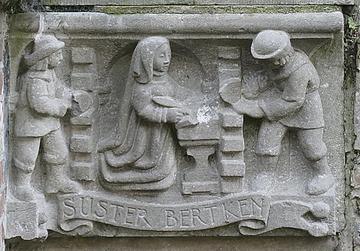
The external world can upset one’s interior world. Dutch anchorite Sister Bertken (1427-1514) recounts this confusion in a poem:
The world held me in its power with its manifold snares it deprived me of my strength.
Yet this nervousness about the effect of sensory input can also be understood as a medieval analogue to a warning against fake news or anxious over-consumption of news. Several guides recommend having a female friend scrupulously guarding the anchorite’s window, refusing to allow access to visitors who spread gossip and lies. Social media today can be a little like such visitors.
Keep busy, keep sane
Anchorites and writers of manuals for anchorites also reflected upon how to keep sane. Keeping occupied prevents one from climbing the walls. British Cistercian monk, Abbot Aelred of Rievaulx (1110-1167), tells his sister, an anchorite, in A Rule of Life for a Recluse that: “Idleness … breeds distaste for quiet and disgust for the cell.”
Routines are key. Anchorites recited sequences of prayers, psalms and other Bible readings at fixed points of the day. According to modern survival psychology, dividing a problem or stretch of time into manageable steps is crucial when faced with a crisis. Equally important is performing each step one by one, never looking further ahead than the next step.
Mentally absorbing hobbies, such as crafts, gardening or reading, are another time-honoured strategy for dealing with self-isolation. After recommending sewing clothes for the poor and church vestments, the Wisse assures anchorites that keeping occupied will shield their minds against temptation:
For while [the devil] sees her busy, he thinks like this: ‘It would be useless to approach her now; she can’t concentrate on listening to my advice.’
These suggestions are easily translatable to today. After all, according to survival psychology, performing manageable, directed actions with a purpose is crucial in crises. Incidentally, the Wisse also recommends keeping a cat.
On the one hand, self-isolation can feel limiting – Julian of Norwich also felt that: “This place is prison,” she said, referring either to earthly life or her cell. But the cell’s cramped space also granted medieval women a paradoxical, spiritual freedom. In his letter to the anchorite Eve of Wilton, the 11th-century monk Goscelin of St Bertin exclaims: “’My cell is so narrow,’ you may say, but oh, how wide is the sky!”
In line with the IMC focus of Memory for 2018, which has also been named as the European Year of Cultural Heritage, the newly-launched MARTRAE network is organizing sessions on ‘Commemorating Saints and Martyrs in Medieval Europe’. The focus of these sessions is to explore the multifaceted ways in which saints and martyrs are remembered and how forms of commemoration functioned in creating, perpetuating or transforming collective cultural heritage.
Papers may focus on tangible as well as intangible forms of commemoration, including (but not limited to): devotional and liturgical practices; material aspects of commemoration in the form of relics, devotional objects and manuscripts; the conceptualisation of martyrdom and sainthood; the legacy and function of medieval forms of commemoration in the modern world; harmony and disharmony in remembering; landscapes as vehicles or anchors for commemoration; and the role of martyrdom in shaping or manipulating identities.
Please send abstracts of ca. 250 words to Nicole Volmering at volmern@tcd.ie or Ann Buckley at buckleai@tcd.ie by September 20th 2017.