Special seminar series co-organized by Charlotte Denoël (Bibliothèque nationale de France) & Nancy Thebaut (Oxford) // generously supported by TORCH
This interdisciplinary seminar will be an interactive forum for thinking about the work of the French author Christine de Pizan (d. 1429/30) in anticipation of a forthcoming exhibition at the Bibliothèque nationale de France to commemorate the 600th anniversary of her death. Speakers will give short presentations followed by group discussion. Please see below for abstracts & reading
MT 2026 / / Wednesdays, 2 – 4:45 pm, Horton Room, Weston Library
Note that attendees will require a Bodleian card to access the Horton Room and that space is limited: please sign up via Eventbrite before each session. More info can be found here: https://www.torch.ox.ac.uk/christine-de-pizan-and-gender-in-the-late-middle-ages
Wednesday, Oct. 21 (week 2): Introductions
*Prof. Helen Swift (Oxford), “Encountering Christine de Pizan in 2026”
*Prof. Andrea Valentini (Université Sorbonne Nouvelle), « Lire les textes de Christine de Pizan autrement » (please note that Prof. Valentini’s presentation will be in French)
Wednesday, Nov 4 (week 4): Christine de Pizan in Context
*Estelle Guéville (Yale), “How Exceptional Was Christine de Pizan? Scribal Practices and Women’s Book Production in Late-Medieval Europe”
*Prof. Sophie Marnette (Oxford), “How Exceptional Was Christine de Pisan? Writing Women in 12th and 13th centuries”
Wednesday, Nov 18 (week 6): Christine de Pizan & Gender Fluidity
*Prof. Daisy Delogu (University of Chicago), “Se trouver trans in Christine de Pizan”
*Hannele Hellerstedt (Oxford), “A City of Ladies? Trans identity and the afterlife of the Livre de la mutacion de fortune in La Cité des dames”
Wednesday, Dec 2 (week 8) : L’Epîtsre d’Othéa & La Ditié de Jehanne d’arc
*Prof. Gervase Rosser (Oxford), “Beyond words: page layout and the generation of meaning in the Epistre d’Othéa”
*Prof. Hannah Skoda (Oxford), “Christine de Pisan’s Ditie de Jehanne d’Arc. What would Jehanne have thought?”
*please see next page for abstracts & recommended readings*
ABSTRACTS & RECOMMENDED READINGS
Christine de Pizan & Gender in the Late Middle Ages
Wednesday, Oct. 21 (week 2) Introductions
*Prof. Helen Swift (Oxford), “Encountering Christine de Pizan in 2026”
Christine de Pizan has iconic status in medieval studies and in the histories of women’s writing and feminist thought. This status is wholly merited but also risks misrepresenting her position and her priorities. Framing her in exceptionalising and singularising terms runs counter to her emphasis on collectivity, relationality, and contingency. For Christine, all human life is positional – it can always turn otherwise, which is a state of both precarity and possibility. I invite us to recontextualise our readings of her most well-known texts today in order to highlight her commitment to thinking and writing change in the world.
Nota bene: Prof. Swift will be focusing primarily on La Cité des Dames and La Mutacion de Fortune
*Prof. Andrea Valentini (Univ. Sorbonne Nouvelle), « Lire les textes de Christine de Pizan autrement »
Dans la présente conférence, j’essaierai de proposer quelques sujets de réflexion autour de la Cité des dames et d’autres textes de Christine de Pizan inspirés d’une approche qui mêle philologie, linguistique et étude matérielle des manuscrits, y compris dans leur composante iconographique. Le but sera de montrer d’une part l’attention avec laquelle l’autrice composait ses œuvres et en suivait la diffusion, d’autre part les lectures que le public, même éloigné chronologiquement ou géographiquement, pouvait faire de celles-ci. Ce type de démarche peut enrichir de manière féconde des approches plus proprement littéraires ou bien inspirées des études de genre.
Wednesday, Nov 4 (week 4) Christine de Pizan in Context
*Estelle Guéville (Yale), “How Exceptional Was Christine de Pizan? Scribal Practices and Women’s Book Production in Late-Medieval Europe”
Christine de Pizan is often presented as an exceptional figure: a professional author, a productive scribe, and a workshop manager whose autograph manuscripts survive in remarkable numbers. But how exceptional was she within the broader landscape of medieval women’s scribal activity? Drawing on the Unknown Hands database of women scribes, we will look at Christine alongside hundreds of other female copyists and manuscript producers to understand what was genuinely unique about her career and what reflected wider patterns of women’s participation in book production. We will then turn to Christine’s workshop as a case study in collaborative manuscript production, showing how traditional paleography can be combined with computational approaches to identify individual scribes, reconstruct collaborative practices, and explore the transmission of scribal habits within a late-medieval scriptorium.
*Prof. Sophie Marnette (Oxford), “How Exceptional Was Christine de Pisan? Writing Women in 12th and 13th centuries”
Christine de Pizan has become an iconic figure of female authorship in the later Middle Ages. But how exceptional was she when compared with earlier women writers such as Marie de France and the Occitan trobairitz? These women are named and sometimes pictured in manuscripts, reflect on their own craft, and are mentioned by other medieval authors. Yet modern scholars continue to debate their identities and the relationship between female first-person voice and female authorship. Bringing lyrical and narrative texts by these earlier writers into conversation with Christine’s Cent ballades d’amant et de dame and Cité des dames, this paper asks how medieval women construct and authorize a writing voice. What does it mean for a woman to say “I” in a medieval text, and does reading Christine alongside her predecessors change our understanding of her exceptional status?
Wednesday, Nov 18 (week 6): Christine de Pizan & Gender Fluidity
*Prof. Daisy Delogu (University of Chicago), “Se trouver trans in Christine de Pizan”
The verb « trouver » in Middle French has a wide semantic field, from “to compose” or “to invent” to “to discover”, “to experience”, and “to perceive”; as a concept it operates in between the sense of creating something, and that of engaging with something that preexists. I would like to think about the creative and dynamic practice of “trouver” in connection to Christine de Pizan’s innumerable accounts of her own (self) generation as a person and a poet, and especially one of the most famous of these, included in the Mutacion de Fortune, wherein she recounts both her birth (to Thomas de Pizan and to Nature) and her transformation from female to male.
Required Reading
The Book of the Mutability of Fortune, trans. Geri Smith. 2017. Book 1 (lines 1-1460) (available via SOLO). Those who can are encouraged to read/consult the Middle French available in Écrire d’amour, parler de soi. Ed. and trans. Sarah Delale and Lucien Dugaz. Paris, 2023.
Recommended Reading
Cavanaugh, Sheila. “Tiresias and Psychoanalysis With/out Oedipus” European Journal of Psychoanalysis (11:2, 2024) (freely available online)
Salah, Trish. “What does Tiresias Want?” Trans Studies Quarterly 4.3-4 (2017): 632-38 (available via SOLO)
*Hannele Hellerstedt (Oxford), “A City of Ladies? Trans identity and the afterlife of the Livre de la mutacion de fortune in La Cité des dames”
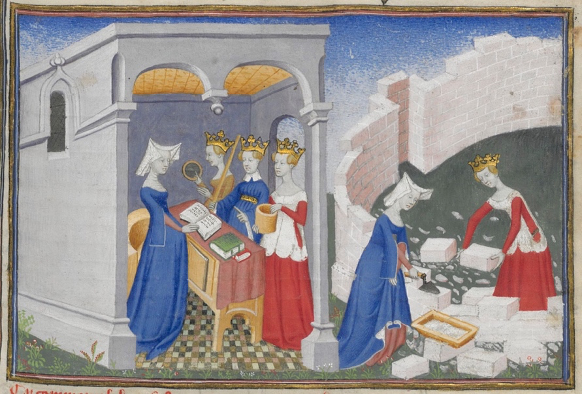
In a miniature of La Cité des dames from The Book of the Queen, Lady Reason guides a group of women outside the city. The image seems to mirror the text, all but for a mysterious figure in the upper left-hand corner– that of a man. His presence seemingly threatens to upend the entire ethos of the book. But what if this figure is intentional? Frequently viewed through a feminist lens, my paper will re-examine La Cité des dames within the context of the Livre de la mutacion de fortune. Using examples of transgender figures and cases of cross-dressing which populate the two texts, I propose a new reading of La Cité des dames as a queer space, made visible by this male-figure atop the roofs.
Recommended reading:
Christine de Pizan, ‘Book Two’, in The Book of the City of Ladies, ed. Rosalind Brown-Grant (Penguin, 1999).
Christine de Pizan, ‘Livre II’, in Le Livre de la Cité des Dames : Edition Bilingue, Traduite et Annotée, ed. Anne Paupert, and Claire Le Ninan (Honoré Champion, 2023) (available via SOLO)
Wednesday, Dec 2 (week 8) L’Epîstre d’Othéa & La Ditié de Jehanne d’arc
*Prof. Gervase Rosser (Oxford), “Beyond words: page layout and the generation of meaning in the Epistre d’Othéa”
In the work she composed c.1400, Christine de Pizan was experimenting boldly with the potential of the manuscript page, not to relay information or to unfold an argument, but to use the juxtaposition of diverse visual and textual stimuli as a means to catalyse thought and reflection.
Christine shared with Boccaccio and other late-medieval writers the conviction that history – including the myths of Antiquity – contained poetic truths, discernible to the wise. Her composition of the Epistre d’Othéa was designed to assist the reader to perceive these truths, and to be morally improved by them.
This seminar discussion will focus (with the aid of photographs) on a copy of the text produced in the 1450s by Jean Miélot, who made many books for the duke of Burgundy, Philip the Good. Miélot appreciated the spiritual aspiration of Christine’s retelling of classical stories, and he emulated and refined her complex page layout.
In the event, these experiments with the manuscript page were marginalised by the triumph of a different standard format, that most familiar today, in which a single block of text delivers an argument sequentially across multiple pages. This model, already becoming dominant in the fifteenth century and consolidated by the emergent technology of print, has tended to occlude other possibilities. To reconsider the Epistre d’Othéa is to problematise this chapter in the history of the book, and to envisage different modes of knowledge production.
*Prof. Hannah Skoda (Oxford), “Christine de Pisan’s Ditie de Jehanne d’Arc. What would Jehanne have thought?”
In Christine de Pisan’s Ditie de Jehanne d’Arc, she celebrates French victories, the possibility of peace, and – most importantly – the channeling of divine will and military victory through a woman. Joan herself remains voiceless throughout – all whilst the poem makes claims about women in the very grandest terms: not only are women superior to men, chosen by God, knowledge itself is claimed as female. I’ll explore the implications of Joan’s voiceless violence alongside the elevation of ‘the female sex’.
Required reading:
Kennedy, A. J., & Varty, K. (1975). CHRISTINE DE PISAN’S “DITIE DE JEHANNE D’ARC”. PART I (C15th French edition), PART II (English translation). Nottingham Mediaeval Studies, 19, 53. (available via SOLO)