Interdisciplinary Conference ‘Trust in the Premodern World’: An Overview

Written by Annabel Hancock (St John’s College, Oxford) 
Lead Organiser 
@annabel_hancock 

@PremodernTrust

After over a year of preparation, the conference took place on 13-14th January 2023 in the Oxford History Faculty, and it was a great success! We were thrilled to welcome five eminent keynote speakers as well as 26 speakers and 20 attendees. Attendance was truly international with speakers from the US, Taiwan, Israel, Australia, The Netherlands, and Spain, to name a few places. There were also participants from a range of career stages with a large number of postgraduate students and ECRs speaking alongside renowned professors.  

The call for papers generated a much greater response than expected, from researchers at a variety of career stages and disciplines. While it led to greater organisational challenges, this led to the decision to run parallel sessions, allowing the acceptance of a greater number of papers and wider conversations. This meant we had panels which focused on trust as an emotion and experience, on trust and its relationship to power, to professions, in trade, credit, and debt relationships, and in spaces and systems.  

The keynote speakers acted perfectly to direct the focus of the conference and encourage wide-ranging discussions. Dr Justyna Wubs-Mrozewicz (University of Amsterdam) started us off perfectly, thinking about generalised trust, encouraging us to think about how communities engage with trust in the common good in the medieval city. Professor Teresa Morgan (Yale Divinity School) then encouraged us to think about the ways in which language and meaning develops, showing how ideas of trust in Early Christian faith developed to relate to belief, redefining one’s relationship to God. Dr Nicholas Baker (Macquarie University, Sydney, Australia) then ended the first day perfectly. He showed us that the ways in which merchants thought about time in sixteenth century Italy was deeply complex, looking at the ways in which language related to trust and time expressed anxieties as well as positive hopes. Dr Antonella Liuzzo Scorpo (University of Lincoln) started day two with a look at trust as an emotion, specifically encouraging us to think about the ways in which women took part in the construction of trusted spaces in diplomacy in thirteenth-century Iberia. Our final keynote speaker, Professor Sheilagh Ogilvie (All Souls College, Oxford) delivered a paper encouraging us to think about the voices of premodern people and the ways theories of social capital/networks can hide the darker side of trust communities. She highlighted the ways in which economic approaches to trust can help us to look deeper into the ways in which communities functioned and encouraged us that as historians we have much to add to this conversation. 

Papers and keynote talks led to a great number of discussions and engagement with trust across a range of times and places. Perhaps one of the most exciting parts of many conversations was the realisation that though the 54 total participants all worked on varied times and places across the globe, and on various forms of trust, we all had knowledge and ideas that could be related it, and questions that could be the start of new ways of thinking.  

There is still much to think about and I know that all participants will be processing the discussions we had for a long time to come. Perhaps one of the main take aways at this early stage is the great power that comes with thinking about trust in the past. Through this focus, we can learn more about the economic, social, and cultural lives of people in premodern Europe, and consider the ways in which rationality and emotions are negotiated. 

The organising committee was thrilled to receive much positive feedback, including on social media, from attendees about the event and a great desire for conversations started at the event to continue. This will be an ongoing global network. 

This event would not have been possible without a great amount of support and encouragement from friends, colleagues, various members of the History Faculty admin team, and our generous sponsors. 

Medieval Matters: Week 2

I hope that you have all settled back into the rhythms of Oxford life. It’s terribly cold this week, with a thick layer of fog covering Oxford’s spires. Here’s some advice from Alcuin on how to wrap up warm:

Nullatenus capitis cura obmittenda est; levius est pedes dolere quam caput
[Care of the head should never be neglected: it is less serious that the feet should suffer than the head, Ep. 114 ]

I interpret this to mean: don’t forget to wear a warm hat! If you want to care for the head in a less literal sense, we of course have a whole host of intellectually stimulating seminars, reading groups and events for you to enjoy this week:

ANNOUNCEMENTS:

  • The Medieval Misuse discussion and reading group meets every 2 weeks, on a Thursday 5-6, for an informal discussion about the ways that medieval history, culture and literature are misused by modern political parties and extremist groups. Interested individuals should email: tristan.alphey@stx.ox.ac.uk
  • The Old French Reading Group takes place at 4-5pm at St Hilda’s College (meet by the lodge) on Wednesdays of Even Weeks in association with Oxford Medieval Studies, sponsored by The Oxford Research Centre in the Humanities (TORCH). We welcome readers of Old French of all abilities. For further information, please email alice.hawkins@st-hildas.ox.ac.uk or irina.boeru@st-hildas.ox.ac.uk
  • Oxford Ancient Languages Society (OALS) is running a great programme of classes and events this term – perfect for medievalists who want to brush up or acquire Latin! For full details, see their website here.
  • Please note that the Carlyle Lectures are medieval this year! This year’s lectures will be given by John Hudson, on common law and Roman law and custom, C12-13: https://www.history.ox.ac.uk/carlyle-lectures

EVENTS THIS WEEK:

Monday 23rd January:

  • The Byzantine Graduate Seminar takes place at 12.30-2pm online via Zoom. This week’s speaker will be Rebecca Amendola (La Sapienza Università di Roma), Manuscripts in Motion: The Parma Gospel Book (Ms. Pal. 5) and Its Journey to Italy. To register, please contact the organiser at james.cogbill@worc.ox.ac.uk.
  • The Medieval Latin Manuscript Reading Group led by Matthew Holford and Andrew Dunning is meeting as usual via Teams from 1-2pm. We will start with natural history from a medieval encyclopaedia. Sign up for the mailing list to receive updates and the Teams invite, or contact matthew.holford@bodleian.ox.ac.uk or andrew.dunning@bodleian.ox.ac.uk for more information. 
  • The Queer and Trans Medievalisms Reading and Research Group meets at 3pm at Univ College, 12 Merton St Room 2. This week’s theme is Heldris of Cornwall’s Le Roman de Silence. All extremely welcome! To join the mailing list and get texts in advance, or if you have any questions, email rowan.wilson@univ.ox.ac.uk.   
  • The Medieval History Seminar takes place at 5pm in the Wharton Room, All Souls College and on Teams (Teams link here). This week’s speaker will be Jamie Wood (Lincoln), The Memory of the Martyrs: The topography of sanctity in Visigothic Toledo.’. The Teams session can be accessed by logging in to Teams with your .ox.ac.uk account and joining the group “Medieval History Research Seminar” (team code rmppucs). If you have any difficulties please email: medhistsem@history.ox.ac.uk 

Tuesday 24th January:

  • The Europe in the Later Middle Ages Seminar will take place at 2–3.30pm in the New Seminar Room, St John’s College. Tea and coffee available from 1.45pm. This week’s speaker will be Catherine Holmes, Oxford, ‘Networks, brokerage and identity in the late medieval eastern Mediterranean‘.
  • The Comparative Philology Seminar: Old High German meets at 2.15-4pm in the Lecture Theatre of the Centre for Linguistics and Philology (Walton Street). This week’s speakers will Luise Morawetz and Howard Jones, Introduction/Phonology. All are welcome, basic linguistic knowledge is assumed. 
  • The Medieval Church and Culture Seminar meets at 5-6pm in the Charlese Wellbeloved Room, Harris Manchester College. This week’s speaker will be Susannah Bain (Jesus), ‘Maps, Chronicles and Treaties: defining political connections in late-thirteenth-century northern Italy‘.
  • The John Hudson Carlyle Lectures takes place at 5pm at South School, Examination Schools. This week’s lecture will be Legal development in Europe: a view from the 1190s. This lecture examines patterns of legal development in England, France and north Italy in the latter part of the twelfth century. It suggests that those patterns do not act as a clear guide to the developments that followed in the thirteenth century. This lecture will be followed by a drinks reception in North Schools. All are welcome!

Wednesday 25th January:

  • The Medieval German Graduate Seminar will meet at 11:15am in the island room of Oriel College for discussing the prologue of this term’s text, Heinrich von Neustadt’s Apollonius von Tyrland. If you are interested to come along, contact Henrike Lähnemann, to be added to the teams chat.
  • The Medieval Italian Seminar will take place at 2pm at Rees Davies Room, History Faculty. This week’s speaker will be Paul Oldfield (Manchester), ‘Inquest and History in Thirteenth-Century Puglia’.
  • GLARE (Greek and Latin Reading Group) takes place at 4-5pm at Jesus College. Please meet at Jesus College Lodge. This week’s text will be Demosthenes, Against Neaera, 72–8. All welcome to attend any and all sessions. For more details and specific readings each week, or to be added to the mailing list, email john.colley@jesus.ox.ac.uk or jenyth.evans@seh.ox.ac.uk.
  • The Medieval Latin Document Reading Group meets on Teams at 4-5pm. We are currently focusing on medieval documents from New College’s archive as part of the cataloguing work being carried out there, so there will be a variety of hands, dates and types. A document is sent out in advance but homework is not expected. Contact Michael Stansfield (michael.stansfield@new.ox.ac.uk) for further details and the Teams link.
  • The Old French Reading Group takes place at 4-5pm at St Hilda’s College (meet by the lodge). We welcome readers of Old French of all abilities. For further information, please email alice.hawkins@st-hildas.ox.ac.uk or irina.boeru@st-hildas.ox.ac.uk
  • The Late Antique and Byzantine Seminar takes place at 5pm at the Ioannou Centre for Classical and Byzantine Studies, 66 St Giles. This week’s speaker will be Olivier Delouis (Maison Française d’Oxford), ‘Teaching Greek grammar to one’s son: an unpublished manual by Nikolaos Artabasdos Rabdas (14th c.)’.
  • The Medieval English Research Seminar takes place at 5.15pm in Lecture Theatre 2, English Faculty, followed by a drinks reception. This week’s speaker will be William Sweet (Independent), ‘Lydgate and Humanist Reading After Arundel’. All welcome.

Thursday 26th January:

  • The Oxford Medieval Commentary Network will meet at 12.45-2.15pm in the McKenna Room at Christ Church. Please note the change of venue! Free lunch from 12.45, seminar paper begins at 1.15. The speaker will be Tristan Franklinos, Wolfson & Oriel Colleges, Oxford, ‘Peter Abelard’s Hymns as exegesis for the sisters of the Paraclete’. Please direct all questions to cosima.gillhammer:chch.ox.ac.uk, or visit the website.
  • The Seminar in Medieval and Renaissance Music will take place on Zoom at 5pm. This week’s speaker will be Julia Craig-McFeely (DIAMM, University of Oxford), The Sadler Sets of Partbooks and Tudor Music Copying. If you are planning to attend a seminar this term, please register using this form. For each seminar, those who have registered will receive an email with the Zoom invitation and any further materials a couple of days before the seminar. If you have questions, please just send an email to matthew.thomson@ucd.ie.
  • The Medieval Misuse discussion and reading group meets at 5-6pm, for an informal discussion about the ways that medieval history, culture and literature are misused by modern political parties and extremist groups. Interested individuals should email: tristan.alphey@stx.ox.ac.uk
  • The Germanic Reading Group meets at 4-5pm on zoom. This week’s topic will be Old Norse skaldic verse (Nelson Goering leading). Please contact Howard Jones Howard.Jones@sbs.ox.ac.uk to be added to the mailing list and receive the zoom link.
  • The Celtic Seminar will take place at 5.15pm via Teams and in The History of the Book Room, English Faculty. This week’s speaker will be Mark Williams (Oxford), ‘Magic and violence in Pedeir Keinc y Mabinogi‘. Please contact david.willis@ling-phil.ox.ac.uk if you need a link.
  • The Medieval Visual Culture Seminar meets at 5.15pm at St Catherine’s College, Arumugam Building. This week’s speakers are Sarah Griffin, Lambeth Palace Library, London, ‘From Hours to Ages: Time in the Large-scale Diagrams of Opicinus de Canistris (1296-c. 1352)‘ and Anya Burgon, Trinity Hall, Cambridge, ‘In a Punctum: Miniature Worlds in Late Medieval Art and Literature‘.
  • The Oxford Interfaith Forum is hosting a lecture by Professor Laurent Mignon, Professor of Turkish Literature at the University of Oxford, UK, at 6-7pm, online. The lecture will be ‘From the People of the Book to the Books of the People: Christian Literature and the 19th Century Ottoman Turkish Literary World‘. For full details and registration, click here.
  • The Oxford Centre for Hebrew and Jewish Studies is hosting The David Patterson Lectures at 6-7pm, at the Catherine Lewis Lecture Room and on zoom. This week’s lecture will be of interest to anyone who teaches papers on the Central Middle Ages, English history, and also to feminist / gender historians of all stripes. The speaker will be Dr Emily Rose, ‘The Expulsion of Jews from England (1290): It is Not What You Think’. To register for online attendance, click here. For enquiries, email enquiries@ochjs.ac.uk.

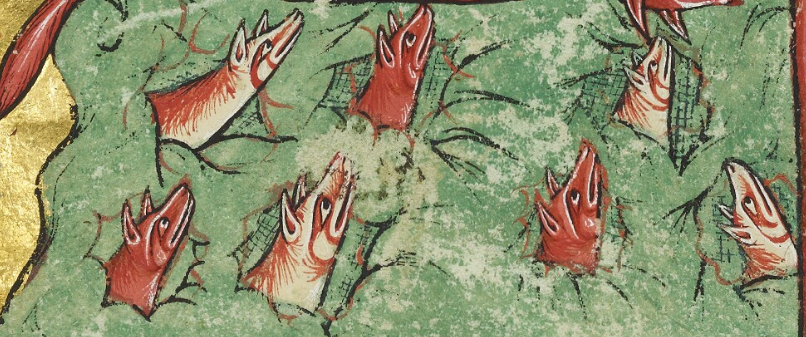
This weekend marked Lunar New Year: Happy New Year to all who celebrate! This year is the year of the rabbit. I wanted to provide a suitable quote and image but to my knowledge, Alcuin has nothing to write about rabbits, and nor are any to be found in the Ashmole bestiary. So please forgive a temporary departure from our usual material. Here is Albertus Magnus describing the importance of camraderie amongst rabbits:

Est […] animal timidum, et ideo injuriatum relinquit habitationem, quod videns grex totus de loco transit, ac si indignetur ad injurias sociorum
[It is a shy animal, and for that reason when disturbed it flees its home, and seeing this the whole colony leaves the place too, as if offended by the insult to their companion 20:29]

May we medievalists enjoy such loyal companionship!

Announcing the year of the Rabbit (no rabbits were harmed in the making of this year)
Detail from La Queste del Saint Graal, France, N., early 14th century, Royal MS 14 E III, f. 89r

Oxford Medieval Visual Culture Seminar

Where: St Catherine’s College, Arumugam Building
When: Thursdays 5.15 p.m.

Convenors: Elena Lichmanova (elena.lichmanova@merton.ox.ac.uk) and Gervase Rosser

The Oxford Medieval Visual Culture Seminar series is exploring visual aspects of medieval knowledge: from anatomy to alchemy, from geometry to the concepts of time and space. We hope that the programme may appeal to audiences beyond those studying the medieval period and art history, so please do share it with anyone who might be interested. 

Week 2, 26 January
Sarah Griffin Lambeth Palace Library, London
From Hours to Ages: Time in the Large-scale Diagrams of Opicinus de Canistris (1296-
c.1352)
Anya Burgon Trinity Hall, Cambridge
In a Punctum: Miniature Worlds in Late Medieval Art and Literature

Week 4, 9 February
Lauren Rozenberg University College London
In the Flat Round: Brain Diagrams in Late Medieval Manuscripts
Sergei Zotov University of Warwick
Christian Motifs in Fifteenth-Century Alchemical Iconography

Week 6, 23 February
Jack Hartnell University of East Anglia
Visualising Wombs and Obstetrical Fantasies in Late Medieval Germany

Week 8, 9 March
Mary Carruthers New York University, All Souls College, Oxford
Envisioning Thinking: Geometry and Meditation in the Twelfth Century

We very much look forward to seeing you in the Hilary Term!

Medieval Matters: Week 1

Welcome back to Oxford, and to Hilary term! I hope that you all had a peaceful and enjoyable vac, and are returning to Oxford well rested and ready for an exciting and busy term. Since many of you have newly returned to Oxford, here is some wisdom for Alcuin about returning:

ex pietatis vestre apicibus audita prosperitate itineris vestri atque reversionis in patriam … toto cordis affectu animoque letissimo gratis egi
[Hearing from your letter of your successful journey and your return to our country … I gave heartfelt and joyful thanks, Ep. 190]

To welcome you all back, we have a new medieval booklet for Hilary 2023: please find a pdf copy attached to this week’s email, and a high-quality version on our website here. We also have a special blog post by Laure Miolo, who has the honour of giving the first medievalist paper of the term, at the Seminar in Manuscript Studies and Palaeography, today at 2.15-3.45pm! To read more about Laure’s paper, see the blog post.

Please note also that this week’s Medieval Church and Culture Seminar, on Tuesday 5pm, Harris Manchester College, is a special medievalist social! Please do come along to enjoy tea, coffee, biscuits, and a chance to catch up / advertise your seminars and events! All very welcome.

Please see below for full details of the week’s events:

ANNOUNCEMENTS:

  • Workshop: Staging a Medieval Mystery Play: On Friday 3 February 2023 (Week 3), 5–6.30pm, at St Edmund Hall, Old Dining Hall (postponed from 20 January). Join this workshop for tips and guidance on how to adapt medieval mystery plays for modern performance or if you are just interested in taking part in some form and shape. The workshop will be led by David Wiles, Emeritus Professor of Drama at the University of Exeter and a veteran director of the Oxford Medieval Mystery Cycle. Let us know if you’re interested in joining by emailing Michael Angerer, the graduate convenor. Meanwhile, we’re still looking for groups to join the Medieval Mystery Cycle: have a look at the original blog post with the sign-up link!
  • Save the Date! The Oxford Medieval Graduate Conference 2023 will take place on 20th-21st April at Ertegun House and online. For more details, visit oxgradconf.wixsite.com/omgc or follow @OxMedGradConf on twitter.
  • The Oxford Interfaith Forum runs its signature Thematic International Interfaith Groups, and our several groups, such as Manuscripts in Interfaith Context, Sacred Literature in Interfaith Contexts, Mysticism in Interfaith Contexts, Eastern Christianity in Interfaith Contexts, etc. Events organised by these groups might be of interest to the Medieval Studies Network, e.g. the Psalms in Interfaith Context Series. The full details of our past and upcoming events are available on our website, or follow us on Twitter at @FaithsOxford.
  • The OMS Small Grants Hilary Term Applications are now open! The TORCH Oxford Medieval Studies Programme invites applications for small grants to support conferences, workshops, and other forms of collaborative research activity organised by researchers at postgraduate (whether MSt or DPhil) or early-career level from across the Humanities Division at the University of Oxford. For full details, please see our blog post.

EVENTS THIS WEEK:

Monday 16th January:

  • The Medieval Latin Manuscript Reading Group led by Matthew Holford and Andrew Dunning is meeting as usual via Teams from 1-2pm. We’ll start this term continuing the natural history theme with another text on elephants, this time from the encyclopaedia of Thomas of Cantimpre (1201-?1272), De naturis rerum. We’ll read it from a 14th-century copy now in Bruges Public Library, https://sharedcanvas.be/IIIF/viewer/mirador/B_OB_MS412, with the text starting on fol. 61v. Sign up for the mailing list to receive updates and the Teams invite, or contact matthew.holford@bodleian.ox.ac.uk or andrew.dunning@bodleian.ox.ac.uk for more information. 
  • The Seminar in Manuscript Studies and Palaeography will take place at 2.15-3.45pm, in the Weston Library, Horton Room. This week’s speaker will be Laure Miolo (University of Oxford), “Astronomy and astrology in fourteenth-century Oxford: MS. Digby 176  in context“. For further information contact matthew.holford@bodleian.ox.ac.uk or andrew.dunning@bodleian.ox.ac.uk
  • The Medieval History Seminar takes place at 5pm in the Wharton Room, All Souls College and on Teams (Teams link here). This week’s speaker will be Lorenzo Caravaggi (University of East Anglia), ‘Magic Saracen treasures, credulous merchants, and other stories: itinerant notaries and their “judicial novellas” in fourteenth-century Italy.’. The Teams session can be accessed by logging in to Teams with your .ox.ac.uk account and joining the group “Medieval History Research Seminar” (team code rmppucs). If you have any difficulties please email: medhistsem@history.ox.ac.uk 

Tuesday 17th January:

  • The Europe in the Later Middle Ages Seminar will take place at 2–3.30pm in the New Seminar Room, St John’s College. Tea and coffee available from 1.45pm. This week’s speaker will be Christopher Fletcher, CNRS, Lille, ‘The politics and anti-politics of labour in late medieval England‘.
  • The Medieval Church and Culture Seminar meets at 5-6pm in the Charlese Wellbeloved Room, Harris Manchester College. This week’s meeting is a special medievalist social! Come along for tea, coffee, biscuits and a chance to share ongoing research, catch up informally, and give suggestions for themes and speakers in coming terms. All are welcome.

Wednesday 18th January:

  • The Medieval German Graduate Seminar will meet at 11:15am in the island room of Oriel College for a short organisational meeting on this term’s text, Heinrich von Neustadt’s Apollonius von Tyrland. If you are interested, contact Henrike Lähnemann, to be added to the teams chat.
  • The Medieval Italian Seminar will take place at 2pm at Rees Davies Room, History Faculty. This week’s speaker will be Chris Wickham (Oxford, All Souls/ History Faculty): ‘Governing twelfth-century city communes’.
  • GLARE (Greek and Latin Reading Group) takes place at 4-5pm at Jesus College. Please meet at Jesus College Lodge. This week’s text will be Cicero, Letters to Atticus. All welcome to attend any and all sessions. For more details and specific readings each week, or to be added to the mailing list, email john.colley@jesus.ox.ac.uk or jenyth.evans@seh.ox.ac.uk.
  • The Medieval Latin Document Reading Group meets on Teams at 4-5pm. We are currently focusing on medieval documents from New College’s archive as part of the cataloguing work being carried out there, so there will be a variety of hands, dates and types. A document is sent out in advance but homework is not expected. Contact Michael Stansfield (michael.stansfield@new.ox.ac.uk) for further details and the Teams link.
  • The Late Antique and Byzantine Seminar takes place at 5pm at the Ioannou Centre for Classical and Byzantine Studies, 66 St Giles and online via Teams. This week’s speaker will be Joshua Hitt (St Hilda’s College), ‘The Poetics of Age in Twelfth-Century Byzantine Literature’. Teams: Click here to join the meeting.
  • The Medieval English Research Seminar takes place at 5.15pm in Lecture Theatre 2, English Faculty. This week’s paper will be followed by a special drinks reception to celebrate recent book publications. This week’s speaker will be Luisa Ostacchini (University of Oxford), ‘After Dido: Carthage in Old English Literature’. All welcome.
  • CfP: The Medieval Church: From Margins to Centre (26-27 June 2023): This conference aims to consider the relationship between the Church and the marginalised in medieval society – minority genders and sexualities, racial minorities, disabled people, non-Christians, and the poor. The conference is prompted by current trends in medieval race studies, trans studies and disability studies, and aims to provide a particular platform for postgraduate and early career researchers who work in these areas. To support this aim, we plan to offer a bursary of £30 per person for up to 10 postgraduates and ECRs. Please send abstracts of up to 250 words to Tim Wingard (tim.wingard@york.ac.uk) by no later than 5pm on Sunday 5 February 2023. For more information, see the website here.

Friday 20th January:

  • The Anglo-Norman Reading Group meets at 5-6.30pm at St Hilda’s College, in the Julia Mann Room. The text will be extracts from the Chronicle of Langtoft; pdf will be provided. For access to the text and further information, please email: stephanie.hathaway@gmail.com or jane.bliss@lmh.oxon.org.
  • The Old Norse Reading Group meets at 5pm at The Royal Oak. Please email Ashley Castelino (ashley.castelino@lincoln.ox.ac.uk) to be added to the mailing list.

OPPORTUNITIES:

  • CFP: Old Norse Poetry in Performance: Inheritance and Innovation. Following its covid-induced hiatus, the third iteration of the triennial Old Norse Poetry in Performance conference will take place at St Hugh’s College, Oxford, on the 21st and 22nd of June 2023. This conference will maintain the format of its previous iterations, showcasing academic research, practical performances, and the possibilities offered by combining the two. The organisers invite proposals for 20-minute papers and/or performances. Proposals should be no more than 300 words and should be sent to oldnorsepoetryinperformance@gmail.com, accompanied by a brief biographical note, by midnight on 17th February 2023. For full details, see the blog post.
  • Workshop on manuscript description and cataloguing: This workshop, to be held over 3-4 weeks in the second half of term, is intended for postgraduate students working on Western medieval manuscript/s in the Bodleian Library who would like, as a by-product of their research, to produce formal catalogue description/s for publication on Medieval Manuscripts in Oxford Libraries. Please express interest using this form.
  • Teaching with manuscripts: Thinking of incorporating medieval manuscript material in your teaching but not sure where to start? Sign up for a workshop with Andrew Dunning and Matthew Holford, curators at the Bodleian Library, where we will try to answer your questions and lead a discussion on what does and doesn’t work when teaching with manuscripts. Please sign up using this form. We will hold one or more workshops (depending on interest) early in term.
  • The Latin Works of Piccolomini (Pius II): A Colloquium: Registration is now open for this colloquium, taking place on Thurs. 23–Fri. 24 March 2023 at the Faculty of Classics, Oxford in collaboration with the Abteilung für Griechische und Lateinische Philologie at Friedrich-Wilhelms-Universität, Bonn. More information and the link to register here.
  • CFP: Bristol CMS Postgraduate Conference, IDENTITIES, COMMUNITIES AND ‘IMAGINED COMMUNITIES’, 14-15 April 2023. We welcome abstracts from postgraduates and early-career researchers, exploring all the aspects and approaches to concepts of identity and communities, in all relevant disciplines pertaining to the medieval period, broadly construed c.500-c.1500. Abstracts are 300 words for 20-minute papers. This year’s conference will be a hybrid event online and on the campus of the University of Bristol. Abstracts and enquiries: cms-conferenceenquiries@bristol.ac.uk DEADLINE: 10 February 2023. For full details, see the blog post here.

Finally, some more wisdom from Alcuin:

novi rerum eventus novos iterum caritatis penna exarare meam devotionem apices exhortantur
[New events urge me to write anew in devotion with the pen of love, Ep. 156]

I’m delighted to be writing anew to you all with the week’s round-up of events, announcements and opportunities, and look forward to seeing you all throughout the term. Wishing you all a productive and enjoyable Hilary!

[Medievalists emerging from the Christmas Vac to peek at the first Medieval Matters of term]
Ashmole Bestiary, Bodleian Library MS. Ashmole 1511, f. 69 r.
Viewable in full at Digital Bodleian

OMS Small Grants HT 2023  

The TORCH Oxford Medieval Studies Programme invites applications for small grants to support conferences, workshops, and other forms of collaborative research activity organised by researchers at postgraduate (whether MSt or DPhil) or early-career level from across the Humanities Division at the University of Oxford.

The activity should take place between the beginning of Hilary term 2023 and end of Trinity term 2023. The closing date for applications is Friday of Week 1 of Hilary Term = 20 January);  decisions will be made promptly after the closing date.

Grants are normally in the region of £100–250. Recipients will be required to supply a report after the event for the TORCH Medieval Studies blog. Recipients of awards will also be invited to present on their events at the next Medieval Roadshow.

Applicants will be responsible for all administrative aspects of the activity, including formulating the theme and intellectual rationale, devising the format, and, depending on the type of event, inviting speakers and/or issuing a Call for Papers, organising the schedule, and managing the budget, promotion and advertising. Some administrative and organisational support may be available through TORCH subject to availability.

Applications should be submitted to  lesley.smith@history.ox.ac.uk  using the grant application form. Applications submitted in other formats or after the deadline will not be considered.

Informal enquiries may be directed to lesley.smith@history.ox.ac.uk

The Oxford Medieval Studies Programme is sponsored by The Oxford Research Centre in the Humanities (TORCH).

For more medieval matters from Oxford, have a look at the website of the Oxford Medieval Studies TORCH Programme and the OMS blog!

CPF: Old Norse Poetry in Performance

Old Norse Poetry in Performance: Inheritance and Innovation Following its covid-induced hiatus, the third iteration of the triennial Old Norse Poetry in Performance conference will take place at St Hugh’s College, Oxford, on the 21st and 22nd of June 2023. Building on the successes of the conferences in 2016 and 2019 – which resulted in the recent publication of Old Norse Poetry in Performance (2022), a collection of essays edited by the previous organisers Brian McMahon and Annemari Ferreira – the intention of this conference remains, as before, to platform and develop the network of scholars and practitioners mutually interested in the poetic performance traditions of medieval Scandinavia.

With the theme ‘Inheritance and Innovation’, the 2023 programme aims to reflect even more completely the diversity in the performance traditions of the Old Norse source material, the scholarly traditions within the field, and the new, interdisciplinary perspectives being developed today. To this end, this conference will maintain the format of its previous iterations, showcasing academic research, practical performances, and the possibilities offered by combining the two.

The organisers invite proposals for 20-minute papers and/or performances, which might cover, but need not be limited to, the following:

• Comparative approaches to eddic, skaldic, and rímur performances

• Legacies of performance traditions

• The ‘beyond-the-page’ approach to source texts

• The effects of translation on performance

• Legacies of scholarly traditions

• Interdisciplinary adaptations of Old Norse poems

Proposals should be no more than 300 words and should be sent to oldnorsepoetryinperformance@gmail.com, accompanied by a brief biographical note, by midnight on 17th February 2023.

For more information, please visit the conference website , or contact the organisers, Inés García López, Clare Mulley, Richard Munro, and Ben Chennells, at the email address given above.

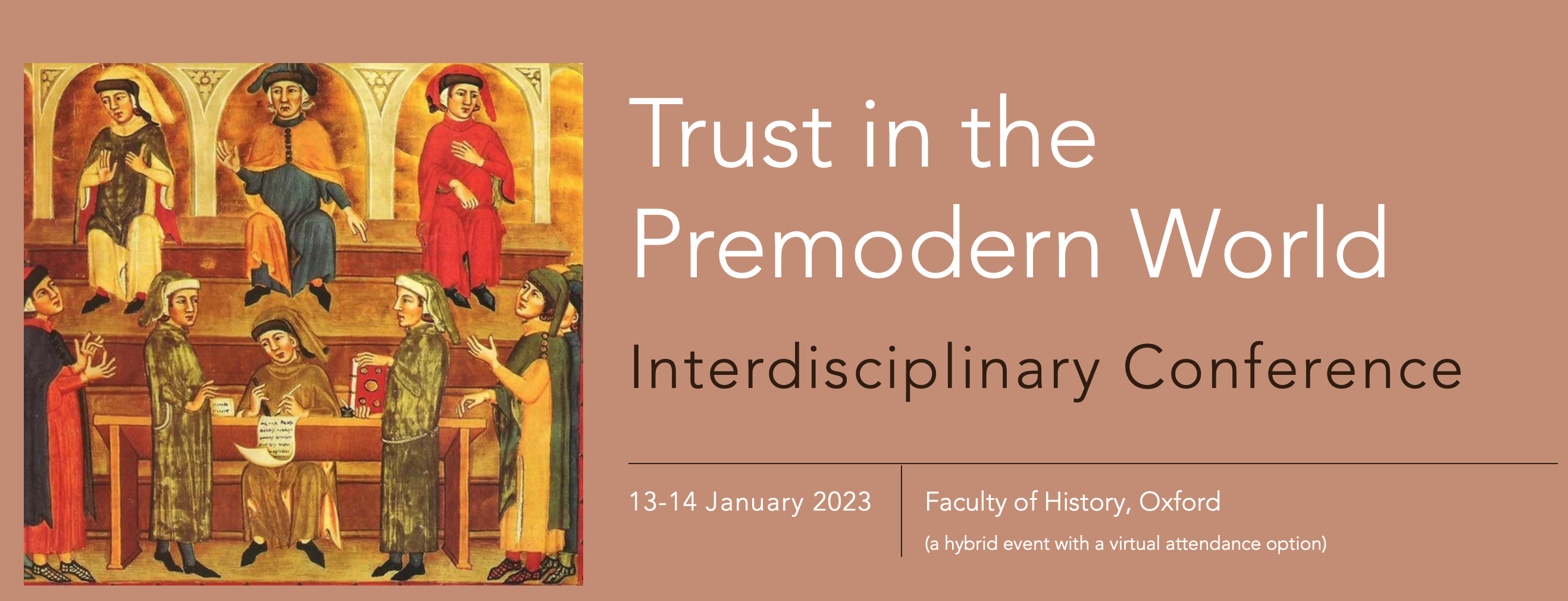
Trust in the Premodern World: Interdisciplinary Conference

When: 13-14 January, 2023

Where: Faculty of History, Oxford / Online (a hybrid event with virtual attendance option)

Virtual attendance registration is still open (deadline 23:00 12 January 2023). Virtual registration fee is £15 and you can sign up here.

Medieval Church and Culture Seminar

Tuesdays. Meeting from 5pm; papers begin at 5.15pm

Tuesdays, Charles Wellbeloved Room, Harris Manchester College

Tea & coffee from 5pm; papers begin at 5.15pm

Everyone is welcome at this informal and friendly graduate seminar

Week 1                        Medieval Church and Culture Social

17 January                   Come along for tea, coffee, and biscuits in the Charles Wellbeloved Room from 5pm-6pm. A chance to share ongoing research, catch up informally, and give suggestions for themes and speakers in coming terms. All are welcome. 

Week 2                        David d’Avray (UCL)

24 January                   The medieval legacy (to 1234) of the first decretal age (c. 400)

Week 3            Susannah Bain (Jesus)

31 January                   Maps, Chronicles and Treaties:  defining political connections in late-thirteenth-century northern Italy                                    

Week 4                        Mary Hitchman (Wolfson)

7 February                   Martyred Mothers: Augustine’s sermons on Perpetua and Felicitas

Week 5                        Federica Gigante (History of Science Museum)

14 February                 Islamic spoils in a Christian context: the reuse of Islamic textiles in Medieval Italian churches

Week 6                        Laura Light (Les Enluminures)

21 February                 The Paris Bible:  what is it, and why its name matters

Week 7                        Bee Jones (Jesus)

28 February                 Bernard’s ‘barbarians’: the Irish in the Life of Malachy

Week 8                        Henrietta Leyser (St Peter’s) and Samuel Fanous (Bodleian Library)

7 March                       The Vision of the Monk of Eynsham

Convenors:Lucia Akard (Oxford SU);  Sumner Braund (St John’s), Bee Jones (Jesus), Lesley Smith (HMC)

Programme Trinity Term 2021

Everyone is welcome at this informal and friendly graduate seminar. This Trinity Term, as always, MCC will feature presentations from the 2020-21 Medieval Studies MSt cohort on their upcoming dissertations. on teams (click on this link to join)

Convenors: Sumner Braund (St John’s), Amy Ebrey (St John’s), IanMcDole (Keble), Lesley Smith (HMC)

Week 2 (4 May): Pilar Bertuzzi Rivett (Lincoln): Ten Names, One God: Exploring Christian-Kabbalistic affinity in a Christian hymn of the twelfth century
Samuel Heywood (St Peter’s): The Finnish Product: translation and transmission of Luther’s hymns in Finland and Sweden

Week 3 (11 May): Jennifer Coulton (Wolfson): Tongue-tied and Legal Loopholes: binding motifs in Early Medieval England
Florence Eccleston (Jesus): The Emotional and Embodied Experience of the Seven Deadly Sins, c.1350-c.1500

Week 4 (18 May): James Tomlinson (Magdalen): The Relationship between Music and Architecture in Late Medieval Creativity: structure, allegory, and memory
Irina Boeru (Wadham): At the frontier of the known world: cartographic and heraldic encounters inLibro del Conosçimiento de todos los Rregons et Tierras et Señorios que son por el mundo, et de las señales et armas que han

Week 5 (25 May): Arielle Jasiewicz-Gill (Oriel): Lay Devotion and Performative Identity in the Fifteenth Century
Florence Swan (Wolfson): The devel of helle sette his foot therin! A literary historical analysis of the cook in late medieval England

Week 6 (1 June): Thomas Henderson(Linacre): Twelfth-Century Mathematical Thinking: an anonymous fractions treatise, Oxford, Bodleian Library, MS Auct. F.1.9

E  A  Lowe Lectures in Palaeography 2023: Professor Niels Gaul 

Manuscripts of Character: Codex, Ethos, and Authority in Byzantium and Beyond

Professor Niels Gaul will deliver the E A Lowe Lectures at 5pm on the following days in the MBI Al Jaber Auditorium, Corpus Christi College. Niels Gaul is A G Leventis Professor of Byzantine Studies and Director of the Centre for Late Antique, Islamic and Byzantine Studies at the University of Edinburgh; from 2005 to 2007 he held the inaugural Dilts-Lyell Research Fellowship in Greek Palaeography at Lincoln College and in the Faculty of Classics.  His research interests include the socio-historical dynamics of schools, learning, and the classical tradition in Byzantium; since 2017 he has been co-directing an ERC-funded comparative project on classicising learning in the Byzantine and middle-period Chinese imperial systems.

Tuesday 28 February  –  “Codex” – explores the phenomenon of Byzantine literati curating their own writings in codex format and possible ancient and patristic models; with glances at similar practices in other medieval manuscript cultures

Thursday 2 March – “Ethos” – examines the ways in which such codices were thought to display the author’s character, and what the concept entailed in this context

Tuesday 7 March –  “Authority” – relates expressions of authorial ethos to matters of mise-en-page, with particular attention to marginal spaces

All welcome!

Corpus Christi College MS 30 (fol. 114r), from the Commentary on the Gospels by Theophylact of Ohrid (late 12th century), a significant Byzantine biblical scholar (ca. 1050/60 – ca. 1108).

Header image: Gospel Lectionary with Marginal Illuminations, second half of 11th century, Dumbarton Oaks MS 1, BZ.1939.12 f.4v (See the manuscript online via Dumbarton Oaks on the Web)

The Latin Works of Piccolomini (PP Pius II): A Colloquium

When: Thursday 23 and Friday 24 March 2023

Where: Ioannou Centre for Classical & Byzantine Studies, Faculty of Classics, 66, St. Giles’ Oxford OX1 3LU

This colloquium is the first in a collaboration on medieval and early modern Latin between the Faculty of Classics at the University of Oxford and the Abteilung für Griechische und Lateinische Philologie at the Friedrich-Wilhelms-Universität, Bonn. There will be eleven papers on the Latin works of the fifteenth-century humanist, Enea Silvio Piccolomini (later Pope Pius II). The draft timetable is available here.

The colloquium begins on Thursday afternoon and runs until Friday evening. The registration fee of £10:- contributes toward the subsidised cost of refreshments (incl. lunch on the full day). To register, please follow this link to the University Stores: https://www.oxforduniversitystores.co.uk/product-catalogue/classics/classics-events/the-latin-works-of-piccolomini-pp-pius-ii-a-colloquium

Please direct any queries to Dr Tristan Franklinos tristan.franklinos@classics.ox.ac.uk